Understanding Growth Hacking in Digital Marketing

Let’s get one thing straight: growth hacking isn't a magic spell. It isn't a collection of shady loopholes, and it definitely isn't a shortcut for founders who are too lazy to build a real product.
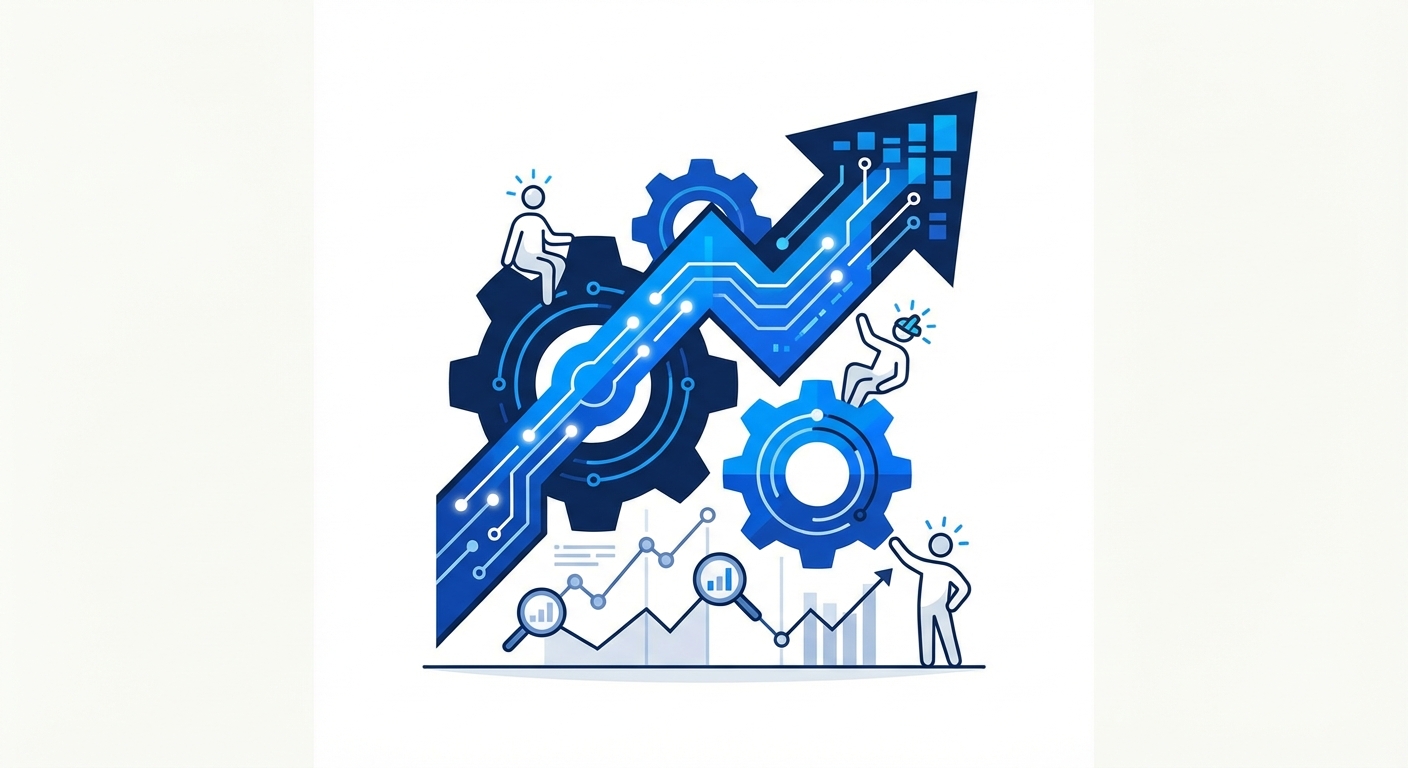
In 2026, the term has finally shed its "get-rich-quick" baggage. It’s no longer about viral invite codes or annoying your friends on social media. It has matured into a rigorous, data-backed discipline. Think of it as building a high-velocity, machine-like infrastructure that turns product utility into sustainable, repeatable growth.
If you’re still treating growth hacking as a series of disconnected tricks to inflate vanity metrics, you’re losing. You’re losing to competitors who have stopped hunting for "hacks" and started building feedback loops that compound over time.
Is Growth Hacking Still Relevant?
The landscape has changed, and it’s not coming back. We’ve moved past the era of aggressive referral schemes and broken API exploits. According to The State of Marketing 2026, the most successful organizations have stopped viewing growth as an isolated department tucked away in a corner office. Instead, they treat growth as a fundamental feature of the product itself.
The "hacker" of today isn’t looking for a loophole. They’re looking for friction. They’re looking for the exact moment a user gets frustrated, drops off, or feels confused, and they’re applying scientific pressure to fix it. It’s no longer about finding a shortcut; it’s about engineering a system where growth becomes the only logical outcome.
The Core Difference: Growth Hacking vs. Growth Marketing
People love to confuse these two, and that confusion usually leads to a messy, fragmented strategy. As outlined in this deep-dive comparison from GrowthHackers, the distinction is simple: growth hacking is about short-term velocity and high-intensity experimentation, while growth marketing is the bedrock of long-term durability.
In 2026, the elite standard is the "80/20 Rule."
Pour 80% of your resources into durable, scalable channels—think high-intent SEO and content that actually helps people. Dedicate the remaining 20% to high-velocity, experimental growth hacks. If you flip this ratio, you’re building a house of cards. If you ignore the 20% entirely, you’re basically betting that your current strategy will never need to evolve. You’ll be left behind. The goal is to use that 20% to discover new, scalable channels that eventually "graduate" into your 80% core.
Why the "Growth Mindset" Outperforms the Tactic
A tactic is a perishable good. It has an expiration date. A mindset, however, is an asset.
The most dangerous trap for a CMO is to copy a competitor’s "successful" campaign. A tactic that drives 10,000 signups for a buzzy fintech app might result in absolute silence for a B2B SaaS platform. Context matters. The true growth hacker doesn’t copy-paste; they follow a scientific framework: Hypothesis, Execution, Data Collection, and Insight.
This cycle is the heartbeat of your business. Every experiment—whether it’s a landing page tweak or a new automated email trigger—needs to be measured against a baseline. If you aren't documenting the "Why" behind your failures, you aren't growth hacking. You’re just guessing. And guessing is a luxury you can’t afford.
Product-Led Growth (PLG): The Ultimate "Hack"
The most effective marketing in 2026? It’s often no marketing at all. It’s marketing baked into the product experience. As noted in research on The Power of Product-Led Growth, users today have zero patience for sales-heavy friction. They want to touch the product, test the utility, and see the value before they ever talk to a human.
By offering free tools, API-first integrations, or "in-product" personalization, you create a self-sustaining acquisition loop. When your product solves a problem so well that it becomes a utility, it becomes its own best advertisement. You stop buying users and start earning them through their own successful outcomes.
AI: Scaling Experiments Without Losing Your Soul
We have moved beyond manual A/B testing. In 2026, the bottleneck isn't the ability to create an experiment; it’s the capacity for human interpretation.
AI agents now allow teams to run hundreds of multi-variant landing page tests simultaneously. They can optimize for anything from color psychology to the nuances of your micro-copy. While you can build an AI-driven content strategy to handle the volume, the human role remains unchanged: you define the strategy and interpret the velocity data.
AI provides the speed, but you provide the intent. If you treat AI as a "set it and forget it" tool, you’ll end up with high-traffic, low-conversion noise. Don't be that person.
The "Anti-Gate" Strategy: Respect the User
The era of demanding an email address in exchange for a generic whitepaper is dying. It creates friction, kills trust, and almost always results in a list full of dead-end leads.
Modern growth teams are shifting toward an "Anti-Gate" strategy. We make high-value content accessible to everyone to maximize reach and brand authority. Instead of forcing a form fill, we use IP-based company identification to track intent. When a high-value prospect from a target account engages with your content, your sales team gets a heads-up in real-time. You map the customer journey without the user ever feeling "trapped" by a lead magnet. By scaling your SEO for 2026 while keeping your insights transparent, you build a reputation as an industry authority rather than a lead-harvester.
The "Anti-Hacks" to Avoid
If it sounds like a trick, it’s a liability. Growth decay is real—it happens when you prioritize short-term spikes over long-term brand equity. Avoid these pitfalls:
- Spammy Bots: Automating LinkedIn outreach or email sequences that lack a human touch is a fast track to being blacklisted. Nobody likes a bot. Your prospects can smell the automation from a mile away.
- Low-Quality Viral Bait: If your content strategy relies on clickbait that has nothing to do with your core product, you will attract "tourists." They’ll click, they’ll leave, and they’ll never come back.
- Intrusive Tracking: Privacy-first browsing is the new standard. If your tracking feels like surveillance, you are destroying the trust required to close a high-ticket sale.
Modern algorithms are smarter than ever; they prioritize user experience and dwell time. If your "hacks" trigger a high bounce rate or negative feedback, the algorithms will bury you.
Case Studies: Who is Getting it Right?
Look at the giants. Slack didn't win by buying billboards; they won by focusing on the "integration ecosystem," allowing their product to exist within the tools their users already loved. ClickUp built a massive following by focusing on utility-first marketing—creating content and tools that were genuinely useful, even for those not ready to pay for a subscription.
These companies didn't scale by finding a single magic loophole. They scaled by building an infrastructure where every experiment was designed to lower the friction between a new user and their "Aha!" moment. They turned their product into a growth engine and their marketing into a service.
Conclusion: The 60-Second Growth Summary
Growth hacking in 2026 is the transition from "hacker" to "growth engineer." It is a discipline of high-velocity experimentation, data-driven decision-making, and product-led value.
- Focus on the loop, not the trick. Every experiment should feed into the next.
- Prioritize utility. If your product doesn't solve a problem, no amount of marketing will fix it.
- Automate the grunt work, not the strategy. Use AI to run the tests, but keep your brain in the driver's seat to interpret what the data actually means.
- Trust is your most valuable metric. Don't trade it for a quick, low-quality lead.
The goal is to build a system that delivers compounding returns. If you can master the loop, you won't need to chase the next big hack.
Frequently Asked Questions
Is growth hacking dead in 2026?
No, it has evolved from a series of "shortcuts" into a sophisticated, data-backed discipline that emphasizes rapid experimentation and product utility.
What is the main difference between growth hacking and growth marketing?
Growth hacking prioritizes rapid, low-cost experimentation for quick wins and learning, whereas growth marketing focuses on the long-term optimization of scalable, durable channels.
Can small businesses use growth hacking effectively?
Absolutely. Growth hacking is uniquely suited for startups because it allows small teams to compete with larger incumbents by prioritizing creativity and experimentation over massive ad budgets.
What metrics matter most for growth hacking in 2026?
Focus on the velocity of your experiments, conversion rate, customer acquisition cost (CAC), and product adoption rate—the speed at which new users find value in your product.
How do I start my first growth experiment?
Start by identifying a specific bottleneck in your funnel, formulating a hypothesis (e.g., "If we change X, then Y will happen"), running a controlled test, and measuring the results against your baseline.