Output Messenger Flaw Exploited in Espionage Attacks

Nikita Shekhawat
Nikita Shekhawat

Junior SEO Specialist

 
May 13, 2025 4 min read

A Türkiye-backed cyberespionage group, known as Marbled Dust, exploited a zero-day vulnerability in Output Messenger, specifically targeting users linked to the Kurdish military in Iraq. The flaw, identified as CVE-2025-27920, is a directory traversal vulnerability in the LAN messaging application. Microsoft Threat Intelligence analysts reported that this vulnerability could allow authenticated attackers to access sensitive files outside the intended directory or deploy malicious payloads on the server's startup folder. "Attackers could access files such as configuration files, sensitive user data, or even source code, and depending on the file contents, this could lead to further exploitation, including remote code execution," stated Srimax, the app's developer, in a security advisory released when the bug was patched with Output Messenger V2.0.63. The hacking group, also tracked as Sea Turtle and UNC1326, specifically targeted users who had not updated their systems. By compromising the Output Messenger Server Manager application, Marbled Dust hackers could steal sensitive data, access user communications, impersonate users, and disrupt operations. Microsoft assessed that Marbled Dust likely used DNS hijacking or typo-squatted domains to intercept and reuse credentials. After gaining access, the attackers deployed a backdoor (OMServerService.exe) onto victims' devices, which checked connectivity against an attacker-controlled command-and-control domain (api.wordinfos[.]com) and provided further information to identify each victim. Attack chain
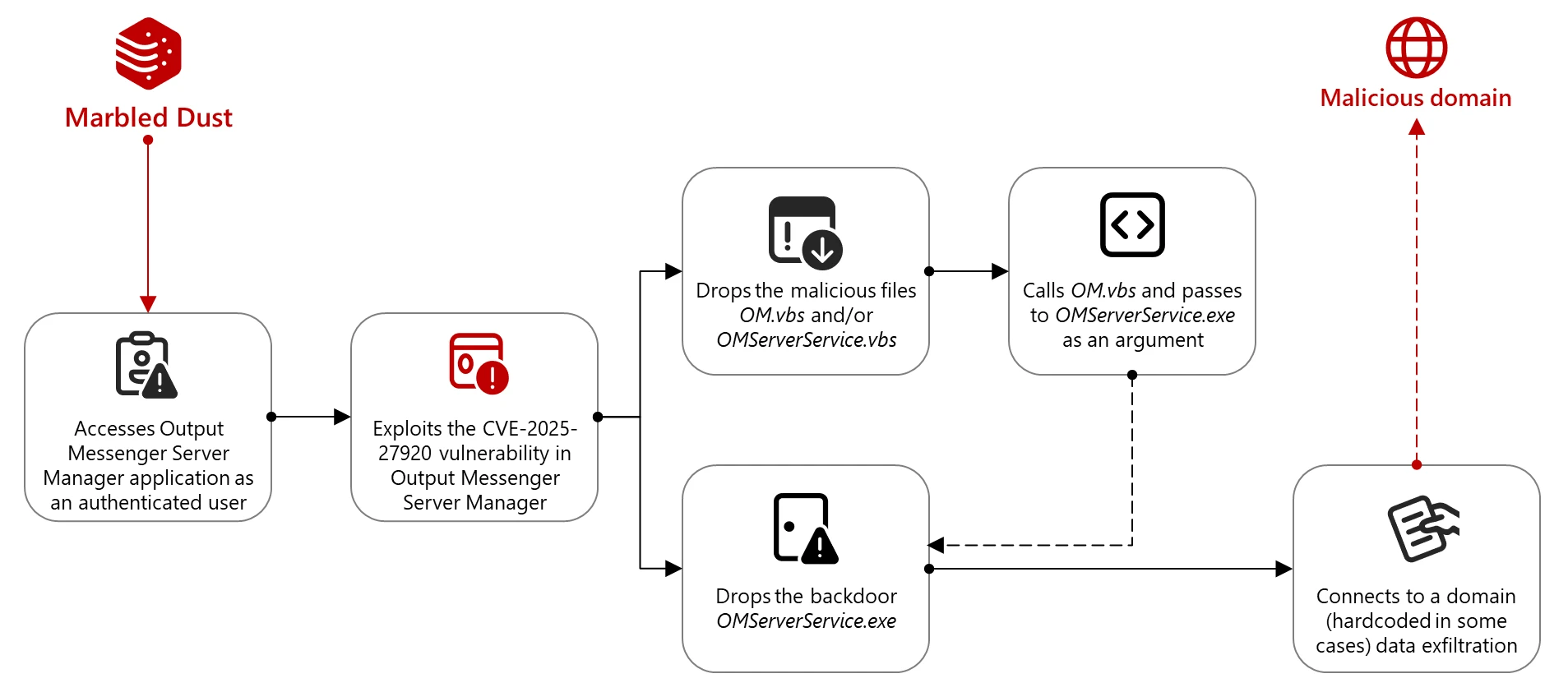
In one instance, the Output Messenger client on a victim's device connected to an IP address linked to the Marbled Dust group for data exfiltration shortly after the malware was instructed to collect files and archive them. Known for targeting Europe and the Middle East, Marbled Dust focuses on telecommunications and IT companies, along with government organizations opposing the Turkish government. To breach networks, the group scans for vulnerabilities in internet-facing devices and exploits access to compromised DNS registries to alter DNS server configurations of government organizations, enabling them to intercept traffic and steal credentials in man-in-the-middle attacks. "This new attack signals a notable shift in Marbled Dust's capability while maintaining consistency in their overall approach," Microsoft added. The use of a zero-day exploit indicates an increase in technical sophistication and escalation in targeting priorities. Last year, Marbled Dust was also linked to multiple espionage campaigns targeting organizations in the Netherlands, primarily in the telecommunications sector. For organizations using Output Messenger, it is crucial to implement robust cybersecurity monitoring and ensure timely updates to mitigate risks from such vulnerabilities.

Trends in Zero-Day Exploitation

Zero-days by year

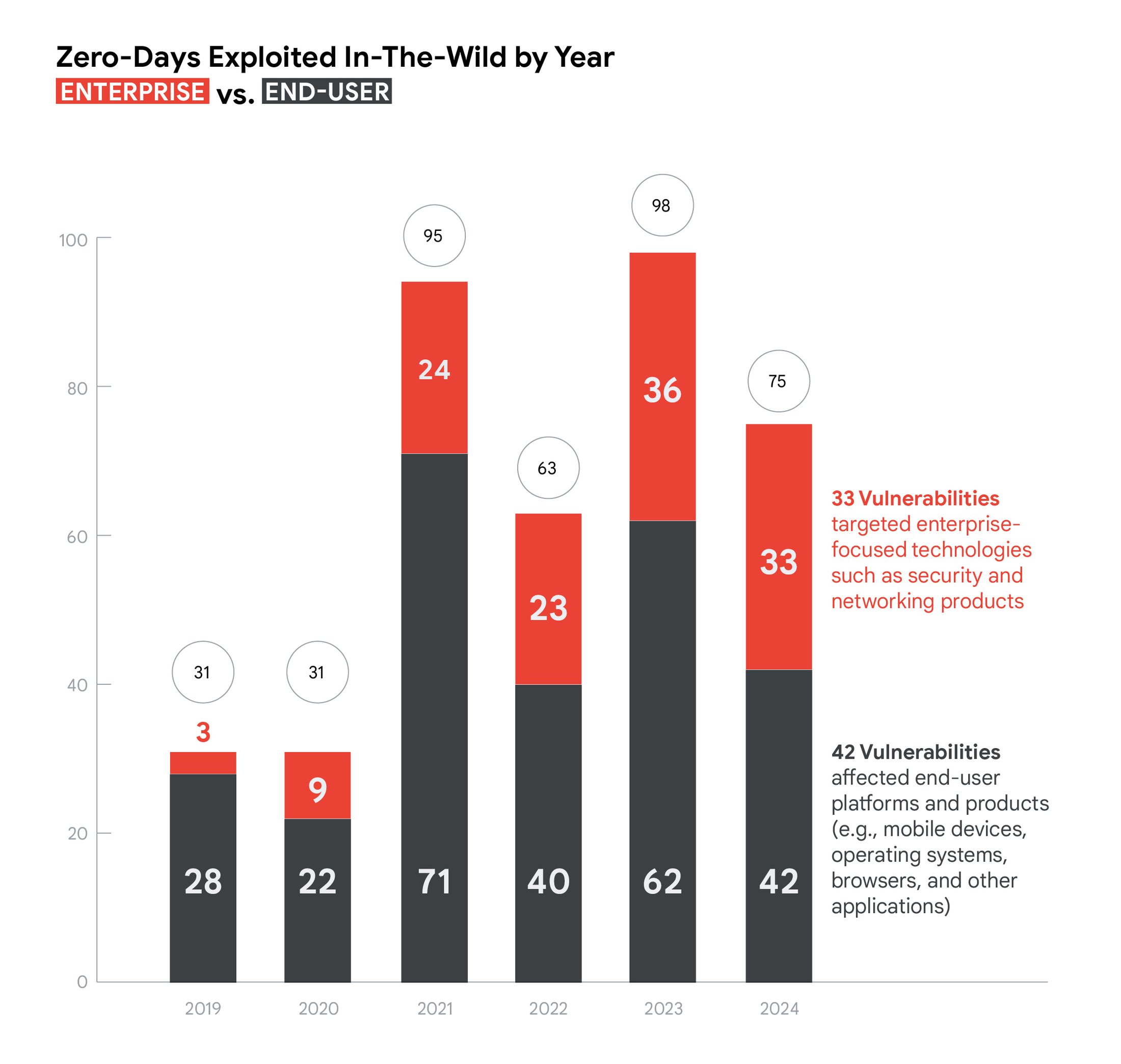
The Google Threat Intelligence Group (GTIG) tracked 75 zero-day vulnerabilities exploited in the wild in 2024, a decrease from 98 in 2023 but an increase from 63 in 2022. The report indicates a shift towards targeting enterprise technologies, particularly security and networking products, while still showing interest in end-user platforms. Notable findings include that 44% of the zero-day vulnerabilities targeted enterprise products, up from 37% in 2023. Zero-day vulnerabilities in security software and appliances were particularly significant, comprising over 60% of all enterprise technology exploitation. This trend emphasizes the need for organizations to enhance their cybersecurity measures, particularly for enterprise-focused products. The report highlights that government-backed groups are responsible for over 50% of attributed zero-day exploitation, with a notable presence from the People's Republic of China and North Korean actors. The increased focus on enterprise technologies suggests that threat actors are looking for high-value targets that can provide extensive access and fewer detection opportunities. Organizations are encouraged to leverage cybersecurity monitoring solutions to remain vigilant against emerging threats and implement strategic content opportunities to address these vulnerabilities. GrackerAI provides an AI-powered platform for transforming security news into actionable insights, helping organizations to stay ahead of potential threats.

Response and Remediation Strategies

Upon the discovery of the zero-day vulnerability in Output Messenger, Srimax acted quickly to release patches for CVE-2025-27920 and a related vulnerability (CVE-2025-27921). Microsoft recommends that organizations using Output Messenger immediately upgrade to the latest version to mitigate risks. Key recommendations include:

  • Network Monitoring: Flag and review traffic to domains and IP addresses associated with Marbled Dust infrastructure, particularly api.wordinfos[.]com.
  • Malicious File Search: Actively search for known malicious file hashes and script names such as OMServerService.vbs, OMServerService.exe, and OMClientService.exe in endpoint and network logs.
  • Credential Reset: Assume that credentials handled by compromised Output Messenger instances are at risk; arrange for organization-wide password resets.

Additionally, organizations can utilize advanced detection and response tools to monitor network flows and maintain visibility across endpoints. GrackerAI’s tools assist in automating the generation of insights from industry developments, allowing marketing teams to create timely, relevant content for cybersecurity professionals. To explore our services or learn more about how GrackerAI can enhance your cybersecurity marketing efforts, visit GrackerAI.

Latest Cybersecurity Trends & Breaking News

Data Breaches Digest - Week 14 2025 LockBit Revelations Following Major Takedown

Nikita Shekhawat
Nikita Shekhawat

Junior SEO Specialist


Nikita Shekhawat is a junior SEO specialist supporting off-page SEO and authority-building initiatives. Her work includes outreach, guest collaborations, and contextual link acquisition across technology and SaaS-focused publications. At Gracker, she contributes to building consistent, policy-aligned backlink strategies that support sustainable search visibility.

Related Articles

The Complete Tech Stack for Programmatic SEO: Tools
programmatic seo tools

The Complete Tech Stack for Programmatic SEO: Tools

Discover the essential tools for programmatic SEO. From data scraping to automated CMS setups, learn the tech stack used by growth hackers to scale b2b saas traffic.

By Ankit Agarwal February 4, 2026 7 min read
common.read_full_article
Top AEO Agencies for Cybersecurity Companies in 2026
AEO agencies

Top AEO Agencies for Cybersecurity Companies in 2026

Discover the leading AEO and GEO agencies for cybersecurity brands in 2026. Learn how to optimize for AI search engines and maintain visibility in LLM responses.

By Ankit Agarwal February 4, 2026 7 min read
common.read_full_article
Building a Moat with Content: Why Some Security Companies Can't Be Copied
marketing strategy

Building a Moat with Content: Why Some Security Companies Can't Be Copied

Discover how security companies use pSEO and GEO to build uncopyable content moats. Learn growth hacking strategies for B2B SaaS in the age of AI assistants.

By David Brown February 4, 2026 6 min read
common.read_full_article
Quality Assurance for Programmatic Content: Testing at Scale
programmatic seo

Quality Assurance for Programmatic Content: Testing at Scale

Master quality assurance for programmatic content. Learn how to test pSEO and AI-generated content at scale for B2B SaaS growth, AEO, and GEO success.

By Ankit Agarwal February 4, 2026 11 min read
common.read_full_article