Enhancing Brand Strategies Through Effective Meme Marketing

TL;DR
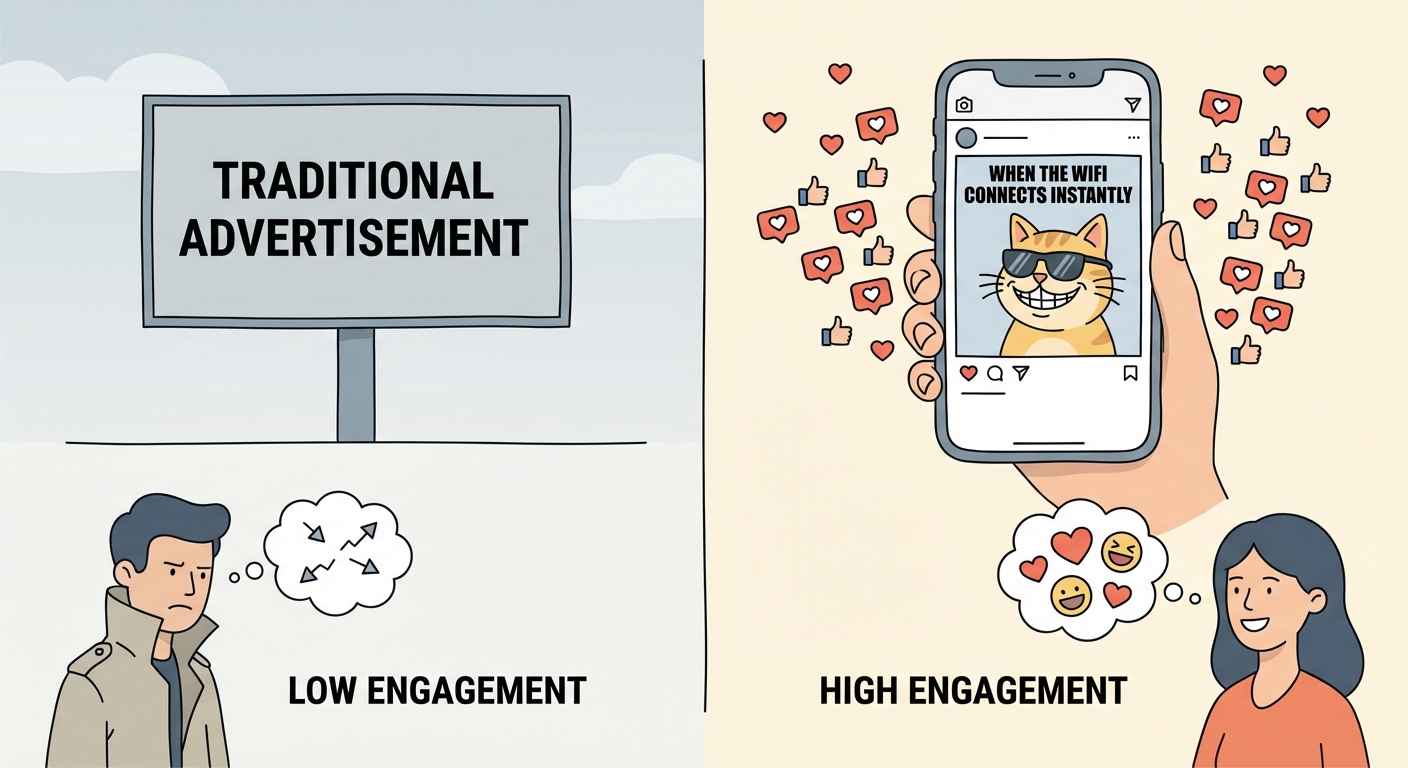
- Memes drive 60% higher engagement than traditional polished studio graphics.
- Chaos Culture replaces the curated Instagram aesthetic with authentic lo-fi content.
- Humor acts as a pattern disruptor to bypass consumer psychological defenses.
- Meme fluency is now a critical leadership skill for modern brand strategists.
- Low production costs make memes a high-efficiency lever for growth hacking.
The ROI of Chaos: Why Meme Marketing is Your Efficiency Engine
Let’s be honest for a second. Nobody wakes up in the morning excited to look at a banner ad.
In the digital ecosystem of 2026, the "glossy ad"—that perfectly polished, focus-grouped piece of creative—is worse than annoying. It’s invisible. Our brains have developed ad-blockers that operate faster than any browser extension. We filter out corporate perfection because it feels synthetic.
So, where are the eyeballs? They’re on the "slop." The chaos. The memes.
Meme marketing isn't just a "nice-to-have" for fast food chains trying to act cool on X (formerly Twitter). It is a critical efficiency lever. We are seeing data showing 60% higher engagement and 14% higher click-through rates (CTR) compared to studio-grade graphics that cost ten times as much to produce.
For the modern strategist, mastering meme fluency isn't about being the class clown. It’s about speaking the native language of the internet. It’s about bypassing psychological defenses to secure the most valuable currency left on earth: retention.
The Shift to "Chaos Culture"
For a decade, we chased the "Instagram Aesthetic." You know the look: millenial pink, perfect lighting, avocado toast, smiles that didn't reach the eyes.
By 2026, that aesthetic screams "I am trying to sell you something." It triggers an immediate scroll-past response.
Enter "Chaos Culture."
This is the rejection of curation. It’s lo-fi. It looks hastily assembled. It mimics the kind of content your best friend sends you at 2 AM. When a brand posts a meme, they aren't just making a joke; they are signaling, "We are in the trenches with you. We consume the same brain-rot you do."
This signal of cultural relevance is the most expensive asset a brand can buy, yet it often costs $0 to produce. It prioritizes speed and wit over production value. A screenshot of a Notes app apology is more authentic to a Gen Z consumer than a $50,000 video production.
Why Meme Fluency is Now a Leadership Skill
If you can't communicate with humor, you are fighting with one hand tied behind your back.
The psychology here is rooted in pattern disruption. Traditional corporate comms follow a sleepy rhythm: Here is a problem -> Here is our solution -> Please click this button.
The brain ignores patterns it has seen a thousand times. It goes on autopilot. Humor—specifically the incongruity found in memes—jams the gears. It forces the brain to stop, process the joke, and release a hit of dopamine.
When that dopamine hit is associated with your logo? You win.
This is particularly vital in "boring" industries. A 50-page whitepaper on cloud security architecture is necessary, sure. But is it memorable? No. A meme about the sheer panic of a "red alert" at 4:59 PM on a Friday encapsulates the emotional reality of that whitepaper in a single image. It says, "We get it."
However, don't mistake chaos for carelessness. A meme cannot exist in a vacuum. It must be a tactical execution of a broader plan. If your meme strategy doesn't align with your core values, you risk looking like a desperate parent trying to use teenage slang ("How do you do, fellow kids?").
You must be rigorous about developing a brand strategy that defines exactly what you are funny about, and where the line is drawn.
Research supports this shift toward "smart humor." According to studies on enhancing brand engagement through meme marketing strategies, viral dynamics are driven not just by the quality of the image, but by the "insider" nature of the joke. When a user understands a niche meme, they feel validated. That validation builds a stronger bond than any "About Us" page ever could.
The 2026 Landscape: Niche Fandoms and AI Agility
The days of the "mass appeal" viral hit are fading. The internet has fractured into thousands of gated communities—Discords, private Slack groups, niche Subreddits.
A meme that tries to appeal to everyone usually appeals to no one.
The winning strategy now is hyper-specific targeting. You don't want a million people to vaguely chuckle at your post; you want 5,000 qualified leads to feel seen by it. For a database company, a meme about SQL injection errors is gibberish to the general public, but it's comedy gold to the exact people who buy the software.
To execute this at the speed of culture, brands are adopting "AI-Assisted Agility." You cannot wait three days for legal approval on a meme. By then, the format is dead. Modern teams use AI monitors to spot rising trends and generative tools to iterate concepts instantly, but the context—the soul of the joke—must remain human.
Here is what the Agile Meme Workflow looks like in a high-performing content team:
This workflow ensures that while machines handle the volume and monitoring, the "human insight" step ensures the joke actually lands. AI can generate the image; it cannot understand the nuance of why the image is funny.
As noted in recent meme marketing stats & trends, the brands that succeed in 2026 are the ones that combine this technological speed with a distinct, unreplicable voice.
Mastering the "Meme Lifecycle": When is it Too Late?
Nothing kills brand credibility faster than posting a meme that peaked three weeks ago. It gives the audience "the ick."
Understanding the Meme Lifecycle is critical for avoiding the "Cringe Zone."
- The Underground Phase: The format appears on 4chan, niche subreddits, or deep Twitter. It is raw, often offensive, and risky. Brands should watch but rarely touch this phase. It's too hot to handle.
- The Breakout: The format hits mainstream Twitter/X and TikTok. Creators start iterating. This is the Goldilocks Zone. You have about 48 to 72 hours to execute here for maximum impact.
- The Corporate Adoption: Wendy's or Duolingo posts it. It is now "safe" but losing coolness. You can still post here, but the returns are diminishing. You are late to the party, but you brought good chips, so it's okay.
- The "Cringe" Phase: The meme appears on morning news shows or is used by a politician. DO NOT POST. Abort mission. If you post here, you signal that your brand is out of touch.
This lifecycle is accelerating. Younger demographics, particularly Gen Z and Alpha, burn through formats at a breakneck pace. To keep up, you need to understand Gen Z marketing techniques, which prioritize raw authenticity over polished adherence to a trend that is already dying.
Can B2B and SaaS Brands Actually Use Memes?
"But we sell enterprise ERP solutions! We can't post memes!"
Stop it. This is a pervasive myth.
People do not stop being human beings when they clock into work. They don't turn into robots that only consume pie charts. In fact, the more boring or stressful the industry, the more effective humor becomes as a relief valve.
For B2B and SaaS, the strategy isn't "mass appeal"; it is "Insider Validation."
- The "Insider Joke": If you sell cybersecurity software, don't make a joke about cats. Make a joke about the specific pain of explaining "Zero Trust" to a Board of Directors who still write passwords on sticky notes. When a CISO sees that, they think, "This vendor gets my life."
- Platform Specificity:
- LinkedIn: The home of "Professional Irony." The memes here should comment on work culture, industry absurdities, or the struggle of work-life balance. It's safe, but relatable.
- Twitter/X: This is for real-time reaction to industry news. AWS down? Post a meme.
- Newsletters: B2B newsletters are often dry walls of text. Breaking up market analysis with a relevant meme resets the reader's attention span. For more on this specific tactic, look into leveraging meme marketing for newsletter growth, which details how visual humor increases open rates and reduces churn.
Navigating Copyright in 2026: The Brand Safety Checklist
The "Wild West" days of the internet are over. In 2026, copyright detection algorithms are ruthless, and rights holders are aggressive. The concept of "Fair Use" is narrowing, particularly for commercial entities.
The Golden Rule: There is a difference between a personal post and a commercial advertisement. If you use a copyrighted image of a celebrity to directly sell your product (e.g., "Buy our software!" with a picture of a movie star), you are inviting a lawsuit.
Risk Management Strategy:
- Avoid Celebrity Likeness: Unless you have a partnership, stay away. Don't use Sydney Sweeney to sell your CRM.
- Remix Generic Formats: Use the structure of a popular meme (like the "Distracted Boyfriend" or stick figure drawings) but recreate the assets using your own brand illustrations or stock art.
- Lo-Fi Originals: The safest route is to create original assets that look like memes—bad drawings, screenshots of text, or simple charts.
To help your social team make fast decisions, use this decision tree:
For a deeper legal perspective, reviewing current precedents on copyright risks in social media is essential for any CMO signing off on a risky strategy.
Measuring Success: Beyond the "Like" Button
If you are reporting "Likes" to your board, you are failing. Likes are a vanity metric. My grandma likes my posts. It doesn't mean she's buying enterprise software.
In meme marketing, the only metrics that matter are those that prove resonance.
- Share Rate (Virality): A "Like" is passive; a "Share" is an endorsement. It means the user identified with the content enough to put their own reputation behind it. High share rates indicate you have successfully tapped into the "Insider Validation" vein.
- Dark Social Traffic: Much of meme sharing happens in DMs, Slack channels, and WhatsApp groups. While hard to track, spikes in direct traffic often correlate with a successful meme campaign.
- Sentiment Analysis: Are people laughing with you or at you? Use sentiment tools to ensure the chaos you're causing is the good kind.
Conclusion: Embracing the Chaos
The brands that will dominate the conversation in 2026 are not the ones with the biggest budgets. They are the ones with the fastest reflexes.
Meme marketing is the art of surfing chaos. It requires a willingness to be imperfect, to move before you feel fully ready, and to trust that being "human" is more valuable than being "corporate."
Start small. Listen to your niche. And don't be afraid to post something a little unhinged—it’s likely the only thing your audience will remember all day.
Frequently Asked Questions
Is meme marketing effective for B2B brands?
Absolutely. For B2B, the goal isn't mass appeal but "insider validation." By using memes that reference specific industry pain points (like coding bugs, compliance audits, or unreasonable client demands), you build authority and camaraderie. You show them you belong to the tribe.
What are the legal risks of using memes for commercial purposes?
In 2026, copyright detection is stricter. While "fair use" often protects social commentary, using copyrighted movie scenes or celebrity images in posts that directly sell a product (commercial use) carries significant risk. The safest strategy is "remixing" generic formats or creating original, lo-fi assets.
How do we measure the ROI of a meme?
Direct conversion is rarely the primary metric for memes. Instead, measure Share Rate (which indicates high relatability), Brand Sentiment (are people laughing with you?), and Reach Efficiency (getting high impressions for zero ad spend).
How can my brand avoid being "cringe"?
The "cringe" factor usually comes from two things: bad timing and over-explanation. To avoid this, ensure your social team has true "meme fluency" (hire digital natives), never explain the punchline in the caption, and avoid using formats that peaked more than three weeks ago.