How to Build an AI-Driven Content Plan That Actually Works

Budgets are tight, and every piece of content you publish needs to prove its worth. I've seen teams waste months chasing vanity metrics while pipeline stalls. Use a simple, repeatable plan to ship high-quality assets, earn citations in AI answers, and turn attention into qualified opportunities.
Start with the Outcome
Choose one clear revenue goal so every piece of content pulls in the same direction.

Pick one measurable business result and anchor every content decision to it. If you try to move five metrics at once, you end up moving none. For the next 90 days, choose sourced pipeline, sales velocity, or expansion revenue as your north star.
Set a Clear Target
Write down your baseline and your forecast. For example, aim to move sourced pipeline from 1.2 million to 1.8 million in 90 days by increasing demo conversions from assistant-cited visits. Tie this to finance-approved assumptions on conversion rates and average deal size so leadership trusts the math.
Define Success and Kill Criteria
Before you ship anything, agree on thresholds. If a pillar does not hit 30 percent scroll depth or 0.6 percent demo starts after four weeks, prune or rewrite it. This discipline keeps your content library lean and effective.
Understand the New Distribution Game
Treat AI-powered answer engines as a primary distribution channel, not a side effect of search. AI answer engines now synthesize and cite content, so your pages must be quotable and trustworthy. Google has expanded AI Overviews to over 200 countries and more than 40 languages (Google, "AI Overviews expansion," May 2025, retrieved 2026-09-21). To win citations, your content has to answer questions directly, not just match keywords. A useful first step is auditing what you already have against that bar — see how to check your content strategy for AI search readiness for a four-point checklist.
What AEO and GEO Mean for You
Answer Engine Optimization (AEO) means structuring content so assistants can extract trustworthy snippets. Generative Engine Optimization (GEO) means designing data-rich pages that increase citation odds. Track brand mentions in assistant answers alongside traditional rankings to see where you stand.
Choose a Narrow ICP and Problem Thesis
Get specific about who you serve and what painful problem you solve so your content cuts through the noise.
Specificity beats volume every time. Focus on one or two segments where you can provide proprietary insight and real proof. For cybersecurity, that might be SOC leaders who want to reduce alert fatigue by 30 percent without sacrificing detection coverage.
Map Jobs to Assistant Questions
Write the exact prompts your audience would type into an assistant, then answer those questions word for word in your content. List how they define success, what is blocking them, and what evidence would remove the risk. When you cover those points directly, assistants are more likely to quote you.
Build Your Content Operating Model
Treat content like a product, with a small team owning the end-to-end process. A small, cross-functional team moves faster than a large committee. Form a two-pizza squad with a strategist, managing editor, subject matter expert (SME) reviewer, designer, AI wrangler, and marketing ops owner. Keep everyone in one project board with clear service-level agreements (SLAs).
Weekly Sprint Rhythm
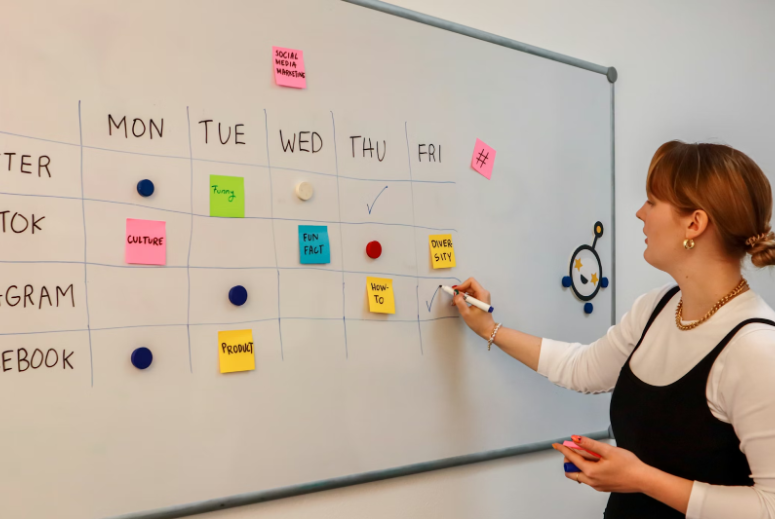
On Monday, choose priority queries and brief your pillars. On Tuesday and Wednesday, prep datasets, clear legal, draft, and get SME review. On Thursday and Friday, revise, add schema, publish, and distribute, then hold a 15-minute retro to capture what improved citations or conversions.
Build Your Citation-Tracking Loop
Publishing without measurement is how AI content plans stall after the first sprint.

Once a pillar page is live, treat the first two weeks as a tracking sprint, not a victory lap. Query the answer engines your ICP actually uses with the exact prompts they would type, and log whether your brand, a competitor, or nobody gets cited. A page nobody ever checks for citations is a page you are flying blind on.
What to Track Every Week
For every pillar, track four things: whether it is cited at all, which engine cited it, the exact sentence or paragraph the engine pulled, and whether a competitor got cited instead on the same prompt. GrackerAI's own citation tracking exists to run this loop across ChatGPT, Perplexity, Google AI Mode and AI Overviews, Microsoft Copilot, Gemini, and Claude rather than doing it by hand in a spreadsheet — noted here because it is directly relevant to this step, not as a pitch.
Turn a Miss Into a Rewrite Brief
When a competitor gets cited on a query you should own, resist the urge to just add a paragraph. Read what the engine actually pulled from the competing page — usually a direct-answer sentence, a defined term, or a comparison row — and rebuild your own section to answer that exact shape of question. Why Most AI Content Strategies Fail covers the pattern behind most of these misses: content that covers a topic without ever answering the specific question the engine needed resolved.
Write for Extraction, Not Just for Ranking
Structure each section so an engine can lift it without the surrounding paragraph.
Keep every core claim in a self-contained sentence — subject, verb, specific number or name — because an assistant synthesizing an answer pulls a sentence, not a paragraph's worth of build-up. Put the direct answer first and the supporting detail after it. Use tables for anything with three or more comparable options, since tables are the structure a model can parse into a comparison most reliably.
Name the Entities Your ICP Actually Searches
Write around the specific standards, frameworks, and terms your buyer uses instead of talking past them. A SOC leader's query includes terms like MITRE ATT&CK, SOC 2 Type II, or mean time to detect; if a page never uses those terms explicitly, an engine has less to match it against when deciding what to cite. The same discipline applies outside cybersecurity — a RevOps buyer searches on CPQ, ARR, or net revenue retention, not on your product's internal name for the feature.
Measurement for AI-Era Content
Track visibility inside AI answers and connect it all the way to revenue. Track what matters: share-of-citation across engines, assistant-cited sessions, scroll depth, demo starts, and opportunity influence. Academic research on generative engine optimization found that content-level changes — adding citations, quotations, and statistics — can boost a source’s visibility in generative answers by up to 40 percent (Aggarwal et al., "GEO: Generative Engine Optimization," arXiv:2311.09735, retrieved 2026-09-21), so treat citation share as a leading indicator.
Pipeline Influence
Attribute demos and meetings to assistant-cited assets and track their impact through to closed deals. Share weekly learnings with sales so everyone sees how content drives revenue.
Conclusion
A focused, test-and-learn approach lets a small team prove revenue impact in a single quarter — for a ready-made 90-day version of this plan, see The AI Search Content Calendar for B2B SaaS, Q1 2026. Building an ai marketing content strategy that works comes down to discipline. Commit to one outcome, structure content so assistants can quote you, and measure everything. Start with one pillar and a webinar, cut short clips, and secure one earned mention that assistants can cite. Your team can prove real impact within a quarter.
Frequently Asked Questions
How Do I Pick the First Two Themes to Focus On?
Choose themes where you have proprietary data and strong SME coverage. Validate them with five to ten customer interviews to confirm the pain is current and urgent.
What Counts as a Good Assistant-Cited Visit?
A visit from an assistant or AI Overview that reaches 30 percent scroll depth and triggers a micro-conversion, like a demo click. Track this as a distinct segment in your analytics.
How Do I Balance SEO and AEO?
Build for humans first with helpful content, then structure pages for extraction with answer boxes and schema. Measure both rankings and share-of-citation.
What Is the Fastest Way to Start with a Small Team?
Publish one pillar and a webinar in two weeks, then run it through your citation-tracking loop before starting a second pillar. To keep production fast in a small team, have one person own the citation checks and rewrite briefs so pillars do not sit unmeasured. Track assistant citations from day one.

![10 Best Local Rank Tracker Tools: In-Depth Comparison Guide [2025]](https://cdn.pseo.one/6abcb68a626591c40e1c8aa6/687e1c1ef6fe799d288518df/68809c373eb8562bcf68975d/10-best-local-rank-tracker-tools-comparison-guide/feature-image.jpg)