How AI Agent Builders Are Transforming Business Automation and Decision-Making

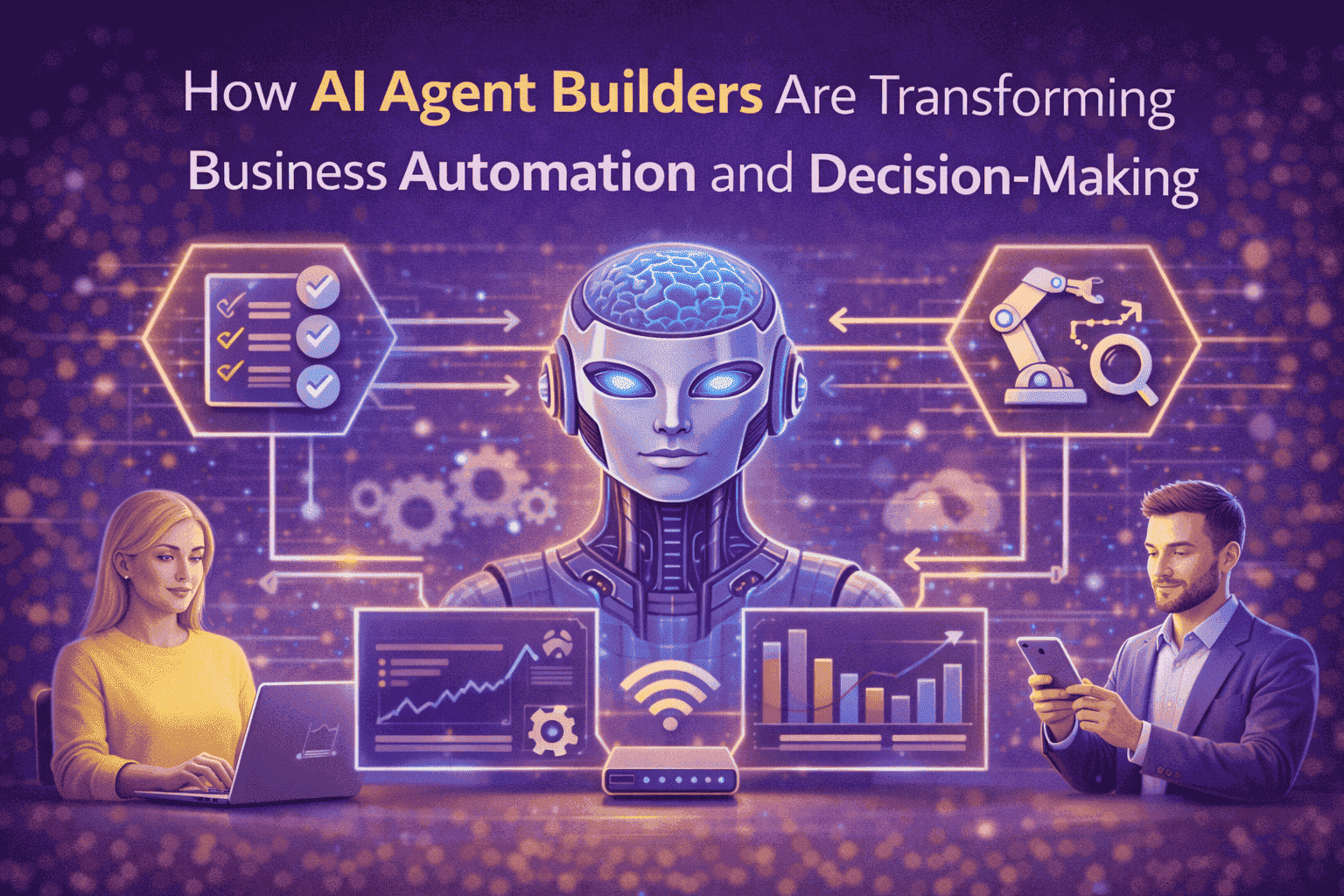
Artificial intelligence has moved beyond simple automation and predictive analytics. Today, businesses are increasingly adopting AI agents that can perform tasks, make decisions, and interact with systems with minimal human input. These intelligent agents are changing how organizations operate, from customer support and data analysis to internal workflows and strategic planning.
As digital ecosystems grow more complex, companies need tools that can manage repetitive processes, analyze information in real time, and adapt to changing conditions. AI agent builders have emerged to meet this demand, enabling organizations to design and deploy intelligent agents without deep engineering expertise.
This article explores what AI agent builders are, how they work, and why they are becoming essential tools for modern business automation and smarter decision-making.
Understanding AI Agents and Their Role in Modern Systems
An AI agent is a software entity designed to perceive information from its environment, process that data, and take action to achieve specific goals. Unlike traditional automation scripts, AI agents can learn from interactions, respond to new inputs, and operate across multiple systems.
For example, an AI agent might monitor customer inquiries, identify patterns in requests, and automatically route issues to the appropriate department. In more advanced cases, agents can negotiate schedules, optimize resource allocation, or assist with financial forecasting.
What makes AI agents particularly valuable is their ability to operate continuously and adaptively. Instead of following rigid rules, they use machine learning models and logic frameworks to make informed real-time decisions.
What Are AI Agent Builders?
AI agent builders are platforms or tools that allow users to create, configure, and deploy AI agents without building everything from scratch. These tools typically provide visual interfaces, pre-built components, and integrations with existing software systems.
Rather than writing extensive code, teams can define goals, workflows, and data sources, then let the platform handle the underlying AI logic. This lowers the barrier to entry and allows non-technical teams to participate in AI-driven initiatives.
According to Cybernews, platforms that rank among the top-rated builders often focus on flexibility, scalability, and ease of integration, making them suitable for startups as well as large enterprises.
How AI Agent Builders Improve Business Automation
Traditional automation relies on predefined rules and static workflows. While effective for simple tasks, these systems struggle when conditions change or when data becomes too complex. AI agent builders address these limitations by introducing intelligence into automation.
One major advantage is contextual awareness. AI agents can analyze incoming data, understand intent, and choose appropriate actions rather than executing a fixed sequence of steps. This is especially useful in customer service, where requests can vary widely. For a closer look at how this plays out with named platforms, see GrackerAI's review of automation platforms that actually help your support team, which maps specific vendors to frontline support jobs.
Another benefit is cross-platform coordination. AI agents can operate across multiple tools such as CRMs, analytics dashboards, communication platforms, and databases. This creates smoother workflows and reduces manual handoffs between departments.
By automating decision-making alongside execution, organizations can reduce operational delays and improve overall efficiency.
Enhancing Decision-Making With Intelligent Agents
Decision-making in modern organizations often depends on analyzing large volumes of data under tight time constraints. AI agent builders help by enabling agents to process information faster and surface insights that would be difficult to identify manually.
For instance, an AI agent can monitor sales performance across regions, identify underperforming areas, and suggest corrective actions based on historical trends. In finance, agents can flag unusual spending patterns or forecast cash flow scenarios.
These tools do not replace human judgment but enhance it. Decision-makers receive clearer insights, real-time alerts, and data-backed recommendations that support more confident choices.
Over time, as agents learn from outcomes, their recommendations become increasingly accurate and aligned with business goals.
Key Features That Define Effective AI Agent Builders
Not all AI agent builders offer the same capabilities. The most effective platforms typically share several core features that support real-world use cases.
First is ease of customization. Businesses need agents that align with their unique workflows, not generic templates. Builders that allow flexible configuration and modular design are better suited for diverse industries.
Second is integration support. AI agents must connect seamlessly with existing tools such as cloud platforms, databases, APIs, and communication systems. Strong integration reduces friction and accelerates deployment.
Third is scalability. As organizations grow, their AI agents must handle increased data volume and complexity without performance issues. Builders designed for scalability ensure long-term value.
Security and transparency are also critical. Enterprises need to understand how agents make decisions and ensure sensitive data is handled responsibly.
Use Cases Across Industries
AI agent builders are being adopted across a wide range of industries. In e-commerce, agents manage inventory levels, personalize customer experiences, and optimize pricing strategies. In healthcare, they assist with scheduling, patient data management, and operational planning.
Marketing teams use AI agents to analyze campaign performance, automate content distribution, and adjust strategies in real time — including agents built specifically to track brand mentions across AI search results rather than running manual spot-checks. In software development, agents can monitor system performance, detect anomalies, and suggest fixes.
These diverse applications highlight the versatility of AI agent builders and their ability to adapt to different operational needs.
Challenges and Considerations When Adopting AI Agents
Despite their benefits, implementing AI agents requires careful planning. Poorly designed agents can produce unreliable outputs or reinforce existing biases in data. Organizations must ensure that data sources are accurate and representative.
There is also the challenge of governance. Clear guidelines are needed to define what decisions agents can make autonomously and where human oversight is required. Transparency in agent behavior builds trust and reduces risk.
For a fuller governance framework — least-privilege access, action logging, sandboxed testing, and clear accountability lines between developer, owner, and user — see Agentic AI: Advantages, Risks, and Controls.
Additionally, teams must invest time in training and monitoring agents to ensure they align with evolving business objectives.
The Future of AI Agent Builders
As AI technologies continue to advance, AI agent builders are expected to become more sophisticated and accessible. Future platforms will likely offer deeper reasoning capabilities, better natural language understanding, and more intuitive design interfaces.
We can also expect increased collaboration between humans and agents, where AI handles operational complexity while people focus on strategy, creativity, and leadership.
Organizations that adopt these tools early and responsibly will be better positioned to adapt to rapid technological change.
Conclusion
AI agent builders are reshaping how businesses approach automation and decision-making. By enabling the creation of intelligent, adaptive agents, these platforms help organizations move beyond static workflows and toward smarter, data-driven operations.
From improving efficiency to enhancing strategic insight, AI agents offer tangible value across industries. As adoption grows, understanding how these tools work and how to implement them effectively will become an essential part of modern business strategy.
When used thoughtfully, AI agent builders empower teams to operate faster, think smarter, and respond more effectively to an increasingly complex digital landscape.
![10 Best Local Rank Tracker Tools: In-Depth Comparison Guide [2025]](https://cdn.pseo.one/6abcb68a626591c40e1c8aa6/687e1c1ef6fe799d288518df/68809c373eb8562bcf68975d/10-best-local-rank-tracker-tools-comparison-guide/feature-image.jpg)