AI Content Marketing for Industry-Specific SaaS: From Cybersecurity to Field Service Software

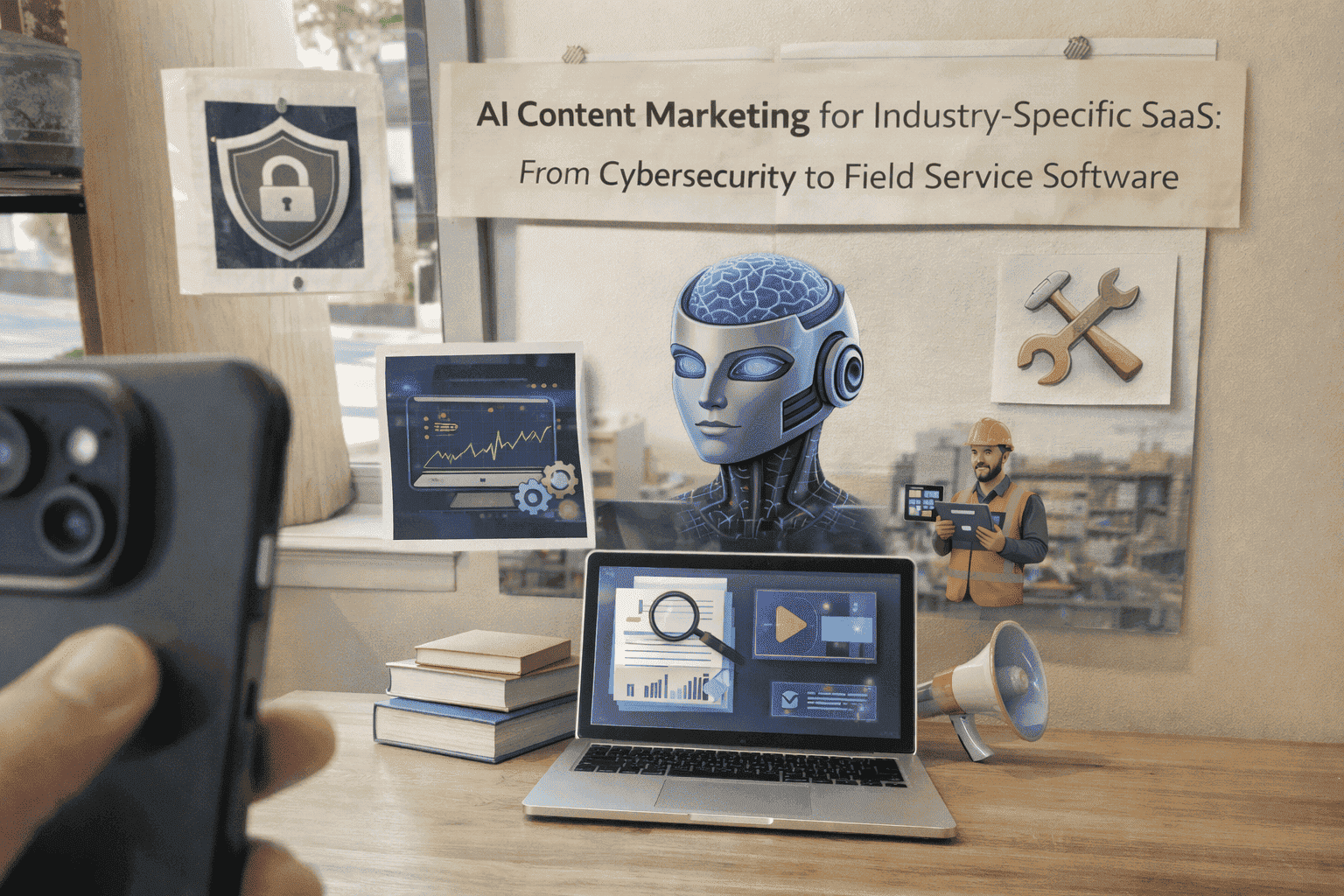
Industry-specific SaaS companies face a unique marketing challenge. Whether you sell cybersecurity platforms to enterprises or field service tools to local contractors, your buyers don’t respond to generic messaging. They expect relevance, technical credibility, and proof that you understand their daily problems.
This is where AI-powered content marketing has become a competitive differentiator.
In 2026, successful SaaS brands no longer publish broad “top of funnel” blog posts and hope for conversions. Instead, they use AI to analyze user behavior, segment audiences by industry, and generate content tailored to very specific operational realities—from SOC analysts managing threat alerts to plumbers juggling dispatch chaos and overdue invoices.
The result is hyper-focused storytelling that speaks directly to how software fits into real workflows.
From Cybersecurity Funnels to Vertical SaaS Narratives
Cybersecurity companies were among the first to adopt AI-driven content strategies. They used machine learning to identify which technical topics actually led to demos and pipeline, then dynamically adapted whitepapers, case studies, and landing pages for different buyer personas.
That same model is now spreading across vertical SaaS.
Whether it’s a cybersecurity platform or plumbing software for small business, niche SaaS brands must align content with real operational pain points rather than generic software messaging. Buyers don’t care about abstract feature lists—they care about missed appointments, delayed billing, security incidents, and workflow friction that directly affects revenue and customer trust.
Instead of promoting “powerful dashboards” or “enterprise-grade architecture,” modern SaaS content focuses on outcomes: fewer breakdowns, faster payments, higher customer retention. AI tools analyze engagement patterns to uncover which problems resonate most with each audience segment, then automatically adjust messaging based on traffic source, company size, and historical behavior.
This shift is especially visible in field service software. Small trade businesses don’t search for “digital transformation.” They search for ways to stop losing invoices, respond faster to customers, and keep technicians productive in the field. AI-driven content systems surface these intent signals and help SaaS vendors build narratives around day-to-day realities rather than aspirational tech language.
The result is vertical storytelling at scale—where cybersecurity firms speak directly to SOC analysts, and field service platforms speak directly to contractors—each with content shaped by data, not assumptions.
How AI Shapes Field Service SaaS Content
Modern AI platforms analyze thousands of user journeys to learn what actually converts. For field service vendors, that often means emphasizing mobile workflows, instant invoicing, and technician visibility rather than dashboards and analytics.
Platforms like Field Complete position themselves around balanced functionality—scheduling, GPS tracking, and billing—without overwhelming smaller teams. Their content typically highlights offline mobile access and quick onboarding, because AI data shows those topics resonate most with growing service businesses. That GPS-and-technician-visibility framing lines up with a broader shift in operations software generally — see how asset tracking software improves visibility and control for the equivalent case made outside field service specifically.
Meanwhile, Jobber attracts very small operations by focusing on simplicity. AI-driven content testing reveals that solo operators care less about route optimization algorithms and more about fast setup and recurring service automation.
Mobile-first platforms such as Housecall Pro lean heavily into reviews, payments, and technician mobility. Their higher-tier messaging often centers on automated customer follow-ups and reputation management, because behavioral data shows online ratings strongly influence purchase decisions in home services.
For larger teams, ServiceTitan markets operational control and revenue intelligence. AI-guided content emphasizes standardized pricing, conversion tracking, and performance metrics—topics that resonate with owners managing eight or more technicians.
Newer entrants like Fieldwork use predictive narratives powered by machine learning. Their positioning highlights AI-driven parts forecasting and reduced return visits, appealing to companies willing to adopt evolving technology in exchange for efficiency gains.
Even niche capabilities become marketing angles when AI shows demand. ServiceChain promotes tamper-proof service records for property managers, while integrations with BitPay and Coinbase Commerce appear in content—not because most customers want crypto, but because a small, high-value segment actively searches for it.
AI surfaces these micro-audiences and helps SaaS companies justify highly specific content.
Pricing Pages Are Now Content Assets
Another major change is how pricing and onboarding content gets optimized.
AI tools track where prospects hesitate, which features trigger upgrades, and how long it takes new customers to reach activation. This data feeds directly into landing pages, FAQs, and onboarding guides.
For field service platforms, content increasingly addresses the real cost of adoption: training time, workflow changes, and short-term productivity dips. Transparency builds trust—and AI confirms that buyers who understand implementation friction churn less later.
Instead of hiding complexity, modern SaaS marketing explains it clearly, then shows how automation offsets the effort through reduced admin work and faster billing cycles.
Personalization at Industry Scale
The most advanced SaaS marketers now personalize content by company size, role, and maturity level.
A two-person plumbing operation sees different messaging than a regional service company. Cybersecurity startups see different case studies than regulated enterprises. AI handles this segmentation automatically, assembling industry-relevant narratives in real time.
What used to require massive marketing teams now happens algorithmically.
The outcome is content that feels handcrafted for each reader—even when delivered at scale.
The Bigger Picture
AI content marketing for industry-specific SaaS isn’t about replacing human writers. It’s about amplifying domain expertise with data. The same dynamic plays out well beyond field service and cybersecurity — see how AI-powered content marketing is reshaping the travel industry for another vertical case study in hyper-personalization at scale.
For a broader look at how AI is reshaping SaaS content operations end to end — personalization, automation, predictive analytics, and customer-support feedback loops — see how AI is redefining content marketing for SaaS companies.
From cybersecurity vendors explaining zero-trust architectures to field service platforms helping contractors modernize operations, the winners in 2026 are those who combine technical credibility with AI-driven personalization.
Buyers no longer tolerate generic SaaS messaging. They expect software companies to understand their workflows, constraints, and priorities.
And increasingly, it’s AI that makes that level of relevance possible.
![10 Best Local Rank Tracker Tools: In-Depth Comparison Guide [2025]](https://cdn.pseo.one/6abcb68a626591c40e1c8aa6/687e1c1ef6fe799d288518df/68809c373eb8562bcf68975d/10-best-local-rank-tracker-tools-comparison-guide/feature-image.jpg)