Secrets to Creating High-Converting Lookalike Audiences

TL;DR
- Standard Lookalike audiences are failing due to poor data quality.
- Learn to leverage Value-Based Lookalikes for higher precision targeting.
- Understand the strategic shift between Broad targeting and Lookalike suggestions.
- Use Lookalikes as essential signals for AI-driven cold starts.
- Optimize campaign ROAS by cleaning data and using creative filtering.
The "easy button" era of digital marketing? It’s gone. Buried.
If you are still uploading a raw CSV of "All Website Visitors" to Meta and expecting a 1% Lookalike Audience to print money, you are playing a game that ended in 2021. The reality of 2026 is brutal but simple: standard Lookalikes fail because they are built on lazy data. To survive in this privacy-first, AI-dominated landscape, you have to stop treating Lookalikes as a safety net. You need to treat them like a precision weapon.
We aren't here to hold your hand through the "Create Audience" menu. We are here to dismantle the strategic architecture behind high-ROAS campaigns. The shift from manual targeting to AI-driven "Advantage+" models hasn't made the marketer obsolete; it has made the strategist essential. The algorithm is a Ferrari, but most marketers are pouring 87-octane fuel in the tank and kicking the tires when the engine knocks.
This is your mechanic’s manual. We are going to strip down the engine, clean out the carbon buildup of "bad data," and rebuild your targeting strategy using Value-Based Lookalikes, Creative Filtering, and Cross-Platform signals. If you need a refresher on the basics, check out our guide on The Purpose of a Lookalike Audience in Marketing. But if you are ready to build audiences that actually convert in a post-iOS world, keep reading.
Are Lookalike Audiences Dead? (The "Broad" vs. "Lookalike" Debate)
Walk into any high-level media buying Slack channel right now, and you’ll see the same war being fought: "Lookalikes are dead; just go Broad."
They aren't entirely wrong. In the current landscape, Broad Targeting (taking the leash off and letting the AI find the buyers) often crushes Lookalikes on massive, established accounts. Research from AdBid.me suggests that on accounts with deep historical data, Broad targeting can hit a 113% ROAS compared to the tight constraints of Lookalikes.
Why? Because platforms like Meta and TikTok have become terrifyingly good at predicting user intent based on real-time behavior, not just static demographic buckets. When you restrict the AI to a 1% Lookalike, you are essentially putting a governor on that Ferrari.
However, declaring Lookalikes "dead" is a rookie mistake. They haven't died; they have evolved into "Suggestions."
Meta’s official stance on Lookalike Audiences has shifted. They now encourage using these audiences as a starting point—a signal to guide the AI during the "learning phase." This is the "Hybrid" reality of 2026.
Here is the strategic split:
- Go Broad when you have a pixel with thousands of purchase events. The AI knows your customer better than you do. Let it run.
- Use Lookalikes for Cold Starts, Niche B2B, and New Offers. If you are launching a cybersecurity SaaS product, "Broad" targeting will burn thousands of dollars showing your ad to teenagers and retirees before it figures out who you want. A high-fidelity Lookalike acts as a compass, pointing the AI in the right direction from day one.
Secret #1: The "Super-Seed" Recipe (Garbage In, Garbage Out)
The single biggest reason Lookalike Audiences fail is Source Dilution.
Marketers are obsessed with audience size. They think, "If I upload my entire email list of 50,000 people, the match rate will be higher, and the audience will be better."
Wrong.
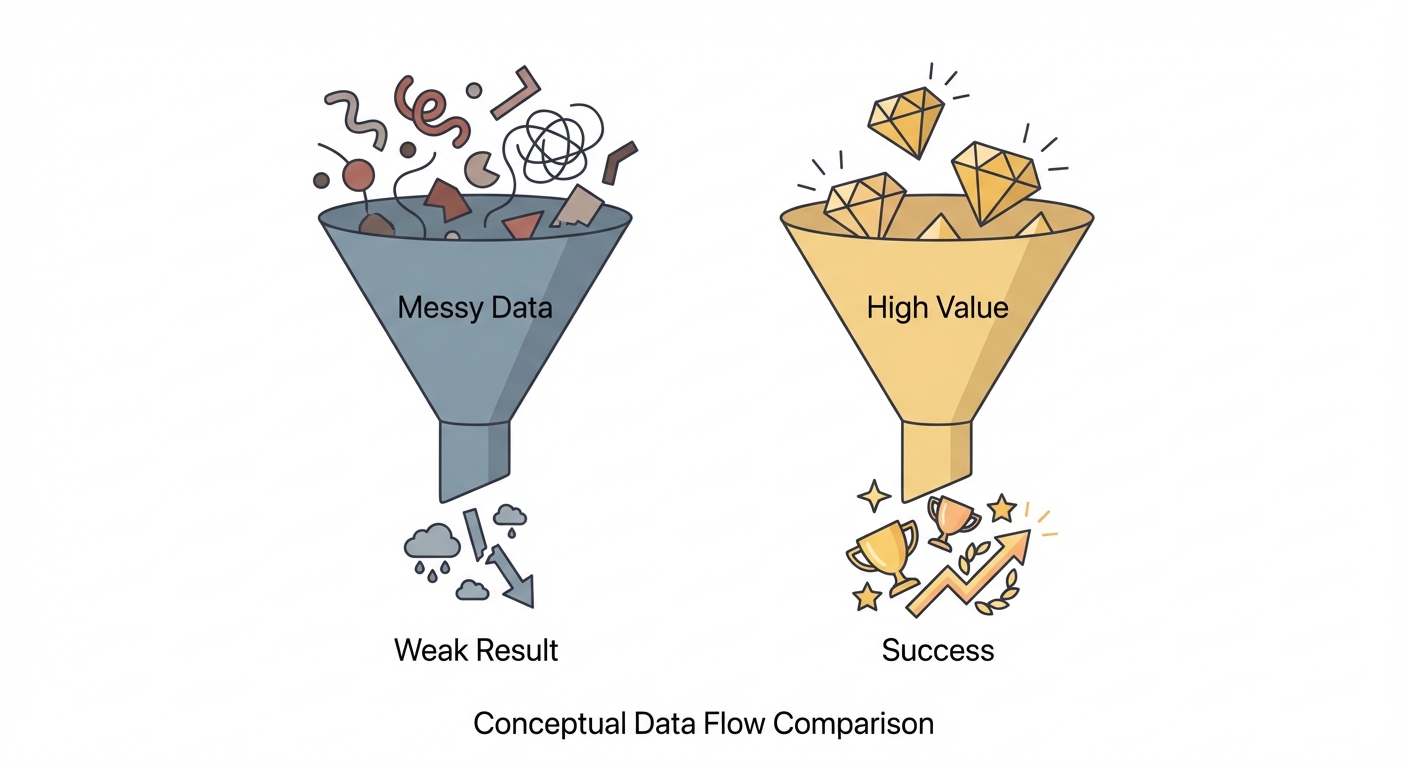
If that list of 50,000 people includes newsletter subscribers who never bought, customers who requested refunds, and people who bought a $5 accessory three years ago, you are feeding the algorithm "noise." You are telling the AI: "Find me more people who look like this mixed bag of non-buyers and cheapskates." And the AI, being an obedient servant, will do exactly that.
You need a Value-Based Pivot. Stop targeting "people who bought." Start targeting "people who spend the most."
If you are unsure how to technically execute the button clicks for this, you can review our tutorial on How to Create a Lookalike Audience, but the strategy is what matters here.
The Super-Seed Formula
To create a "Super-Seed" audience, you must be ruthless with your exclusions. Here is the recipe for 2026:
- Include: Top 20% by LTV (Lifetime Value). Isolate your whales. These are the customers who don't just convert; they retain.
- Include: Recent Purchasers (Last 60 Days). Consumer behavior shifts fast. A customer from 2022 looks very different digitally than a customer from 2026. Recency is relevance.
- Exclude: The "Poison" Data. Actively filter out refunded customers, "one-time low-value" buyers, and support complainers.
The Technical Requirement: Server-Side Tracking
You cannot pull this off with a browser pixel alone. Browser pixels are losing signal daily thanks to ad blockers and privacy updates. To build a true Value-Based Lookalike, you must pass accurate LTV data back to the ad platform directly from your server. This requires the Conversion API (CAPI). CAPI allows you to send the actual profit margin or lifetime value of a customer to Meta, ensuring the AI optimizes for profit, not just revenue.
Secret #2: The "Engagement Ladder" (Bypassing Signal Loss)
Let’s say you are a B2B startup or a new e-commerce brand. You don’t have 1,000 high-LTV customers to create a Super-Seed. You have zero data.
If you try to run a generic Lookalike based on "Website Visitors," you will fail. The iOS privacy wall blocks so much of that traffic data that your seed audience will be full of holes.
The solution is On-Platform Data.
Data that happens inside the app (Facebook, Instagram, TikTok) is immune to Apple’s privacy blocking. Meta knows exactly who watched your video, who clicked "See More," and who opened your Lead Form. They don't need a cookie to track that.
The Strategy: Build the Ladder
Instead of asking for marriage (a purchase) on the first date, use content to qualify the audience, then build a Lookalike of the engagers.
- Step A: The Broad "Value" Ad. Run a video ad that delivers pure value. No hard pitch. Just educational content relevant to your niche. Target this Broad.
- Step B: The Filter. Create a Custom Audience of people who watched 95% of that video. These people didn't just scroll past; they voted with their attention.
- Step C: The Clean Lookalike. Create a 1% Lookalike of those 95% watchers.
- Step D: The Conversion. Serve your sales ad to that Lookalike.
You have now bypassed the pixel entirely. You created a high-intent audience using only the platform's own data.
Secret #3: Creative Filtering (The New Targeting)
In 2026, your ad creative is the targeting.
This is the hardest concept for old-school media buyers to grasp. They want to find the setting that says "Target CEOs of Tech Companies." But those settings are often inaccurate or expensive.
Instead, you use Creative Filtering. You write a hook that only your target avatar would care about.
If you are selling enterprise cybersecurity software, don't just target "IT Managers." Run an ad with a headline like: "The 3 Ransomware Protocols Your CISO Missed in the Q1 Audit."
- A teenager won't click that.
- A retiree won't click that.
- A random dropshipper won't click that.
Only a genuine security professional will engage with that language.
When you pair this creative strategy with a Broad or broad-Lookalike audience, the creative acts as a magnet. It pulls the right people out of the crowd. The Lookalike helps you find the first batch of people, but the Creative ensures that only the qualified leads actually click.
We see this often in high-stakes industries. For example, in Cybersecurity Marketing Strategies, the technical specificity of the ad copy is often more important than the audience settings. If your copy is vague ("Secure your business today!"), you attract low-quality clicks. If your copy is specific ("Prevent SQL Injection on Legacy Systems"), you attract buyers.
Secret #4: Beyond Meta (Google & LinkedIn Opportunities)
Most "Lookalike" guides stop at Facebook. That is a mistake. Real scale comes when you apply this logic cross-platform.
Google Demand Gen & "Optimized Targeting"
Google has retired the term "Similar Audiences" in favor of "Optimized Targeting" and "Demand Gen" campaigns, but the mechanic is the same. You can leverage GA4 Predictive Audiences, which is a mind-blowing feature where Google uses machine learning to predict which users are likely to purchase in the next 7 days.
Building a Lookalike (or "Similar Segment") off of a "Predicted 7-Day Purchaser" audience is incredibly powerful because it is forward-looking, not backward-looking.
LinkedIn Matched Audiences
For B2B, LinkedIn is the gold standard, though expensive. Their version is "Lookalike Audiences" based on "Matched Audiences" (uploaded company lists).
- The Hack: Don't just upload a list of contacts. Upload a list of Target Accounts (Companies). LinkedIn’s algorithm is better at matching firmographics (Company Size, Industry) than individual psychographics. Create a Lookalike of your "Best 100 Clients" by company domain to find other organizations with similar hiring patterns and tech stacks.
FAQ: Troubleshooting Your Audiences
1. Are Lookalike Audiences still effective in 2026? Yes, but their role has changed. They are primarily a "kickstarter" for new campaigns, niche offers, or cold ad accounts. For scaling established offers, Broad targeting with AI optimization is often superior because it has no ceiling.
2. What is the optimal Lookalike percentage size (1% vs. 5%)? Stick to 1% for high-ticket, niche B2B offers where precision is non-negotiable. Test 3-5% (or even 10%) for low-ticket e-commerce items. The larger the percentage, the more room you give the algorithm to find cheaper conversions, provided your creative is strong enough to filter them.
3. My Lookalike Audience isn't converting. What's wrong? 90% of the time, it is a Seed Audience issue. You are likely feeding the AI "noisy" data (e.g., all site visitors, including 3-second bouncers). Tighten your seed to paying customers only, specifically those with high frequency or high value.
4. How do I create a Lookalike without a customer list? Use the "Engagement Ladder." Create a custom audience based on Instagram interactions or Video Views. This data is owned by the ad platform and is readily available, unlike pixel data which is subject to browser blocking.
5. Should I use Advantage+ Audience with Lookalikes? Yes. When you check the "Advantage+" box, you allow Meta to use your Lookalike as a suggestion. It will start with your Lookalike, but if it finds a pocket of buyers outside that group who can be acquired cheaply, it has permission to chase them. This prevents audience fatigue.