Master AEO, SEO, and GEO: The Ultimate Strategy for Organic Traffic Growth

TL;DR
- AEO, GEO and programmatic SEO are one system with three jobs — structure the answer, earn the citation, scale the shape — bound together by JSON-LD and measured on revenue influence rather than clicks.
The new era of organic traffic optimization
Remember when we just stuffed keywords into a meta tag and called it a day? Yeah, me too—those were the easy days, but they're long gone and honestly, search is a lot more interesting now.
We've moved from "ranking for the sake of ranking" to a fight for actual pixels on the screen. It's not just about being #1 in a list of blue links; it's about whether a user even sees your site before an ai overview swallows the answer. According to Saood Zafar at ClickRank, we're seeing a massive rise in zero-click searches where the user gets what they need without ever leaving the search page.
The shift from rank to pixels: In industries like healthcare, a "position one" result might be pushed down by three ads, a map pack, and an ai summary. You have to optimize for "Share of Voice" across all these features.
Zero-click behavior: In retail, users might check a price or shipping time directly on the SERP. If you don't provide that data via schema, you don't even get the "impression" of being an authority.
Semantic engineering: In finance, search engines don't just look for "best savings account." They look for entities—interest rates, FDIC insurance, and liquidity—to see if you actually know your stuff. The same entity-and-trust-signal logic shows up outside B2B SaaS too — AI infrastructure marketplaces are a good example of how structured data and verification signals drive AI search rankings in a purely transactional category.
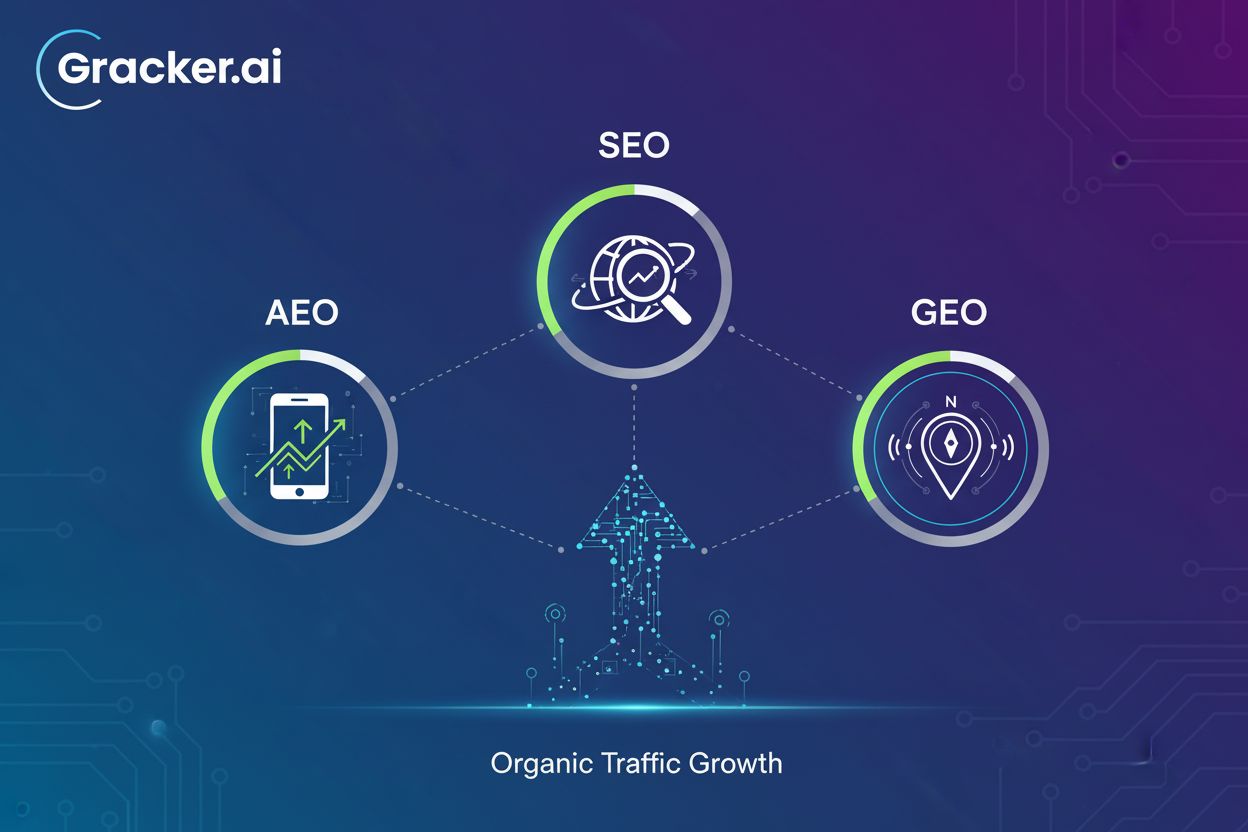
To win now, you need to balance three pillars. SEO is your foundation, but AEO (Answer Engine Optimization) is how you talk to siri or alexa. GEO (Generative Engine Optimization) is the new kid on the block—it's how you make sure LLMs like ChatGPT or Gemini actually cite you as a source.

For SaaS brands, this means your documentation needs to be "machine-readable" so an ai can explain your api to a developer. It's about building a web of trust. As noted by ClickRank, ai-referred visitors can actually be worth 4.4x more because they've already been "vetted" by the engine before they click. That's the whole pitch for treating GEO as a pipeline channel and not just a visibility metric — see how GEO visibility tools turn AI searches into marketing pipeline for how that tracking actually works.
We're moving toward a world where "Information Gain" is the only way to survive. This isn't just a buzzword; it's a concept from google's own patent documentation about content diversity. Basically, it's a score of how much new info you bring to the table compared to what the engine already knows. Think of "originality" as your proxy metric here.
Next, let's look at how to actually build these semantic clusters without losing your mind.
Mastering AEO for the conversational search shift
Ever tried asking your phone a question while cooking, only to have it read out a three-paragraph essay that doesn't actually answer the "how much salt" part? It's annoying as hell, and it's exactly why we need to rethink how we build content for the conversational era.
The way we talk to alexa or gemini is fundamentally different from how we type into a search bar. We don't type "best savings account interest rates 2024," we ask, "Hey, what's the best interest rate I can get on a savings account right now?" To win here, you gotta adopt what I call the Socrates Method: Question, direct Answer, and then the Evidence.

Diagram 2: The Socrates Method flow for AEO. It starts with a clear Question (H2/H3), followed immediately by a concise Answer (the snippet), and then provides the Evidence (data/details) to back it up.
I've found that using h3 tags as direct questions is basically like leaving a trail of breadcrumbs for an ai. If your heading is "How do I integrate a CIAM platform with OIDC?" and the very next sentence is a clear, 40-word summary, you're much more likely to be the "voice" of that search.
The 40-word rule: Keep your initial answer punchy. Voice assistants have a short attention span; if you can't explain it in under 45 words, they'll probably skip you.
Natural language patterns: Stop writing like a textbook. Use "I," "we," and "you." Modern algorithms like BERT are built to understand the nuance of human speech, not robotic keyword strings.
Directness over fluff: In healthcare, if someone asks about symptoms, they don't want a history of the disease first. They want the list. Give it to them immediately.
If your site's technical health is a mess, aeo isn't going to save you. Think of schema as the "translation layer" between your human-readable content and the machine's database. Without faq and how-to schema, you're basically asking gemini to guess what your page is about. And let's be honest, ai is smart, but it's also lazy.
Building a knowledge graph for your brand is the long game here. You want the engine to see your brand as an "entity"—a trusted source that exists across the web, not just a random url. This means your "About" page, your linkedin, and your technical docs all need to point to the same set of facts.
FAQ Schema: Don't just dump questions at the bottom of a page. Use it to answer the high-intent queries that lead to conversions.
How-To Schema: Especially for SaaS, showing a step-by-step api integration via schema makes it incredibly easy for a developer-focused ai to cite you.
Entity Linking: Link to established authorities. If you're talking about finance, reference the FDIC or the SEC. It tells the ai you're part of a trusted conversation.
As previously discussed by Saood Zafar, we're moving away from just counting clicks. In a world where voice and ai overviews dominate, being the source of the truth is often more valuable than the visit itself. It's about building that "Share of Voice" so when a user is finally ready to buy, yours is the only name they remember.
Next, we're going to dive into the messy, exciting world of GEO—Generative Engine Optimization—and how to make sure these LLMs actually mention your brand when someone asks for a recommendation.
For a shorter, tactics-first version of the AEO section above — seven concrete moves without the full strategy build-out — see 7 Powerful Strategies to Win at Answer Engine Optimisation (AEO).
GEO tactics for winning in ChatGPT and Perplexity
If you think ranking on the first page of google is still the "end game," i've got some news that might sting a bit: your potential customers are already getting their answers from chatgpt before they even see your link. We're moving into a world where being the "invisible choice"—the brand an ai casually suggests during a conversation—is way more valuable than a blue link.
It's wild to think about, but a huge chunk of b2b research is happening inside closed loops now. According to a 2024 report by Gartner, search engine volume is expected to drop by 25% by 2026 because of these chatbots. People aren't just looking for "best crm," they're asking perplexity to "compare hubspot and salesforce for a 50-person startup with a focus on ease of use."
If you aren't mentioned in that comparison, you don't exist to that buyer. This is where tools like GrackerAI come in handy for teams trying to figure out how to actually show up in these generative responses. It's about optimizing for "citation share"—making sure that when claude or perplexity builds an answer, your data is the stuff they're leaning on.
The 40% shift: Roughly 40% of b2b buyers are already using ai for their initial research phase. They want the "cliff notes" version of the market before they talk to a salesperson.
Citation is the new click: In perplexity, the links at the top are the new "position one." If you're cited, you get the traffic; if not, you're just background noise.
Industry nuance: In retail, geo might look like an ai recommending a specific pair of running shoes because your site has the most detailed breakdown of "arch support for marathoners."

Honestly, the biggest mistake i see right now is people using ai to write "seo content" that just summarizes what's already out there. It's a race to the bottom. If your article says the same thing as the top 10 results, why would an llm bother citing you? They already have that info in their training data.
As previously discussed by Saood Zafar, search engines (and by extension, generative engines) are becoming "sameness detectors." They want Information Gain. This is a literal score of how much new stuff you're bringing to the table. If you're a finance brand, don't just explain what a 401k is. Share a proprietary study on how 20-somethings are actually using them in 2025.
"AI can summarize existing data, but it cannot conduct a new experiment or interview an industry veteran." — This is your moat.
Unique Data: If you have internal data on how users interact with your api, publish it. That’s "textual food" that ai can't find anywhere else.
First-hand insights: Use phrases like "In our experience testing this architecture..." or "We found that 60% of users fail at step three..." This signals to the engine that you are a primary source.
The "Echo Chamber" Trap: Rewriting existing content is a one-way ticket to algorithmic demotion. If you don't have something new to say, don't publish it.
Let's look at how this plays out in the real world. If you're in healthcare, an ai might be asked, "What are the latest clinical trials for immunotherapy?" If your site has a proprietary tracker or a unique interview with a lead researcher, the ai is going to pull that specific detail and link to you.
In the saas world, it's about being the "how-to" king. Instead of a generic "what is CIAM" page, write a "Trade-offs of implementing OIDC in a multi-tenant architecture" guide. The ai loves specific, technical trade-offs because they provide the nuance that "intro to" guides lack.
The goal here isn't just to rank; it's to be the source of truth that the ai feels "obligated" to mention because your info is just too good to ignore. It’s a bit of a shift in mindset, but it’s the only way to stay relevant when the search bar starts talking back.
Next up, we're gonna look at how to actually scale this stuff with programmatic seo and some heavy-duty ai tools.
Scaling with programmatic SEO and ai tools
Scaling content is usually where things go south. You start with a great strategy, but then you try to hit "10x" and suddenly your site feels like a ghost town of generic, ai-generated junk.
The trick to programmatic seo (pSEO) in 2025 isn't just about spinning up pages; it's about building a system that actually provides utility. You want to capture those weirdly specific long-tail queries without looking like a spam bot. It’s a delicate balance between automation and "human-first" design.
I've seen so many people fail at pSEO because they just swap out a city name or a keyword and think they’re done. That’s how you get flagged for doorway pages. To win, you need "Dynamic Enrichment."
If you're in the retail space, don't just make a page for "Best running shoes in Chicago." Pull in real-time data—local weather patterns, top-rated local trails, or even inventory levels from nearby stores. This makes the page actually useful for a human, not just a crawler.
Niche targeting: In healthcare, this might look like creating pages for every specific drug interaction or symptom combination. If you use api data to show real-time clinical trial availability, you're providing massive information gain.
Human-centric automation: Use tools like Byword or Koala to handle the heavy lifting, but don't just hit publish. You need to use custom LLM prompts to inject your brand's specific "voice" and ensure your programmatic templates don't sound like a dry manual. Even small variations in sentence structure make a huge difference.
The "Value Hook": Every automated page needs one unique element—a calculator, a custom chart, or a specific case study—that doesn't exist on any other page in your set.

As mentioned earlier by Saood Zafar, search engines are now "sameness detectors." If your 5,000 pSEO pages all look the same, the ai algorithms will just ignore them. You have to feed the ai the high-quality, unique data it craves to earn that citation.
When you're dealing with 10k+ pages, you can't just hope google finds everything. You have to be the architect of your own crawl budget. I always tell people: stop thinking about individual pages and start thinking about "Pattern Integrity."
Directing the bots: Use your high-authority "pillar" pages to link down to your new pSEO spokes. This "Equity Siphoning" helps the new pages rank way faster than they would on their own.
Pattern Integrity: If your site structure is messy, the bot gets confused and leaves. Keep your url strings clean and your internal navigation consistent across every single page.
Pruning the dead weight: Honestly, if a page hasn't seen a single visitor in six months, kill it or merge it. Low-quality pages are a drain on your entire site's "Quality Score."

In the saas world, this is huge. If you have a massive documentation site, you want the bot to prioritize the api endpoints that people actually search for. Use your footer or a "trending docs" sidebar to push link juice to those high-priority areas.
Next, we're going to get into the weeds of schema and structured data to make sure these machines can actually read the brilliant stuff you're building.
The technical deep-dive: Schema and Structured Data
If you want to be a "Verified Entity" in the eyes of the major ai players, you can't just hope they understand your content. You have to tell them exactly what it is using JSON-LD schema. This is the "translation layer" that turns your blog post into a set of facts an LLM can digest.
Organization Schema: This is the baseline. It tells the engine who you are, what your logo is, and where your social profiles live. It’s how you build that "Knowledge Graph" presence.
Product and Review Schema: In retail, this is non-negotiable. If you want your price, availability, and star rating to show up in a zero-click snippet, you need this data structured perfectly.
SameAs Properties: This is a secret weapon. By using the
sameAsattribute in your schema, you can link your website entity to your official profiles on LinkedIn, Crunchbase, or Wikipedia. It’s like showing the ai your ID card.
When you implement this, you're making it incredibly easy for an engine like Perplexity to cite you. They don't have to "guess" if you're the manufacturer or a reseller; the schema tells them the truth.
Next, let's look at how this technical foundation supports B2B SaaS growth through topical authority.
B2B SaaS growth through topical authority
Building topical authority in b2b saas is kind of like building a reputation at a massive industry conference. You don't just walk in and scream your product name; you win by being the person who actually understands how all the complex pieces of the tech stack fit together.
If your content is just a bunch of isolated blog posts about "what is cloud security," you’re basically standing in the corner talking to yourself. To the modern search engine—and more importantly, the ai models crawling your site—isolation is the kiss of death for authority.
In my experience, the biggest mistake saas teams make is treating their blog like a chronological feed instead of a structured knowledge graph. You need to map out entity relationships. If you're selling a CIAM platform, your "hub" might be a massive guide on identity orchestration.
The "spokes" are the specific, thorny problems: oidc vs saml for legacy apps, or how to handle mfa fatigue in healthcare environments. By linking these together, you aren't just helping seo; you're building a semantic web that tells gemini or chatgpt, "Hey, these guys own the entire concept of identity."
Mapping Entity Relationships: Don't just link randomly. Link based on logical dependencies. If a user is reading about api keys, they probably need to know about secret rotation next.
Breaking Content Silos: Your documentation, your marketing blog, and your whitepapers shouldn't live on islands. Cross-link them. An ai sees a site with connected technical docs and thought leadership as a much higher authority than a site with just "marketing fluff."
Problem-Solution Clusters: Map your content to the actual messy journey of a cto. They start with a headache (security breach), look for a category (zero trust), and then evaluate a specific fix (your product).

We need to talk about the fact that nobody wants to read a 3,000-word whitepaper on their lunch break anymore. Adding video isn't just a "nice to have" for engagement; it's becoming a massive signal for brand salience. As noted earlier, video snippets can actually help you bypass traditional organic competition by landing you right at the top of the serp.
I've found that embedding a 2-minute "explainer" at the top of a technical post does wonders for dwell time. It keeps people on the page, which tells google your content is actually useful. But the real magic is in the metadata—transcribing those videos provides "textual food" that helps ai understand the nuance of your spoken expertise.
Multi-modal Authority: When you show up in the "All" tab, the "Video" tab, and as a citation in an ai overview, you're dominating the pixels. It makes your brand feel omnipresent.
Transcription for Context: Don't just embed a youtube link and walk away. Use a full transcript and add "chapters." This lets robots index specific moments of your video as answers to specific long-tail questions.
Human Connection: In b2b, trust is everything. Seeing a real engineer explain a complex architecture on video builds more authority than ten anonymous blog posts ever could.

Honestly, the goal here is to stop being a vendor and start being a primary source. If you're a retail saas, publish your own data on cart abandonment trends during black friday. If you’re in finance, write about the trade-offs of different encryption standards.
When you provide that "Information Gain" we keep talking about, you aren't just ranking for keywords. You're becoming an entity that the ai feels it must include in the conversation because your perspective is unique.
Next, we're going to talk about how to actually measure this stuff without losing your mind in a sea of vanity metrics—because let's be real, "impressions" don't pay the bills.
Measuring success in a zero-click world
Honestly, if your boss is still asking for "total clicks" as the main kpi, they are basically living in 2015. We're entering a phase where traffic volume is becoming a total vanity metric. If you get a million hits from a viral meme but none of those people actually buy your saas product, that traffic is just a liability that slows down your site.
As mentioned earlier by Saood Zafar, we have to pivot toward "Revenue-Generating Traffic" (RGT). In a zero-click world, success isn't just about the visit; it is about the impact. You need to look at how your content influences the user journey even when they don't land on your page immediately.
We need to start tracking "Assisted Conversions" and topical deep-dives. But how do you track this when the user never visits your site? You have to use proxy metrics:
Brand Lift Surveys: Ask your new signups "How did you hear about us?" If they say "ChatGPT recommended you," that's a win you can't see in GA4.
Search Volume for Brand Name: If your brand is being cited in AI overviews, you'll see a spike in people searching for your brand specifically. This is a huge indicator of AI-driven awareness.
Share of Voice in AI Tools: Use tools to track how often your brand appears in Perplexity or Gemini responses for your target keywords.
Qualified Sessions over Raw Visits: I'd rather have 50 ctos reading a technical deep-dive on oidc than 5,000 students looking for a definition.
Brand Salience: If your brand name keeps appearing in the "Sources" section of an ai answer, you're building trust that pays off later in the funnel.
Engagement as a Proxy for Trust: Look at scroll depth and internal link clicks. If people are actually interacting with your tools or calculators, you're winning the "Information Gain" game.

In retail, this might look like tracking how many users check a "shipping time" snippet on the serp before eventually visiting your store. In healthcare, it could be measuring how often your clinic is cited as the source for symptom explanations. It's about being the "Destination," not just a "Stopover."
We should talk about the "Compounding Nature" of these organic assets. Unlike ppc where the leads stop the second you turn off the credit card, seo and geo keep working for you. I've seen brands reduce their ad spend by 400% just by establishing solid domain authority.
The gap in that chart is where the real profit lives. By the second year, the cost-per-acquisition for organic is usually a fraction of what you'd pay for ads. It's a long game, sure, but it's the only one that builds a moat.
Anyway, it's not just about the numbers; it's about the technical foundation that makes those numbers possible. Next, we're going to wrap things up by looking at how to audit your current strategy to make sure you aren't leaving money on the table.
Final checklist for the organic traffic optimizer
So, we’ve covered a lot of ground, from the death of the "blue link" to the rise of generative citations. It’s a bit overwhelming, right? But honestly, if you just focus on being the most helpful person in the room, the algorithms—and the humans—will find you.
The first thing you gotta do is stop writing for robots and start auditing for Information Gain. As previously discussed, search engines are now "sameness detectors," so if your content is just a remix of the top five results, you're invisible.
Your Actionable Checklist:
Audit for unique value: Go through your top 10 pages. Ask yourself: "Does this page provide data, a perspective, or a technical trade-off that doesn't exist anywhere else?" If the answer is no, it's time to add some proprietary data or expert interviews.
Implement conversational hooks: Start using h3 tags as direct questions. In finance, instead of "Interest Rate Trends," try "What is the best interest rate I can get right now?" Follow it with a punchy, 40-word answer for aeo.
Automate with intent: Use tools like Byword or custom LLM prompts to handle your schema and internal linking. In retail, ensure your product pages have live inventory and pricing schema so ai browsers don't have to guess.
Track the "Un-trackable": Add a "How did you hear about us?" field to your lead forms to capture AI-driven brand lift that doesn't show up in your clicks.

In healthcare, this might look like a clinic adding a "patient-first" faq that addresses specific billing anxieties—stuff an llm wouldn't know unless you told it. For saas, it’s about making your api docs so clear that a dev asking chatgpt for a code snippet gets your library as the solution.
Anyway, the goal isn't to "win" at seo anymore. It’s to be the source of truth that the ai feels obligated to mention. If you build for the human first and the machine second, you're going to be just fine. Good luck out there.

![10 Best Local Rank Tracker Tools: In-Depth Comparison Guide [2025]](https://cdn.pseo.one/6abcb68a626591c40e1c8aa6/687e1c1ef6fe799d288518df/68809c373eb8562bcf68975d/10-best-local-rank-tracker-tools-comparison-guide/feature-image.jpg)