From Static to Systematic: Building a High-Growth pSEO Content Machine

Deepak Gupta · Co-founder/CEO
· Updated September 22, 2026
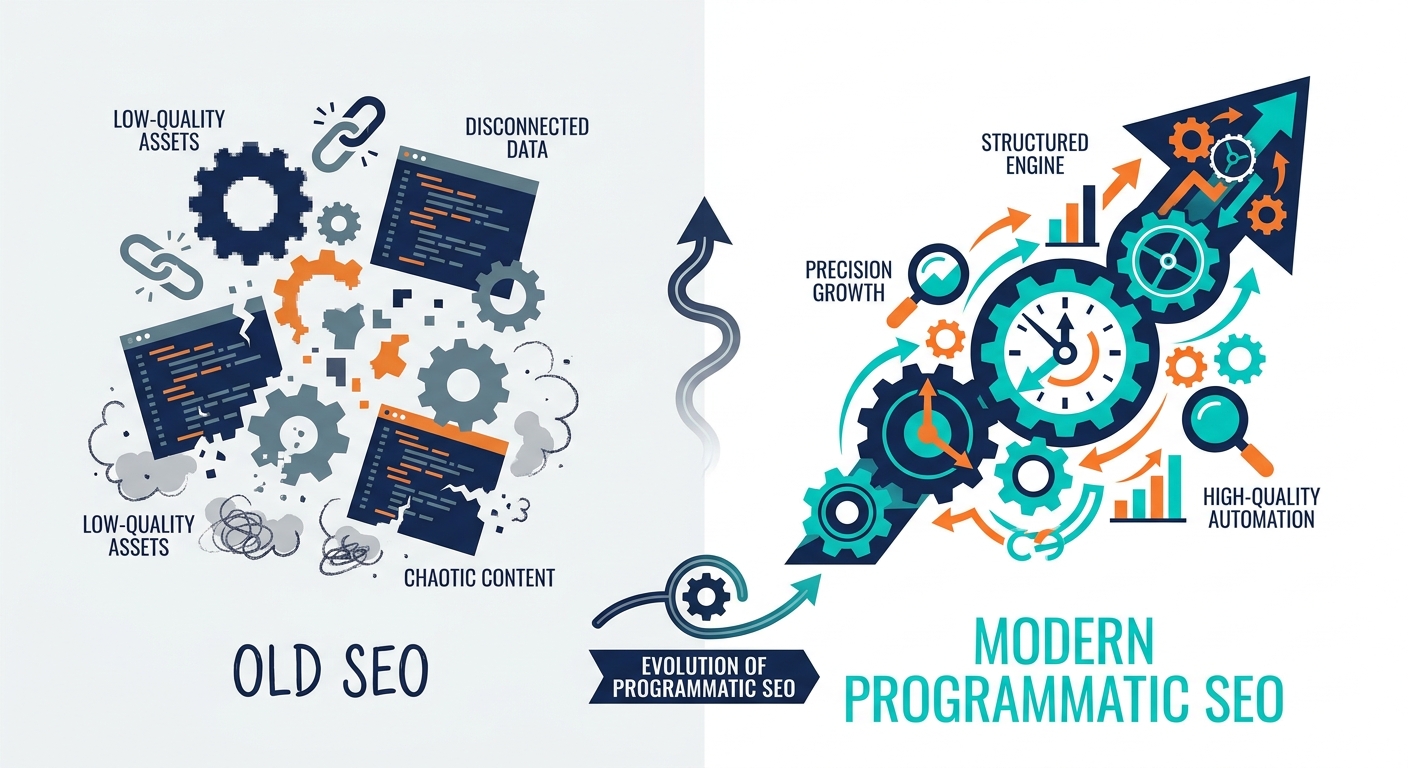
Programmatic SEO (pSEO) isn’t the “get out of jail free” card it used to be. The days of spamming the index with thousands of low-effort doorway pages are over. If you’re still churning out templated “city + service” pages, you’re basically handing Google a reason to ignore your domain.
Today, pSEO is an engineering challenge. It’s the difference between building a sustainable growth engine and watching your site get buried in the 2026 spam graveyard — see the 90-day inbound engine for a month-by-month plan that builds exactly this kind of system without burning out your content team. If you want to win, you have to treat your content like a product—a data-driven machine that solves real problems.
The math is still sexy: deploy 5,000 pages, capture 200 monthly visits on each, and you’ve got a million-visitor acquisition engine. But the “volume at all costs” era is dead. Now, it’s all about data density.
Why the “Bulk” Era of pSEO is Dead
For years, the industry was obsessed with the idea that more equals better. We all churned out thousands of pages with the exact same structure, swapping out a single keyword in the title tag.
Google caught on. With the latest guidance on scaled content abuse, they’ve made it crystal clear: if your content exists only to manipulate rankings without adding unique value, it’s a liability.
We’ve moved from “Pattern-Density” to “Data-Density.” If your pages look like a script vomited them out—because they were—you’ve already lost. Your pages need to offer utility that literally doesn’t exist anywhere else. No more generic boilerplate. You need proprietary datasets, unique visualizations, and expert commentary that only your team can deliver. If you aren’t bringing something new to the table, why should Google rank you? For those building a comprehensive B2B SaaS SEO strategy, pSEO isn’t a side project. It’s the backbone of your topical authority.
How Do You Architect a Data-Driven pSEO Pipeline?
Forget static spreadsheets. You need a dynamic, automated pipeline where data flows from source to surface without you touching a thing. The modern, lean stack is simple: Airtable for data management, Webflow for the frontend, and Whalesync to bridge the two.
flowchart LR
    A[Proprietary Data] --> D[Airtable / Database]
    B[Third Party Public Datasets] --> D
    D --> E[Whalesync]
    E --> F[Webflow]
    F --> G[SEO Indexing]
This no-code stack for pSEO — the same kind of system covered in the complete tech stack for programmatic SEO — lets you treat your content database like a product backend. You aren’t just writing blog posts; you’re managing a relational database of entities. By pulling in proprietary product data—think user benchmark stats, integration compatibility lists, or unique pricing models—and layering it with public data, you build a “content moat” that competitors can’t touch.
What is the “50-Page Pilot” Framework?
“Bulk” is the enemy of quality. It’s the fastest way to get hit with a site-wide quality penalty. Before you dream of launching 10,000 pages, run a 50-page pilot. This is your sandbox. Use it to learn which intent categories—integrations, use-case comparisons, “alternative to” searches—actually convert.
The process is disciplined. Map your categories. Launch 50 pages. Watch the engagement. Are they driving sign-ups, or are they just bouncing? Using a Content Velocity Framework helps you measure the pulse of these pages in real-time — see why publishing more can actually kill your domain authority for the tradeoff this framework is meant to catch. If the pilot flops, you lost a week, not six months of engineering. If it wins, you have the data to scale with confidence.
How Do You Optimize for Generative Engine Optimization (GEO)?
We’re entering the era of Generative Engine Optimization (GEO). People are moving away from blue links and toward direct answers from AI. If your pSEO pages are just walls of text, the AI will skip you. You need to be “Answer-Engine Ready.”
Start with a “Summary-First” structure. Every page should lead with a high-density data block—a table, a key-stat summary, or a direct answer to the user’s query—that is easily digestible by LLMs. Your templates should be built around FAQ schema and entity-based sub-headers that clearly define the relationship between your service and the user’s problem.
erDiagram
    PROGRAMMATIC_PAGE ||--o{ PILLAR_PAGE : "links_to"
    PROGRAMMATIC_PAGE {
        string url
        string entity_data
        string unique_commentary
    }
    PILLAR_PAGE {
        string topic
        string authority_score
    }
    PROGRAMMATIC_PAGE ||--|| TOPICAL_CLUSTER : "belongs_to"
    TOPICAL_CLUSTER {
        string category
    }
By structuring your content this way, you aren’t just chasing keywords; you’re positioning your brand as the “source of truth.” You want the AI to cite you because your data is the cleanest and most relevant.
How Do You Build a “Content Moat” That Defends Against Penalties?
To survive, your machine needs a “human-in-the-loop” angle. Automation handles the data, but humans must handle the “why.” Inject unique, expert-written commentary blocks into every template. This breaks the repetitive “AI vibe” that Google’s algorithms are trained to sniff out.
Your internal linking is your primary defensive asset. Think of your programmatic pages as satellites that feed authority back to your core pillar pages. This flow of equity reinforces your topical authority. And don’t be afraid to prune. If a page isn’t performing, kill it. Keeping your site-wide quality signal high is more important than vanity metrics.
Is Your Resource Allocation Optimized for ROI?
Many founders blow their budget on custom dev before they’ve even proved the model. The reality of the math of programmatic SEO is that the ROI lives in the efficiency of your stack, not the complexity of your code. A well-built no-code system costs a fraction of a traditional content team while producing way more value.
Don’t just look at traffic. Look at “customer acquisition cost per programmatic page.” If your system is automated, your marginal cost per page is near zero, while the revenue from a single long-tail conversion is high. That is the leverage that makes pSEO the most powerful tool in your arsenal.
Frequently Asked Questions
Is programmatic SEO dead after the 2026 Google updates?
No, programmatic SEO is not dead; the era of “thin content” is. Google is rewarding sites that provide dense, unique, and actionable data. If your pSEO strategy is based on utility and proprietary value rather than just keyword repetition, you are in a stronger position than ever.
How do I prevent my programmatic pages from being flagged as spam?
The best defense is uniqueness. Avoid generic, template-heavy text. Instead, mix your automated data with human-written expert insights, ensure every page links meaningfully to a high-authority pillar page, and prune low-performing pages that fail to provide real user value.
What is the minimum tech stack needed to start a pSEO machine?
You need a database to store your content (Airtable), a frontend to display it (Webflow), and an automation tool to sync your database to your frontend (Whalesync). This setup allows you to scale from zero to thousands of pages with minimal technical overhead.
How does GEO (Generative Engine Optimization) change my pSEO strategy?
GEO requires a shift toward “Answer-Engine Ready” content. You must prioritize structured data, tables, and summary-first layouts. By providing clear, extractable information, you make it easier for AI search models to cite your content as the primary source for a user’s query.
Why should I start with a 50-page pilot instead of launching thousands of pages?
Launching thousands of pages at once is a high-risk gamble that often leads to spam penalties. A 50-page pilot allows you to validate user intent and refine your content template based on real interaction data, ensuring that when you do scale, you are scaling a proven, high-performing system. A single webinar transcript can seed that entire pilot on its own. Our guide to turning webinars into evergreen, structured assets walks through the extraction and templating process end to end.
Related Articles
-
 cybersecurity content audit
 How to Audit Cybersecurity Content for Accuracy and Originality
Cybersecurity content with incorrect facts destroys confidence fast. Here's a practical audit framework for correctness and originality that preserves the credibility of your security publications.
-

10 Examples of SaaS Companies with Exceptional Marketing
Explore 10 SaaS marketing examples with actionable tactics. Learn innovative strategies from top companies to elevate your own campaigns.
-

How to Find the Right B2B Prospects for Your SaaS Product
Stop wasting sales outreach on leads that're not a good fit. Learn ways to find, check, and work with the right B2B prospects for your SaaS product.
-
 online reputation management
 The Importance of SEO in Online Reputation Management
Discover how SEO influences your digital brand. Learn actionable strategies to suppress negative search results and build a positive online reputation today.