SaaS Growth Hacks: Combining pSEO and Growth Hacking for Exponential Results

TL;DR
- ✓ Abandon fragile quick hacks for systemic architecture and sustainable market authority.
- ✓ Use programmatic SEO to scale content production across high-intent keyword sets.
- ✓ Apply growth hacking principles to turn automated landing pages into conversion hubs.
- ✓ Build a data-driven flywheel that captures intent and compounds over time.
- ✓ Shift from creating generic content to engineering utility for your target audience.
The "growth hack" is dead. Bury it. If you’re still hunting for that one secret loophole to trick the algorithm, you’re just burning cash while your competitors build moats.
In 2026, scaling a SaaS company isn't about being clever. It’s about being relentless. It’s about building a machine that turns raw data into market authority. By marrying the sheer scale of programmatic SEO (pSEO) with the ruthless, iterative testing of growth hacking, you stop chasing fragile traffic spikes and start building a compounding revenue engine. This isn't just about ranking on page one; it's about making your brand the default utility in your space.
Why Are "Quick Hacks" Failing in 2026?
If you’re still looking for silver bullets, stop. You’re bleeding budget and your brand is losing its edge. The game of B2B SaaS growth hacking has moved past tactical experiments and into systemic architecture. Remember when "growth hacking" meant scraping directories or spamming forums for a quick hit of traffic? Those days are gone. Today, that behavior just gets you flagged by spam filters and ignored by the people you actually want to sell to.
We are living in a Trust Deficit. The internet is drowning in a sea of generic, AI-generated sludge. Everything looks the same, which means everything is invisible. To win this year, you have to stop "creating content" and start "engineering utility."
Systemic growth is your only insurance policy against the next algorithm update. If your strategy depends on a trick that can be patched away in an afternoon, you don’t have a strategy—you have a ticking time bomb.
How Do pSEO and Growth Hacking Create a Competitive Moat?
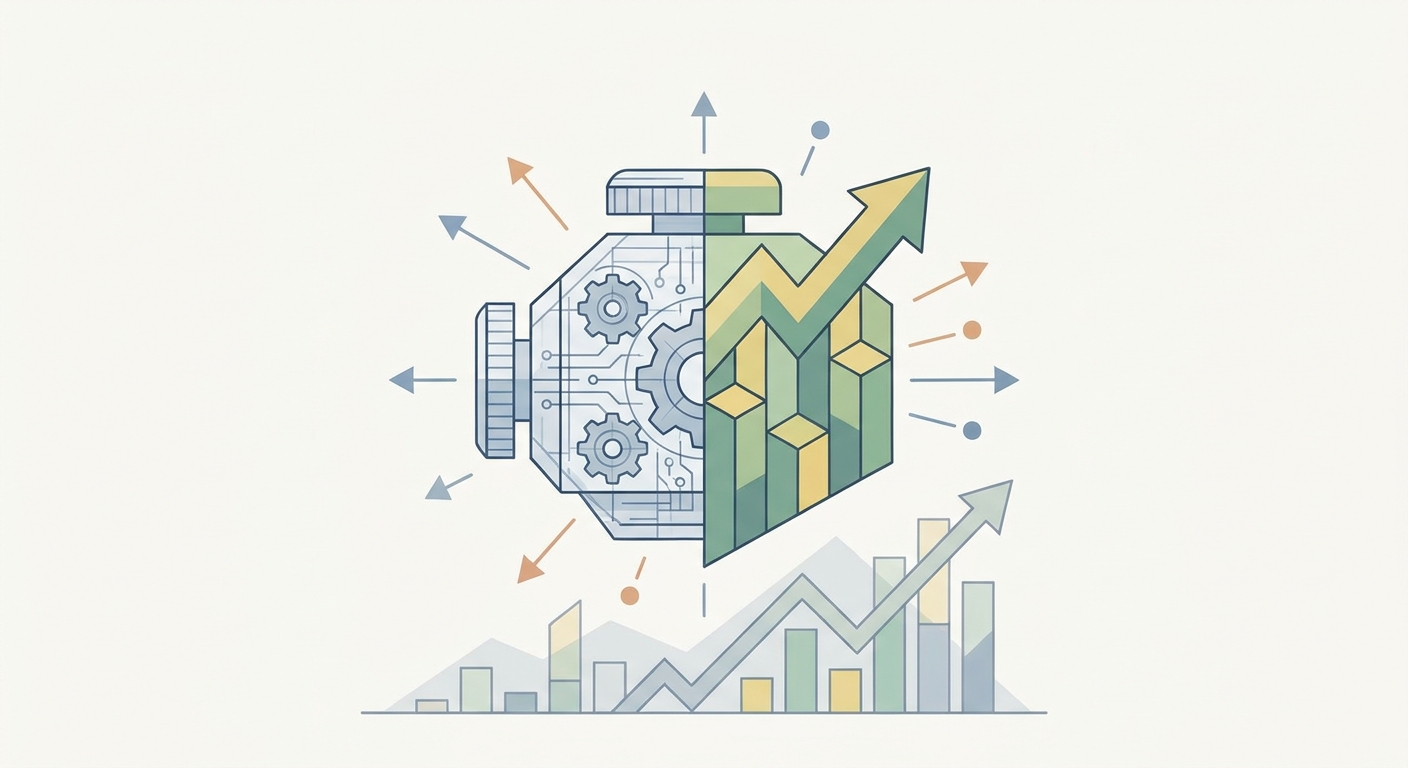
Think of your growth strategy like a high-performance vehicle. Programmatic SEO is the engine—it gives you the raw power and the reach to cover massive amounts of ground without needing a thousand manual hours. Growth hacking? That’s the tuning. It’s the conversion optimization, the UX tweaks, and the relentless testing that ensures that once the traffic lands, it actually converts into revenue.
When you fuse them, you create a flywheel. You aren't just fighting for keywords; you're building an automated infrastructure that captures intent at every single turn.
The velocity you get from pSEO is undeniable. By automating landing pages based on high-intent data sets, you achieve a level of market coverage that a traditional content team couldn't touch in a decade. But the real magic happens when you treat these pages like product hubs, not just SEO filler.
Step-by-Step: Building Your pSEO-Growth Machine
How Do You Identify High-Intent Long-Tail Keywords?
Most teams fail here because they chase volume. They go for "CRM software" and then cry when they don't see any signups. In 2026, you map keywords to pain points. Forget broad terms. You want the "how-to" and "versus" queries that signal a buyer who is done browsing and ready to decide.
Look at your internal data. Where is the overlap between high search volume and high conversion? If your customers are constantly asking how to "integrate X with Y," that’s your goldmine. Stop competing for eyeballs and start competing for decision-makers.
What Makes a Data-Driven Content Template Successful?
A successful template isn't a template—it's a framework. If you’ve spent time on automated content strategy, you know the enemy is "template fatigue." That’s when every page feels like a carbon copy, and the reader (and Google) realizes there’s nobody home.
The fix? "Human-in-the-loop" validation. Use AI to build the bones and ingest your proprietary data, but bring in human editors to layer on the nuance. You need that human spark to make the content feel like it was written for a person, not a crawler.
Why Must You Integrate Interactive Product Elements?
The "hook" is everything. If someone lands on your page and sees a wall of text, they’re gone in three seconds. If they land and find a calculator, a template generator, or an interactive demo that solves their problem right now, you’ve just turned a searcher into a lead.
Turn your landing pages into product hubs. If you sell project management software, don't just write about "task management." Build a free, interactive task-prioritization tool on the page. This is utility-first growth. It turns your SEO strategy into a direct pipeline to your product.
Are You Ready for the AI Search Era (AEO/GEO)?
The blue-link era is fading fast. As discussed in recent industry analysis on AI search, we are moving toward "Answer Engines" like Perplexity and ChatGPT Search. Your content has to be structured so these machines can digest it, summarize it, and serve it up.
To dominate here, prioritize structured schema, clean data tables, and high-value summaries. AI models thrive on clarity. If your pages are dense and messy, they’ll get ignored. If you structure your data effectively, you become the definitive source of truth.
How Can You Avoid the "Spam" Label?
The "spam" label is a death sentence. To avoid it, prioritize utility over volume. I’d rather have 500 pages that users bookmark than 50,000 pages of thin, redundant filler.
First-party data is your shield. If your pages are just rehashed versions of what’s already on the web, you’re at risk. But if your pages offer original research or unique tools? You’re indispensable. As noted by experts in content strategy, the future belongs to those who provide utility that no generic LLM can replicate.
Case Study: Scaling Traffic via Automated Content
Consider a mid-market SaaS firm that hit a wall. Manual content production was too slow and too expensive. They switched to a programmatic strategy, targeting 2,000 long-tail intent keywords. They didn't just write articles; they built a library of interactive comparison tools.
The result? Within six months, organic traffic jumped 300%. More importantly, their CAC (Customer Acquisition Cost) dropped by 40%. By using growth hacking services that focused on the user journey, they turned an SEO engine into a revenue machine. They stopped worrying about rankings and started focusing on acquisition velocity.
Conclusion: Moving from Traffic to Revenue
The transition from "growth hacking" to "systemic growth" is the defining challenge of 2026. Programmatic SEO isn't a hack; it’s a foundation. When you integrate your product, validate your data, and optimize for AI search, you move past vanity metrics and into the realm of real, scalable revenue.
Build a system that works while you sleep. A programmatic data layer that fuels your funnel, educates your users, and cements your authority. The tools are here. The strategy is clear. Stop playing the game and start building the engine.
Frequently Asked Questions
Does programmatic SEO still work in the age of AI search?
Yes, but it has evolved. It’s no longer about keyword stuffing; it’s about becoming the primary source of truth for specific data sets that AI search engines can cite. By structuring your content for AEO, you ensure visibility in AI-generated answers.
How do I prevent my pSEO content from being flagged as spam?
Focus on "Utility over Volume." Ensure every programmatic page provides unique value—such as calculators, comparison data, or templates—rather than just repeating generic information. If the user finds value, the search engine will find authority.
What is the biggest mistake SaaS companies make with growth hacking?
Treating growth as a series of isolated "hacks" instead of building a repeatable, data-backed engine that compounds over time. Growth is not a sprint; it is an architectural project.
How does Answer Engine Optimization (AEO) differ from traditional SEO?
Traditional SEO focuses on ranking for blue links through keyword density and backlink profiles. AEO focuses on providing structured, concise, and high-utility data that AI models can easily summarize and present directly to the user.
How can I integrate my SaaS product directly into programmatic content?
Embed interactive tools like calculators, templates, or mini-demos directly onto your programmatic landing pages. This creates a low-friction path from discovery to product activation, turning your content strategy into a direct sales channel.