10 Essential Monthly SEO Tasks to Maximize Your Website’s Potential in 2025

Search Engine Optimization (SEO) is an ever-evolving field, and keeping your website optimized is not a one-time task but a continuous process. To stay ahead in the increasingly competitive digital landscape, it’s essential to engage in monthly SEO tasks that fine-tune your website’s performance. These activities not only help you maintain your current standing but also propel your site toward higher rankings, increased traffic, and better user engagement. Consistency is key when it comes to SEO. While isolated efforts can yield some short-term gains, it’s the cumulative effect of consistent, monthly SEO tasks that will truly maximize your website’s potential. Think of it as nurturing a garden: regular attention, care, and updates ensure growth. The algorithms used by search engines like Google are continually updated, and so must be your SEO strategies. Regular SEO audits and updates allow you to identify new opportunities, stave off potential penalties, and keep up with best practices. The ultimate goal of this blog post is to guide you through 10 essential monthly SEO tasks that will help you achieve a robust and enduring online presence. Whether you’re a seasoned marketer or a small business owner, these tasks are designed to be practical and effective, addressing various aspects such as keyword analysis, content updates, backlink audits, and technical SEO checks. By the end of this post, you’ll have a clear, actionable roadmap to ensure that your website not only meets current SEO standards but is also well-positioned for future growth. If you need faster wins before committing to this full monthly cadence, our 5 easy tips for fast SEO success guide is a good starting checklist covering speed, mobile optimization, and backlinks.
Essential Monthly SEO Tasks
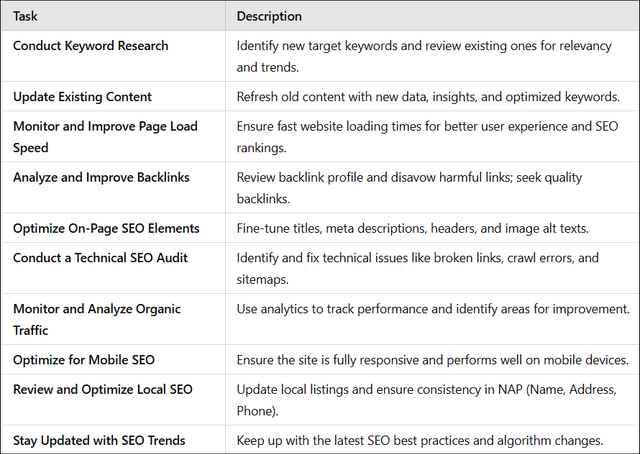
1. Conduct Keyword Research
Identify New and Relevant Keywords
One of the bedrocks of effective SEO is continually updating and expanding your list of target keywords. Conducting keyword research every month ensures that you stay tuned to the latest search trends and user interests. Start by identifying new and relevant keywords that align with your industry’s current landscape. Use tools like Google’s Keyword Planner or Ubersuggest to uncover keywords that your audience is searching for. These tools allow you to input seed keywords and receive suggestions based on search volume, competition, and other critical metrics.
Analyze Competitor Keyword Strategies
While focusing on your own keyword strategy is vital, keeping an eye on your competitors can provide invaluable insights. By analyzing the keyword strategies of top-ranking competitors, you can discover gaps in your own approach as well as new opportunities. SEO tools like SEMrush and Ahrefs are excellent for this purpose. They allow you to enter a competitor’s URL and see which keywords they rank for, what their highest-traffic pages are, and more. This analysis can help you understand why competitors outrank you and how you can adjust your strategy to overtake them.
Use SEO Tools to Refine Keyword Lists
After gathering a robust set of potential keywords, the next step is to refine your list using SEO tools. Tools like Moz Keyword Explorer and SpyFu can help you zero in on high-potential keywords by providing advanced metrics, such as keyword difficulty, click-through rates, and search volume trends. Additionally, these tools can help you remove irrelevant keywords that might have initially appeared promising but ultimately don’t align well with your content strategy or have too much competition. Regularly refining your keyword list ensures that your SEO efforts stay focused and effective. Incorporating fresh, relevant keywords, understanding your competitors’ strategies, and leveraging advanced SEO tools can significantly enhance your website’s visibility. By consistently dedicating time each month to keyword research, you are setting a strong foundation for your broader SEO strategy, ultimately driving more traffic and engagement to your site.
2. Update Existing Content
Refreshing Outdated Statistics or Information
A critical aspect of content update is ensuring that all information on your website remains accurate and up-to-date. Google favors fresh, relevant content, and outdated statistics or information can harm your site’s credibility and ranking. For instance, if you previously referenced social media statistics from 2019, look for the latest data from reputable sources to replace those figures. Websites like Statista or Pew Research Center offer reliable statistical data across various industries. Refreshing your content this way helps maintain its relevance and accuracy, ensuring that visitors always get the most current information.
Adding New Sections or Insights
Your website’s existing content is a goldmine that can be enriched further. Periodically adding new sections or insights not only bolsters the value of the content but also encourages users to spend more time on your site, positively impacting bounce rates and user engagement metrics. For example, consider adding a Frequently Asked Questions (FAQ) section or breaking down complex topics into easily digestible sub-sections. This approach ensures your content evolves with your audience’s needs and questions, ultimately driving higher user satisfaction.
Optimizing for Newly Identified Keywords
Search engine algorithms and user queries evolve, making keyword research an ongoing necessity. By incorporating newly identified keywords into your existing content, you can tap into fresh traffic streams and maintain a competitive edge in search engine rankings. Tools like Ahrefs or SEMrush offer insights into emerging keywords relevant to your niche. Incorporate these keywords naturally within your content, titles, and meta descriptions to achieve optimal content optimization. Regularly optimizing for new keywords not only enhances your visibility but also ensures that your content aligns with current search trends. Updating existing content isn’t merely a task to check off your SEO to-do list. It is a continuous process that, when done correctly, can significantly improve your content’s relevance, user engagement, and search engine rankings. By refreshing outdated statistics, adding new insights, and optimizing for new keywords, you keep your content dynamic and valuable, ensuring it remains a potent asset for attracting and retaining your audience. For more in-depth guides on content optimization, Moz and Search Engine Journal provide extensive resources to help you get started.
3. Monitor and Improve Page Load Speed
Use Tools Like Google PageSpeed Insights
One of the foundational aspects of performance optimization is understanding your current situation. Google PageSpeed Insights is an invaluable tool for this purpose. By simply entering your website URL, you receive a comprehensive analysis of both your mobile and desktop performance. This tool provides a detailed report on various metrics, such as First Contentful Paint (FCP), Speed Index, and Time to Interactive. Understanding these metrics gives you a clear picture of how your website is performing and where improvements can be made. Google PageSpeed Insights also offers actionable suggestions tailored to your site’s needs. You can click here to access Google PageSpeed Insights and start optimizing today.
Identify Elements Causing Slow Load Times
After running an analysis with tools like Google PageSpeed Insights, your next step is to identify specific elements that contribute to slow page speeds. Often, the culprits for slow load times include unoptimized images, excessive JavaScript execution, or server response times. By pinpointing these problem areas, you can take targeted actions to resolve them. Many of these tools will highlight problematic resources, showing how much they are delaying your overall load time. Additionally, browsers’ built-in developer tools can help you analyze and diagnose these issues in real time.
Implement Technical Fixes to Enhance Speed
Once you’ve identified the problematic elements, it’s time to get hands-on with performance optimization. Here are some common technical fixes that can significantly improve your page speed:
- Image Optimization: Compress images using tools like TinyPNG or ImageOptim. Also, consider using modern image formats like WebP.
- Minify CSS, JavaScript, and HTML: Tools like UglifyJS for JavaScript and CSSNano for CSS can effectively reduce the size of your files without sacrificing functionality.
- Leverage Browser Caching: Configure your server to specify how long browsers should keep certain assets in their cache. This reduces the need for repetitive downloads and speeds up subsequent visits to your site.
- Optimize Server Response Time: Make sure your server is configured for peak performance. Upgrading to a faster DNS provider or improving your server’s backend code can make a marked difference.
- Prioritize Above-the-Fold Content: Use lazy loading for images and videos and prioritize the loading of content that appears above the fold to improve perceived load times.
By consistently monitoring and improving page load speed, you not only enhance user experience but also boost SEO rankings since search engines reward faster sites. Tools, diagnostics, and technical fixes all play a crucial role in your performance optimization strategy, making it an essential monthly SEO task to maximize your website’s potential.
4. Analyze and Improve Backlinks
Analyze and Improve Backlinks
Backlinks, or incoming links from other websites to yours, play a significant role in search engine optimization (SEO). They can greatly influence your website’s authority and ranking in search engine results pages (SERPs). Here are some steps to help you analyze and improve your backlinks effectively. You may also like to read
Link Building Strategies for Cybersecurity Websites: A Comprehensive Guide
Use Backlink Analysis Tools
First, leverage powerful backlink analysis tools to get a clear picture of your current backlink profile. Tools such as Ahrefs, Moz Link Explorer, and SEMrush Backlink Audit provide comprehensive data about your backlinks. These tools can help you identify the quantity and quality of your backlinks, track their growth over time, and pinpoint which domains are linking to your website. Analyzing these reports will inform you about the strength and weaknesses in your link building strategy, allowing you to make data-driven decisions to enhance your SEO efforts.
Identify and Remove Toxic or Spammy Links
Not all backlinks are beneficial. Some could be toxic or spammy and might harm your website’s reputation and ranking. These are low-quality links that come from questionable or irrelevant websites, which can be flagged by search engines like Google. Using tools like Google’s Disavow Tool alongside Ahrefs or SEMrush can help you identify and disavow these harmful links. Regularly checking for toxic links is crucial to maintaining a clean backlink profile and preventing any negative impacts on your website’s SEO performance.
Seek Opportunities for Quality Backlinks
Quality backlinks are like gold in the realm of SEO, significantly boosting your website’s authority and search rankings. To acquire quality backlinks, you need to focus on link building strategies that include:
- Guest Blogging: Write high-quality articles for reputable sites in your niche. This not only builds backlinks but also positions you as an authority in your field.
- Content Marketing: Publish valuable, share-worthy content on your site that naturally attracts backlinks. Infographics, in-depth guides, and original research are particularly effective.
- Building Relationships: Network with influencers and professionals within your industry. Engage with their content, participate in discussions, and collaborate on projects that can result in mutual link building.
Additionally, monitor your competitors’ backlinks using the same tools mentioned earlier. Identify which sites are linking to them and consider reaching out to these sites if your content is relevant and valuable. Implementing these strategies will help you enhance the quality and quantity of your backlinks, contributing positively to your website’s SEO. By consistently analyzing and improving your backlinks, you can ensure your website remains competitive, authoritative, and well-optimized for search engines. Prioritizing backlink management as part of your monthly SEO tasks can significantly maximize your website’s potential.
5. Optimize On-Page SEO Elements
Ensure Meta Titles and Descriptions are Engaging and Keyword-Rich
One of the fundamental aspects of on-page SEO is crafting compelling meta titles and descriptions. These elements not only help search engines understand the content of your pages but also entice users to click on your links when they appear in search results. To maximize effectiveness, include primary keywords organically within your meta tags. Make sure your titles are between 50-60 characters and your descriptions are around 150-160 characters. Engaging, persuasive language can significantly increase your click-through rate (CTR). Tools like Yoast SEO can be beneficial for optimizing these elements, offering real-time feedback on title length, relevance, and keyword use. You may also like to read
How to Create Effective Meta Title Tags: Optimize for SEO and User Experience Writing Powerful Meta Descriptions in 2025: Key Tips for Success
Check Header Tags (H1, H2, etc.) for Keyword Alignment
Header tags (H1, H2, H3, etc.) are critical components of on-page SEO that structure your content and signal its hierarchy to search engines and users. Your H1 tag should include the primary keyword for the page and clearly convey the main topic. Subsequent headers (H2, H3, etc.) help to break down the content into digestible sections, ideally aligning with secondary and related keywords. Properly aligned header tags not only enhance the readability of your content but also improve your SEO performance. You can use the SEOquake tool to review your page and ensure that your header tags are correctly optimized and appropriately placed.
Optimize Image Alt Texts
Images are more than just visual elements—they play a vital role in your SEO strategy. Search engines rely on alt texts to understand the content of an image since they cannot “see” images. Optimizing your alt texts with relevant keywords can improve your site’s relevance for those terms and enhance your on-page SEO. Additionally, descriptive alt texts ensure better accessibility, providing a textual description for users who rely on screen readers. For example, instead of using a generic alt text like “image1.jpg,” describe the image with keywords, such as “woman using a laptop for on-page SEO optimization.” Tools like Ahrefs can assist you in conducting a thorough audit of your image alt texts and identify optimization opportunities. By diligently optimizing these on-page SEO elements—meta titles and descriptions, header tags, and image alt texts—you lay a strong foundation for better visibility, improved user experience, and higher rankings in search engine results pages (SERPs).
6. Conduct a Technical SEO Audit
Conduct a Technical SEO Audit
A thorough technical SEO audit is crucial for maintaining the health and performance of your website. Regular technical audits ensure that search engines can efficiently crawl and index your site, which is a foundational aspect of any effective SEO strategy. Below are some key steps to include in your monthly SEO tasks:
Check for Crawl Errors Using Tools like Google Search Console
Crawl errors can prevent search engines from accessing your content, which can significantly impede your search engine rankings. Use tools like Google Search Console to identify and resolve any crawl issues. Within Google Search Console, the Coverage report shows you which of your pages have crawl errors. Common issues include ‘404 Not Found’ errors and ‘Server 5xx’ errors. By addressing these errors promptly, you ensure search engines can properly navigate and understand your site.
Ensure Proper Indexing of Website Pages
Once you’ve checked for and resolved crawl errors, the next step in your SEO audit is to ensure that all the important pages on your website are indexed correctly. You can verify this using the Index Coverage report in Google Search Console. Moreover, it’s beneficial to cross-reference this information with an indexed pages report by performing a “site:yourdomain.com” search in Google. If you notice that important pages are missing or irrelevant pages are indexed, take immediate corrective action, such as updating your robots.txt file or using the ‘noindex’ tag where necessary. site: is one of only a handful of operators Google officially documents and supports — for the full set of indexing and content-audit operators worth adding to this monthly checklist, see GrackerAI's guide to 30 Google search operators every digital marketer must know.
Fix Any Broken Links or 404 Errors
Broken links and 404 errors not only degrade user experience but can also hurt your SEO performance. Implement tools such as Screaming Frog SEO Spider or Ahrefs Site Explorer to crawl your website and identify broken links. These tools can provide a detailed report of all the URLs resulting in 404 errors. Once identified, you can either remove the broken links or set up 301 redirects to guide users to the correct pages. This ensures that your website maintains a smooth navigation experience, which is crucial for user engagement and search engine rankings. Conducting a regular technical SEO audit not only improves the user experience but also plays a significant role in maintaining and boosting your website’s search visibility. By systematically addressing crawl errors, ensuring proper indexing, and fixing broken links, you can keep your website in top shape, thereby maximizing its potential.
7. Monitor and Analyze Organic Traffic
Use Google Analytics to Track Traffic Trends
One of the most essential tasks in your monthly SEO routine is monitoring and analyzing organic traffic, and there’s no better tool for this than Google Analytics. By consistently tracking traffic trends, you can gain invaluable insights into how users are interacting with your website over time. Google Analytics allows you to see fluctuations in organic traffic, pinpoint the sources of your visits, and understand user behavior. To get started, make sure your Google Analytics account is properly set up and linked to your website. Navigate to the “Acquisition” section and then select “All Traffic” followed by “Channels.” Here, you can view how much of your website’s traffic is coming from organic search. Keeping an eye on this data monthly helps you spot trends, enabling you to adapt your SEO strategies accordingly.
Identify Top-Performing Pages
Another crucial aspect of your SEO audit involves identifying your top-performing pages. Within Google Analytics, head over to “Behavior,” then “Site Content,” and finally “All Pages.” This section details which pages are driving the most organic traffic. Understanding which pages are successful allows you to focus your SEO efforts where they matter most. If certain pages consistently achieve high organic traffic, study what factors may be contributing to their success. These could include high-quality content, effective keyword optimization, or strong backlinks. Replicating these successful elements on other pages can help enhance your overall organic traffic.
Analyze the Reasons Behind Any Traffic Drops
It’s not enough to just monitor the rise and fall of organic traffic; you must also understand why these changes are occurring. If you notice a sudden decline in traffic, dig deeper to determine the cause. Google Analytics provides several tools to help you with this. First, compare your traffic data over different time periods to pinpoint the exact moment the drop occurred. Next, check if there were any changes to your website around that time—did you recently publish a new piece of content, or perhaps remove an old one? Have there been any recent updates to Google’s algorithm that might have affected your rankings? You might also want to investigate the “Behavior Flow” in Google Analytics to see where users are dropping off. Additionally, look into potential technical issues like site speed or mobile friendliness that might be affecting user experience. Tools like Google Search Console can also provide additional insights into any crawl errors or issues with your webpages. By digging into these factors systematically, you can identify and rectify issues promptly, helping to stabilize and eventually increase your organic traffic. For more information on analyzing traffic data, Moz’s Beginner’s Guide to SEO is a valuable resource.
8. Optimize for Mobile SEO
Ensure Website is Mobile-Friendly
In the era of mobile-first indexing, Google predominantly uses the mobile version of the content for indexing and ranking. Therefore, it’s crucial to ensure your website is mobile-friendly. Use Google’s Mobile-Friendly Test to check how easily a visitor can use your page on a mobile device. A mobile-friendly website should have a responsive design, easy-to-read text without zooming, touch-friendly elements, and a smooth navigation flow. Address any issues flagged by the test to enhance your mobile SEO and provide a seamless user experience.
Conduct Mobile Usability Tests
Mobile usability goes beyond just having a responsive design. It includes elements like interactivity, layout, and overall user experience. Regularly conduct mobile usability tests to identify potential issues. Use tools like Google Search Console to access the Mobile Usability Report, which highlights problems such as clickable elements too close together or content wider than the screen. Also, manually testing your website on various mobile devices and browsers can uncover design flaws that automated tools might miss. Address these usability issues promptly to ensure a smooth and efficient user experience, essential for effective mobile optimization.
Improve Mobile Page Load Times
Page load time is a critical factor in both user experience and SEO. Slow mobile page load times can lead to higher bounce rates and lower search engine rankings. To optimize your website’s load times, start by using tools like Google PageSpeed Insights to analyze and receive suggestions for improvement. Consider implementing AMP (Accelerated Mobile Pages) to create fast-loading pages, and optimize images by compressing them without losing quality. Additionally, leverage browser caching, reduce redirects, and minify CSS, JavaScript, and HTML files. Enhanced load times not only contribute to better mobile SEO but also significantly improve user satisfaction and retention. Integrating these essential mobile optimization strategies into your monthly SEO tasks can ensure your website performs optimally across all devices, ultimately maximizing its potential in search engine rankings and user engagement. Consistent attention to mobile SEO helps maintain your site’s competitiveness and relevance in an increasingly mobile-driven digital landscape.
9. Review and Optimize Local SEO
Update Google My Business Listing
One of the most important monthly tasks to maximize your website’s potential through local SEO is to keep your Google My Business listing updated. Google My Business is a free tool that helps businesses manage their online presence across Google’s services, including Google Search and Google Maps. Regularly updating your Google My Business profile ensures that your potential customers see the most accurate and current information about your business. Check details such as your business hours, address, and types of services you offer. Incorporate new photos, update your business description, and post updates about special offers or new products. This not only helps in improving local search rankings but also enhances your credibility and reliability in the eyes of customers.
Ensure Accurate NAP (Name, Address, Phone) Citations
Accurate NAP (Name, Address, Phone) citations are essential for effective local SEO. Ensuring consistency of these details across various platforms – including your website, social media profiles, and online directories – can significantly influence your search rankings. Discrepancies in NAP citations can confuse search engines and customers alike, potentially leading to a loss of traffic and business opportunities. Use tools like Moz Local or Yext to monitor and manage your NAP citations. Make this a monthly task to review and correct any inconsistencies, which will help build a stronger local presence and improve your website’s credibility.
Encourage and Respond to Customer Reviews
Customer reviews are a powerful factor in local SEO. Positive reviews can enhance your reputation and directly impact search engine rankings. Make a habit of encouraging satisfied customers to leave reviews on your Google My Business listing and other relevant review sites like Yelp and TripAdvisor. You can do this by sending follow-up emails or messages with a direct link to the review page. Additionally, it’s crucial to actively respond to reviews, both positive and negative. Responding to reviews shows that you value customer feedback, and it can sway potential customers in your favor. A well-handled negative review can even turn a dissatisfied customer into a loyal one. This ongoing interaction will build trust and foster a community around your brand, further boosting your local SEO efforts. By dedicating time each month to review and optimize your local SEO, you can foster a stronger connection with your community, improve your online visibility, and attract more local customers. For further reading on how to manage customer reviews effectively, check out this comprehensive guide on Search Engine Journal.
10. Stay Updated with SEO Trends
Subscribe to Leading SEO Blogs and Forums
Keeping up with SEO trends is crucial in ensuring your strategies remain effective and you’re aware of the latest industry updates. One of the best ways to stay informed is by subscribing to leading SEO blogs and forums. Websites like Moz and Search Engine Journal offer up-to-date insights and thorough analyses on the shifting landscape of SEO. These platforms provide articles, case studies, and expert advice that can help you understand what changes might affect your site and how to adapt strategically. Additionally, forums such as Warrior Forum and SEO Chat allow you to engage with other professionals, discuss trends, and share solutions to common problems. By integrating insights from these resources into your monthly SEO tasks, you can proactively adjust your tactics to align with the latest advancements.
Attend Relevant SEO Webinars and Conferences
In the digital marketing world, webinars and conferences are gold mines for acquiring fresh SEO insights. Events like SMX (Search Marketing Expo), BrightonSEO, and SEO Summit often feature presentations from industry leaders who share their latest research and experiences. These gatherings are fantastic opportunities to deepen your understanding of effective SEO practices and network with industry peers. Regularly attending such events helps ensure that you’re always in the loop with the latest SEO trends. Many of these conferences also offer online versions or webinars, making it easier to participate from anywhere in the world. By absorbing the insights gained from these events into your strategies, you can stay ahead of the curve and pivot quickly when new techniques prove effective.
Implement New Strategies Based on Trend Analysis
Once you’re updated on the latest industry trends and have gathered sufficient insights from blogs, forums, and events, it’s essential to put that knowledge into practice. Conduct a thorough trend analysis to identify which emerging strategies might benefit your website the most. For instance, the rise of voice search has led to changes in keyword strategies, with a focus on long-tail keywords and natural language processing. Similarly, advancements in AI and machine learning can influence how search engines rank content, making it crucial to adapt your approach to content creation and optimization. Implementing new strategies doesn’t mean overhauling your existing plans entirely; instead, it’s about integrating fresh insights into your current framework. Set aside time each month to review and experiment with new tactics, measure their effectiveness, and refine as needed. This practice not only keeps your SEO endeavors dynamically aligned with prevailing trends but also enhances your website’s ability to achieve and maintain higher search rankings. By religiously following these steps, you’ll ensure your website is consistently primed to leverage the latest SEO trends, securing its competitive edge in a constantly evolving digital landscape.
One More Thing Worth Adding to This Checklist
Ranking on Google is no longer the whole picture. Forrester's 2026 Buyers' Journey Survey found that 94 percent of B2B buyers now use AI somewhere in their purchase process (Forrester, retrieved 2026-09), which means a monthly checklist that only tracks search rankings has a blind spot.
Add one recurring task: run your top 5-10 buyer questions through ChatGPT, Perplexity, and Google AI Overviews, and note whether your brand gets cited. Purpose-built AI-visibility tools automate this once the query list outgrows a manual spreadsheet, tracking citation frequency and position the same way this checklist already tracks rankings.
Frequently Asked Questions
How long does a monthly SEO task list actually take to complete?
For a small-to-midsize site, budget 8-12 hours a month once the process is routine: a few hours for keyword and content review, a couple for the technical audit, and the rest split across backlinks, on-page checks, and trend monitoring. The first month or two will run longer while you set up tracking.
Which of these 10 tasks matters most if I only have time for a few?
Updating existing content and fixing technical issues (crawl errors, broken links, page speed) tend to deliver the fastest, most reliable gains, since they affect pages that are already indexed and partially ranking. Keyword research and backlink work compound over a longer horizon.
Do I need paid tools like Ahrefs or SEMrush, or can I do this for free?
Google Search Console, Google Analytics, and Google's PageSpeed Insights and Mobile-Friendly Test cover crawl errors, indexing, traffic analysis, and speed at no cost. Paid tools mainly add competitor visibility and bulk backlink data, which matter more as a site scales.
How is this different from a one-time SEO audit?
A one-time audit is a snapshot; this is a recurring cadence. Search rankings, backlink profiles, and content freshness all decay without maintenance, so the value comes from repeating these checks every month rather than fixing everything once and moving on.
Should this checklist include AI search visibility now, or just Google rankings?
Both, going forward. Traditional rankings still drive the majority of organic traffic today, but a growing share of research happens inside ChatGPT, Perplexity, and AI Overviews instead of a search results page, so tracking whether your content gets cited there is becoming a normal part of the monthly routine, not an optional extra.
Conclusion
In today’s hyper-competitive digital landscape, the importance of diligently performing monthly SEO tasks cannot be overstated. By incorporating a consistent and effective SEO strategy, you ensure that your website remains optimized, relevant, and attractive to search engines. This results in higher search rankings, increased organic traffic, and ultimately, greater opportunities for conversions. Staying consistent with your SEO efforts is crucial. Missing out on these monthly SEO activities can leave your website lagging behind competitors, potentially resulting in missed business opportunities. By making SEO maintenance a regular part of your digital marketing routine, you lay down the foundation for long-term online success and sustainability. We encourage you to share your own strategies and insights for effective monthly SEO in the comments section below. Your experiences and tips are invaluable to our community of readers, and they can offer fresh perspectives and new approaches for those looking to enhance their SEO efforts. Remember, the SEO landscape is always evolving, and staying informed through shared knowledge can contribute significantly to mutual growth and success. For more detailed insights on SEO strategies and best practices, you may refer to Moz’s Beginner’s Guide to SEO or Google’s Search Engine Optimization (SEO) Starter Guide. These resources provide a solid foundation and up-to-date recommendations to help you fine-tune your monthly SEO tasks for optimal results.
![10 Best Local Rank Tracker Tools: In-Depth Comparison Guide [2025]](https://cdn.pseo.one/6abcb68a626591c40e1c8aa6/687e1c1ef6fe799d288518df/68809c373eb8562bcf68975d/10-best-local-rank-tracker-tools-comparison-guide/feature-image.jpg)