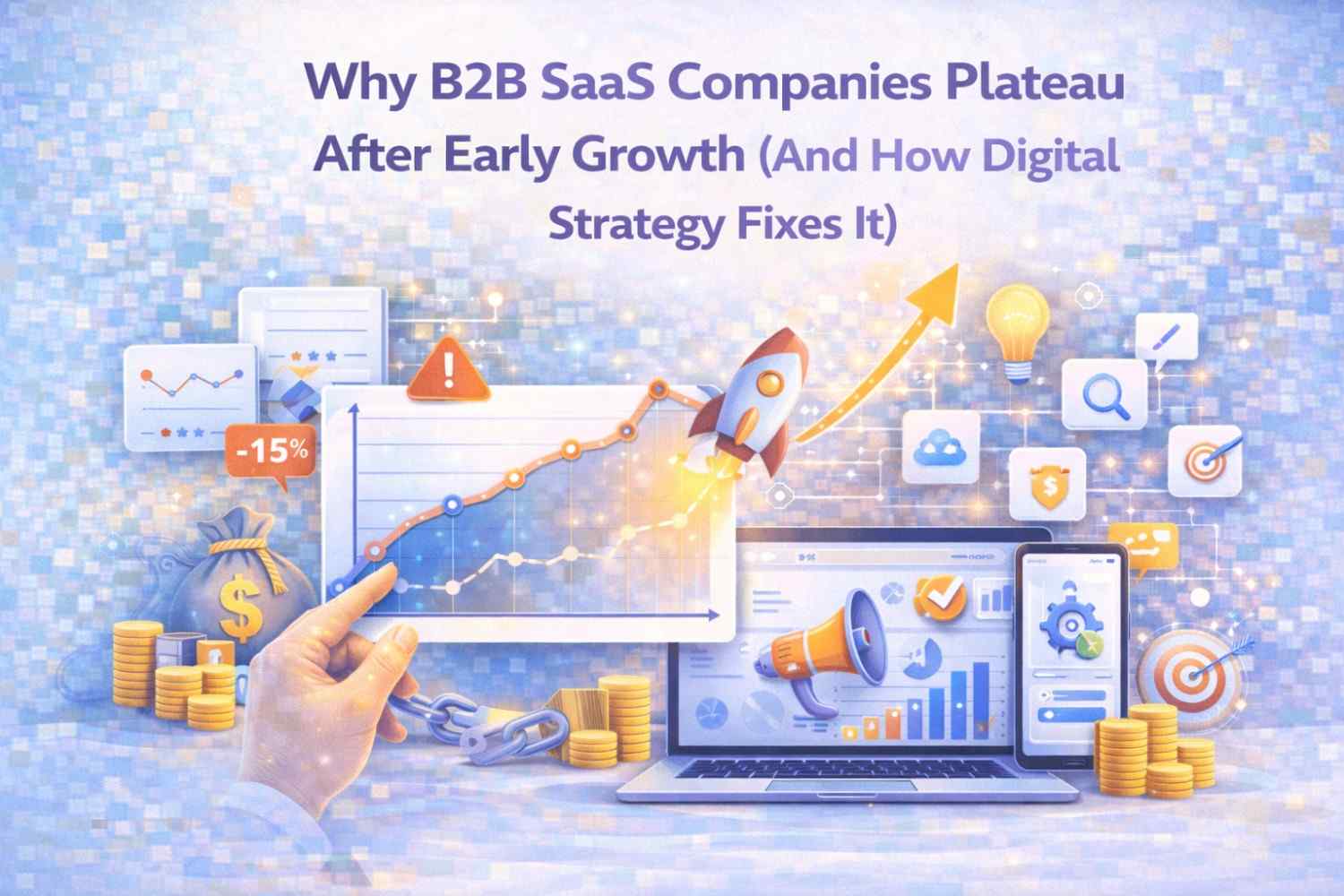
Why B2B SaaS Companies Plateau After Early Growth (And How Digital Strategy Fixes It)

A lot of B2B SaaS companies go through a fast early growth phase. The phones ring, inquiries come in, and revenue starts to go up. For many founders, it feels like they've finally figured it out. And then, somewhere between "busy" and "established," things start to slow. Sales flatten. Lead flow becomes unpredictable. Growth feels harder than it should.
This is one of the most common and least understood phases in a business lifecycle.
The issue is rarely a lack of effort or talent. Most of the time, it's because the systems that helped them succeed at first weren't built to scale. A B2B company can only get so far on word-of-mouth, referrals, and a couple of high-performing channels. Even the best businesses stop growing if they don't move to a deliberate digital strategy at the next stage.
That is why so many companies eventually turn to expert digital marketing support — not because something is broken, but because what worked at the start no longer works at scale.
The “Early Win” Trap
In the early days, B2B SaaS growth often comes from a small number of strong levers:
A great product
A tight founder network
Early adopters who spread the word
One or two marketing channels that perform well
This gets things moving, but it also creates dependency. A business is weak when it depends too much on one source of leads or visibility. If referrals slow down, if competition gets tougher, or a platform suddenly changes its algorithm, all growth pretty much stalls overnight.
Plenty of business owners tend to mistake this plateau for market saturation or lack of demand. In reality though, it’s a clear sign that the business has outgrown its original growth engine.
Here’s Why Doing the Same Thing Over & Over Again Doesn’t Work
When SaaS growth slows, the instinctive reaction is to “do more” …more ads, more social posts, more sales calls. But if the underlying strategy is weak, doing more of the same only creates diminishing returns – this is where a lot of businesses get stuck.
Ads get more expensive
The quality of the leads coming in drops
The time it takes to make a sale gets longer
Marketing becomes reactive instead of strategic
Without a cohesive digital framework, marketing becomes a series of unrelated tasks instead of a system that consistently generates demand.
The Missing Piece? A Scalable Digital Strategy
When businesses break through their first plateau, they usually do so by moving from tactics to strategy. A scalable digital strategy has three main pillars:
Visibility: Your business must be easy to find when people are actively searching for what you offer — and increasingly, when they're asking ChatGPT or Perplexity a comparison question instead of typing it into Google. SEO, content, and high-intent channels still beat social media on its own, but "visible" now also means being the source an AI answer engine actually cites. A plateaued security or B2B SaaS company that's invisible in those answers is losing a growing share of research-stage buyers it never sees in Google Search Console. GrackerAI tracks that specific layer — which AI engines cite your brand, and which cite the competitor instead — for cybersecurity and B2B SaaS companies.
Authority: Buyers are far more educated than they used to be. Before they even have to ask for it, buyers want proof, case studies, expertise, and trust signals. Strategic content, thought leadership, and strong brand positioning turn browsers into buyers — even against a much larger competitor, as covered in How to Position Against a Market Leader When You Can't Outspend Them on Content.
Conversion: If traffic doesn’t turn into sales, it means absolutely nothing. User experience, landing pages, offers, and messaging must be aligned with how real customers make choices — see how AI-driven UX insights fix a leaky B2B SaaS conversion funnel for the page-by-page version of this fix.
When these three work together, marketing stops being a gamble and starts becoming predictable.
Why Digital Strategy Opens Up the Next Phase of Growth for B2B SaaS
The biggest difference between a plateaued business and a growing one is leverage. A strong digital strategy creates leverage by:
Turning website traffic into a 24/7 sales asset
Finding the customers who are already looking for what you have to offer
Nurturing leads before your sales team ever speaks to them
Reducing reliance on referrals and paid ads alone
To put it another way, your business starts to automatically attract qualified prospects instead of having to chase every lead by hand. This is what allows companies to grow without burning out their teams or constantly increasing their spend. Attracting more trial signups only moves the plateau if those signups actually convert and stick - see how to reduce churn and increase paid conversion using SaaS onboarding for the retention side of the same growth equation.
From Hustle to Infrastructure
In the early days, growth comes from hard work… but in the next phase, it comes from infrastructure. Digital infrastructure includes:
SEO that builds on itself over time
Content that builds trust before a sales call
Data that shows what actually drives revenue
Campaigns that can be tried out, improved, and scaled bigger
This shift is what separates businesses that plateau at $1-2 million from those that grow well beyond it. Content builds the trust that gets someone to try the product in the first place, but the product still has to close the loop — see Content-Led Growth vs. Product-Led Growth: The Hybrid Model Nobody's Talking About for how the two combine into one growth engine instead of competing strategies.
Breaking through the plateau
If your SaaS business feels like it is "busy but stuck," you're not alone. It's one of the most common stages of growth… and one of the most dangerous if left unaddressed. The solution is not working harder; it's to build a digital strategy that turns your marketing into a growth engine instead of a cost center. With the right approach, the plateau is not the end of the road – it's simply the signal that your business is ready to move on to its next, smarter phase of growth.
If you're a security vendor specifically, the tactical version of this fix looks different from generic B2B SaaS advice — see The Product-Led SEO Framework for Security for how to turn your own product and compliance data into the visibility layer that gets you unstuck.