Why Answer Engine Optimization Is Replacing Traditional SEO

Ankit Agarwal · Head of Marketing
· Updated September 20, 2026
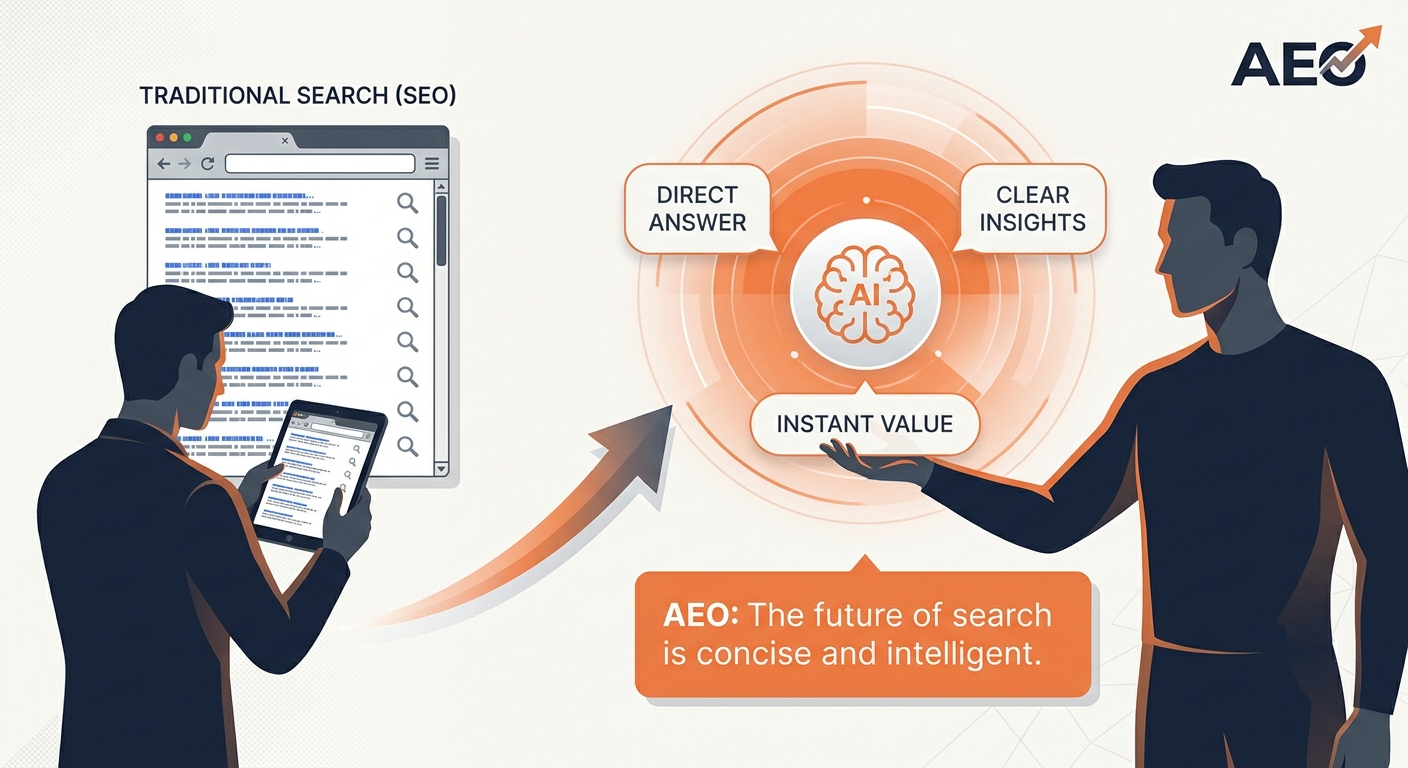
Let’s be honest: SEO has been on life support for a while. We spent twenty years obsessed with “blue links,” chasing clicks like they were the only currency that mattered. But the game has changed. We aren’t just shifting gears; we’re driving on an entirely different road.
Gartner projects search engine volume will drop by 25 percent by 2026. Why? Because people are tired of clicking through three different sites just to find one half-decent answer. They want the truth, they want it now, and they want it synthesized. Answer Engine Optimization (AEO) isn’t the death of SEO—it’s the long-overdue maturation of it. It’s time to stop fighting for a spot in a list and start becoming the source the AI actually trusts.
Why the “Blue Links” Are Fading
Search is shifting from ranking pages to synthesizing answers, and AI models pull from whichever sources they trust enough to cite. A brand’s job is no longer to win a click; it’s to become the source an AI is confident enough to name.
Remember the old days? You’d pick a keyword, stuff it into a headline, sprinkle in some backlinks, and pray to the algorithm gods. It was arbitrage. It was a game. But the modern user? They’re different. They don’t want to be a digital treasure hunter. They want the answer to their problem served on a silver platter.
This is the “Zero-Click” reality. When someone asks an AI a complex question, they don’t want a list of links. They want a summary. They want an answer. If your content is the bedrock of that AI’s response, you’ve won. If you’re just another generic listicle fighting for the tenth spot on page one? You’re already irrelevant. Traffic is a vanity metric; authority is the real prize.
How Does RAG (Retrieval-Augmented Generation) Change the Game?
RAG is the mechanism most AI answer engines use to ground a response in real sources instead of guessing from memory. Understanding how it retrieves, ranks, and cites content is the entire foundation of AEO, because you cannot influence a process you don’t understand.
If you want to survive, you need to understand the “Black Box.” It’s called Retrieval-Augmented Generation (RAG). Think of traditional search as a librarian pointing at a bookshelf. Think of RAG as a researcher who reads the books, takes notes, and writes a report just for you.
Here is what actually happens under the hood, and why it matters for how you write. A RAG system doesn’t read your whole page at once. It breaks content into chunks, converts each chunk into a numerical representation of its meaning (an embedding), and stores that alongside millions of other chunks from across the web. When a user asks a question, the system retrieves the chunks whose meaning most closely matches the question, not the chunks with the most matching words. That distinction is the whole game. A page can rank for a keyword and still be invisible to retrieval if the actual sentence-level meaning is buried under throat-clearing, or if the answer is split across three paragraphs instead of living in one self-contained block.
This is also why a single well-structured paragraph often outperforms an entire well-optimized page. Retrieval works at the chunk level, not the page level. If your best insight is trapped inside a 400-word paragraph with no clear boundary, the system has to guess where the useful part starts and ends, and it often guesses wrong or skips it entirely. Content that gives each idea its own clean, quotable unit gets retrieved more reliably than content that reads well as prose but poorly as data.
Retrieval and citation are also not the same event, and conflating them is where most brands misjudge their own AEO performance. Getting retrieved means your chunk made it into the small set of candidate passages the model considers before it writes an answer. Getting cited means the model chose your passage over the others in that set and named you as the source. A brand can be retrieved constantly and cited rarely if its content is technically relevant but weakly authoritative compared to what else got pulled into the same candidate pool. This is why two competitors can rank similarly on traditional SEO metrics while one dominates AI citations and the other is nearly invisible in them: both are getting retrieved, only one is winning the selection step that happens after retrieval.
There is also a consistency dimension RAG systems weigh that keyword-era SEO never had to account for. When a model retrieves several chunks that describe the same fact in compatible terms, that agreement functions as a confidence signal. When it retrieves chunks that contradict each other, even from your own site, the model has to hedge, soften the claim, or drop your source in favor of one that speaks with a single, consistent voice. Every outdated page, every abandoned microsite, every stale bio is a small vote against your own authority.
Position Digital’s deep-dive into AEO best practices hits the nail on the head: AI doesn’t care about your keyword density. It cares about entities and relationships. It’s not looking for the phrase “best shoes.” It’s looking for the brand that keeps showing up in expert reviews, durable gear roundups, and high-quality discussions. It’s looking for a signal, not a keyword.
graph LR
    A[User Input] --> B{AI Model}
    B --> C[RAG Mechanism: Retrieval]
    C --> D[(Content Source: Your Site)]
    D --> E[Synthesized Answer]
    E --> F[User]

    style D fill:#f9f,stroke:#333,stroke-width:2px
    style B fill:#bbf,stroke:#333,stroke-width:2px
Is AEO, SEO, and GEO the “Triple-Threat” Strategy You Need?
SEO, AEO, and GEO are not competing disciplines fighting for the same budget line. They solve three different retrieval problems: getting found, getting cited, and getting remembered as the default answer for a category.
Stop thinking you have to pick a lane. SEO, AEO, and Generative Engine Optimization (GEO) aren’t competitors; they’re parts of a machine. SEO grabs the long-tail intent. AEO grabs the direct-answer intent. GEO makes sure your brand is the entity that comes to mind when the AI is asked for a solution.
The three disciplines fail differently when neglected, which is the clearest way to see why you need all three. Weak SEO means your pages are never crawled or indexed in the first place, so there is nothing for a retrieval system to find. Weak AEO means your pages get indexed but never structured well enough to be lifted into an answer, so competitors get cited on the exact prompts your content should own. Weak GEO means individual pages might get cited once, but your brand never accumulates enough consistent, cross-referenced mentions to become the entity an AI reaches for by default, so every citation is a one-off instead of a compounding advantage.
As explored in Writer’s guide to the Triple-Threat Strategy, it’s all about alignment. You need an AI-Driven Content Strategy that treats every paragraph like a potential citation. Write with backbone. Use data. Structure your thoughts so a machine can pull them apart and rebuild them into a perfect answer.
How Do You Become the “Source of Truth” in an AI-First World?
Becoming a source AI models trust means giving them a reason to reduce their own risk of being wrong. Original data and a consistent entity footprint both do that; generic, derivative content does the opposite.
We’re living through a crisis of confidence. The internet is drowning in AI-generated fluff, and users are starting to smell the rot. This is your opening.
The Entity Depth Problem
Most brands treat their web presence like a scattered filing cabinet: a bio here, a product page there, a LinkedIn profile that hasn’t been touched since a rebrand two years ago. An AI model doesn’t experience your brand as one coherent thing unless you give it a reason to. It experiences fragments, and it has to decide whether those fragments describe the same entity or several different, weaker ones.
Entity depth is the fix. It means every mention of your brand, across your own site, your partner pages, your directory listings, and third-party coverage, describes the same facts in compatible language: the same category, the same core claims, the same name for the same thing. When a knowledge graph sees a hundred consistent signals instead of ten strong ones and ninety contradictory ones, it resolves your brand into a single, high-confidence node. That confidence is what gets cited. An AI model would rather cite an entity it is sure about than one it is still trying to disambiguate.
Picture two brands selling the same category of software. Brand A’s homepage calls it a “platform,” its About page calls it a “suite,” its G2 listing calls it a “tool,” and a two-year-old press release calls it something else entirely. Brand B describes itself the same way everywhere, in the same three or four sentences a reader would find on the homepage, the About page, the G2 listing, and every guest byline its team publishes. A model doing entity resolution has to do real work to decide whether Brand A’s four descriptions are one entity or several loosely related ones. Brand B never asks the model to do that work. When both brands are retrieved for the same prompt, the entity the model can resolve without friction is the one it names.
That is the practical reason entity depth compounds while keyword rankings don’t. A ranking resets every time an algorithm updates. A consistent entity, once established, keeps paying off on every new prompt an AI engine tries to answer about your category, because the model already knows who you are.
Entity Mapping
The Knowledge Graph is the AI’s map of the world. You need to be on that map. This goes beyond meta tags. It’s about building a consistent footprint across the web. When you utilize Programmatic SEO services, you aren’t just scaling pages—you’re building a pattern of authority that tells the AI, “Yes, this brand is the expert.”
Comparison Table: SEO vs. AEO
| Feature | SEO (Traditional) | AEO (Answer Engine) |
|---|---|---|
| Primary Goal | Ranking & Click-throughs | Authority & Citations |
| Success Metric | Traffic & Keyword Position | Brand Mentions & AI Grounding |
| Content Focus | Keyword Density/Search Volume | Utility/Direct Answers |
| Outcome | User visits your site | AI provides answer (with source) |
The Future: Semantic Authority
By 2026, ranking for keywords stops mattering nearly as much as being recognized as a stable, trustworthy entity across every surface an AI model draws from. That recognition compounds; keyword rankings don’t.
Keyword stuffing is dead. It’s not coming back. By 2026, search will be personal, multimodal, and incredibly fast. It’ll know who you are and how you like your information served.
The winners won’t be the ones hoarding traffic; they’ll be the ones who provide the bedrock of knowledge. Stop fighting the AI. Start being the information it trusts enough to share. If you aren’t the source, you’re the background noise.
Understanding why this shift is happening is one thing. Acting on it is another. Once the concepts here make sense, the step-by-step AEO implementation sequence walks through exactly how to structure, schema-mark, and publish content that puts these ideas into practice.
Frequently Asked Questions
Is AEO replacing SEO, or are they just evolving together?
AEO is the next stage of SEO. Traditional SEO was about getting a link in front of someone; AEO is about being the answer they’re looking for. They’re two sides of the same coin.
Why is technical SEO more important than ever for AEO?
Technical SEO is the plumbing. If your site structure is a mess, the AI can’t crawl it, parse it, or understand it. If it can’t understand you, it can’t cite you.
Related Articles
-
 cybersecurity content audit
 How to Audit Cybersecurity Content for Accuracy and Originality
Cybersecurity content with incorrect facts destroys confidence fast. Here's a practical audit framework for correctness and originality that preserves the credibility of your security publications.
-

10 Examples of SaaS Companies with Exceptional Marketing
Explore 10 SaaS marketing examples with actionable tactics. Learn innovative strategies from top companies to elevate your own campaigns.
-

How to Find the Right B2B Prospects for Your SaaS Product
Stop wasting sales outreach on leads that're not a good fit. Learn ways to find, check, and work with the right B2B prospects for your SaaS product.
-
 online reputation management
 The Importance of SEO in Online Reputation Management
Discover how SEO influences your digital brand. Learn actionable strategies to suppress negative search results and build a positive online reputation today.