What an AEO/GEO Marketing Manager Actually Does: The First 90 Days


Introduction
You have hired an AEO/GEO marketing manager, or you have just become one. Now what? The role is new enough that there is no standard onboarding, which means the first 90 days can drift. This plan fixes that. It lays out exactly what to do in each month, what to deliver, and which numbers to baseline on day one, so the role produces a measurable result by the end of the quarter.
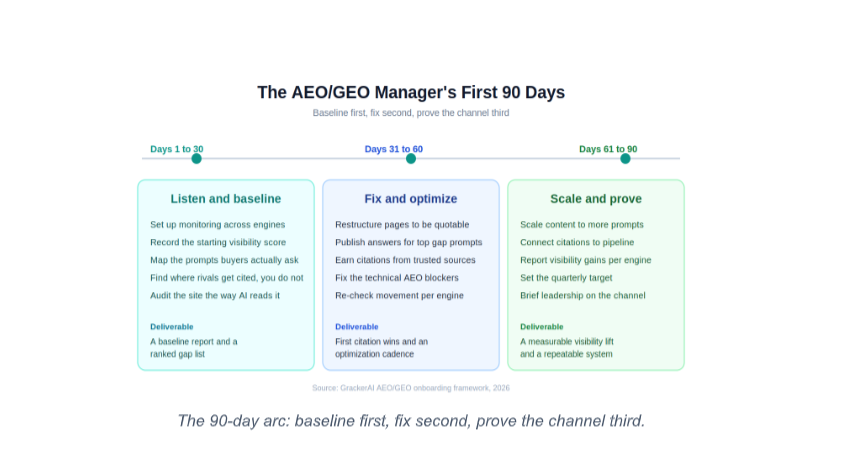
The logic is simple. You cannot improve what you have not measured, so month one is about baselining. Month two is about fixing the highest value gaps. Month three is about scaling what works and proving the channel to leadership.
TL;DR
• Days 1 to 30: set up monitoring, record a baseline visibility score, map buyer prompts, and build a ranked gap list.
• Days 31 to 60: restructure and publish content for the top gaps, fix technical AEO, and earn the first citations.
• Days 61 to 90: scale content, connect citations to pipeline, and report a measurable visibility lift per engine.
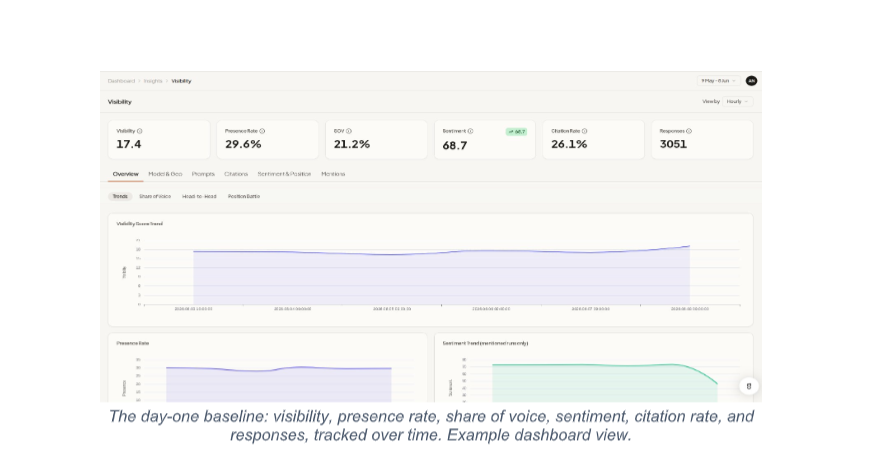
• Baseline six numbers on day one: visibility, presence rate, share of voice, sentiment, citation rate, and responses.
• A platform like GrackerAI compresses the ramp, since monitoring and content are ready on day one instead of week four.
Why the first 90 days matter
AI visibility is a compounding channel. The pages you publish and the citations you earn in month one keep paying off in month six. That makes an early, disciplined start unusually valuable. It also means the new manager needs a baseline fast, because every week without one is a week where you cannot prove progress later. The goal of the quarter is not perfection. It is a measurable lift and a system the team can repeat. For teams building that foundation, understanding how to get cited by ChatGPT and Gemini can help accelerate visibility gains and establish a repeatable AI search strategy from the start
Days 1 to 30: listen and baseline
Resist the urge to publish in week one. The job this month is to see clearly. Set up monitoring across every engine your buyers use, then record where you stand.
1. Connect monitoring across ChatGPT, Perplexity, Claude, Gemini, Copilot, and AI Overviews.
2. Record the baseline visibility score and the supporting metrics, so you have a before picture.
3. Map the prompts your buyers actually ask, including category, comparison, compliance, and CVE questions.
4. Identify the prompts where competitors are cited and you are not.
5. Audit the site the way AI reads it, and note the technical blockers.
Deliverable: a baseline report and a ranked gap list. The screenshot below shows the kind of baseline you are capturing, six headline numbers in one view.
Days 31 to 60: fix and optimize
Now you act on the gap list. This is the month where the score should start to move, even if only a little.
6. Restructure your most important pages so AI engines can extract and quote them.
7. Publish clear, self contained answers for the highest value gap prompts.
8. Work on earning citations from the sources AI trusts in your category.
9. Fix the technical AEO blockers you found in month one.
10. Re-check movement per engine, since a fix that works on Perplexity may not move ChatGPT.
Deliverable: Your first citation wins and a repeatable optimization cadence. Expect uneven results across engines. That is normal and exactly why you track each one separately.
Days 61 to 90: scale and prove
With a cadence that works, you scale it and connect the work to revenue. This is the month that justifies the role.
11. Scale content production to cover more of the prompt list.
12. Connect citations and AI-referred traffic to pipeline.
13. Report visibility gains per engine against your day one baseline.
14. Set a quarterly target for the next 90 days.
15. Brief leadership on the channel, in their language: pipeline, not just rankings.
Deliverable: a measurable visibility lift and a system the team can run every quarter.
The 30-60-90 plan at a glance
Phase | Focus | Deliverable |
|---|---|---|
Days 1–30 | Listen and baseline: monitoring, score, prompts, gaps | Baseline report and ranked gap list |
Days 31–60 | Fix and optimize: content, citations, technical AEO | First citation wins and a content cadence |
Days 61–90 | Scale and prove: scale content, connect to pipeline | Measurable lift and a repeatable system |
The six metrics to baseline on day one
These are the numbers a new manager should screenshot on their first day, so progress is provable later. They map directly to what a platform like GrackerAI tracks.
Metric | What It Tells You |
|---|---|
Visibility Score | Your overall presence inside AI answers — the single number to improve over time. |
Presence Rate | How often your brand appears when a relevant prompt is asked. |
Share of Voice | Your share of the conversation compared to named competitors. |
Sentiment | How positively or negatively AI describes your brand. |
Citation Rate | How often AI answers cite your content as a source. |
Responses | The volume of AI answers analyzed, representing your sample size. |
How GrackerAI compresses the ramp
The plan above assumes you can monitor and act quickly. The slowest part of month one is usually building the prompt list and wiring up monitoring. GrackerAI removes that delay for cybersecurity teams: more than 30,000 security prompts and full monitoring across engines are live in under three minutes, and critical CVEs are tracked automatically. That turns weeks of setup into an afternoon, so the new manager spends month one analyzing instead of assembling. Teams on the platform report a 25 percent average AI visibility increase within 90 days, which is the exact window this plan covers. Organizations looking to benchmark and improve performance can start by understanding their AI visibility score and the factors that influence it.
Start your own baseline now. Run a free AI visibility score and you have day one of the plan done before lunch.
Frequently asked questions## Leading the Function, Not Just Running It
A 90-day plan covers the metrics and deliverables; it doesn't cover the people side of the job once the team grows past one person. For that, the fundamentals in team lead responsibilities -- delegation, coordination, conflict resolution -- apply directly once an AEO/GEO manager is running more than a solo function.
What should an AEO/GEO manager do in the first 30 days?
Set up monitoring across every AI engine, record a baseline visibility score, map the prompts buyers ask, and build a ranked list of gaps where competitors win. Do not rush to publish before you can measure.
How soon should AI visibility improve?
Expect small, uneven movement by days 31 to 60 as your first optimized content and citations land, and a clearer, measurable lift by day 90. It compounds from there, so early work keeps paying off.
What does a good 90-day result look like?
A measurable increase in visibility and share of voice against your baseline, first citation wins across multiple engines, and a repeatable system. Teams using a dedicated platform report around a 25 percent average lift in this window.
Do I need a special tool to do this?
You can start manually, but it is slow. A purpose built platform handles monitoring, prompt research, and content, which is what makes the 90-day plan realistic for one person rather than a team.
Conclusion
The first 90 days of an AEO/GEO marketing manager should follow one arc: baseline, fix, prove. Measure honestly in month one, attack the highest value gaps in month two, and connect the work to pipeline in month three. Do that and you end the quarter with a number that went up and a system you can run again.
Ready to start day one? Get your free AI visibility score and capture your baseline in about a minute.
![10 Best Local Rank Tracker Tools: In-Depth Comparison Guide [2025]](https://cdn.pseo.one/6abcb68a626591c40e1c8aa6/687e1c1ef6fe799d288518df/68809c373eb8562bcf68975d/10-best-local-rank-tracker-tools-comparison-guide/feature-image.jpg)