The 2026 Playbook: Proven SEO Growth Hacks for Early-Stage Startups

David Brown · Head of B2B Marketing at SSOJet
· Updated September 21, 2026
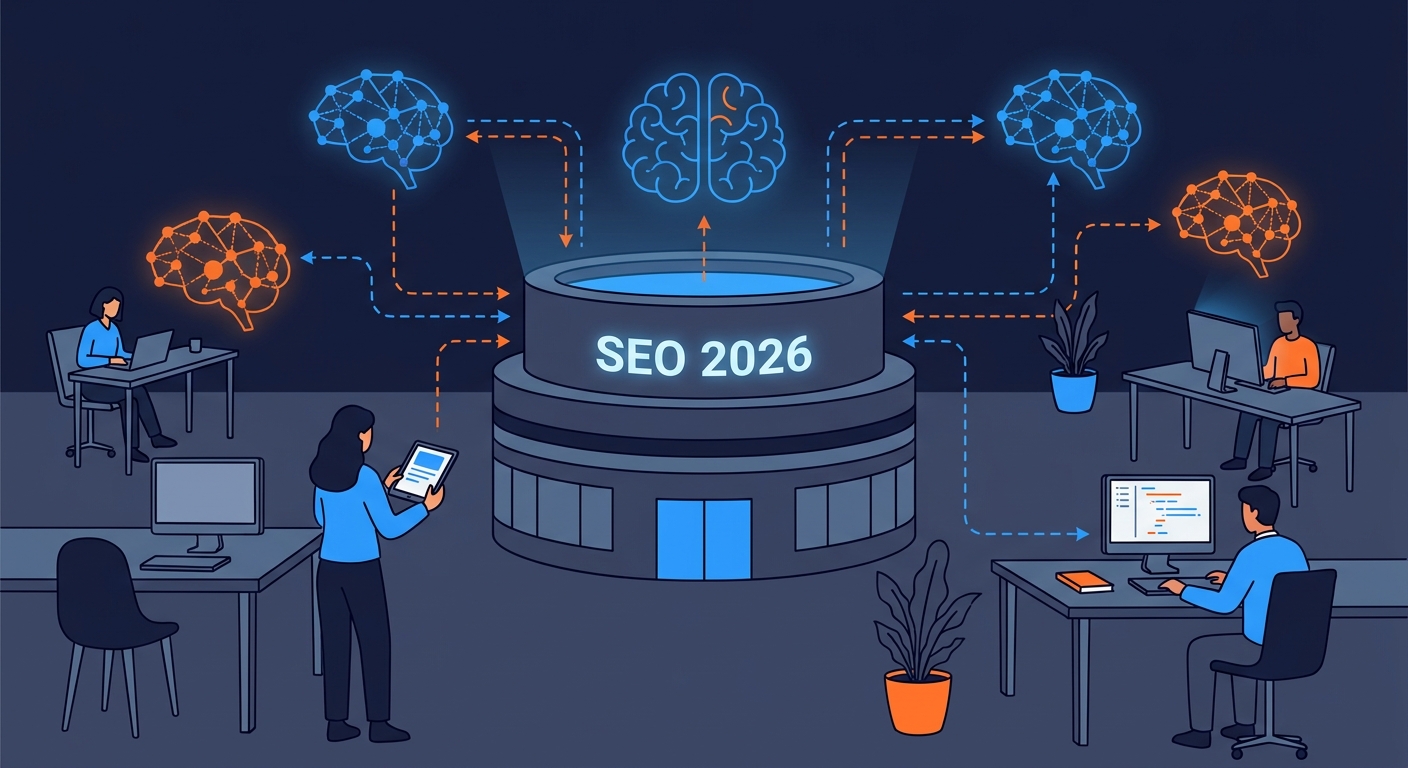
The “ten blue links” era? It’s history. In 2026, the real fight for visibility isn’t about keywords—it’s about becoming the primary source of truth for the AI engines running the show.
Early-stage startups aren’t fighting for clicks anymore. They’re fighting for Share of Voice — the percentage of AI answers in their category that name them instead of a competitor. If ChatGPT, Perplexity, or Gemini doesn’t cite you, you’re basically a ghost. This isn’t about gaming an algorithm; it’s about making your startup the indispensable expert. When an AI synthesizes an answer for a potential customer, your brand needs to be the one providing the evidence.
Is “Ranking” Still the Goal?
For years, we were obsessed with the top spot. We tracked rankings, obsessed over CTR, and built backlink profiles that looked like spiderwebs. Today? Those metrics are second-tier.
The “Answer Engine” paradigm has flipped the script. When a user asks an AI, “What is the best project management software for agencies?” they aren’t looking for a list of links. They want a definitive, synthesized answer.
For a scrappy startup, this is a massive advantage. While the big incumbents are bloated, dragging around years of keyword-stuffed, outdated legacy content, you can move fast. You can pivot. By becoming the authoritative source that AI models actually reference, you don’t just compete with the incumbents—you leapfrog them.
The New Hierarchy: Generative Engine Optimization (GEO)
Traditional SEO is still your bedrock—your site needs to be fast, indexable, and clean. If you haven’t nailed that yet, our long-term SEO growth strategy guide covers those fundamentals in depth; this playbook picks up from there. But think of GEO as the skyscraper you build on top of that foundation. SEO gets the user to your site; GEO gets your knowledge into the AI’s brain.
As noted in the Search Engine Land 2026 Strategy Guide, the brands that win now prioritize discipline over hacks. If your site is a mess of thin content and broken links, the AI crawler isn’t going to stick around. It’ll move on, effectively blacklisting you from its synthesis process.
This isn’t abstract for cybersecurity and B2B SaaS specifically — it’s the category GrackerAI’s own platform was built to measure. When a security buyer asks ChatGPT or Perplexity “what’s the best XDR platform for a mid-market team” or a B2B SaaS buyer asks Google’s AI Mode to compare vendors, the answer engine cites two or three sources, not ten blue links. GEO is how you become one of them.
How Do AI Engines Decide Who to Cite?
Think of AI as a high-end research assistant. They don’t care about your keyword density. They care about trust signals. Princeton University researchers tested this directly: in a large benchmark evaluation, engineering content around citations, statistics, and quotations improved a page’s visibility in generative engine responses by up to 40% (Aggarwal et al., arXiv:2311.09735, presented at KDD 2024, retrieved 2026-09-21).
When an AI builds a response, it’s calculating probabilities. It’s asking, “Is this source accurate?” If you have original data, clearly formatted snippets, and quotes from real people, your “trust score” skyrockets.
The Crawl-to-Synthesis Process
The diagram below shows how your content travels from a static page to an authoritative citation.
graph TD
    A[User Prompt] --> B{AI Engine}
    B --> C[Query Index/Knowledge Base]
    C --> D{Evaluate Trust Signals}
    D -->|Check| E[Primary Data/Stats]
    D -->|Check| F[Expert Citations]
    D -->|Check| G[Page Performance/Structure]
    E & F & G --> H[Synthesize Response]
    H --> I[Final Answer with Citations]
    style B fill:#f9f9f9,stroke:#333,stroke-width:2px
    style I fill:#e1f5fe,stroke:#01579b,stroke-width:2px
Your job is to feed the beast the right inputs (E, F, and G) so it has no choice but to cite you.
Are You Building a “Citation-Worthy” Strategy?
If your strategy is still “write 1,000 words on a keyword to rank,” stop. You’re burning cash. Modern content has to be “fact-first.” Use this 5-Point GEO Checklist:
- Originality: Every piece of content needs one original data point, chart, or insight that doesn’t exist elsewhere.
- Clarity: Use HTML tables or clear definitions. Make it easy for the AI to parse without having to “read” the whole page.
- Expertise: Author bios must link to real credentials. If an LLM can verify your author via a LinkedIn or public profile, your odds of citation shoot up.
- Speed: Performance is a proxy for quality. If your site loads in under a second, you’re a serious, well-maintained entity.
- Citations: Don’t be afraid to link out. Linking to high-authority research signals to the AI that your content is part of a verified, legitimate ecosystem.
Can Programmatic SEO Still Scale Growth?
Programmatic SEO (pSEO) has a bad name because of the “brute force” era—thousands of junk pages meant to capture long-tail traffic. In 2026? That’s a death sentence. AI engines are experts at sniffing out template-driven slop.
But pSEO isn’t dead. It’s just evolved into “curated scaling.” GrackerAI’s own AI-optimized content and programmatic portal tooling follows this model for cybersecurity and B2B SaaS clients — data-driven templates built around a company’s own proprietary data (CVE feeds, for example) rather than generic keyword-stuffed wrappers. The key is factual depth. If your pages provide unique, valuable data, the AI will trust them. If they’re just keyword-stuffed wrappers, they’ll be ignored.
Where Does SaaS SEO Fit?
For SaaS, you need to map your content to the “Solution-Aware” phase of the buyer’s journey. Your product pages, case studies, and comparison pages need to be contextually mapped to the queries users ask AI. When someone asks, “How do I automate my lead generation?” your content should provide the how (the strategy) while naturally positioning your product as the who (the answer).
Check Perplexity’s own crawler documentation (retrieved 2026-09-21) to confirm PerplexityBot isn’t blocked before you optimize anything else — a stray robots.txt rule silently zeroing out your GEO work is one of the most common, and most avoidable, failure modes. Once your site is crawlable, GrackerAI’s AEO and GEO platform — built specifically for cybersecurity and B2B SaaS companies — maps your technical documentation and solution pages against the actual prompts buyers run through ChatGPT, Perplexity, and Google’s AI Mode, so you’re optimizing for what they’re actually asking, not what you assume they’re asking.
The “Data-First” Hack: Research on a Budget
You don’t need a massive budget to create proprietary data. Your internal customer data is your most undervalued asset.
Try the “Survey Hack.” Ask your user base five questions about a common pain point. Even if you only get 100 responses, that’s “Original Data.” Publish a report on those findings. Suddenly, you’re the primary source. Other sites will link to you, and AI engines will cite your report as the authority. It creates a “Flywheel of Authority”: you produce data, you earn backlinks, the AI cites you, and your brand trust grows. It’s that simple.
Measuring Success: Forget CTR, Track Share of Voice
If your KPIs are still stuck on organic traffic and CTR, you’re blind to the biggest shift in the industry. Share of Voice (SOV) — the percentage of relevant AI answers that mention your brand versus your tracked competitors — is your new North Star metric.
This isn’t a hunch; it’s the headline metric in GrackerAI’s own 12-KPI framework for AI search performance, and it exists because Pew Research Center found that users who see a Google AI Overview click through to a source only 8% of the time, versus 15% for a standard result with no summary (retrieved 2026-09-21). The click is disappearing. Stop tracking search volume alone and start tracking citation frequency, prompt coverage, and per-engine visibility alongside it — a single blended score hides exactly the gap you need to fix, especially since a brand can rank well in ChatGPT and be invisible in Perplexity or Google’s AI Overviews. When you become the answer AI engines default to, traffic becomes a byproduct of that authority rather than the goal itself.
How This Guide Was Sourced
Written by GrackerAI’s content team (gracker.ai) — an AEO and GEO platform built for cybersecurity and B2B SaaS companies, tracking brand citations across ChatGPT, Perplexity, and Google’s AI Mode on the Starter plan; adding Microsoft Copilot on Scale; and adding Google AI Overviews, Gemini, DeepSeek, Grok, Claude, and Brave Leo on Enterprise. Every external claim above carries its own citation and retrieval date. No GrackerAI telemetry is used in this guide — every figure is external and linked. AI search behavior changes fast; if a cited page or engine capability has moved on since 2026-09-21, treat the underlying mechanism as more durable than the exact number.
For the traditional-SEO groundwork this playbook builds on, see our long-term SEO growth strategy guide. For a walkthrough of how GrackerAI’s own tools apply these ideas day to day, see Effective SEO Strategies with Gracker. If you’re comparing GEO tools on an early-stage budget, see the best GEO tools for early-stage startups.
Frequently Asked Questions
Is traditional SEO dead in 2026?
No, it’s not dead—it’s been subsumed. Traditional SEO is now just the foundation. If your site isn’t fast and indexable, the AI won’t trust it enough to cite it. You still have to do the heavy lifting to get in the race.
How do I measure success if my traffic isn’t coming from clicks?
You measure through Share of Voice — how often your brand is cited in AI responses relative to competitors, tracked per engine. If you’re the source for industry insights, you’re winning, even if the user never clicks through to your site.
What is the fastest way to get cited by ChatGPT or Perplexity?
Publish original, verifiable data. AI engines love sources that provide unique, factual information. Charts, primary survey data, and expert commentary make your content “citation-ready” by design.
Should startups still use Programmatic SEO?
Yes, but only for value. Never bulk-generate low-quality pages. Use programmatic methods to scale data-rich landing pages that solve specific problems. If the content is deep and factual, the AI will reward it.
How can a small startup compete with large incumbents for AI visibility?
Startups have the agility advantage. Incumbents are trapped by legacy SEO strategies and massive, slow-moving content libraries. A startup can pivot to a “data-first” strategy, creating original research that incumbents are too disorganized to produce. By focusing on quality and authority, you can win the battle for AI citations.
Related Articles
-
 cybersecurity content audit
 How to Audit Cybersecurity Content for Accuracy and Originality
Cybersecurity content with incorrect facts destroys confidence fast. Here's a practical audit framework for correctness and originality that preserves the credibility of your security publications.
-

10 Examples of SaaS Companies with Exceptional Marketing
Explore 10 SaaS marketing examples with actionable tactics. Learn innovative strategies from top companies to elevate your own campaigns.
-

How to Find the Right B2B Prospects for Your SaaS Product
Stop wasting sales outreach on leads that're not a good fit. Learn ways to find, check, and work with the right B2B prospects for your SaaS product.
-
 online reputation management
 The Importance of SEO in Online Reputation Management
Discover how SEO influences your digital brand. Learn actionable strategies to suppress negative search results and build a positive online reputation today.