Effective Market Research with ChatGPT: 28 Proven Prompts


TL;DR
- This article provides a technical guide on using ChatGPT for market research, detailing a structured workflow to enhance efficiency and accuracy. It covers how to leverage AI for desk research synthesis, drafting instruments, and analyzing qualitative data, while offering strategies to avoid common pitfalls like hallucinations and unreliable quantification. Practical prompts for competitor analysis, market trends, and product development are also included.
Leveraging ChatGPT for Market Research: A Technical Guide
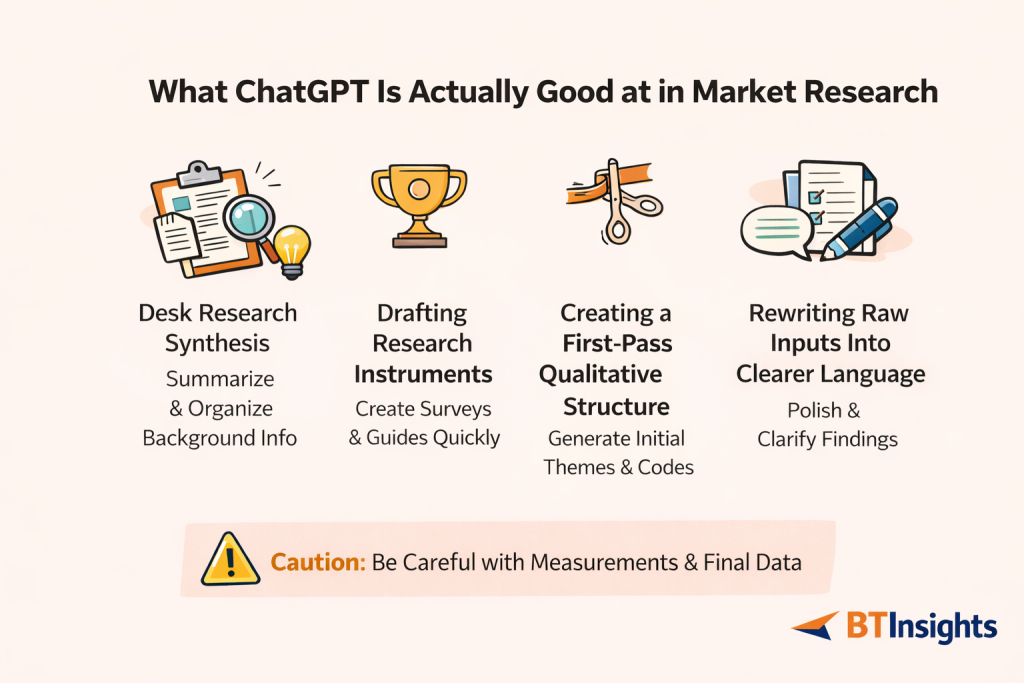
ChatGPT can significantly enhance market research efficiency, particularly for text-heavy tasks requiring quick transitions from raw data to actionable insights. However, be aware of potential issues such as hallucinations, weak traceability, and unreliable quantification. The key is to use it within a structured, auditable process.
- ChatGPT is effective for desk research synthesis and structuring background information.
- It can assist in drafting research instruments, such as screener questions and discussion guides.
- ChatGPT can create a first-pass qualitative structure for open-ended responses.
- It helps in rewriting raw inputs into clearer language suitable for stakeholder reports.
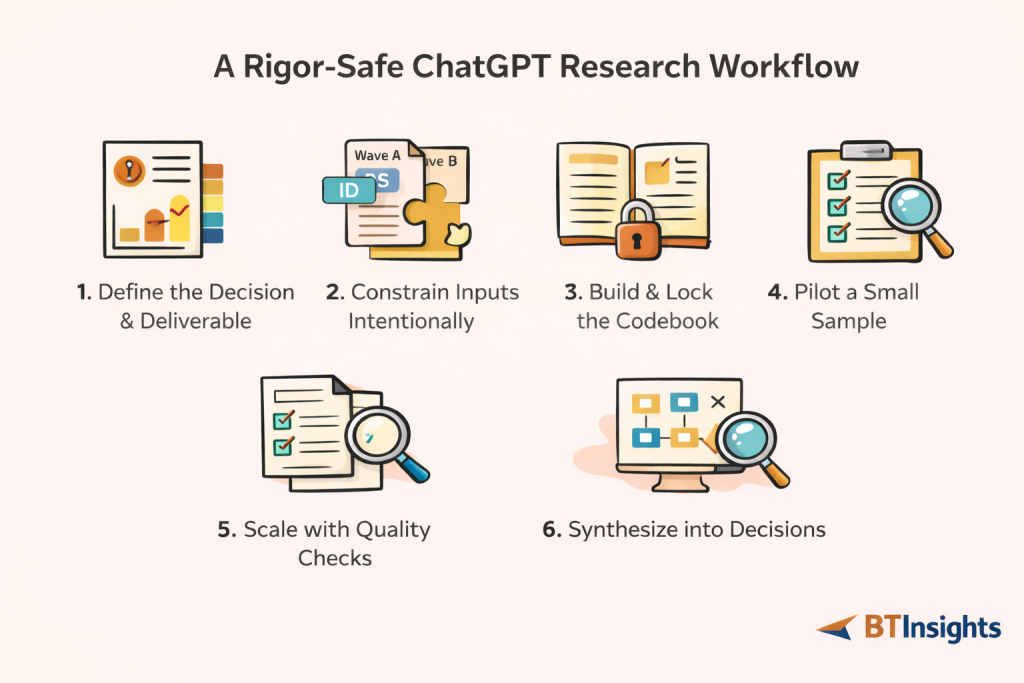
Workflow for Maintaining Research Rigor with ChatGPT
To ensure decision-ready outputs, follow a workflow that minimizes errors like fabrication, inconsistent interpretation, and untraceable conclusions.
- Define the Decision and Deliverable: Clarify the decision the research will inform and the required deliverables (themes, quantifications, narratives).
- Constrain Inputs Intentionally: Limit the scope of analysis to single questions, segments, or topics, preserving metadata for auditability. Process large datasets in batches. If your dataset is large, process it in batches and keep batch identifiers consistent. The goal is not to “fit everything in.” The goal is to keep the analysis auditable.
- Build and Lock a Codebook: Develop a codebook with theme names, definitions, and boundaries to maintain consistency. A useful codebook includes a theme name, a clear definition, and boundaries. Boundaries matter because they prevent theme drift.
- Run a Pilot on a Small Sample: Test the codebook on a small sample to identify overlaps or inconsistencies. Refine the codebook based on observations, not assumptions.
- Scale with QA: Check the model's output, focusing on edge cases like sarcasm and mixed sentiment. Keep a record of codebook changes to ensure trend comparisons remain meaningful.
- Synthesize with Evidence: Tie findings to supporting evidence, such as quotes and segment identifiers. Treat the model as a drafting assistant, not the source of truth.
Common Pitfalls of Using General AI Chatbots in Market Research
Understanding the limitations of AI chatbots is crucial for effective use.
- Hallucination Increases with Input Size: Subtle inventions can occur, such as themes not actually present or exaggerated prevalence. The practical fix is to reduce ambiguity. Constrain the scope, process in batches, and require evidence. Ask the model to provide claims only when it can provide supporting quotes and identifiers. If it cannot, it should say so.
- Insights Lack Traceability: General chatbots don't inherently provide audit trails, making it difficult to defend findings. The fix is to build traceability into the workflow. Keep respondent IDs. Require quote excerpts. Keep an “insight to evidence” table as you work. Use the model to help draft summaries, but not to replace the evidence chain.
- Quantifying Themes is Unreliable: Chatbots can miscount or produce inconsistent numbers, undermining trust in reporting outputs. The fix is to treat the model as a text assistant, not as your counting engine. Use it to propose codes and to label responses, then quantify using auditable methods. If your deliverable requires numbers, you should be able to reconcile them, repeat them, and explain how they were derived.
When to Consider Purpose-Built Tools
While ChatGPT is useful for small-sample, exploratory work, purpose-built tools offer advantages for reliability, traceability, and repeatable deliverables at scale.
For structured qualitative analysis, tools like BTInsights help surface themes from interviews and focus groups, facilitating easy quote extraction. For open-ended survey responses, BTInsights’ survey coding solution supports theme coding and sentiment analysis, designed for review and editing.
For consistent reporting outputs, tools like PerfectSlide automate the creation of survey cross-tab tables and PowerPoint slides.
Validation Checklist for AI-Assisted Research
Ensure explicit validation steps to maintain research integrity.
- Define what "done" means for your analysis.
- Run a pilot before scaling.
- Review a subset from every batch, focusing on edge cases.
- Require evidence for every insight.
- Keep a clear record of codebook revisions.
- Reconcile quantitative outputs using auditable methods.
Key Components of a Decision-Ready Research Report
A strong report prioritizes key insights and demonstrates the research process.
- Include an executive summary highlighting insights that drive decisions.
- Present themes in a ranked order, clarifying prevalence, drivers, and affected segments.
- Support claims with relevant verbatims.
- Offer recommendations based on findings and suggest further testing.
- Provide the codebook and QA approach for transparency and future reference.
Using ChatGPT Prompts for Market Research
ChatGPT can be a game-changer for conducting in-depth market research, streamlining data collection, uncovering customer insights, and boosting productivity.
Competitor Analysis Prompts
Use these prompts to understand competitor positioning and identify market gaps.
- Identifying Competitor Strengths:
Prompt: "Analyze the website, product descriptions, and customer reviews of [Competitor X]. Identify their key strengths in terms of product offering, messaging, and brand positioning. Summarize the top three differentiators they emphasize in their marketing." More details !Competitor Strengths Image courtesy of Juma (Team-GPT) 2. Identifying Competitor Weaknesses:
Prompt: "Analyze negative customer reviews and online discussions about [Competitor X]. Identify recurring complaints, unmet expectations, and weak points in their product or service. What are the top three areas where they underperform?" Example prompt !Competitor Weaknesses Image courtesy of Juma (Team-GPT) 3. Analyzing Competitor Messaging & Positioning:
Prompt: "Analyze the homepage, about page, and key product pages of [Competitor X]. What are the recurring words, phrases, and themes they use to position themselves? Identify their brand tone (e.g., formal, conversational, innovative) and core messaging pillars." See visual !Competitor Messaging Image courtesy of Juma (Team-GPT) 4. Extracting Competitor Growth Strategies:
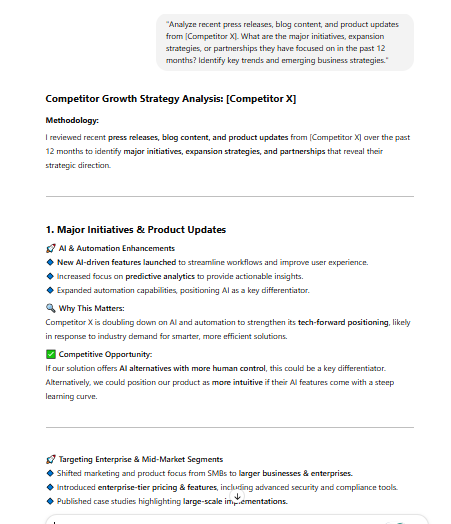
Prompt: "Analyze recent press releases, blog content, and product updates from [Competitor X]. What are the major initiatives, expansion strategies, or partnerships they have focused on in the past 12 months? Identify key trends and emerging business strategies." View example !Competitor Growth Image courtesy of Juma (Team-GPT)
Market Trend Identification Prompts
Stay ahead of consumer preferences and industry disruptions by identifying market trends.
- Consumer Sentiment Trend Analysis:
Prompt: "Analyze recent social media discussions, customer reviews, and online forums related to [product/service]. Identify shifts in consumer sentiment, emerging preferences, and potential dissatisfaction trends. Summarize the top insights and how they have evolved over the past 6 months." Sentiment Example !Consumer Sentiment Image courtesy of Juma (Team-GPT) 2. Competitive Trend Forecasting:
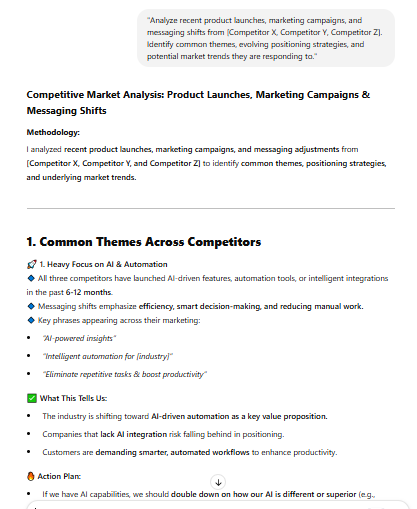
Prompt: "Analyze recent product launches, marketing campaigns, and messaging shifts from [Competitor X, Competitor Y, Competitor Z]. Identify common themes, evolving positioning strategies, and potential market trends they are responding to." Trend forecasting !Competitive Trends Image courtesy of Juma (Team-GPT) 3. Industry Development & Regulatory Changes:
Prompt: "Analyze recent news articles, government policies, and industry whitepapers related to [industry name]. Identify major regulatory changes, shifts in market demand, and key industry developments in the past 12 months. How are these changes affecting businesses in this sector, and what future trends can be anticipated?" Industry Changes !Regulatory Changes Image courtesy of Juma (Team-GPT) 4. Emerging Technological Advancements & Disruptions:
Prompt: "Analyze recent patents, research papers, startup funding rounds, and product launches in the [industry name] space. Identify breakthrough technological advancements and potential disruptions. How are these innovations likely to impact existing market leaders and reshape industry competition?" Tech advancements !Technological Advancements Image courtesy of Juma (Team-GPT)
Product Development Research Prompts
Use ChatGPT insights to validate ideas, identify pain points, and align with customer needs throughout the product development lifecycle.
- Identifying Product Improvement Opportunities:
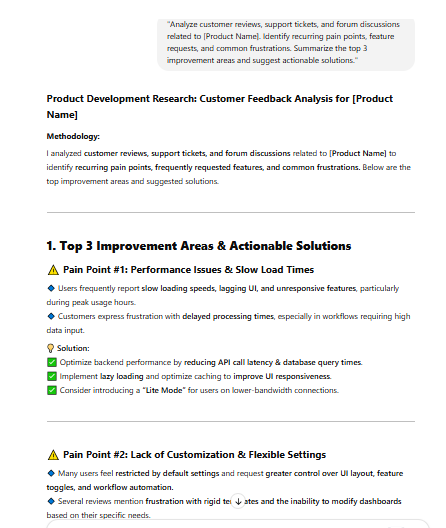
Prompt: "Analyze customer reviews, support tickets, and forum discussions related to [Product Name]. Identify recurring pain points, feature requests, and common frustrations. Summarize the top 3 improvement areas and suggest actionable solutions." More details !Product Improvement Image courtesy of Juma (Team-GPT) 2. Prioritizing New Features Based on Demand:
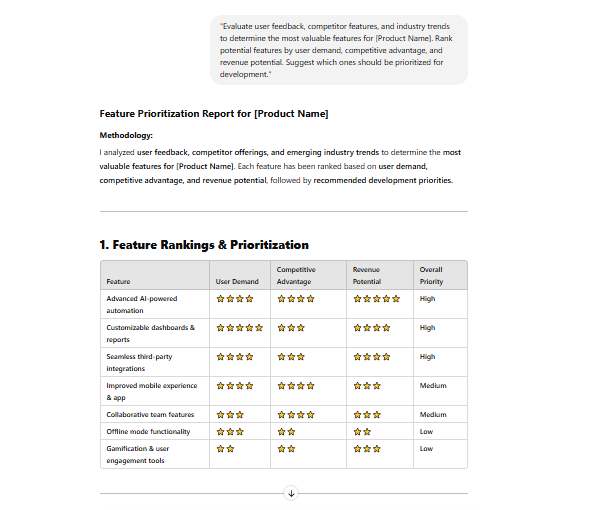
Prompt: "Evaluate user feedback, competitor features, and industry trends to determine the most valuable features for [Product Name]. Rank potential features by user demand, competitive advantage, and revenue potential. Suggest which ones should be prioritized for development." Feature Prioritization !Feature Demand Image courtesy of Juma (Team-GPT) 3. Assessing Product-Market Fit & User Adoption Barriers:
Prompt: "Analyze user feedback, early adoption data, and competitor positioning to determine whether [Product Name] has achieved product-market fit. Identify key adoption barriers and suggest strategies to improve user engagement and retention." Adoption Barriers
- Generating Product Launch Messaging Based on User Needs:
Prompt: "Based on user pain points, desired benefits, and competitor messaging, craft compelling launch messaging for [Product Name]. Develop a value proposition, tagline, and key message points that will resonate with the target audience." User Needs
Deep Research Feature of ChatGPT for Market Analysis
OpenAI's Deep Research is a ChatGPT feature that acts as an autonomous research assistant, launched in 2025.
Instead of a regular ChatGPT chat, Deep Research performs multi-step research on the internet for complex tasks, gathering, interpreting, and synthesizing information from numerous web sources into one report. According to OpenAI, this feature can accomplish in minutes what would take a human analyst many hours.
Deep Research uses a specialized version of the new GPT-4.o3 model optimized for browsing, data analysis, and reasoning. Deep Research !ChatGPT’s Deep Research Image courtesy of ChatGPT
Each Deep Research output is fully documented with citations and a summary of its reasoning, making it easy to verify information. In practice, the tool can find niche or non-intuitive data (e.g., from PDFs, images, or specialized sites) that would take a human much longer to gather.
How to Use Deep Research
- Select the “Deep Research” mode in the ChatGPT interface.
- Enter a clear, focused query about your market analysis needs.
- Attach relevant files (like spreadsheets, market reports, or PDFs) to give the AI extra context.
- Let it run for 5–30 minutes.
- Review the structured report in chat form, complete with source links and a summary of findings.
Tips for Effective Use
- Set a clear goal: Phrase a specific research request.
- Provide context or data: Attach any relevant data files or reports.
- Let it run: Start the Deep Research query and wait.
- Review and verify: Check the provided source links to fact-check critical data.
Practical Use Cases
- Identifying Customer Demographics and Segments: Deep Research can quickly compile target audience information, identifying characteristics such as age, income, and location.
- Building Buyer Personas: The tool can draft detailed buyer personas, including lifestyle, income, and preferences.
- Competitive Analysis: Deep Research can review competitors’ websites, news mentions, products, and content to outline their strategies.
- Market Trend Analysis: The feature can ingest recent industry reports, news articles, and social media discussions to summarize emerging trends and shifts in consumer behavior.
AI Tools for Investment Finance
AI tools are now available within ChatGPT for investment workflows, including:
- Create an image: Visualize concepts, strategies, or charts for presentations or reports.
- Search the web: Access real-time financial news, macroeconomic data, or company updates.
- Write or code: Generate Python, SQL, or Markdown for data analysis and reporting.
- Run deep research: Combine reasoning, summarization, and citations to synthesize in-depth insights.
Choosing the Right GPT Model for Finance
- Analyzing a Stock: Use GPT-4 Turbo for extracting financial ratios, evaluating price performance, and drafting investment theses.
- Sentiment Analysis: Use GPT-4 Turbo or GPT-4 for interpreting tone from forums and social comments.
- Portfolio Screening: Use GPT-3.5 for screening stocks based on criteria like P/E ratio and ROE.
Prompting Techniques
- “Act as an equity analyst with 10 years’ experience.”
- “List the top 5 ETFs by 5-year annualized return.”
- “Summarize a 10-K in 3 bullet points.”
- “Compare valuations using DCF assumptions.”
- “Report format: • Summary • Metrics • Recommendation.”
GrackerAI: Automating Cybersecurity Marketing with AI
GrackerAI automates your cybersecurity marketing with daily news, SEO-optimized blogs, an AI copilot, newsletters, and more. Start your FREE trial today! GrackerAI
GrackerAI helps streamline data collection, uncover valuable customer insights, detect opportunities, and boost productivity across all levels of your organization.
Contact GrackerAI today to learn more about how our services can transform your marketing efforts.