Comprehensive Guide to Sales Forecast Accuracy: Methods & Best Practices


TL;DR
- This article explores the critical importance of forecast accuracy in business operations, detailing how it impacts inventory, costs, and service levels. It provides a comprehensive, step-by-step guide to enhancing forecast accuracy, including refining demand history, utilizing ABC analysis, selecting appropriate metrics like MAPE, and understanding forecast bias. Learn practical strategies and best practices to achieve more precise sales forecasting and drive predictable growth.
Understanding Forecast Accuracy
Forecast Accuracy is the precision with which your forecast aligns with actual demand. The closer the match, the higher the accuracy, minimizing deviations. Manhattan's guide emphasizes that achieving higher forecast accuracy reduces inventory, lowers carrying costs, minimizes waste, optimizes resource utilization, and enhances service levels. Explore Supply Chain Planning Solutions to streamline operations and enhance customer satisfaction.
Bias in forecasting is a consistent tendency for forecasts to either overshoot or undershoot actual values. Ignoring bias can lead to flawed decision-making. Learn more about bias.
Key Steps to Enhance Forecast Accuracy
Manhattan Active® Supply Chain Planning team recommends several steps to improve forecast accuracy:
- Unearthing Your SKU Demand History: Dive deep into past data to build a robust foundation. More on SKU demand history
- Treating Your Demand History with Care: Clean and refine your data for accuracy. Details on data refinement
- Prioritize with ABC Analysis: Prioritize your efforts where they matter most. ABC Analysis details
- Classify and Conquer Your SKUs: Set clear parameters for analysis and action. SKU classification
- Establish Your Forecast Accuracy Baseline: Establish a reference point to measure progress. Forecast accuracy baseline
- Selecting the Right FAMs for Forecast Success: Choose the right metrics and timing for assessment. FAMs selection
- Visualizing Your Forecast Accuracy Metrics: Visualize your data to track and communicate performance. Data visualization
- Rewarding Top Forecasters: Recognize and incentivize exceptional performance. Incentivizing performance
- Setting Goals and Applying Lessons: Continuously refine your strategies and aim for achievable targets. Refining strategies
- Enhance Your Forecasting with VAS: Enhance your forecasting process with additional insights and tools. VAS enhancement
Detailed Look at Enhancing Demand History
Building a robust demand history for SKUs requires incorporating information on lost sales and promotional activities. Capture demand history at the most granular level possible—monthly, weekly, or daily. Learn more about building demand history.
Refining Demand History
Accurately depict demand by meticulously analyzing SKU demand history. A sophisticated application offers capabilities, including:
- SKU Categorization: Identify and group demand patterns.
- Outlier Management: Handle non-recurring outliers effectively.
- Smoothing Demand Spikes: Manage and smooth nonrecurring demand spikes, especially those influenced by shifting holidays.
- Promo Quantity Reevaluation: Adjust promotional quantities for better accuracy.
ABC Analysis for Prioritization
Use the Pareto principle to segment SKUs into ABC classifications. Classify SKUs according to their historical demand in units, dollars, or both. More on ABC classification.
Introduce a secondary dimension for further segmenting SKUs into XYZ classifications, utilizing historical forecasts and sales data.
Classifying SKUs
Classify your SKUs into three broad categories:
- Easily Predictable: Forecasting these items requires minimal effort.
- Manageable with Effort: These items need reasonable time and attention.
- Unmanageable: Due to high demand variability, these items are tough to forecast accurately at the SKU level.
Apply different strategies to maintain enough inventory for when those sales do occur. Tailored forecast strategies lead to more effective forecasting and better revenue management.
Establishing a Forecast Accuracy Baseline
Having a point of reference is crucial when measuring forecast performance. Historical forecasts can form a baseline to measure and compare current SKU forecast accuracy metrics. Establishing a baseline helps evaluate how well a forecaster manages the forecast over time.
Selecting the Right FAMs
There are many forecast accuracy metrics available, each with its merits and demerits:
- MAPE (Mean Absolute Percentage Error): Great for understanding the magnitude of forecast errors but struggles with zero-demand periods.
- SMAPE (Symmetric Mean Absolute Percentage Error): Provides a balanced view of accuracy and handles zero values effectively.
- WMAPE (Weighted Mean Absolute Percentage Error): Assigns appropriate weights to critical products or periods, reflecting business priorities.
Selecting the right FAMs ensures the evaluation of forecast accuracy mirrors specific business goals.
Guidelines for capturing forecast accuracy metrics:
- Express forecast error in units, dollars, and percentages (relative error).
- Capture the bias to understand tendencies to over or under-forecast, which helps measure precision.
- When deriving consensus, consider both accuracy and bias.
Visualizing Forecast Accuracy Metrics
Creating a dashboard with Forecast Accuracy Metrics (FAMs) is essential. Focus on the items with the least accurate forecasts to uncover the root causes of errors. Track the time-phased progress numbers in a table and provide a progress graph.
Sales Forecasting Accuracy: Predictable B2B Growth
Sales forecasting accuracy determines whether revenue goals are realistic, resources are allocated correctly, and growth is sustainable. An accurate sales forecast enables leadership to make confident decisions about hiring, budgeting, and market expansion. Predictive sales forecasting relies on data-driven methods to achieve accuracy.
Measuring Sales Forecasting Accuracy
Sales forecasting accuracy refers to the degree to which predicted sales outcomes match the actual sales results. Tracking sales forecast accuracy validates whether your forecasting process is working or needs adjustment.

Common Ways to Measure Sales Forecasting Accuracy:
- Forecast Accuracy % (Simple Formula): [(Forecasted Value - Actual Sales) / Forecasted Value] x 100. Simple Formula
- Mean Absolute Percentage Error (MAPE): Measures the average error across multiple periods. MAPE
- Symmetric MAPE (sMAPE): Handles extreme differences between forecasts and actuals more fairly. sMAPE
Benchmarks for Forecast Accuracy:
- World-class sales teams: 80–95% accuracy
- Average B2B teams: 50–70% accuracy
- Lagging organizations: Below 50% accuracy
Factors Impacting Forecasting Accuracy:
- Data Quality: Incomplete CRM fields or missing deal updates can drastically reduce sales forecasting accuracy. Improve CRM data to increase forecast accuracy.
- Pipeline Management: Poorly defined sales pipeline stages often lead to forecast errors. Pipeline stages
- Methodology: Relying solely on weighted pipeline forecasting limits precision.
- Sales Behavior: Reps who forget to update deals can skew overall forecast accuracy. Coaching culture reduces this risk.
- Market Volatility: External factors can quickly derail otherwise accurate forecasts. External factors
GrackerAI automates your cybersecurity marketing: daily news, SEO-optimized blogs, AI copilot, newsletters & more. Start your FREE trial today!
Sales Forecasting Analysis Techniques:
- Historical Analysis: Compare past forecasts to actual sales across months or quarters.
- Trend Analysis: Identify seasonal trends or consistent upward/downward shifts.
- Pipeline Analysis: Evaluate conversion rates between pipeline stages.
- Scenario Analysis: Review best-case, worst-case, and most-likely outcomes.
- Cohort Analysis: Analyze forecast accuracy by rep, team, region, or product line.
Methods of Sales Forecasting and Their Accuracy:
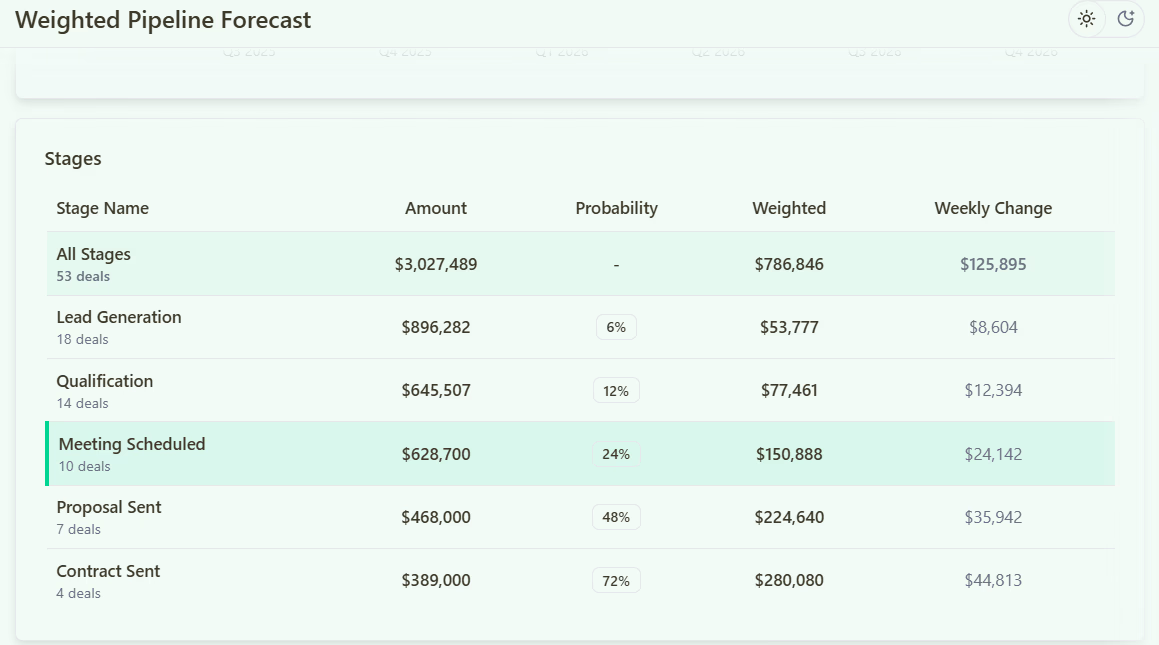
- Weighted Pipeline Forecasting: Applies stage-based probabilities to open deals. Typical accuracy: 60-75% in B2B sales. Weighted pipeline
- Time-Series Analysis: Uses historical sales data to identify patterns. Typical accuracy: 70-85%. Time series forecasting
- Deal-Level Forecasting (AI/ML Models): Considers multiple data points for improved accuracy. Typical accuracy: 75-90%. AI sales forecasting
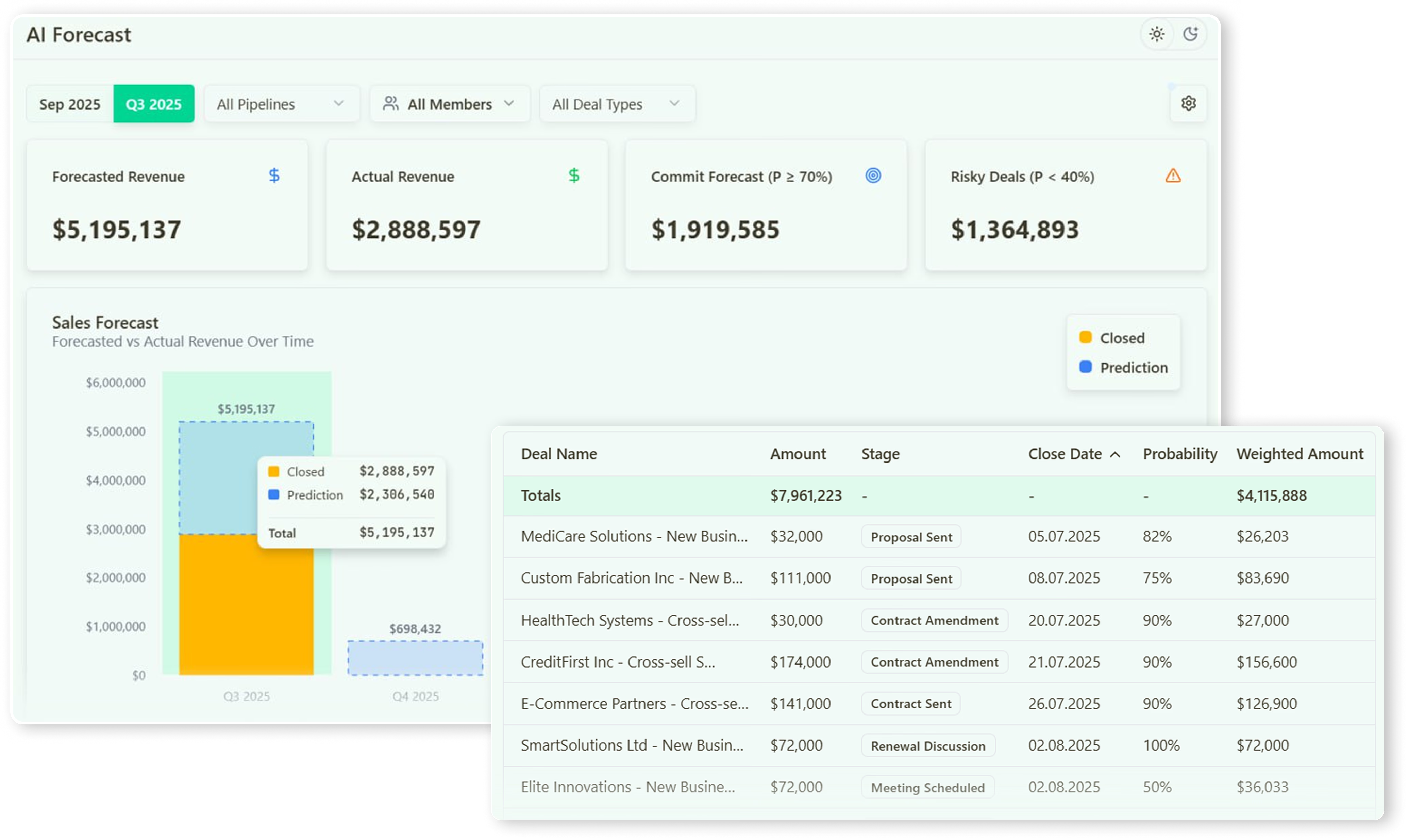
- Hybrid Forecasting: Combines pipeline data, historical forecasting, and AI forecasting for the highest accuracy.
Improving Sales Forecasting Accuracy:
- Data-Driven Practices: Enforce CRM hygiene policies and standardize sales pipeline stage definitions.
- Process Improvements: Hold weekly forecast review calls and involve both Sales and RevOps in validation.
- Technology Enablers: Use automation to track probabilities and adopt AI-driven predictions.
Role of Sales Leaders & RevOps:
- Sales Leaders: Create a culture where forecasting is treated as seriously as hitting quota.
- RevOps: Ensure the forecasting process is based on reliable data.
- Coaching: Provide targeted coaching based on forecast analysis.
Challenges in Achieving High Forecasting Accuracy:
- Human Bias: Optimism vs. sandbagging.
- Complex B2B Sales Cycles: Deals can stall for reasons beyond the rep's control.
- Constantly Changing Market Conditions: External factors can alter buying behavior.
- CRM Discipline and Data Reliability: Accurate forecasting depends on reliable data.
Future of Forecasting Accuracy:
- AI-Powered Forecasting: AI models assign deal-level probabilities by analyzing dozens of data points.
- Continuous Forecasting: Forecasts update in real time as new sales data enters the CRM.
- Revenue Intelligence Platforms: Combine forecasting with deal insights and sales performance analysis.
Best Practices for Sales Forecasting Accuracy:
- Track Multiple Accuracy Metrics
- Automate Forecasting with Technology
- Align Forecasts with Business Goals
- Measure and Minimize Bias
Evaluating Forecast Accuracy
Evaluate forecast accuracy using genuine forecasts. Separate the available data into training and test data. More on training and test sets.
Functions to Subset a Time Series
The window() function is useful when extracting a portion of a time series. Another useful function is subset() which allows for more types of subsetting. Time series functions
Forecast Errors
A forecast “error” is the difference between an observed value and its forecast. Forecast errors are calculated on the test set. Forecast errors details
Scale-Dependent Errors
The forecast errors are on the same scale as the data. The two most commonly used scale-dependent measures are based on the absolute errors or squared errors:
- Mean absolute error: MAE
- Root mean squared error: RMSE Scale-dependent errors
Percentage Errors
The percentage error is given by (p_{t} = 100 e_{t}/y_{t}). The most commonly used measure is:
- Mean absolute percentage error: MAPE Percentage errors
Scaled Errors
Scaled errors were proposed as an alternative to using percentage errors when comparing forecast accuracy across series with different units.
- Mean absolute scaled error: MASE Scaled errors
Time Series Cross-Validation
A more sophisticated version of training/test sets is time series cross-validation. Time series cross-validation
Take the Next Step
Ready to transform your marketing with AI-driven insights? GrackerAI automates your cybersecurity marketing, delivering daily news, SEO-optimized blogs, AI copilot assistance, and newsletters. Start your FREE trial today and see how we can elevate your marketing strategy!