2025 Holiday Shopping Trends: Insights into Consumer Behavior


TL;DR
- This article explores the 2025 holiday shopping trends, highlighting how consumers are balancing economic mindfulness with festive spending. It reveals a strong focus on value, promotions, and premium items, alongside insights into evolving gifting behaviors and the increasing influence of AI in product discovery. The data showcases a strategic approach to holiday purchases across different generations and regions.
2025 Holiday Shopping Trends: A Data-Driven Overview
Consumers are balancing economic mindfulness with festive cheer this holiday season. Circana's report indicates that shoppers are actively seeking value through promotions and discounts, leading to projected holiday spending that aligns with last year's results, fluctuating between a 1% decline and 2% growth. Despite "invisible inflation," where shoppers acknowledge higher prices without significantly reducing overall spending, the desire for gifting and celebration remains strong.
Festive Feasts and Beverages
A majority (55%) of consumers plan to eat their Christmas meal at home, a slight decrease from 2024. Shoppers are carefully curating their holiday baskets, opting for premium and branded items while reducing purchases of products replaceable by private labels. Nearly a quarter (23%) intend to order pre-cooked or ready-to-serve items from restaurants or grocery stores, while a smaller percentage (9%) will order their entire meal. Ready-to-drink adult beverages saw a 5.9% year-over-year (YoY) dollar sales increase, reaching nearly $191 million.
Unboxing Gifting Trends
Toys are a popular choice, with dollar sales rising 5% YoY. Beauty products are also in demand, with consumers planning to spend an average of $247. One-third of consumers intend to gift beauty products, and sales in the prestige beauty segment rose 9% YoY. "Intangible" experience gifts are gaining traction, with 57% of consumers planning to purchase them. Additionally, 69% of consumers believe in giving to those less fortunate, up three points from last year.
The Behavioral Shift in Holiday Shopping
Holiday shopping patterns are evolving, with a divergence between stated intentions and actual behavior. Lotame emphasizes that real behavior provides better insights than stated intent. Despite discussions about budget cuts, Millennials' planned holiday spending has jumped 30% year-over-year, reaching $896, the highest among all generations.
Emerging Demand Categories
Behavioral signals indicate strong growth in specific categories:
- Women’s fashion: Shopping activity is nearly double that of the general population.
- Home design and decor: Interest in remodeling and upgrades is increasing.
- Green vehicles and sustainable goods: Environmentally conscious purchases are rising.
The Role of AI in Discovery
AI-powered tools are increasingly used for early shopping journeys. Specifically, data shows 37% of Millennials and an astonishing 93% of Gen Z using AI tools for inspiration and decision-making.
Value Signals and Omnichannel Approach
Shoppers are scrutinizing product origins, material quality, and value per dollar spent. The holiday shopping journey is omnichannel, with Millennials planning to shop both online (92%) and in-store (91%). Lotame suggests dashboards and attribution models need to capture the full lifecycle, from online discovery to in-store experience.
Consumer Frustrations and Habits
While AI is a topic of discussion, customer experience (CX) remains crucial. SurveyMonkey research indicates that understanding real-world consumer concerns is key.
Leading Frustrations
Overcrowded stores are the leading frustration for 44% of Americans. Other frustrations include not knowing what gifts to buy (40%) and concerns about shipping delays (27%).
Budget and Gift Decisions
Budget remains a major concern, especially for women, with 34% worrying about overspending. Boomers are particularly overwhelmed by gift decisions, with 48% finding it a major hurdle.
Shopping Behavior
Vibe-based shopping is on the rise, with 35% of Americans buying presents whenever inspiration strikes. Only a small fragment of consumers use AI to guide their gift-giving.
AI Adoption in Gift-Giving
Despite the focus on AI, 85% of Americans aren’t using AI for gift selection. Although 44% might consider using AI in the future, 41% would not.
Global Holiday Retail Trends
The retail landscape reflects economic uncertainty alongside improving financial situations in some markets. Shoppers are strategic, balancing budget-consciousness with celebration desires.
Regional Outlooks
- United Kingdom: Optimism is rising, especially among younger and higher-income households.
- United States: Consumer confidence is steady but cautious, with 84% planning to use money-saving tactics.
- Germany: Affordability is prioritized, with many opting for cheaper gifts.
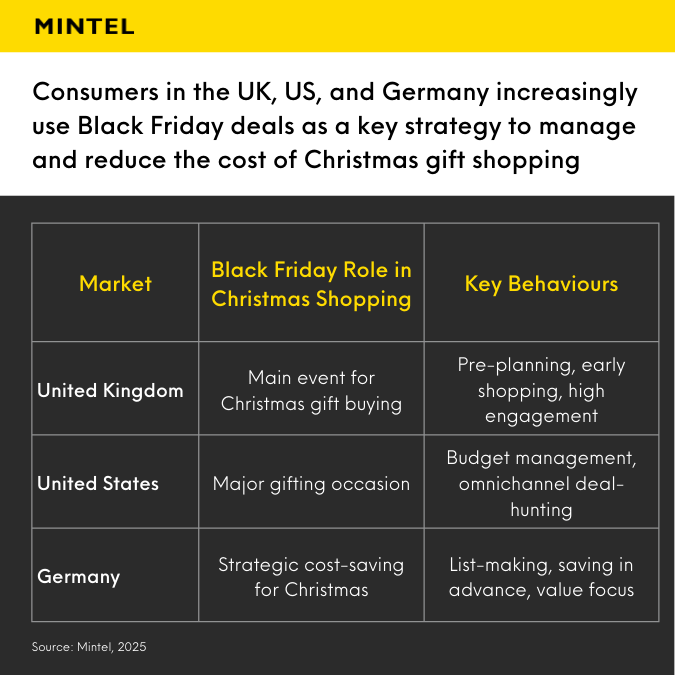
Black Friday's Role
Black Friday is a crucial sales driver, with consumers using it to plan and maximize budgets. In the UK, over two-thirds of Black Friday buyers plan to purchase Christmas gifts during these promotions.
Alternative Gifting
Gift reduction and mindful gifting are on the rise. In the UK, a third of gift buyers participated in Secret Santa in 2024. In the US, 77% try to find unique, meaningful gifts.
Sustainability
Eco-conscious gifting is a core consideration, especially among younger demographics. In Germany, 36% of Christmas shoppers prioritize environmentally friendly gifts.
In-Store Experiences
Social and experiential elements in-store enhance festive spirit and encourage spending. For instance, seven in 10 adults in the United States agree that a festive in-store experience enhances their holiday enjoyment.
Online Leadership and AI Emergence
Online channels continue to lead in holiday retail sales, and AI is increasingly part of the shopping journey. Nearly half of US shoppers are willing to use AI shopping assistants.
Omnichannel Expectations
Omnichannel shopping is now an expectation. Two-fifths of US consumers select retailers based on the availability of both physical and digital channels.
GrackerAI automates your cybersecurity marketing: daily news, SEO-optimized blogs, AI copilot, newsletters & more. Start your FREE trial today!
Ready to revolutionize your marketing strategy with AI-driven insights? Visit GrackerAI to explore our services and start your free trial today!