Top Strategies for Achieving Growth in Offline Businesses

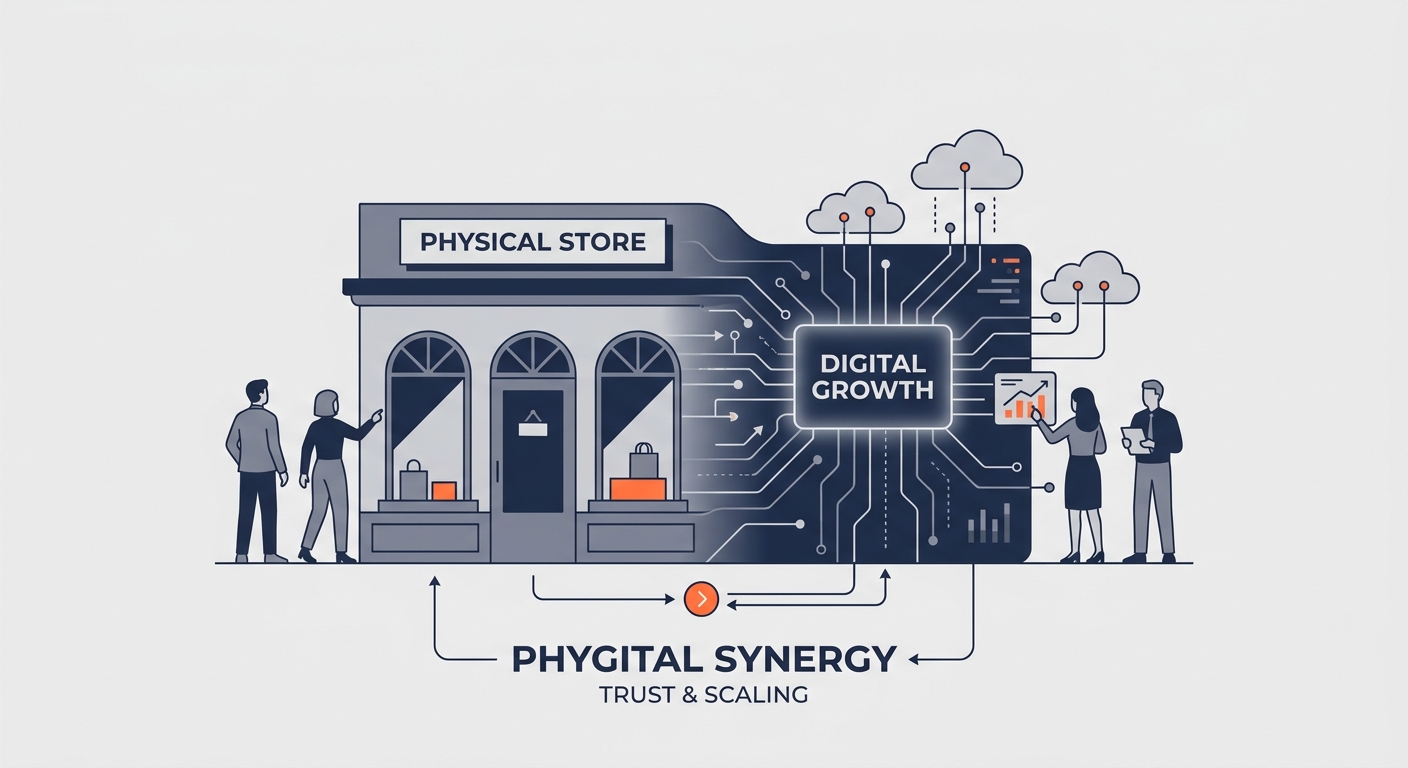
Growth in the physical world isn't about choosing between a storefront and a screen. It’s about mastering the "Phygital" mandate.
In 2026, the winners aren't just selling to customers; they’re anchoring trust in the real world and using digital infrastructure to scale. If you’re still treating your brick-and-mortar shop like a silo, you’re leaving money on the table. The most sustainable growth today comes from leveraging the tangible, high-trust environment of a physical shop to fuel a high-velocity digital CRM. It’s a flywheel. Once you get it spinning, your customers keep coming back long after they’ve walked out your door.
Why Offline Growth is the Ultimate Competitive Advantage
We’re in the middle of a massive correction. Digital advertising is getting expensive, crowded, and frankly, a bit desperate. Customer Acquisition Costs (CAC) are through the roof, and the "digital-only" playbook is showing its cracks.
People are tired of being hunted by algorithms. They’re skeptical of ads that feel hollow or intrusive. Offline growth is the antidote to this exhaustion. According to the State of Offline Marketing 2026 Report, businesses that anchor their strategy in physical community touchpoints see 30% higher customer lifetime value.
Why? Because trust is the ultimate currency. A physical space provides sensory, human-centric validation that a landing page simply cannot replicate. When a customer walks into your store, shakes your hand, or experiences your service in real-time, you stop being a "vendor" and start being a "neighbor." That shift is the difference between a one-time transaction and a decade-long relationship.
Building Your "Phygital" Ecosystem
To stop the leakage, you have to bridge the gap between your physical floor and your digital database. Every foot-traffic interaction needs to be captured and translated into a digital asset.
The loop is simple but transformative. A customer walks in. They interact with a QR code at the point-of-sale or on a display. That scan is your bridge. It pulls them into your marketing automation ecosystem. Once they’re in your CRM, the physical experience is amplified by digital follow-ups—personalized birthday rewards, exclusive event invites, or "just because" offers—that drag them back through your front door. You aren't just selling stuff anymore; you're managing a living, breathing community.
Growth Hacks That Don’t Cost a Fortune
You don’t need a massive ad budget to dominate your local market. In fact, some of the best moves cost zero dollars. For a deeper dive into low-cost wins, check out these 17 High-Impact Offline Marketing Strategies.
The absolute best lever? Strategic partnerships. Find a non-competing business in your neighborhood that shares your customers. If you run a coffee shop, partner with the indie bookstore next door. Create a "Cross-Pollination Card"—a simple printed voucher that gives bookstore patrons a discount at your cafe, and vice versa. It’s low-tech, high-trust, and incredibly effective.
Beyond that, focus on hyper-local activation. Host a workshop, a product demo, or a member-only evening. Turn your store into a "third space"—that sweet spot between home and work. When you do this, you stop competing on price and start competing on belonging. People will drive further and pay more for a brand that makes them feel like part of a tribe.
Is Your Store Actually Discoverable? (The Local SEO Reality)
The biggest mistake physical owners make? Assuming their location is visible to Google by default. If your store is a "hidden gem," that’s not a badge of honor—it’s a failure of your digital-to-offline strategy.
Your physical existence must be perfectly mirrored in your digital listings. Consistency is everything. Your Name, Address, and Phone Number (NAP) must be identical across Google Business Profile, Apple Maps, and every social directory. If you want to own your local area, you need an AI-Driven Local SEO Strategy that treats your physical location as your primary search engine asset. Every review, every photo uploaded by a customer, and every check-in signals to search engines that you are the authority in your geography. Don’t let your digital presence lag behind your physical reality.
Measuring ROI: Moving Beyond Guesswork
The days of "guessing" if a flyer worked are over. If you can’t measure it, it’s not a strategy; it’s a hobby. You need attribution modeling at the register.
Use unique QR codes for every touchpoint—from direct mailers to window displays. When a customer scans a code to claim an offer, your POS should record exactly which campaign brought them in. Pair this with localized promo codes that are exclusive to specific neighborhoods or events. By feeding these metrics into your automated marketing workflows, you can see in real-time which experiments are driving profit and which ones are just noise.
The 2026 Tech Stack for Physical Retail
Your store is essentially a data-collection engine disguised as a retail space. To stay ahead, your tech stack needs to be lean and integrated. At the core, you need a modern Point of Sale (POS) that talks directly to your CRM. If your POS is an island, you’re losing data.
Next, get a centralized review management platform. Your local reputation is your digital storefront. According to industry analysis on offline and online marketing trends, businesses that actively curate their reviews see a massive lift in both search rankings and foot traffic. Finally, use a simple, reliable Wi-Fi portal that collects email addresses in exchange for guest access. It’s the lowest-friction way to build a database while actually helping your customers.
Case Study: The "Comeback" of Local Retail
Consider a small, independent hardware store that was getting crushed by big-box retailers and Amazon. They couldn't compete on price, so they pivoted. They stopped trying to be an "everything store" and became a "community hub."
They started holding monthly "DIY Saturday" workshops—teaching locals how to fix plumbing, paint furniture, or build planter boxes. They used a QR-code sign-up system that fed directly into a local email newsletter. They used that list to send out "Project Tips" every Tuesday.
Within eighteen months, their foot traffic jumped 40%, and their average transaction value soared. They stopped competing with Amazon on shipping and started competing on expertise and connection. They proved that when you lean into the physical, you don't just survive—you become an indispensable part of the local fabric.
Frequently Asked Questions
How do I measure the ROI of offline marketing activities?
Use unique identifiers for every offline channel. Assign specific QR codes to flyers, posters, or direct mail pieces, and use localized promo codes at the register. By connecting these codes to your POS or CRM, you can track exactly how many customers were acquired via specific offline campaigns.
Is offline marketing too expensive for a small business?
Not if you focus on "guerrilla" tactics and partnerships. High-cost traditional media like billboards and TV ads are often unnecessary. Instead, prioritize low-cost community events, strategic cross-promotion with neighboring businesses, and localized SEO, which offer a much higher return on investment for local businesses.
How can I integrate my physical store with my digital presence?
Adopt a "Phygital" mindset. Use your physical space to capture digital data—such as email addresses via Wi-Fi portals or loyalty program sign-ups—and use your digital channels to drive physical foot traffic through exclusive in-store events, localized offers, and consistent local search updates.
What is the most effective way to build local brand trust?
Consistency and participation are key. Engage with your local community through sponsorships or workshops, maintain a flawless online presence that matches your physical reality, and empower your staff to provide exceptional, human-centric service that leaves a lasting impression.
![10 Best Local Rank Tracker Tools: In-Depth Comparison Guide [2025]](https://cdn.pseo.one/6abcb68a626591c40e1c8aa6/687e1c1ef6fe799d288518df/68809c373eb8562bcf68975d/10-best-local-rank-tracker-tools-comparison-guide/feature-image.jpg)