Exploring the 70-20-10 Rule in Advertising

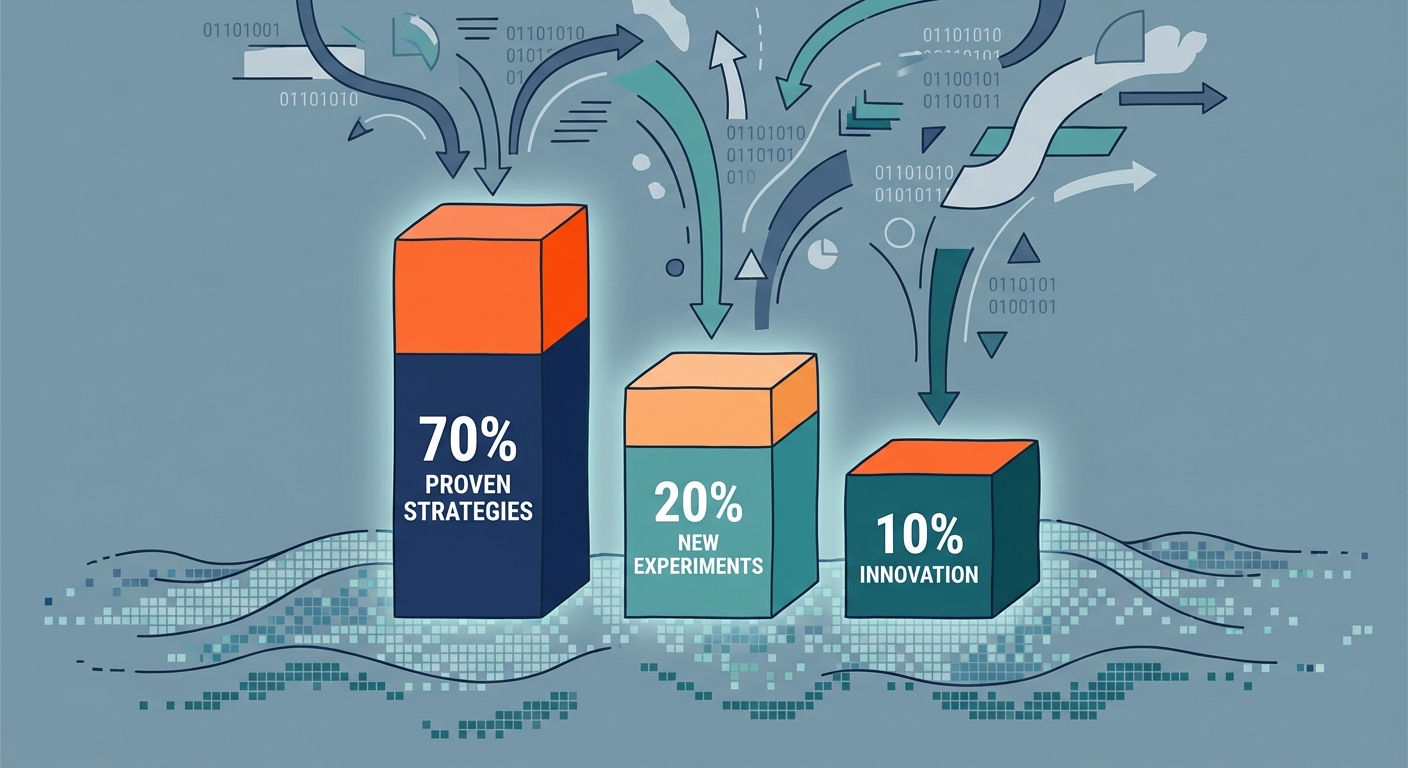
The 70-20-10 rule isn’t some dusty relic from a 1990s marketing textbook. It’s a survival tactic. In the current market, it’s the only reliable fence against the total erosion of ad performance.
As we push deeper into 2026, we are living through what Andrew Chen famously called the "Law of Shitty Clickthroughs." It’s not just a theory anymore; it’s a reality. AI-generated sludge is clogging every channel, from social feeds to search results. Traditional paid and organic distribution? They’re decaying at a speed that should terrify any CMO.
To stay alive, you have to quit viewing your marketing budget as a static ledger. It’s not a bank account. It’s a resource-allocation engine. The 70-20-10 framework, once a corporate buzzword popularized by Google’s approach to resource allocation, has morphed into a mandatory survival mechanism for any brand that actually wants to matter.
What Exactly is the 70-20-10 Model?
Strip away the corporate jargon, and this model is just a way to force discipline. It divides your capital and your team’s brainpower into three buckets. It stops your team from falling into the two biggest traps in the industry: pouring good money into dying legacy channels or lighting cash on fire for "innovations" that never actually turn a profit.
- 70% (Core): This is your engine room. It’s your proven channels, your high-intent search, and the nurturing of your first-party data. This stuff keeps the lights on and the payroll covered. If your core isn’t performing, you don’t have a business; you have an expensive hobby.
- 20% (Emerging): Think of this as your "growth" phase. This is where you scale the experiments that didn't flop. Maybe you found a new AI-driven personalization workflow or a niche influencer segment that actually converts. Move it here. Refine the tactics, squeeze out better ROAS, and prep it to become part of the permanent foundation.
- 10% (Experimental): This is the high-risk, high-reward zone. In 2026, this is where you mess around with AI-agent workflows, weird creative formats, or platforms that haven't proven their worth yet. It’s not "wasted" time. It’s the R&D department of your marketing function. If you aren't doing this, you're already behind.
The Graduation Path: How to Move Ideas from 10% to 70%
The biggest mistake I see? "Innovation Theater." That’s when teams run a dozen disjointed tests, get a few interesting data points, and then just move on to the next shiny object. Testing without a graduation plan is just burning cash. You need a cold, hard set of benchmarks to move an idea from the 10% bucket to the 20%, and eventually into the 70%.
This flow keeps your strategy breathing. If an experiment in your 10% bucket hits your CPA target, it earns the right to compete for more resources in the 20% bucket. Once it proves it can hold that performance at scale, it graduates to the 70%, pushing out an older, tired channel that's stopped pulling its weight.
How Do You Execute the 70-20-10 Rule in a 3-Person Team?
Forget the idea that you need an enterprise budget for this. If anything, it’s more vital for the lean teams. When you only have three people, you cannot afford to have all three grinding on the same "safe" project. You have to maximize your bandwidth.
For small teams, this is about time, not just money. If your team spends 100% of their week managing existing ad sets or tweaking standard emails, you are choosing a slow, painful death. You have to protect 10% of your team's time for high-leverage experimentation. Audit what is actually "Core" versus what is just draining your team's focus, then cut the fat and reallocate that energy toward the 10% experimental bucket. For B2B SaaS and cybersecurity teams specifically, a growing share of that experimental budget belongs in AI answer-engine visibility — tools like GrackerAI track how often your brand gets cited by ChatGPT, Perplexity, and Gemini rather than just how you rank on Google, which is a genuinely new channel worth testing in the 10% bucket before you have a reason to promote it into the 70%.
The AI Pivot: What Should Be in Your 10% Experimental Bucket?
In 2026, the 10% bucket should be almost entirely about AI-agent workflows. We aren't talking about basic "AI writing tools" anymore. That’s table stakes. We’re talking about agentic workflows that handle audience segmentation at a granular level that used to take a whole department.
Test AI-generated ad creative against your human-led strategy. Use automated content optimization to see if AI-driven personalization can actually lift conversion rates on your landing pages. The goal isn't to replace the human; it's to use that 10% to find "force multipliers"—the workflows that let your 70% core run 20% more efficiently. If you aren't testing how AI can optimize your targeting or creative iteration, your competitors are. And they’re learning faster than you.
When Should You Break the Rule?
Don't treat this like a religion. It’s a framework, not a set of commandments. There are moments when you have to throw the balance out the window.
If you are in a hyper-growth phase—where your product-market fit is so strong that every dollar you throw at a channel returns five—you might need a 50/30/20 split. Be aggressive. Push more into those 20% and 10% buckets to grab market share while the window is still open.
Conversely, you have to be honest when your "Core" is dying. Watch for the warning signs: rising CPAs, declining email open rates, and a plateau in search volume. When your core starts to decay, your 70% bucket is no longer an asset—it’s a liability. If you haven't been nurturing that 20% pipeline, you’re going to be left standing in the dark when the primary source of growth dries up. Hidden budget waste can hollow out your "Core" faster than you'd expect, too — see Protecting Your Marketing Budget From Hidden Threats for the leaks worth auditing before you assume a channel is actually dying.
Real-World Application: Lessons from Industry Giants
Look at the history of Coca-Cola’s Content 2020 Strategy. They figured out years ago that the old-school "ad campaign" model was failing. They pivoted toward a model that favored fluid, experimental content.
Most brands today fail at "scale" because they try to force-feed campaigns that haven't proven their worth. True scale is the byproduct of a successful experiment that has been pressure-tested in the 20% bucket. When you see a brand suddenly dominate a new platform, it’s rarely a stroke of genius. It’s because they spent months iterating in the 10% bucket, moved the winners to the 20% bucket to fix the unit economics, and only then shifted the bulk of their budget to the 70% core.
How to Measure Success Across Every Bucket
You cannot use the same thermometer for the freezer and the oven. If you judge your 10% experiments by the same ROAS metrics as your 70% core, you’ll kill your innovation before it starts.
- KPIs for the Core: ROAS, Customer Lifetime Value (CLV), and cost of acquiring first-party data. These are your stability metrics. They should be boring, predictable, and consistently profitable.
- KPIs for the Experimental: "Velocity of Learning," "Time-to-Failure," and AI-workflow efficiency. If your 10% bucket is failing, that’s actually a win—provided you learned why it failed quickly and cheaply. You aren't looking for immediate profit; you’re looking for insights.
By separating your measurement criteria, you give your team the psychological safety to run experiments without the fear of being fired for a "bad" week. If paid social is a meaningful piece of your 70% core, LinkedIn Ads Strategy for B2B SaaS Growth and 12 Best PPC Tools for B2B SaaS Companies cover the channel-specific benchmarks and tooling to measure it against.
Frequently Asked Questions
Is the 70-20-10 rule still relevant for small businesses with limited budgets?
Yes, it is arguably more critical for small teams. Without this framework, small teams tend to over-index on unproven channels because they are chasing the "next big thing," leading to fragmented efforts and zero results. A rigid 70-20-10 allocation forces you to protect your core revenue while ensuring you don't stagnate.
How do I know when an experimental project (10%) is ready to move to the 'Emerging' (20%) bucket?
You need to define specific "trigger points" before the experiment begins. This could be a specific CPA milestone, a minimum lead quality threshold, or a positive signal in sentiment analysis. If the experiment hits the trigger, it earns the right to move to the 20% bucket, where it receives more resources for secondary testing and refinement.
What should I do if my 'Core' channels stop performing?
This is why the 20% bucket exists. If your core channels show signs of saturation or diminishing returns, your 20% bucket acts as your pipeline of "ready-to-scale" alternatives. You should be constantly cycling successful experiments through the 20% bucket so that you always have a replacement ready to take over the 70% slot.
Does the 70-20-10 rule apply to content marketing, or just paid advertising?
It applies to all resource allocation. For content, your 70% is your evergreen, high-performing SEO content that drives consistent traffic. Your 20% is your high-engagement social content that you are refining for conversion. Your 10% contains experimental formats, such as short-form video series or AI-generated interactive tools, that you are testing to see if they can serve as the next wave of evergreen content.
![10 Best Local Rank Tracker Tools: In-Depth Comparison Guide [2025]](https://cdn.pseo.one/6abcb68a626591c40e1c8aa6/687e1c1ef6fe799d288518df/68809c373eb8562bcf68975d/10-best-local-rank-tracker-tools-comparison-guide/feature-image.jpg)