10 Tips for Social Media Marketing in the Cybersecurity Companies

TL;DR
- Market cybersecurity on social media by replacing fear with education — define the persona by the job's real problems, publish trust-building content, target ads by job title, and measure demo requests rather than impressions.
In today's digital-first world, cybersecurity companies face a unique challenge: how to market sophisticated security solutions without resorting to fear-based tactics. LinkedIn alone counts more than 1 billion members across 200+ countries (LinkedIn, About LinkedIn, retrieved 2026-09-18), and it has become one of the primary channels where security buyers research vendors long before they book a call. Mastering social media marketing has become crucial for cybersecurity brands that want to reach them there.
Understanding Social Media Marketing in Cybersecurity
Social media marketing for cybersecurity companies involves strategically using social platforms to build trust, demonstrate expertise, and engage with security-conscious audiences. Unlike traditional marketing channels, social media allows for real-time interaction and authentic relationship-building with potential clients.
Why Traditional Marketing Falls Short
Traditional cybersecurity marketing often relies on fear, uncertainty, and doubt (FUD). However, modern buyers are more sophisticated. They seek education, insights, and value rather than scare tactics. 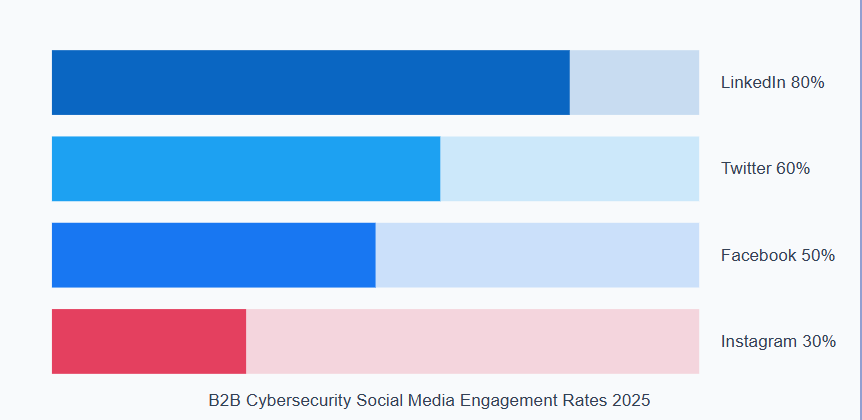
1. Understand Your Audience
In cybersecurity marketing, understanding your audience means getting to know the real people behind the job titles. Here's what I mean: Break your target audience into buyer personas. Picture Sarah, a 45-year-old Head of Security at a fintech company. She spends her mornings scanning Krebs on Security and Dark Reading, worried about the growing pile of security certificates her team needs to manage. When she's not putting out fires at work, she's attending virtual security conferences, trying to stay ahead of the latest threats. What keeps her up at night? It's not just general security concerns - it's specific headaches like:
Managing thousands of certificates across cloud platforms
Convincing the board to invest in better security tools
Staying compliant while moving fast
By understanding these real-world concerns, you can create content that speaks to Sarah's daily challenges, not just generic security fears. Pro Tip: Build 3-5 different audience profiles like Sarah's. Maybe your next persona is Dave, the recently promoted Security Engineer who's drowning in alert fatigue, or Michelle, the CISO who needs data to justify her security budget. Remember: You're not just marketing to job titles - you're talking to real people with real problems who happen to work in cybersecurity. Meet them where they are, speak their language, and show you understand their world.
2. Master Platform Selection
Social media marketing works well, but it's important to choose platforms where your audience is active. For example, LinkedIn is better for business-to-business (B2B) marketing, while Instagram and TikTok are better for business-to-consumer (B2C) marketing. Let's break down where your security audience spends their time
LinkedIn:
Who's there: The decision-makers - CISOs, IT leaders, and security architects who hold the budget keys
What works: Deep technical content, like that detailed whitepaper on the zero-trust architecture you've been working on
Why it works: It's like a 24/7 professional conference where security leaders go to learn and connect
Pro tip: Use LinkedIn's laser-focused targeting to reach specific security roles in target companies
Who's there: The hands-on security pros - threat researchers, SOC analysts, and security engineers
What works: Quick threat alerts, tool recommendations, and breaking security news
Why it works: Security folks check Twitter like others check the weather - it's their pulse on what's happening
Pro tip: Jump into infosec conversations and share real-time threat insights
Instagram/TikTok
Who's there: Regular folks who need basic security help
What works: Simple security tips, password safety guides, and phishing awareness
Why it works: Perfect for reaching everyday users who need help staying safe online
Pro tip: Great for consumer products like password managers or VPNs
Remember: Make sure your content matches the platform. Save the technical deep-dives for LinkedIn and keep things lighter on Instagram.
3. Create Trust-Building Content
Building trust without sounding like a typical marketer is something every security marketer struggles with.
Think of it like this: if you're looking for a home security system, would you trust the salesperson who just throws scary crime statistics at you, or the one who takes time to explain how different security features actually protect your family?
Here's how to be that second person in cybersecurity marketing. Show, don't sell. Instead of saying "We're the best at stopping hackers," share real stories:
How a company prevented a ransomware attack
Weekly security tips your audience can use
Behind-the-scenes looks at how security tools work
Pick Your Platform Based on Your Audience For the Enterprise Folks (LinkedIn & Twitter):
Deep-dive technical articles
Research papers that teach something
Case studies with real numbers and results
For Regular Users (Instagram & TikTok):
Quick security tips in plain English
Simple explainer videos
Eye-catching infographics about staying safe online
The Secret Sauce? Be Consistently Helpful
Share insights regularly, not just when you're selling
Join conversations about security challenges
Answer questions, even when there's no immediate sale
Remember: People trust teachers more than salespeople. So teach first, sell second. Quick Win: Start by sharing one helpful security tip each week. No pitch, no product mention - just pure value. Watch how your audience starts seeing you as a helpful expert, not just another vendor. 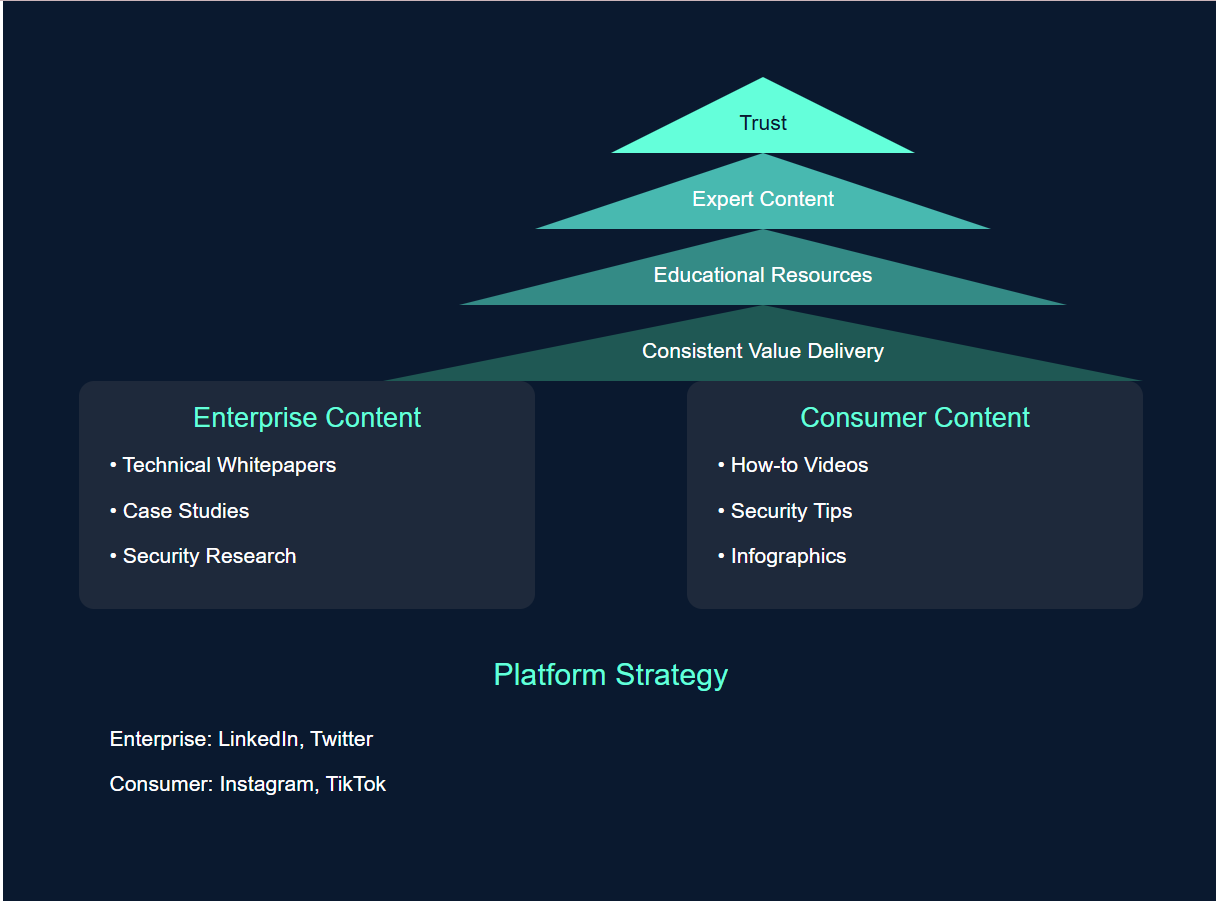
4. Use Targeted Advertising
Targeted advertising means getting your security message to exactly the right people, not a broad audience that happens to include a few prospects.
Picture this: you've got an amazing enterprise security solution, but your ads are reaching teenagers looking for gaming VPNs. Fixing that starts with defining who you actually want to reach.
For Enterprise Security Products: Find the Decision Makers
Target specific job titles (CISO, Security Director, IT Manager)
Focus on company sizes that match your solution
Look for people who engage with enterprise security content
For Consumer Security Tools: Reach Security-Conscious Users
Target based on interests in privacy and security
Focus on age groups who make household tech decisions
Find people reading about online safety
Smart Targeting Tips: 1. Use LinkedIn for B2B security products
Filter by job title
Target specific industries
Focus on decision-maker seniority levels
2. Try Facebook/Instagram for consumer security
Target by tech interests
Focus on privacy-conscious audiences
Find people worried about online safety
Pro Tip: Start small and specific. It's better to reach 100 perfect prospects than 10,000 random viewers. Test different audience combinations and see what works best. Remember: In cybersecurity, speaking to the right audience isn't just about saving money - it's about finding people who actually need your solution and can make decisions about it. Quick Win: Create a "perfect customer profile" first, then build your targeting around their specific characteristics. Your ads will perform better, and your budget will thank you!
5. Making Ads That Stand Out
Good visuals make people stop and look at your ad. While your brand matters, it's the pictures and design that grab attention. For cybersecurity ads, keep it simple:
Make clear pictures showing cyber attacks and how to stay safe
Create short videos teaching basic security tips
Focus on easy-to-understand visuals that teach people about cybersecurity without using complex terms. Want to make a lasting impression? Ensure your social media accounts are complete with a profile picture that aligns with your brand’s professional and trustworthy image. Professional cybersecurity ad visual 
6. Writing Copy That Sells Security
Simple copy rules:
Write like you're talking to a friend
Focus on security problems and your solutions
Keep messages consistent from ad to landing page
Example Ad for a Security Awareness Training: Headline: "Your Employees: The First Line of Defense" Body Copy: "Tired of phishing attacks getting through? 77% of companies faced email scams last year. Our 15-minute training turns your team into security champions. No tech jargon. Just practical skills. Download our free guide: '5 Steps to Build a Human Firewall' [Current clients: Microsoft, IBM, Oracle]" Landing Page matches with:
Same "Human Firewall" theme
Same 15-minute training promise
Same statistics
Same straightforward language
This works because it:
Speaks to a real problem (phishing)
Uses clear numbers
Offers quick solution
Stays consistent
Shows social proof
Uses simple language
7. Make Complex Security Simple with Video
Use videos to explain security in simple ways:
Show step-by-step guides for setting up protection
Record expert talks about staying safe online
Create short animations about cyber attacks
Share these on YouTube and TikTok where more people can learn from them. Keep videos short, clear, and focused on one topic at a time. Example: "What's a DDoS Attack?" (30-second animation)
Show website as a store
Display too many customers rushing in at once
Store gets overwhelmed and closes
Explain how protection works (like having security at door)
This helps people understand complex security ideas through familiar examples.
8. Show Your Success Stories
Publish outcomes you can evidence. A usable proof point names the customer or says why it cannot, states the starting position, states the measured change, and gives the window — a claim without a baseline and a timeframe is not a result, it is an adjective.
Structure each one as: what was failing → what changed → what it was measured against → over how long. If the customer will not be named, the numbers still need an internal source you could produce on request.
Third-party reviews on G2 or Capterra carry more weight than a self-published quote, because the reviewer's identity is verified by someone other than you. Once you have that third-party proof, surfacing it in a live, aggregated feed on your own site keeps it working for every visitor, not just the ones who go looking for it.
9. Share Free Security Tools
Give away helpful security resources to show your expertise. Share downloadable guides about staying safe online, security checklists, and simple tools to check for weaknesses in your system. Example: "Download our 5-minute Security Checklist - protect your business today! Our free tool helps you:
Find system weaknesses
Set up basic protection
Train your team
Get it here: [link] #CyberSecurity" Pro tip: Share trusted free tools like Cyber Essentials to help businesses start their security journey.
10. Measure Your Success
Measuring success means tracking a short list of numbers consistently, not every metric your analytics tool offers.
Numbers that matter:
Post likes, shares, comments
How many people click your ads
How many download your security tools
Use Hootsuite or Google Analytics to see these numbers and improve what's working. Example: "February Security Report: Ad clicks up 25% Demo requests: 50 (up from 30) Top post: '3 Ways to Stop Ransomware' Action: Create more ransomware prevention content" Keep what works, fix what doesn't. Check numbers weekly to stay on track.
Don't Forget AI Search Visibility
Social platforms are not the only place security buyers research vendors before a demo call — a growing share now ask ChatGPT, Perplexity, or Google AI Overviews the same question they would have typed into a search bar. The trust-building content described above (real breach-prevention stories, plain-language explainers, free checklists) is also the material that gets cited when an AI tool answers a question about your category.
Two things make that content easier for an answer engine to cite: clear, direct language (the same "teach first, sell second" approach from Tip 3), and a way to track whether it is actually showing up. GrackerAI's AI visibility tracking and cybersecurity marketing copilot are built for exactly that — pairing the social content workflow above with visibility into ChatGPT, Perplexity, and other answer engines. For a deeper look at avoiding the pitfalls that keep security content from earning that trust, see 8 cybersecurity marketing mistakes to avoid and building a cybersecurity content strategy that converts.
Frequently Asked Questions
Which social platform should a cybersecurity company prioritize first?
LinkedIn, for most B2B security vendors. It is where CISOs, IT leaders, and security architects who hold budget actually spend time, and it supports the longer, technical content that builds credibility with that audience.
Is fear-based messaging ("FUD") ever effective in cybersecurity marketing?
It can capture short-term attention, but modern buyers who already understand the threat landscape tend to respond better to education and evidence than to scare tactics. Trust-building content — real prevention stories, plain-language explainers, practical checklists — builds credibility that FUD-driven ads do not.
How often should we post on social media as a security vendor?
Consistency matters more than volume. A weekly cadence of genuinely useful content — one tip, one explainer, one story — outperforms sporadic bursts of promotional posts, and it is easier to sustain long-term.
What metrics actually matter for cybersecurity social media marketing?
Track engagement (likes, shares, comments), click-through rate on ads, and downloads of gated resources like checklists or guides, reviewed on a consistent weekly or monthly cadence. Vanity metrics like follower count matter far less than whether content is driving demo requests or tool downloads.
Does this apply to AI search, or just traditional social platforms?
Both. The same educational, evidence-backed content that builds trust on LinkedIn or Twitter is the content AI answer engines pull from when a buyer asks a question in ChatGPT or Perplexity instead of searching Google. Structuring it clearly (short paragraphs, direct answers, real sources) helps on both fronts.
Conclusion
Effective social media marketing in cybersecurity requires understanding your audience, choosing the right platforms, creating trustworthy content, and measuring results. Focus on providing value through educational content, real success stories, and free resources while maintaining consistent messaging across all channels.
![10 Best Local Rank Tracker Tools: In-Depth Comparison Guide [2025]](https://cdn.pseo.one/6abcb68a626591c40e1c8aa6/687e1c1ef6fe799d288518df/68809c373eb8562bcf68975d/10-best-local-rank-tracker-tools-comparison-guide/feature-image.jpg)