Backlinks in AI Search: What SEO Experts Believe (and What That Means in Practice)

If your pages don’t rank, they usually don’t get cited—because most AI systems still pull answers from pages that already perform well in “classic” search.That’s exactly why link building still matters for AI visibility. Not as a magic lever, but as an amplifier: it increases the odds your pages reach the shortlist AI assistants draw from. In this article, you’ll learn what survey data says about backlinks, nofollow links, and brand mentions in 2025—and how to turn those insights into a clean, scalable link strategy.
Why backlinks still influence AI visibility
A large majority of specialists believe backlinks influence AI search performance.
In the survey referenced in the transcript, 73.2% of experts said backlinks affect the chance of appearing in AI search results.
That lines up with how AI systems typically source information:
Google AI Overviews / Gemini lean heavily on what already ranks in Google.
ChatGPT (with live web) often relies on top results in Bing for retrieval.
So even if AI feels “new,” the pipeline is familiar: rank first → get cited second. For security vendors specifically, that pipeline is exactly what's breaking down as buyers skip the ranked list entirely — see why blue link SEO is dying for security vendors for what citation share and sentiment now measure instead of rank.
Backlinks remain one of the strongest inputs into ranking—so they remain an indirect lever for AI visibility.
The nofollow shift: why “non-passing” links still matter
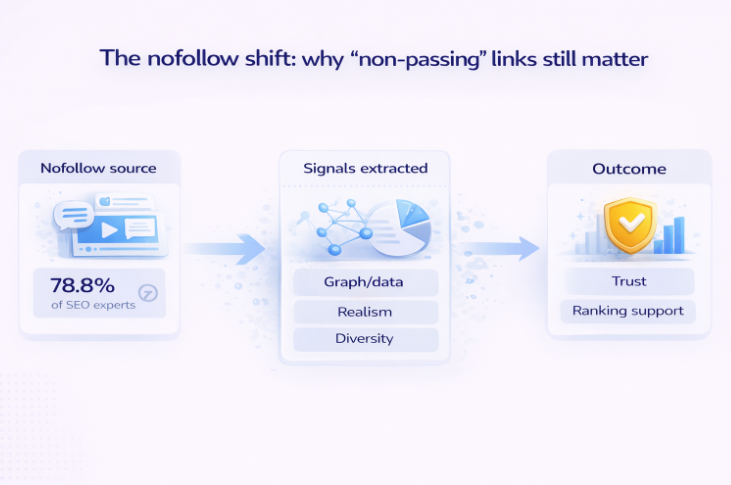
Nofollow links were designed to not pass PageRank. But reality is messier.
In the transcript’s survey data:
- 78.8% of SEO experts believe nofollow links impact rankings.
What’s happening in practice?
1) Google wants more link graph data
Fewer people publish on blogs than they used to. More content lives on platforms, social, and video. That shrinks the “traditional” web link graph—so search engines have incentives to extract value from different types of backlinks.
2) Nofollow makes your profile look real
A link profile with only dofollow links can look engineered. Same with anchor text that’s overly exact-match and repetitive.
A healthy profile usually includes:
a mix of dofollow and nofollow
branded anchors
generic anchors
naked URLs
and mentions without links (more on that next)
Important nuance: believing nofollow matters doesn’t mean everyone actively builds it. In the transcript, last year only 46.9% said they deliberately pursued nofollow links. Many people still treat it as “nice to have,” not a core KPI.
Unlinked brand mentions: the missing half of credibility
This stat matters more than people think:
- 80.9% of specialists believe unlinked brand mentions influence organic rankings.
Even if they’re not a direct ranking factor, they can affect rankings indirectly by shaping:
awareness (people search your brand)
trust signals (your brand shows up in relevant contexts)
naturalness (links + mentions is a normal pattern; links-only can look odd)
Here’s the practical takeaway:
If you’re building links, but nobody is talking about you, it can look artificial—especially at scale.
Brand mentions solve that “why would anyone link to this?” question.
Can you rank without backlinks? Yes—if you target the right keywords

The transcript cites:
- 64.9% say a website can rank high on Google without backlinks.
That’s not wishful thinking. It’s search intent + competition mechanics.
You can often rank without page-level links when you target undertargeted keywords—queries where:
people want to take action (bottom-of-funnel)
the SERP is weak (titles/H1s don’t match well)
nobody built a page specifically for that intent
These keywords tend to have lower volume, so fewer marketers chase them. But they’re often more lucrative, because they imply purchase intent.
Translation:
For new sites, you can win earlier by targeting “boring” money keywords that others ignore.
For competitive keywords, paid backlinks become more necessary—sometimes even to the specific page, not just the domain.
What a “high-quality backlink” actually is (and what it’s worth)
The transcript quotes an “average acceptable price” of $58.95 for one high-quality backlink.
Price aside, the definition of “high-quality” in practice looks like this:
the site is trusted in your niche (real audience, real editorial standards)
the page is indexed, gets engagement, and isn’t a link farm
the outbound links are selective (not hundreds of random placements)
the link context makes sense (not forced)
anchor text isn’t manipulative (often branded is enough)
One link like this—even to your homepage with a branded anchor—can lift more than the single page it points to. It can increase how often Google “tests” your other pages in the SERP.
That’s why quality links compound.
What tactics SEOs think are risky but still work
The transcript lists tactics that respondents view as “shady/risky but effective.” The top ones included:
PBNs
expired domains with backlinks
guest posts on low-quality sites
paid homepage links
forum/comment links
mass press release distribution
widget/footer links
social bookmarking / directory submissions
web 2.0 blogs
Two clarifications matter here:
“Effective” doesn’t mean “safe.” Many of these work until they don’t.
Some tactics aren’t inherently shady—the quality level is what makes them risky (e.g., directories can be legitimate; low-quality directories are the problem).
Red flags when choosing sites for link placement

This part of the transcript is one of the most useful.
Top red flags included:
Spammy outbound links (the biggest one)
Low-quality content
Poor authority
Low relevance
Declining organic traffic
A dedicated link index such as Majestic’s Trust Flow and Citation Flow metrics gives you a fast, evidence-based way to check a prospective site’s authority against those red flags before you pursue a placement there.
The principle is simple:
If the site doesn’t look like it’s built for users, your link will behave like a liability, not an asset.
Why disavowing links is mostly a mistake now
The transcript notes:
only 39% still use Google’s disavow tool
Google recommends it only in extreme situations
Bing has sunset the feature
experiments/anecdotes suggest disavowing can hurt performance
The practical stance in 2025 is conservative:
focus on not building garbage links in the first place
avoid panic-cleanups unless you have a real, evidence-based reason
don’t treat disavow like routine maintenance
The cost problem: how to scale links without sacrificing quality
Most respondents cite two big challenges:
high cost of premium backlinks
scaling without losing quality
Here’s the strategy that solves both—without turning link building into a spam factory. For SaaS teams specifically, that means pairing this earned-placement approach with the editorial and programmatic content it points back to — see GrackerAI’s breakdown of how backlinks power editorial and programmatic SEO for SaaS for how the two content models compound each other’s link equity:
1) Build authority with “earned” placements
Use journalist/expert request platforms and respond consistently. One strong placement can outperform dozens of mediocre ones.
2) Use linkable assets for leverage
Create something people naturally cite: a template, dataset, tool, or genuinely useful resource.
Linkable assets can outperform any budget, but they require creativity and distribution.
3) Do “boring marketing”
Directories, partnerships, community involvement, testimonials, and collaborations produce links and mentions that look natural because they are natural. Community-sourced testimonials and reviews do double duty here — structured and published on your own site, they also become the kind of verified, human-authored signal AI answer engines look for; see how to leverage user-generated content for AI search rankings.
If you want a natural link profile, do natural business activity.
Five mistakes that waste time
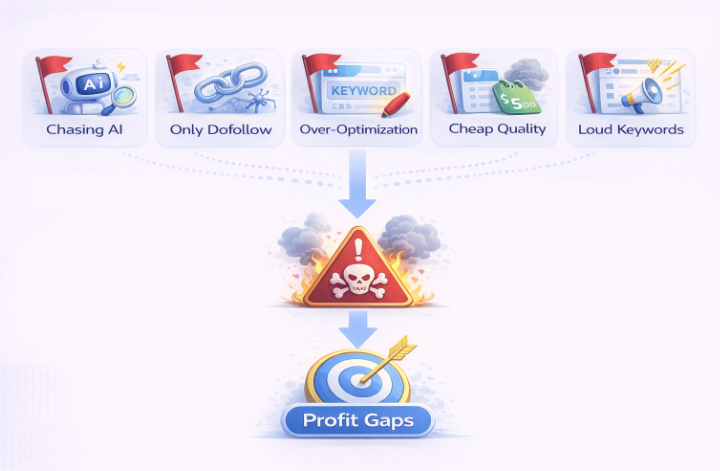
1) Chasing AI visibility directly
AI pulls from pages that already win in search. If you ignore fundamentals, you cap your AI exposure.
2) Building only dofollow links
A profile without nofollow, mentions, and variety can look manufactured.
3) Over-optimizing anchors
Exact-match anchors still work—until they’re the pattern. Mix in branded, partial-match, and natural phrasing.
4) Paying for “cheap quality” at scale
The fastest way to tank ROI is buying placements on sites with spammy outbound links and no real audience.
5) Ignoring undertargeted bottom-funnel keywords
If you want early wins, stop fighting for the loudest keywords and start capturing the profitable gaps.
Final thoughts
The most useful way to think about link building in 2025 is this:
Backlinks don’t guarantee rankings—but they increase your probability of being tested, surfaced, and cited.
And as AI assistants lean on top-ranking pages for retrieval, that probability matters more than ever.
If you’re building links, don’t build just links.
Build a credible footprint:
links + nofollow variety + brand mentions + relevance + real distribution.
That’s what scales without breaking.
![10 Best Local Rank Tracker Tools: In-Depth Comparison Guide [2025]](https://cdn.pseo.one/6abcb68a626591c40e1c8aa6/687e1c1ef6fe799d288518df/68809c373eb8562bcf68975d/10-best-local-rank-tracker-tools-comparison-guide/feature-image.jpg)