B2B Growth Hacking Strategies for Business Development

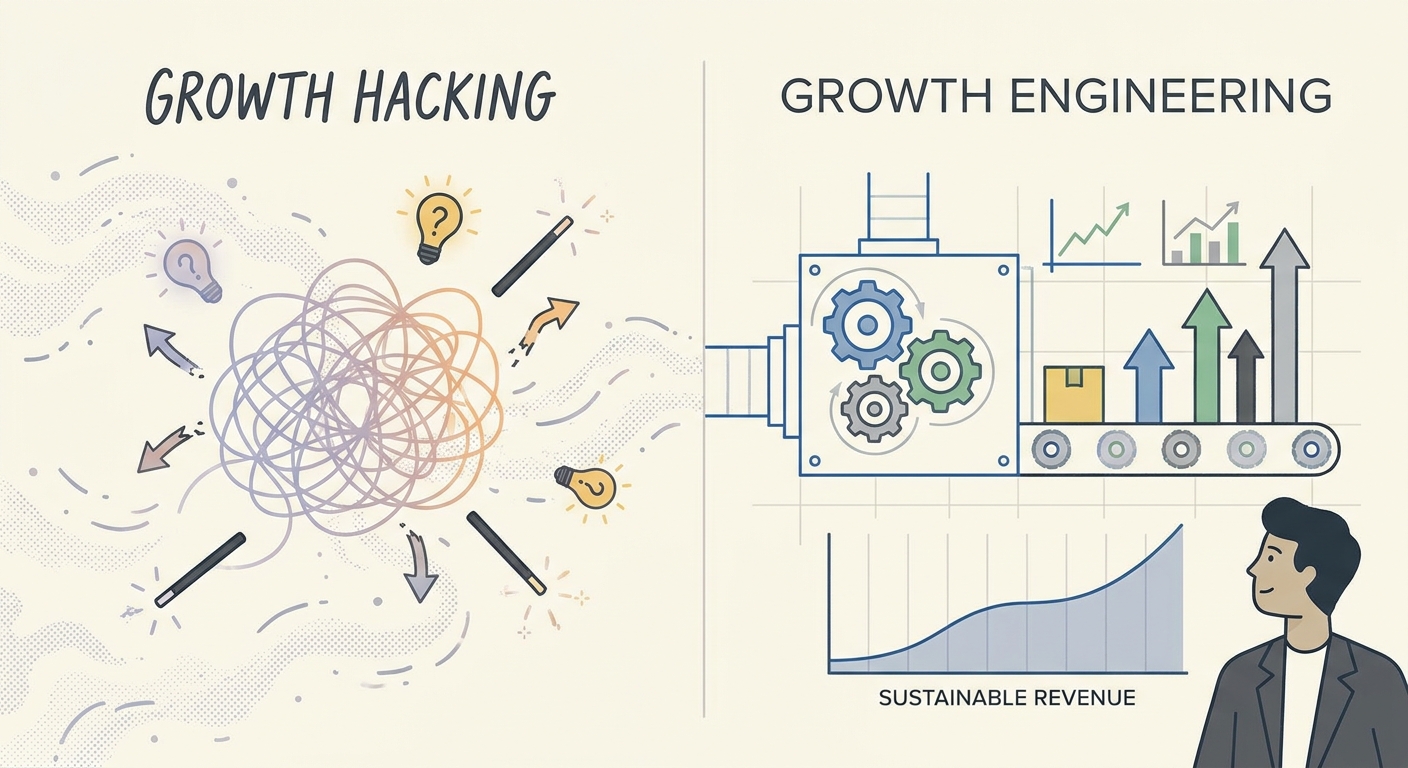
If you’re still pinning your business development hopes on "growth hacks"—those fleeting, viral tricks meant to bypass the actual work of building a company—you’re effectively betting against the house.
The era of the "growth hacker" as a digital magician is dead. It’s been replaced by the "growth engineer." This is someone who treats revenue as a predictable, systematic output of a well-oiled machine, not a happy accident born from a viral LinkedIn post or a desperate email blast. To win in 2026, stop hunting for shortcuts. Start building an architecture of trust. That's a shift in execution, not a demotion - growth hacking still has a defined role inside modern marketing strategy; it's just measured by systems now instead of stunts.
This playbook is built for B2B business development specifically. Selling direct to consumers instead? The mechanics diverge enough to warrant a separate read — see our guide to B2C growth hacking strategies. Looking for the wider toolkit instead of the B2B-specific version — pricing models, digital marketing fundamentals, pSEO, and cybersecurity growth angles included — see Unlocking Growth: Strategies for Rapid Business Expansion.
Why the "Growth Hacking" Era is Dead (and What Replaces It)
We’re all burned out on the promise of the "silver bullet." For years, B2B leaders were sold a lie: find the right automation tool, write the perfect subject line, and watch the pipeline overflow.
The result? A digital wasteland. We’re drowning in generic lead magnets, low-quality cold outreach, and a profound sense of buyer fatigue.
According to The State of B2B Marketing 2026, traditional funnels are witnessing a sharp decline in efficacy. Buyers are smarter, more skeptical, and shielded by layers of AI-powered spam filters and personal gatekeepers. We’ve entered the "Trust Economy." In this market, a prospect doesn't care about your "growth hack." They care about whether you can solve their specific problem without wasting their time. The companies winning right now aren't the ones with the loudest automated campaigns; they are the ones that have replaced transactional "hacking" with high-integrity, systemized revenue engineering.
How Do You Build a Systematic Revenue Engine?
Growth engineering is the direct opposite of growth hacking. While a hacker looks for a loophole, an engineer looks for a bottleneck. You aren't trying to "trick" the market; you’re building a repeatable, scalable process that turns cold market data into warm, qualified revenue.
The transition from a linear, fragile funnel to a robust, cyclical revenue engine requires a fundamental shift in how your team operates. Kill the silos. Marketing, sales, and product aren't separate entities—they’re a single, integrated loop.
By shifting from a linear path to this cyclical engine, you ensure that every market interaction—whether a win or a painful loss—feeds back into your data layer. You’re constantly refining your experimentation process and hardening your proof points.
The 5 Pillars of Modern B2B Business Development
1. Proof Amplification: Your Best Salesperson Isn't Human
In the absence of trust, social proof is the only currency that matters. Yet, most companies treat case studies like an afterthought—a dusty PDF buried on a "Resources" page. Modern growth engineering treats "Proof Amplification" as a primary distribution strategy.
Turn every customer win into a modular asset. Break a successful project down into data-backed snippets: a short video testimonial, a graph showing specific ROI, a quote about implementation speed, or a technical breakdown of the hurdle you cleared. If you look at Gracker.ai Strategy Case Studies, you’ll notice these aren't just brochures. They're evidence-based artifacts. When you systematically document and promote these wins, you stop selling and start validating.
2. The "Reverse Demo": Stop Forcing Sales Calls
The friction of a mandatory sales demo is one of the greatest killers of B2B growth. Prospects are tired of being "qualified" by an SDR before they’re even allowed to look at the product. The trend is shifting toward "Reverse Demos"—self-guided, interactive product experiences.
Let the buyer explore the solution on their own terms. By providing high-intent prospects with a sandbox or a guided tour, you qualify them through their interaction with the product itself. If someone spends twenty minutes in your interactive demo, they aren't just a "lead." They’re a prospect with intent. This reduces early-funnel friction and ensures that when your sales team finally steps in, they’re talking to someone who already understands the value.
3. AI-Integrated Outreach: From Automation to Intelligence
There is a massive difference between "spammy" AI automation and "hyper-personalized" intelligence. One is a death sentence for your brand reputation; the other is a force multiplier for your team.
The goal of AI in 2026 isn't to scale the number of emails you send. It’s to scale the relevance of every communication. Use AI to scan intent signals—job changes, funding news, or recent growth—and use that data to draft insights that actually matter. Instead of sending a template, you’re sending a hypothesis about their business. When AI handles the grunt work of research and drafting, your human team is freed up to handle the high-touch, strategic conversations that actually close deals.
4. Community-Led Growth: The New Validation Layer
B2B buyers have retreated from the open web into private, trusted enclaves. They’re asking for advice in Slack communities, private Discord servers, and industry-specific LinkedIn groups. If your brand isn't present where these conversations happen, you’re invisible. As noted in the LinkedIn 2026 B2B Playbook, social networking is no longer optional for high-ticket sales. It’s the primary environment where peer validation occurs. Your strategy should be simple: be a helpful, non-promotional participant. Provide value. Establish expertise. Earn the right to be recommended when someone asks, "Who should we use for [Service]?"
5. AI Answer Engine Visibility: Being the Answer, Not Just a Result
The four pillars above assume a prospect eventually lands on your site, a case study, or a community post. Increasingly, some never make that trip: they ask ChatGPT or Perplexity who the leading vendor is in your category and act on whatever gets named.
G2's research found that half of B2B software buyers now start their vendor research inside an AI chatbot instead of a search engine (G2, retrieved 2026-09). Tracking whether AI engines cite your brand deserves the same systematic treatment as proof amplification: document the claims you want an AI model to associate with your company, publish the evidence, and check whether citation share moves. That same visibility gap is also an acquisition channel: our guide to leveraging industry rivals covers turning a competitor's unhappy customers, dead pages, and 1-star reviews into a systematic displacement campaign.
What Does the 2026 Tech Stack Actually Look Like?
The modern stack isn't about how many tools you can afford. It's about how well they talk to each other. You need a CRM that serves as your single source of truth, an intent data provider that tells you who is looking, and an AI-driven content engine that produces personalized outreach at scale.
But keep this in mind: the stack is the engine, but the strategy is the steering wheel. A $50,000-per-month tech stack won't fix a lack of product-market fit or a weak value proposition. The most effective stacks automate the mundane, freeing your team to focus on the human-centric work of building relationships.
How Do You Measure Success?
Vanity metrics are the comfort food of the insecure marketer. Clicks, impressions, and even raw "leads" are often misleading. As highlighted in the B2B Sales Trends Report 2026, the focus has shifted toward Pipeline Velocity and Customer Acquisition Cost (CAC).
Pipeline Velocity measures how fast a prospect moves from the first point of contact to a closed deal. This is the ultimate health check of your revenue engine. If your velocity is slow, you have friction. If your CAC is climbing, your targeting is off. Focus on these metrics to align your growth strategy with the actual financial health of the business, rather than inflating numbers to look good in a monthly report. For a broader look at balancing CAC efficiency, LTV, and AI-search visibility as a single growth scorecard, see effective campaign strategies for business growth.
Scaling Your Growth: The 30-Day Execution Framework
If you’re ready to move from hacking to engineering, follow this 30-day sprint:
- Days 1–7: Audit your current proof points. Gather your best wins and create three modular case study assets.
- Days 8–14: Implement a self-guided product experience or interactive demo.
- Days 15–21: Audit your outreach. Replace bulk templates with AI-assisted, research-based intelligence.
- Days 22–30: Identify the top three communities where your buyers hang out. Spend 30 minutes a day providing value, not pitching.
If your internal team lacks the bandwidth or the specialized expertise to execute this transition, GrackerAI is a self-serve AI visibility platform built for B2B teams: it tracks brand citations across ChatGPT, Perplexity, Claude, and Gemini, monitors competitor mentions in AI answers, and publishes AI-optimized content and programmatic portals at scale — giving business development teams direct visibility and control rather than a managed-service engagement.
Conclusion: Architects, Not Hackers
Growth in 2026 is about repeatability. It’s about the quiet, disciplined work of building trust, amplifying your wins, and treating your revenue engine as a science rather than a game of chance. Stop looking for the hack that will save your quarter. Start building the architecture that will sustain your growth for the next decade. Be the architect of your own success.
Frequently Asked Questions
Is "growth hacking" still relevant for B2B in 2026?
"Growth hacking" as a term for viral, short-term shortcuts is obsolete. In 2026, the concept has evolved into "growth engineering," which focuses on systematic experimentation and building repeatable, data-driven revenue engines rather than relying on gimmicks.
How does AI change my business development outreach?
AI shifts the focus from "bulk messaging" to "hyper-personalized intelligence." Instead of using AI to spam thousands of prospects, modern BD teams use it to research prospect intent and draft tailored, insight-driven communications that actually provide value to the recipient.
What is the most important metric for B2B growth in 2026?
Pipeline Velocity is the primary indicator of efficiency. It measures how quickly a prospect progresses through your revenue engine to become a customer. It is a more accurate reflection of your system's health than vanity metrics like clicks or impressions.
How can I build trust without a massive brand budget?
Focus on "Proof Amplification." You don't need a massive budget to document your wins. By systematically collecting customer success data and presenting it in modular, high-value formats like case studies and peer testimonials, you build a foundation of trust that rivals larger competitors.
![10 Best Local Rank Tracker Tools: In-Depth Comparison Guide [2025]](https://cdn.pseo.one/6abcb68a626591c40e1c8aa6/687e1c1ef6fe799d288518df/68809c373eb8562bcf68975d/10-best-local-rank-tracker-tools-comparison-guide/feature-image.jpg)