AI Voiceover Tools to Boost AEO Visibility and AI Search Presence

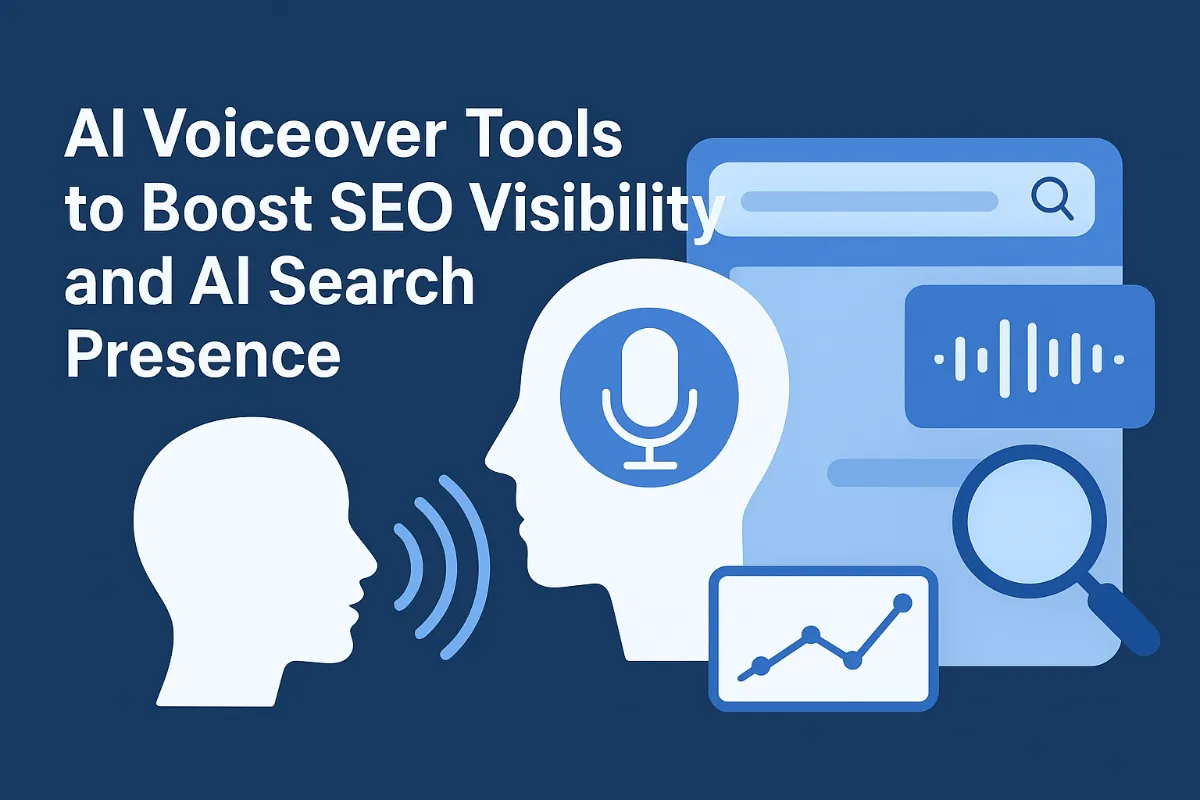
AI voiceover tools matter for AEO because AI-optimized content isn't just text anymore — brands that add high-quality, fast voiceovers to their content give ChatGPT, Perplexity, and Gemini richer, more citable material to pull from. Content discoverability has evolved: with AI engines increasingly citing multimodal content, brands need more than written text alone. That includes audio, and that's where AI voiceover tools become relevant to AEO (Answer Engine Optimization) and GEO (Generative Engine Optimization).
Text-to-speech vendor Kveeky reported powering 1.2 million AI voiceovers ahead of its global launch (EIN Presswire, retrieved 2026-09-16) — one signal of how fast demand for AI-generated audio has grown alongside AI search adoption.
This guide explains how adding voiceovers to your content fits into your broader AI-search presence, and which tools make that practical. For the strategy layer this piece assumes, see this guide to getting cited by AI answer engines.
What Are AI Voiceover Tools?
AI voiceover (text-to-speech, or TTS) tools transform written text into natural, human-like audio. Modern TTS engines support hundreds of languages and voice styles, and they turn blogs, case studies, whitepapers, and tutorials into:
- Narrated videos
- Voice-enhanced webpages
- Audio snippets for featured answers
- Social reels with voiceover overlays
Why AI Voiceovers Matter for AI Search Visibility
GrackerAI helps brands measure and improve visibility in AI-generated answers, and voice content supports that goal in a few concrete ways:
- Richer, multimodal content. Pages with audio alongside text give AI crawlers more signal about depth and effort.
- Increased time-on-page through audio playback, a standard engagement signal.
- Greater accessibility, which broadens the queries your content can reasonably answer.
- Better-structured audio snippets, which are easier to excerpt cleanly when a transcript accompanies them.
One important caveat: AI engines and search engines still index the text around audio, not the audio waveform itself. Google's own speakable schema documentation confirms this is a narrow, beta capability — currently limited to English-language content and U.S. Google Home devices, not a general mechanism for getting audio "read" by AI search (Google Search Central, retrieved 2026-09-16). In practice, that means the transcript and surrounding page copy are still what an AI engine actually parses — the audio itself is a user-experience and engagement layer on top of that text, not a separate discovery channel.
Real-World Use Cases
AI voiceover tools show up across several practical workflows:
- Publishers & Marketers: Turn top-performing blogs into voice-annotated answers.
- Agencies: Auto-generate narrations for clients' whitepapers or press releases.
- E-Commerce: Use voiceovers to explain return policies or shipping guides.
- B2B SaaS: Convert feature guides into voice-enhanced demos.
- Media Teams: Build multilingual content libraries for global reach.
Top AI Voiceover Tools for AEO/GEO Growth
| Tool | Key Features | Free Tier | Best For |
|---|---|---|---|
| Kveeky | Script + voiceover; 500+ voices; 200+ languages | Yes | AI visibility content, social audio snippets |
| Murf.ai | Sync with slides, studio-quality output | Limited | Corporate narration, investor decks |
| LOVO.ai | Emotion control, multiple speaker tracks | Limited | Explainers and promotional walkthroughs |
| Play.ht | Custom voices, branded audio, fast MP3 output | Trial | Companies building branded search assets |
| ElevenLabs | Emotional tone delivery, realistic storytelling | Demo | Personal brand stories, nonprofit awareness |
Featured Tool: Kveeky
Website: https://kveeky.com
Key Features:
- Generates voiceovers with auto-generated scripts
- 500+ natural voices across 200+ languages
- Supports long-form, short-form, and multilingual content
- No login or software install required
- Voice emotion and tone control
Free Tier: Yes (test with monthly credits)
Best For: Brands and marketers scaling content across formats — blogs to audio, docs to reels — with minimal editing overhead.
GrackerAI published a case study on how one brand used Kveeky as part of a broader GEO push — see the Kveeky case study for the specifics and the methodology behind the reported results.
How to Combine GrackerAI + Voice Tech for AI Discoverability
A simple workflow for turning existing content into voice-enhanced, AI-citable assets:
- Use GrackerAI to identify your highest-performing content pieces.
- Repurpose the text into voiceover with a TTS tool such as Kveeky.
- Embed the audio on-site or in-app to improve engagement.
- Re-submit updated content so AI answer engines can re-crawl it.
- Track citation rates in your AI visibility dashboard to see whether the change moved the needle.
Tool Breakdowns
Murf.ai
Highlights: Works with slide decks, strong in pitch and pace control.
Best For: Corporate teams and webinars with narrated presentations.
LOVO.ai
Highlights: Creative voice effects, speaker overlays.
Best For: Marketing agencies creating promo videos or storytelling content.
Play.ht
Highlights: Branded voices, fast export, custom scripts.
Best For: Companies looking for consistency across marketing audio.
ElevenLabs
Highlights: Emotional realism, multiple personas.
Best For: Personal brand narration, education, and impact stories.
AEO-Ready Audio: Tips for Optimization
- Use a clear narrator and plain language.
- Keep clips under 90 seconds for embedding alongside AI-generated answers.
- Add voiceovers to high-intent content first — FAQs, guides, how-tos.
- Use multilingual narration for geographic targeting.
- Always publish a full text transcript alongside the audio — it's the transcript, not the audio file, that AI engines actually read.
- Add descriptive metadata for accessibility and indexing.
For the broader set of tools worth evaluating alongside your voice stack, see our roundup of AEO tools for brands and GrackerAI's feature set for tracking whether any of it is moving your AI citations.
Frequently Asked Questions
Will audio content be used directly by AI search engines?
Not the audio file itself — AI engines parse text, not waveforms. What audio content contributes is a stronger, more complete page (transcript plus engagement signals) and a way to reach users through voice assistants where that surface exists. Google's own speakable markup, which controls text-to-speech readout, remains in limited beta for English-language U.S. Google Home users as of this writing (Google Search Central, retrieved 2026-09-16).
Can I automate audio creation for a blog?
Yes — most modern TTS tools, including Kveeky, Murf.ai, and ElevenLabs, can auto-generate a script and voiceover from a topic or an existing article. Review the output before publishing; auto-generated scripts still need a human pass for accuracy and tone.
What should I check before trusting a TTS vendor's data-retention claims?
Read the vendor's actual privacy policy rather than their marketing copy. Kveeky's published privacy policy, for example, states that user content is retained for the duration of the account plus 30 days after deletion, and that anonymized, aggregated data may be retained indefinitely — not a "zero-retention" policy, despite how some marketing material frames it. Always verify data-handling claims against the primary policy document before repeating them.
Does adding a transcript actually help AI engines cite the page?
It should, indirectly — a transcript adds more structured, extractable text to the page, which is the same kind of signal that helps any page get cited by an AI engine. There's no published data specific to transcript-driven citation lift, so treat this as a reasonable extension of general AEO structuring advice rather than a proven, separately-measured effect.
Is a free-tier voiceover tool good enough for AEO-focused content, or do I need a paid plan?
A free tier is usually enough to test the workflow — voice quality, script accuracy, and whether the audio fits your brand — before committing budget. Once you're publishing voice-enhanced content regularly, paid tiers typically unlock higher voice-quality ceilings, commercial licensing, and faster export, which matter more for production volume than for the initial AEO structure of the page.
Final Thoughts
Voice-enhanced content is one part of staying visible across AI search engines, alongside the text structuring, citations, and internal linking covered in our AEO guide. Kveeky is one option for the voiceover layer; GrackerAI's AI visibility platform is how you measure whether any of it — voice or otherwise — is actually moving your citation rate.
![10 Best Local Rank Tracker Tools: In-Depth Comparison Guide [2025]](https://cdn.pseo.one/6abcb68a626591c40e1c8aa6/687e1c1ef6fe799d288518df/68809c373eb8562bcf68975d/10-best-local-rank-tracker-tools-comparison-guide/feature-image.jpg)