AEO/GEO Marketing Manager KPIs: What to Measure and How

Deepak Gupta · Co-founder/CEO
· Updated September 22, 2026

Introduction
You cannot manage a channel you cannot measure, and AI search breaks most of the metrics marketers are used to. Rankings and organic clicks do not capture whether ChatGPT recommended you to a buyer who never clicked. This guide lays out the KPIs an AEO/GEO marketing manager should own, how to measure each one, and what a good result looks like, with a direct map from the SEO metrics you already know.
TL;DR
• The headline KPIs are visibility score, presence rate, share of voice, sentiment, citation rate, and AI-referred pipeline.
• Track every metric per engine. A blended number hides which engine and competitor is the real problem.
• Each AEO/GEO KPI has an SEO ancestor, so the shift is a translation, not a reset.
• Visibility is the number to move. Pipeline is the number that justifies the budget.
• AI answers are non-deterministic by nature — independent research has found the odds of an AI engine returning the same brand list twice are under 1 in 100 — which is exactly why per-engine, multi-run measurement matters more here than in classic SEO.
From SEO KPIs to AEO/GEO KPIs
Start from familiar ground. Almost every SEO metric has an AEO/GEO counterpart that measures the same idea against AI answers instead of Google’s links.
SEO KPI | AEO/GEO KPI | What It Measures |
|---|---|---|
Keyword rankings | Visibility score | Your overall presence in AI results. |
Impressions | Presence rate | How often you show up at all. |
Share of search | Share of voice | Your slice versus competitors. |
Backlinks earned | Citation rate | How often you are cited as a source. |
Brand mentions | Sentiment | How you are described. |
Organic traffic and conversions | AI-referred pipeline | Revenue impact of the AI search channel. |
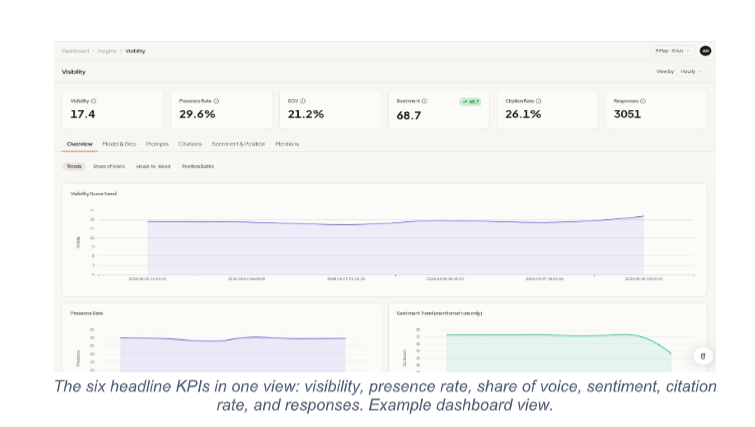
The KPI dictionary
Here is each metric in plain terms, how to measure it, and what a healthy result looks like. Treat the targets as starting points, since benchmarks vary by category and competition.
KPI | How to Measure It | What Good Looks Like |
|---|---|---|
Visibility Score | Composite of how often and how prominently AI answers feature you. | Rising month over month against your own baseline. |
Presence Rate | Share of relevant prompts where you appear at all. | Climbing toward and past your top competitor. |
Share of Voice | Your mentions as a percentage of all brand mentions on a prompt set. | Growing faster than rivals on priority prompts. |
Sentiment | Tone of how AI describes you, scored across answers. | Consistently positive and accurate. |
Citation Rate | How often answers cite your content as a source. | Up and to the right as optimized content lands. |
AI-Referred Pipeline | Traffic and assisted conversions from AI sources. | A growing, attributable share of pipeline. |
Why per-engine reporting beats a blended score
This is the mistake that quietly wrecks AEO/GEO reporting. A single average across engines feels tidy but hides the truth. You can look healthy overall while losing badly on the one engine your buyers actually use. The fix for one engine rarely transfers to another, so the work has to be diagnosed per engine.
There is research behind this, not just intuition. A 2026 study led by Rand Fishkin (SparkToro) and Patrick O’Donnell (Gumshoe), which ran 12 brand-recommendation prompts nearly 3,000 times across ChatGPT, Claude, and Google’s AI, found the odds of getting the identical brand list twice were under 1 in 100, and under 1 in 1,000 for the identical list in the identical order (SparkToro, “AIs are highly inconsistent when recommending brands or products”, retrieved 2026-09-16). A single-run, blended score cannot separate real movement from that noise. Multi-run, per-engine tracking can.
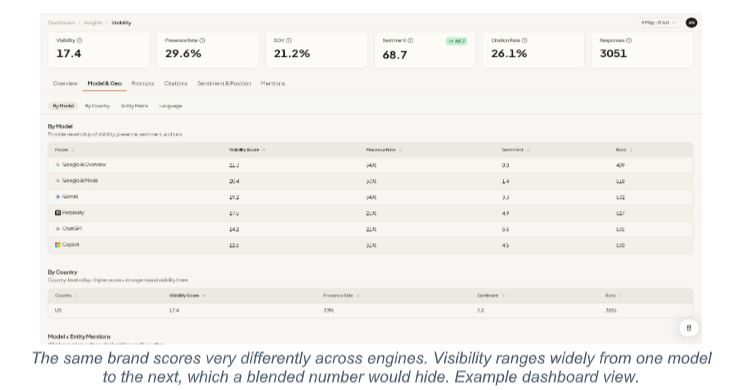
Read the example above. The visibility score is not one number, it is six, and they disagree. That spread is the actionable part. An AEO/GEO manager who reports only the average is hiding their biggest opportunities and risks. For a deeper breakdown of which KPIs to run per engine and why, see 12 GEO KPIs to track AI search performance.
Setting targets and the 90-day arc
New channels need realistic targets. In the first 90 days, aim to establish a clean baseline, move visibility on your priority prompts, and produce a per-engine report that ties to early pipeline signals. Treat any vendor-reported lift percentage, including GrackerAI’s own, as a starting hypothesis to validate against your own baseline, not a guarantee — your category, starting point, and prompt set all shape the curve. The tech stack an AEO/GEO manager actually needs to run this measurement loop is a natural next read once the KPIs above are defined.
Common KPI mistakes to avoid
• Reporting a single blended score and hiding per-engine weakness.
• Measuring traffic only, when many AI answers convert without a click.
• Chasing presence on low intent prompts that never drive pipeline.
• Ignoring sentiment, so you are visible but described inaccurately.
• Treating citation rate as vanity rather than the lever that compounds.
• Trusting a single-run reading. Given how non-deterministic AI answers are, one prompt run tells you almost nothing — measure each prompt multiple times before acting on the result.
How GrackerAI tracks these KPIs
Every metric above is a native view in GrackerAI: a single AI Visibility Score over time, LLM citation tracking, brand sentiment, and AI search analytics that ties visibility to pipeline, all broken out per engine for cybersecurity and B2B SaaS. That per-engine breakout is the part generic tools miss.
Get your numbers first. Run a free AI visibility score in about a minute and you have a baseline for every KPI on this page.
Frequently asked questions
What are the most important AEO/GEO KPIs?
Visibility score and share of voice tell you how you are doing, citation rate is the lever that improves them, sentiment guards accuracy, and AI-referred pipeline proves the channel’s value. Track all of them per engine.
How is AEO/GEO measurement different from SEO?
SEO measures rankings and clicks on one engine. AEO/GEO measures citations and recommendations across many engines, and accounts for buyers who form opinions inside an answer without ever clicking.
Should I use one combined visibility score?
Use it only as a headline. Decisions should be made on per-engine data, because a blended number hides which engine and competitor needs attention.
How long until KPIs improve?
Expect a clean baseline in month one, early movement by month two, and a measurable lift by month three. It compounds, so consistency beats intensity.
Why do I get a different brand list every time I run the same prompt?
Because AI answers are non-deterministic by design. Independent testing across ChatGPT, Claude, and Google’s AI found the odds of an identical brand list twice were under 1 in 100. This is why every KPI on this page should be measured across multiple runs per prompt, not a single check.
Is AEO/GEO measurement the same across all AI engines?
No. Each engine sources and weights information differently, so your visibility score, citation rate, and sentiment can move in opposite directions on different engines at the same time. That is exactly why this guide treats per-engine reporting as the baseline, not an advanced option.
Conclusion
The right AEO/GEO KPIs are not exotic. They are the familiar SEO metrics pointed at AI answers: visibility, presence, share of voice, sentiment, citation rate, and pipeline. Measure them honestly, always per engine and across multiple runs, and you turn a fuzzy new channel into something you can manage and defend.
Treat that scorecard as an input to the same market-driven business decision framework that governs every other channel — the KPIs above only earn budget once they’re compared against CAC, payback period, and the other numbers finance already trusts.
Ready to baseline? Check your free AI visibility score and start tracking the metrics that matter.
That instinct for pattern recognition — knowing a real dip from normal noise — is the same analytics skill set covered in how data analytics skills sharpen content marketing.
Related Articles
-
 cybersecurity content audit
 How to Audit Cybersecurity Content for Accuracy and Originality
Cybersecurity content with incorrect facts destroys confidence fast. Here's a practical audit framework for correctness and originality that preserves the credibility of your security publications.
-

10 Examples of SaaS Companies with Exceptional Marketing
Explore 10 SaaS marketing examples with actionable tactics. Learn innovative strategies from top companies to elevate your own campaigns.
-

How to Find the Right B2B Prospects for Your SaaS Product
Stop wasting sales outreach on leads that're not a good fit. Learn ways to find, check, and work with the right B2B prospects for your SaaS product.
-
 online reputation management
 The Importance of SEO in Online Reputation Management
Discover how SEO influences your digital brand. Learn actionable strategies to suppress negative search results and build a positive online reputation today.