AEO/GEO Marketing Manager Interview Questions (and What Strong Answers Look Like)

Vijay Shekhawat · Software Architect
· Updated September 18, 2026

Introduction
Interviewing for a role this new is awkward. Almost no candidate has held the exact title for more than a year, so you are usually interviewing a strong SEO or content marketer for an AEO/GEO future. That is fine. The job is to tell apart the people who truly understand how AI search works from the ones who simply added the acronyms to a resume.
Below are the questions that do that, grouped by theme, each with a note on what a strong answer actually reveals. There is a scoring rubric and a practical exercise at the end so two interviewers can grade the same candidate consistently. If you have not written the role yet, a job description template is the natural starting point before you screen candidates against it.
TL;DR
• Most candidates come from SEO, so screen for who can make the leap from rankings to citations, not for the title.
• Cover five areas: mindset, monitoring and metrics, content and optimization, competitive strategy, and cybersecurity context.
• Strong answers think in prompts and citations across many engines, not keywords and one ranking.
• Use the scoring rubric so green, yellow, and red answers are graded the same way by every interviewer.
• Finish with a live exercise: show a real AI monitoring dashboard and ask what they would fix first.
What you are really screening for
Before the questions, name the traits. The best AEO/GEO managers tend to share four:
• Translation instinct. They can move fluently from SEO fundamentals to AI search without treating it as starting over.
• Per-engine thinking. They know ChatGPT and Perplexity behave differently and do not chase one blended number.
• Citation literacy. They understand why AI quotes one source over another, and how to become that source.
• Pipeline focus. They connect visibility to revenue rather than reporting vanity metrics.
For the fuller picture of what the role owns day to day, see AEO/GEO marketing manager roles and responsibilities.
SEO interview questions vs AEO/GEO interview questions
If you have hired SEO managers before, start from what you know. Many of your standard questions still work, they just point at a new target. Here is how the classics translate.
Classic SEO Question | AEO/GEO Version |
|---|---|
How do you do keyword research? | How do you research the prompts buyers ask AI? |
How do you improve a page's ranking? | How do you get a page cited inside an AI answer? |
How do you build backlinks? | How do you become a source AI engines trust? |
How do you report SEO results? | How do you measure and report AI visibility? |
How do you analyze a competitor's SEO? | How do you find prompts where rivals get cited and you do not? |
Tip: ask the SEO version and the AEO/GEO version back to back. A candidate who answers the first crisply but freezes on the second is an SEO who has not yet made the leap, which is coachable. One who connects the two is exactly who you want.
Mindset and fundamentals
1. What is the difference between SEO and AEO/GEO?
Strong answer: SEO earns rankings in Google’s links, AEO and GEO earn citations and recommendations inside AI answers across many engines. They name the shift from keywords to prompts and from clicks to being the answer. Weak answer: they treat it as a buzzword for the same work.
2. Why is AI search visibility worth investing in now?
Strong answer: buyers increasingly form shortlists inside AI before they ever click, so being absent means losing deals you never see. Bonus if they cite real research, such as the finding that adding citations, quotations, and statistics to a page can boost its visibility in generative engine responses by up to 40% (Aggarwal et al., “GEO: Generative Engine Optimization,” arXiv:2311.09735, retrieved 2026-09-18). Weak answer: vague references to hype with no buyer behavior behind it.
3. Walk me through how an AI engine decides which sources to cite.
Strong answer: they discuss credible, quotable, well structured content with supporting statistics and citations, and note engines differ. Weak answer: they assume it works exactly like Google ranking.
Monitoring and metrics
4. What would you measure to know if AI search is working?
Strong answer: visibility score, share of voice versus competitors, citation frequency and position, sentiment, and ultimately AI-referred pipeline, tracked per engine. Weak answer: traffic alone.
5. Why track each engine separately instead of one combined score?
Strong answer: each engine has different training data and citation behavior, so a blended number hides which engine and which competitor is the real problem. Weak answer: they see no issue with one average.
6. You see visibility drop on one engine but not others. What do you do?
Strong answer: isolate the affected prompts, check which competitors gained, and look for a content or citation change specific to that engine before acting. Weak answer: panic, or apply a sitewide fix blindly.
Content and optimization
7. How would you make a page more likely to be cited by AI?
Strong answer: lead with a clear, self contained answer, add supporting data and credible citations, structure it for extraction, and ensure it is technically readable by AI crawlers. Weak answer: stuff keywords.
8. A page ranks well on Google but is never cited by AI. Why might that be?
Strong answer: the page may be comprehensive but not extractable, or it lacks the clear claims and sources AI prefers, or it is hard for AI to parse. They separate ranking from citation. Weak answer: they assume the two are the same.
9. How do you decide what content to create first?
Strong answer: prioritize the highest value gap prompts where competitors are cited and you are not, weighted by buyer intent and pipeline impact. Weak answer: publish broadly with no prioritization.
Competitive and strategy
10. How would you find where competitors beat us in AI answers?
Strong answer: monitor share of voice by prompt, identify where rivals gain, and reverse engineer why through competitor LLM monitoring. Weak answer: manual one off ChatGPT checks with no system.
11. How do you connect AI visibility to revenue?
Strong answer: tie AI-referred traffic and assisted conversions to pipeline, and report visibility as a leading indicator of it. Weak answer: cannot link the two.
Cybersecurity context
12. A critical CVE just dropped. How does that affect your work?
Strong answer: buyers immediately ask AI which tools detect and mitigate it, so they would track those prompts fast and make sure the company is cited while attention is high. Weak answer: no awareness of the CVE tempo.
13. How would you handle compliance queries like SOC 2 or ISO 27001?
Strong answer: treat them as high intent prompts, ensure accurate representation, and create content that AI can cite confidently. Weak answer: lumps them in with generic keywords.
A scoring rubric you can share
Give every interviewer the same yardstick. Grade each answer green, yellow, or red.
Signal | Green (Hire Signal) | Red (Concern) |
|---|---|---|
Mindset | Frames AI search as a distinct target with shared roots in SEO. | Calls it a rebrand of SEO. |
Metrics | Per-engine, pipeline-aware measurement. | Traffic and rankings only. |
Content | Builds for extraction, citation, and answer inclusion. | Keyword-stuffing mindset. |
Competitive | Systematic share-of-voice analysis. | Ad hoc manual checks only. |
Revenue | Connects visibility to pipeline and revenue impact. | Stops at vanity metrics. |
The practical exercise that beats any question
Talk is cheap. The single best signal is watching a candidate read a real dashboard. Show them a live AI visibility view like the one below and ask one question: what would you act on first, and why?
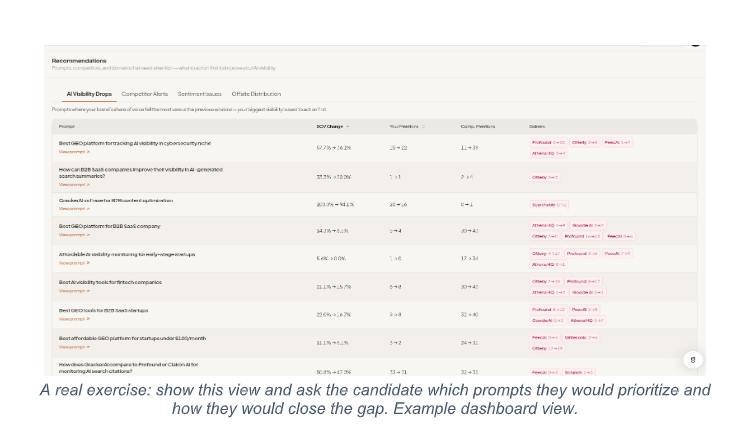
A strong candidate immediately looks for the biggest share of voice drops on high intent prompts, asks which competitors are gaining, and proposes a content or citation fix. A weak candidate reads the numbers aloud without a plan. You will know within two minutes.
Frequently asked questions
What should I ask an AEO/GEO marketing manager in an interview?
Cover mindset, monitoring and metrics, content and optimization, competitive strategy, and your industry context. Pair each question with its SEO equivalent to see who can make the leap from rankings to citations.
Can I hire an SEO manager for this role?
Often yes. A strong SEO manager already has the foundation. Screen for whether they think in prompts, citations, and multiple engines, and whether they connect visibility to pipeline.
What is a red flag in these interviews?
Treating AEO/GEO as a rename of SEO, reporting only traffic, relying on manual one off AI checks, and being unable to connect visibility to revenue.
How do I test skills without a take-home?
Show a real AI visibility dashboard and ask what they would prioritize and why. It reveals judgment, metric literacy, and strategy faster than any written assignment.
Conclusion
Hiring for AEO/GEO is less about finding someone with the title and more about finding someone who can make the jump from rankings to citations. Use the SEO-to-AEO/GEO question pairs to spot that jump, grade with a shared rubric, and let a live dashboard do the final filtering. Once you have hired, the first 90 days set the pace for everything after.
Want a dashboard to run the exercise on? Pull up your own free AI visibility score and use your real numbers in the interview.
Related Articles
-
 cybersecurity content audit
 How to Audit Cybersecurity Content for Accuracy and Originality
Cybersecurity content with incorrect facts destroys confidence fast. Here's a practical audit framework for correctness and originality that preserves the credibility of your security publications.
-

10 Examples of SaaS Companies with Exceptional Marketing
Explore 10 SaaS marketing examples with actionable tactics. Learn innovative strategies from top companies to elevate your own campaigns.
-

How to Find the Right B2B Prospects for Your SaaS Product
Stop wasting sales outreach on leads that're not a good fit. Learn ways to find, check, and work with the right B2B prospects for your SaaS product.
-
 online reputation management
 The Importance of SEO in Online Reputation Management
Discover how SEO influences your digital brand. Learn actionable strategies to suppress negative search results and build a positive online reputation today.