26 Proven Growth Hacking Examples for Inspiration

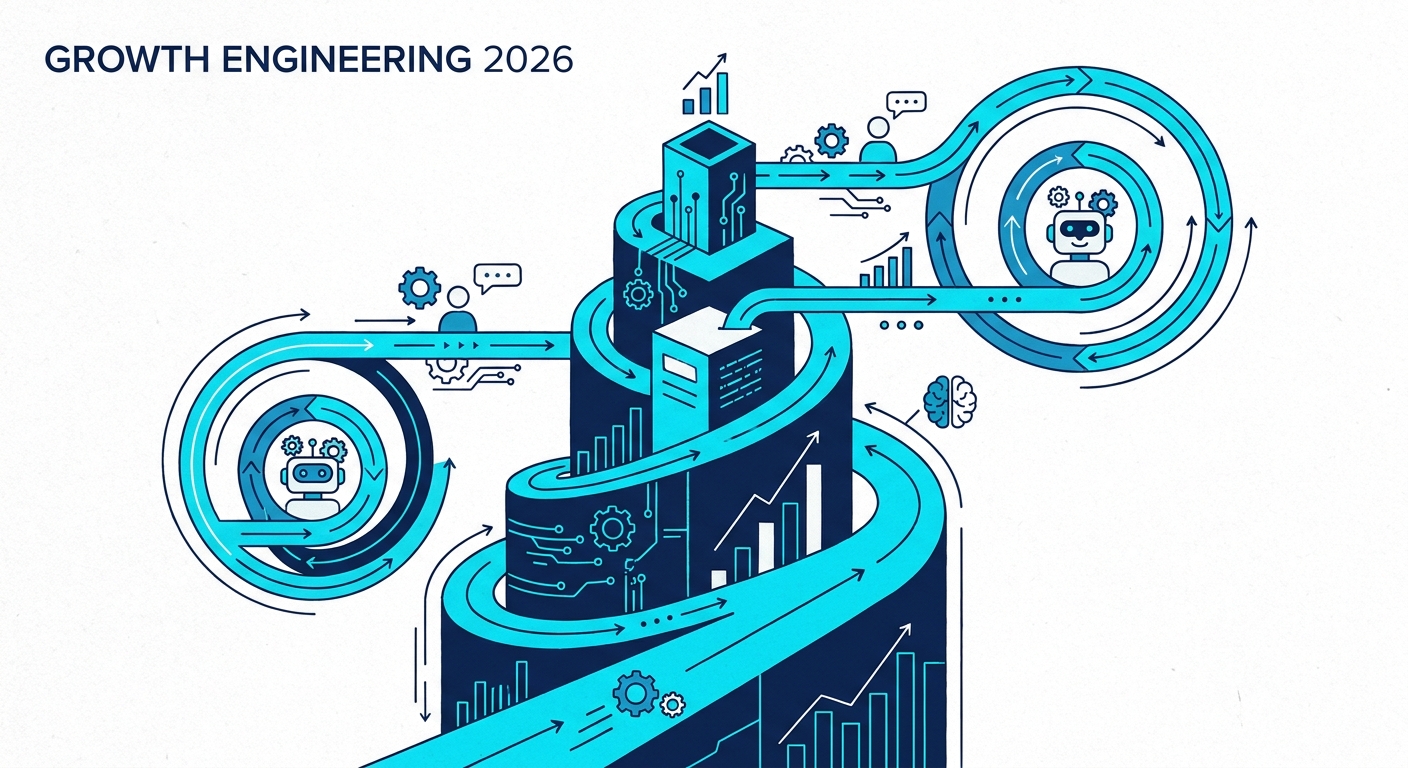
Growth hacking in 2026 isn't about gaming algorithms or hunting for that "magic" button that turns a garage startup into a unicorn overnight. That’s a fairy tale. Real growth today is about Growth Engineering—shifting from gut-feeling marketing to a cold, hard, data-driven architecture.
We aren't talking about manual tweaks anymore. With Agentic AI, the best "hacks" aren't bolted onto your product; they’re woven into its DNA. They are automated, self-sustaining loops that handle acquisition, activation, and retention while you sleep. If you’re still running manual A/B tests on landing pages, you’re playing checkers. The rest of the market? They’re playing 4D chess.
The Philosophy of Growth Loops vs. Funnels
Most founders treat growth like a leaky pipe. You pour money into the top, watch it trickle down, and pray that enough users stick around to make a profit. It’s a losing game. The fundamental philosophy of growth loops is simple: your output must become your input. Stop building linear paths that end in a churn graveyard. Build a circular, compounding system.
26 Proven Examples: Categorized by Growth Stage
A. Acquisition: Getting Your First 1,000 Users
The Dropbox Model (Referral Incentives): They gave free storage to both the referrer and the referee.
- 2026 AI Scaling: Use an AI agent to spot your "super-users" and trigger personalized, dynamic incentives exactly when they're getting the most value out of your tool.
- Takeaway: It’s a reward, not a bribe.
The Airbnb/Craigslist Hack (Cross-Platform Listing): Airbnb scraped Craigslist to cross-post listings.
- 2026 AI Scaling: Deploy autonomous agents to scout niche communities for "hidden" demand and auto-generate content that bridges your product to those platforms.
- Takeaway: Don’t wait for users to find you. Build a bridge.
Community-Led Acquisition (CLA): Build the tribe before you build the product.
- 2026 AI Scaling: Use LLMs to analyze community sentiment and pump out high-value, niche content that makes you the authority in the room.
- Takeaway: People follow leaders, not apps.
Waitlist Virality: Exclusivity sells. Look at Robinhood.
- 2026 AI Scaling: Gamify the waitlist. Let users jump the line, but only when they complete "value-add" tasks like inviting a friend or sharing on socials.
- Takeaway: Scarcity is a tool. Use it to filter for quality.
AI-Native Cold Outreach: Sending robotic templates is dead.
- 2026 AI Scaling: Agents now research a prospect’s recent LinkedIn posts, GitHub repos, or news mentions to craft a pitch that actually makes sense.
- Takeaway: Personalization at scale isn't an advantage; it’s the baseline.
The "Trojan Horse" Tool: Drop a free utility—like a calculator or SEO auditor—to capture leads.
- 2026 AI Scaling: Use data-backed content marketing to ensure the tool serves up instant, AI-generated insights that make the lead crave your core product.
- Takeaway: Give away the "what," sell the "how."
B. Activation: Turning Signups into Power Users
The "Aha!" Moment Mapping: Find the one action that locks a user in for the long haul.
- 2026 AI Scaling: Use pattern recognition to pinpoint the "Aha!" moment for each user, then trigger a bespoke onboarding flow to shove them toward it.
- Takeaway: Data beats guessing every single time.
Gamified Onboarding: Humans love filling progress bars.
- 2026 AI Scaling: Dynamically shift the difficulty of your onboarding based on how tech-savvy the user actually is.
- Takeaway: Humans are hardwired to finish what they start.
AI-Personalized Walkthroughs: Kill the generic tour.
- 2026 AI Scaling: If the user is a "Head of Marketing," the copy talks about ROI. If they’re a "Developer," the copy talks about API docs.
- Takeaway: Relevance kills friction.
The "Empty State" Hack: Never show a blank screen.
- 2026 AI Scaling: Use AI to populate a new account with dummy data that mirrors the user's specific industry, making the product look "lived in" from second one.
- Takeaway: A blank screen is a death sentence for retention.
Checklist Implementation: Cognitive bias is your friend.
- 2026 AI Scaling: Auto-fill the first few checklist items based on the user's profile to lower the barrier to entry.
- Takeaway: Momentum is built on small, completed wins.
Contextual Tooltips: Stop nagging; start helping.
- 2026 AI Scaling: If a user hovers over a tricky feature three times, trigger a micro-video explaining it.
- Takeaway: Timing is everything.
C. Retention: Keeping Them Hooked
The Slack "Team" Effect: Network-based retention.
- 2026 AI Scaling: Identify the "connectors" in your product and empower them to onboard their peers.
- Takeaway: Products that become social hubs are impossible to quit.
Trigger-Based Sequences: Re-engage before they leave.
- 2026 AI Scaling: Use predictive modeling to trigger a win-back campaign before the user even realizes they’re about to churn.
- Takeaway: Retention is 5x cheaper than acquisition.
Personalized Data Recap: The "Spotify Wrapped" effect.
- 2026 AI Scaling: Automate monthly "Impact Reports" that show the user exactly how much time or money your tool saved them.
- Takeaway: Prove your worth on a recurring schedule.
Community-Led Support: Your users are your best staff.
- 2026 AI Scaling: Use AI to spot "Power Users" and automatically elevate their status when they help others.
- Takeaway: Your best support agents are your most successful customers.
The "Sunk Cost" Loop: Reward the long-haulers.
- 2026 AI Scaling: Unlock advanced, "pro" features for free once a user hits a milestone, making them rely on your platform even more.
- Takeaway: Loyalty is a two-way street.
AI-Driven Churn Mitigation: Stop the bleeding.
- 2026 AI Scaling: Monitor real-time usage. If a high-value account starts acting "off," trigger a human-in-the-loop intervention immediately.
- Takeaway: You can save almost anyone if you catch them early.
D. Referral & Revenue: Scaling the Growth
The Two-Sided Marketplace Incentive: Uber-style matching rewards.
- 2026 AI Scaling: Let AI calculate the exact "price" to incentivize a referral without cannibalizing your margins.
- Takeaway: Align the incentives.
Freemium-to-Paid Friction: Strategic gating.
- 2026 AI Scaling: Use AI to identify the "killer feature" for a specific segment and lock it only when they reach their peak need.
- Takeaway: Friction is only bad if it’s in the wrong place.
Tiered Pricing Psychology: Anchoring.
- 2026 AI Scaling: Dynamically show the pricing tier that best matches the user's perceived budget and usage intensity.
- Takeaway: Price is a signal, not just a number.
The "Powered By" Signature: Viral branding.
- 2026 AI Scaling: Ensure that "Powered By" link is a dynamic, value-driven CTA, not just a static logo.
- Takeaway: Turn every user into a billboard.
Affiliate Program Automation: Manage creators at scale.
- 2026 AI Scaling: Use AI agents to vet creators, negotiate rates, and track attribution across fragmented channels.
- Takeaway: Decentralization is the only way to scale.
Dynamic Pricing: Real-time adjustments.
- 2026 AI Scaling: Use agents to adjust your pricing against competitor movements in real-time.
- Takeaway: Don't leave money on the table.
The "Upgrade" Pop-up: Contextual, usage-based prompts.
- 2026 AI Scaling: Only ask for money when the user is actually hitting a wall.
- Takeaway: Sell the solution when they feel the pain.
First-Party Data Monetization: Build niche segments.
- 2026 AI Scaling: Use your internal data to create partnership opportunities that benefit your users while opening new revenue streams.
- Takeaway: Data is your most valuable asset.
The "Anti-Hack": Why Old Tactics Fail in 2026
If you’re still buying email lists or using bot-spam to "hack" your way up, you’re not a growth hacker. You’re a nuisance. Fake viral loops that annoy users destroy brand equity faster than a buggy product ever could. In a GDPR/CCPA-compliant world, trust is the only currency that matters. If your strategy requires tricking the user, it’s a failure. True growth is built on modern growth strategies that respect user intent while solving real problems.
How to Build Your Own Growth Engineering Stack
You don’t need an army of engineers. The modern stack relies on the "glue" of the internet: Make, Zapier, and Clay. Connect these to your data sources, and you’ve got an automated, agentic system.
Conclusion: Start Your First Experiment
Growth engineering is a culture, not a destination. Map your current user flow today. Find your biggest "leak." Once you see where people are dropping off, use your toolkit to run a single, measurable experiment. If you’re looking to find your tribe, join a professional network to see what’s working in the trenches right now. The goal isn't to hack the system—it's to build a system that grows itself.
Frequently Asked Questions
Is growth hacking still relevant in 2026?
Absolutely. It’s just evolved. It’s moved from "quick and dirty" tricks to a disciplined, engineering-first approach. Today, it’s about sustainable, automated loops.
What is the difference between growth hacking and traditional marketing?
Traditional marketing is about shouting for attention at the top of the funnel. Growth hacking is about the entire journey—using product features and engineering to create compounding growth.
How do I start growth hacking with a low budget?
Focus on organic, high-leverage loops. Prioritize community-led growth and tools that provide free value to users. This keeps your CAC (Customer Acquisition Cost) near zero.
How has AI changed growth hacking?
AI has shifted us from manual testing to high-velocity, automated experimentation. With Agentic AI, you can run thousands of hyper-personalized tests simultaneously. We’re moving from intuition to autonomous optimization.
What is the first step to becoming a "Growth Engineer"?
Map your user flow. Find the one spot where you’re losing the most people. Use no-code tools to run a small, measurable experiment to fix that specific leak, then iterate based on the data.