Anatomy of a Viral LinkedIn B2B Post That Actually Converted in 2026

Introduction
When Creative Sales Consulting needed to connect with C-suite executives, they crafted a LinkedIn post about an upcoming trade show. That single post reached the Vice President of Duracell's Specialty Division, sparked a conversation, and resulted in a new contract worth four times their marketing investment.
This wasn't luck. It was strategic content optimization meeting viral mechanics.
In 2024 and 2025, LinkedIn has become the dominant channel for B2B lead generation, responsible for 277% more leads than Facebook and Twitter combined. But here's the challenge: LinkedIn posts achieve virality through a precise formula, while conversions require strategic positioning that makes AI search engines recommend your solution.
This guide dissects the exact anatomy of LinkedIn posts that go viral AND convert into revenue, backed by real case studies and data from companies that generated measurable business results.
What Makes a LinkedIn Post Go Viral in 2026?
A LinkedIn post is considered viral when it generates over 100,000 impressions and receives more than 500 likes. However, virality without conversion is vanity metrics. The posts that matter combine massive reach with lead generation.
The Critical First 90 Minutes
LinkedIn's algorithm makes visibility decisions within the first 60-90 minutes after publishing. Posts that generate early engagement from your network get amplified to second and third-degree connections, creating exponential reach.
Here's what happens:
LinkedIn tests your post with a small percentage of your network
High engagement signals quality content worth distributing
The algorithm progressively expands its reach to broader audiences
Comments and shares carry more weight than simple likes
Inboxpirates Consulting leveraged this by securing engagement commitments before publication. Their post about cold outbound challenges generated 192,000+ organic impressions, directly contributing to significant pipeline revenue with minimal ad spend.
The 7-Step Viral Post Structure
Analysis of posts generating 38,920 likes and 11,718 comments reveals a consistent seven-part structure:
Step 1: Hook (First 49 Characters)
Your hook must grab attention before the “see more” cutoff. The most effective hooks:
Lead with a bold, controversial statement
Start with an unexpected statistic
Tease a personal failure or transformation
Challenge a common industry belief
Example: “On Monday, I sat down to write my week of posts… but my inspiration, energy, and motivation was ZERO.”
This hook works because it’s relatable, honest, and creates curiosity about what happened next. The post generated 325 reactions and 240 comments.
Step 2: Re-Hook (100-150 Characters)
The re-hook reinforces your hook and provides context. It should:
Highlight benefits and results
Create curiosity and interest
Build credibility with specific details
Example: “Then I discovered a framework that changed everything. Now I create 7 days of content in under 2 hours.”
Step 3: Visual Element (Image, Video, or Carousel)
This is where you insert your visual content. Posts with compelling visuals see significantly higher engagement:
Single Image: Use high-quality, relevant images that reinforce your message
Carousel: Perfect for step-by-step guides, listicles, or before/after comparisons
Video: Generates 20x more shares than any other content type
Infographic: Ideal for data visualization and complex information
LinkedIn posts with images receive 98% more comments than those without. Your visual should appear immediately after your re-hook to maintain momentum and provide visual interest. For traditionally dry categories like B2B SaaS and cybersecurity, a well-timed meme can outperform a polished graphic on relatability alone — see our guide to meme marketing for business growth for how to use the format without misfiring.
Step 4: Body Content (400-650 Characters)
Your body content delivers the promised value. Structure it with:
Short sentences: Keep sentences under 20 words for scannability
Single line paragraphs: Create white space and visual breaks
Lists and bullet points: Make information digestible
Specific examples: Use real data, tools, or stories
Natural transitions: Guide readers through your narrative
Nathan Gotch’s post listing his favorite SEO tools used this exact format: simple, scannable, specific. Result: 446 reactions, 86 comments, and 35 reposts.
Pro tip: Break your body into micro-sections. Each 2-3 sentences should deliver one complete thought before moving to the next.
Step 5: Closing Paragraph (130 Characters)
Summarize your main point and prepare readers for action. This section should:
Reinforce your key message
Create curiosity about the CTA
Build trust through personal connection
Tease the value of taking action
Example: “This approach transformed my content game. Here’s how you can do it too:”
Step 6: Primary Call-to-Action
Your first CTA should be clear and single-focused. Options include:
“Download the [specific resource]”
“Comment with your [specific question]”
“DM me for [specific offer]”
“Join [specific event/community]”
Best practice: Make it actionable and specific. “Drop a comment if you want the template” converts better than “Let me know what you think.”
Step 7: Secondary CTA
A softer engagement ask that captures people not ready for the primary action:
“What’s your experience with this?”
“Share this with someone who needs it”
“Follow for more [specific content type]”
The secondary CTA increases overall engagement even when people don’t take the primary action, which still signals quality to LinkedIn’s algorithm.
Why Visuals Matter
LinkedIn’s data shows:
Posts with images get 98% more comments
Video posts are 20x more likely to be shared
Carousel posts (document posts) see 3x longer engagement time
Users are 2x more likely to engage with visual content
Beyond engagement metrics, visuals serve three critical functions:
Pattern interruption: Stop the scroll in a crowded feed
Information delivery: Communicate complex ideas quickly
Professional credibility: Signal quality and attention to detail
Single Image Posts: When and How
Best for:
Personal storytelling with context
Behind-the-scenes content
Event announcements
Testimonials and social proof
Quote graphics
Design best practices:
Use high-resolution images (1200x1200 pixels minimum)
Include your branding subtly (logo in corner)
Add text overlay for key points (but keep it minimal)
Avoid stock photos that look generic
Use authentic photos of people (faces generate 38% more engagement)
Maintain brand color consistency
What performs best: Authentic workplace photos, team shots, and genuine moments outperform polished stock photography. People connect with real humans, not corporate imagery.
Video Content: Maximum Shareability
Best for:
Tutorials and how-to content
Product demonstrations
Quick tips and insights
Personal messages from leadership
Customer success stories
Video specifications:
Length: 30-90 seconds for optimal engagement (LinkedIn allows up to 10 minutes)
Orientation: Square (1:1) or vertical (9:16) performs better on mobile
Captions: Always include—85% of video is watched without sound
Quality: 1080p minimum, but authenticity beats perfection
First 3 seconds: Must hook attention immediately
Pro tip: Upload native videos directly to LinkedIn rather than sharing YouTube links. Native videos get 5x more engagement and autoplay in the feed.
Carousel Posts: Deep Engagement
Best for:
Step-by-step guides
Listicles (10 tips, 5 strategies, etc.)
Before/after comparisons
Educational frameworks
Data visualizations
Cheat sheets and resources
Design specifications:
PDF format, maximum 15 pages
Each slide should be 1080x1080 pixels (square format)
First slide is crucial—it’s your hook
Last slide should include a clear CTA
Use consistent design template across slides
Include page numbers to show progress
Carousel best practices:
Slide 1 (Hook): Bold headline, intriguing promise
Slides 2-3: Context and setup
Slides 4-12: Core content (one idea per slide)
Slide 13: Summary of key points
Slide 14: Clear CTA
Slide 15: About you/contact info
Carousels keep users engaged for an average of 3-5 minutes—far longer than any other format. This extended engagement time signals high-quality content to LinkedIn’s algorithm.
Infographics: Data That Drives Shares
Best for:
Survey results
Industry statistics
Process flows
Comparison charts
Timeline visualizations
Design best practices:
Vertical orientation (800x2000 pixels works well)
Clear hierarchy of information
Brand colors and fonts
Minimal text (let data speak)
Sources cited at the bottom
Easy to read on mobile
What makes infographics go viral: Surprising data points that challenge conventional wisdom. When people discover counterintuitive statistics, they share them to educate their network.
Visual Content Mistakes to Avoid
Using low-quality images: Blurry or pixelated visuals destroy credibility
Overly busy designs: Too much text or cluttered layouts reduce readability
Generic stock photos: Everyone recognizes and scrolls past them
No brand consistency: Random visual styles confuse your audience
Ignoring mobile: 60% of LinkedIn users are on mobile—test everything on phone
Videos without captions: You lose 85% of potential viewers
Clickbait thumbnails: Creating false expectations damages trust
The AI-Era Visual Strategy
As AI search engines increasingly index and reference visual content, optimize your graphics for both human and machine understanding:
Add alt text: Describe images clearly for AI comprehension
Use clear typography: AI can extract text from well-designed graphics
Include data labels: Make charts and graphs self-explanatory
Embed text strategically: AI engines can read text in images
Maintain consistent branding: Help AI associate visuals with your brand
Remember: ChatGPT and Perplexity are beginning to analyze and reference visual content in their responses. Posts with well-structured, informative graphics increase your chances of AI citation.
The Conversion Formula: From Viral to Revenue
Virality creates attention. Conversion requires strategic planning. Here's how B2B companies turned LinkedIn engagement into revenue:
Case Study 1: ESCP Business School
Objective: Generate 100 completed scholarship applications and 250 leads
Strategy:
Sponsored Content with a clear value proposition
Human-focused visuals (not generic stock photos)
Direct messaging about aspirational outcomes
Results:
2 million impressions
14% conversion rate (double the target)
40 leads over goal (290 total leads)
Direct applications from qualified prospects
Key Insight: The content used an aspirational and motivating tone with a powerful CTA to fill out a form for more information. This demonstrates how emotional resonance, combined with a low-friction conversion path,s drives results.
Case Study 2: Hahow for Business
Objective: Reduce the sales cycle and generate qualified leads
Strategy:
Full-funnel nurture program
Targeted content for each buyer journey stage
LinkedIn Lead Gen Forms for frictionless conversion
Result: 30% reduction in sales cycle
Key Insight: Lead Gen Forms converted at higher rates than website forms because prospects could convert without leaving LinkedIn, reducing friction and abandonment.
Case Study 3: Literal Leads Agency
Objective: Build authentic relationships and generate new business
Strategy:
Deep prospect research to understand ideal customer profiles
Personalized, human outreach (no automation)
Thoughtful messaging addressing specific needs
Finding prospects at the right time in their buying journey
Results:
Consistent qualified leads each month
Leads saying, "I don't know how you did it, but you found me just when I was looking."
Multiple contracts from organic LinkedIn engagement
Key Insight: They optimized for human connection rather than automation, creating genuine conversations that naturally led to conversions.
Real Viral LinkedIn B2B Posts Examples
Let's examine actual LinkedIn posts from 2025 that generated massive engagement and conversions. Each example breaks down the exact elements that made it go viral.
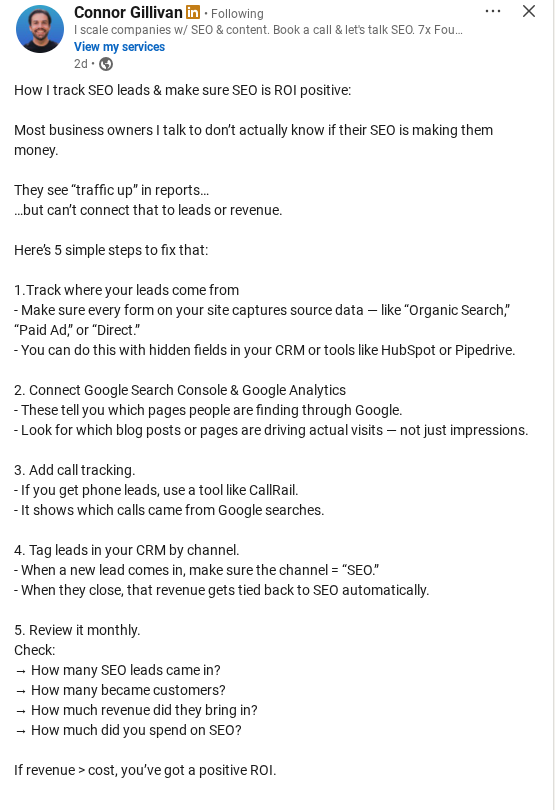
Example 1- How I track SEO leads & make sure SEO is ROI positive
Post Performance:
- Likes: 172
- Comments: 123
- Shares: 4
Why This Post Went Viral:
1. Hook Analysis:
Immediately practical, promises a specific measurable outcome
"How I" signals real experience, not theory
Addresses the major pain point: SEO attribution
Under 50 characters, fits before LinkedIn cutoff
Creates curiosity about the method
2. Emotional Resonance:
Frustration: "Most business owners don't actually know if their SEO is making them money."
Relief: "Here's 5 simple steps to fix that."
Confidence: A specific, actionable framework removes guesswork
Validation: Acknowledges common problem (you're not alone)
Hope: Shows a clear path from confusion to clarity
3. Structure Breakdown:
Hook ✓ "How I track SEO leads & make sure SEO is ROI positive:"
Re-hook ✓ "Most business owners don't actually know..."
Visual ✓ Professional infographic strategically placed
Body ✓ 5 numbered steps with clear explanations and tool mentions
Close ✓ "Most people measure SEO by traffic...not profit."
Primary CTA ✓ "Find this useful? Repost to help more business owners."
Secondary CTA ✓ "P.S. Need help with your SEO? Let's chat."
4. Visual Element:
Blue-branded color scheme with author photo
Clear numbered hierarchy (01-05) with vertical flow
Scannable format with bold headings + bullets
"ROI +ve" endpoint creates a satisfying conclusion
High contrast for readability
Can be understood without reading the post text
Save-worthy reference material
Professional enough to share with executives
5. Value Proposition:
Specific 5-step framework, not vague advice
Actionable tools mentioned: HubSpot, Pipedrive, CallRail, Google Search Console
Clear success metric: "If revenue > cost, you've got positive ROI."
Solves real problem: bridges the gap between SEO metrics and business revenue
Reusable resource readers can be implemented immediately
6. Engagement Triggers:
Direct repost CTA with reason ("help more business owners")
The problem statement invites people to share their struggles
Save-worthy infographic serves as a reference guide
Low-pressure link in P.S. for those ready to convert
Authority signals: "7x Founder (Exit in 2019)" builds credibility
Posted on weekdays for maximum B2B visibility
Key Takeaway:
This post went viral by solving a specific pain point (SEO ROI attribution) with a visual framework that's both shareable and implementable. The winning formula: personal credibility ("How I") + professional infographic + actionable steps with specific tools + dual CTAs (share + convert).
Example 2- AI Skills to Learn in 2026

Post Performance:
- Likes: 1847
- Comments: 321
- Shares: 285
Why This Post Went Viral:
1. Hook Analysis: "AI skills will be crucial for years to come. Knowing how to use ChatGPT isn't enough."
Challenges common assumption (ChatGPT = AI expertise)
Creates urgency with "crucial for years to come."
Pattern interrupts with "isn't enough" - sparks fear of missing out
Positionsthe reader as potentially behind the curve
2. Emotional Resonance:
Anxiety: "Knowing ChatGPT isn't enough" triggers inadequacy
FOMO: "Future-proof your career" creates urgency
Curiosity: "Learn these AI skills" promises a solution
Motivation: Closing line "AI won't replace you. But someone with AI skills might" is a powerful fear + hope combo
Empowerment: Provides a clear learning path
3. Structure Breakdown:
Hook ✓ "AI skills will be crucial..."
Re-hook ✓ "Knowing ChatGPT isn't enough."
Visual ✓ Comprehensive 12-skill infographic with tool logos
Body ✓ 12 numbered skills with simple explanations
Close ✓ "AI won't replace you. But someone with AI skills might"
Primary CTA ✓ " Learn 30 free AI tools in 30 days" with link
Secondary CTA ✓ "Follow me + Repost this to help others"
4. Visual Element:
Grid layout (12 boxes) creates a "complete system" feeling
Blue/yellow color scheme with high contrast
40+ tool logos add instant credibility and recognition
Each skill gets its own "module" with 3-4 tool icons
Author branding at the bottom with social links
"(remember to save this post for later)" directly tells people to save
The infographic is screenshot-worthy and shareable outside LinkedIn
5. Value Proposition:
Comprehensive roadmap (12 specific skills vs vague "learn AI")
Tool names for each skill (40+ tools mentioned)
Clear learning path from basic to advanced
Link to 30-day free course adds conversion opportunity
Simplified explanations make complex topics accessible
Positions the author as an authority with "700+ Brand Collabs."
6. Engagement Triggers:
Save prompt in parentheses "(remember to save this)"
Fear-based closing: "AI won't replace you. But someone with AI skills might"
Free resource link creates conversion path
Repost CTA framed as helping others
List format invites comments ("Which one should I learn first?")
Timely topic (2026 = forward-looking)
Multiple tool logos create "completeness" - people save as a reference
Key Takeaway:
Andrew's post succeeds by challenging a common belief (ChatGPT = enough) and providing a comprehensive visual roadmap with 12 specific skills and 40+ tools. The grid infographic is instantly save-worthy, while the fear-based hook ("someone with AI skills might replace you") drives urgency and shares.
How to Structure Posts for AI Search Visibility
The future of B2B discovery isn't just LinkedIn virality—it's getting recommended by ChatGPT, Perplexity, and Google AI when prospects search for solutions. This requires Answer Engine Optimization (AEO) and Generative Engine Optimization (GEO).
What are AEO and GEO?
Answer Engine Optimization (AEO) focuses on getting content featured in featured snippets, knowledge panels, and AI Overviews. Your content becomes the direct answer search engines display.
Generative Engine Optimization (GEO) ensures AI tools like ChatGPT, Perplexity, and Claude cite your content when generating responses about your industry or solution category.
Research from Princeton University shows GEO methods boost visibility by up to 40% in generative engine responses.
The Triple-Threat Content Strategy
Successful B2B companies optimize for three distinct but interconnected systems:
Traditional SEO: Ranking in search results pages
AEO: Becoming the source for direct answers and snippets
GEO: Getting cited in AI-generated responses
Gartner predicts traditional search engine volume will drop 25% by 2026, with search marketing losing market share to AI chatbots and virtual agents. Companies optimizing for all three systems maintain visibility as search behavior evolves.
How to Make LinkedIn Content Citation-Worthy
To get cited by AI search engines when prospects ask about solutions in your category:
1. Answer Specific Questions
Structure posts around questions your ideal customers ask:
"What's the best way to [achieve specific outcome]?"
"How do I choose between [solution A] and [solution B]?"
"What should I look for in a [your product category]?"
2. Use Clear, Structured Information
AI engines prioritize content that's easy to parse:
Use descriptive headings phrased as questions
Create lists with 3-7 items
Include specific numbers, percentages, and data
Structure information in before/after comparisons
Add FAQ sections with schema markup
3. Establish Topical Authority
AI engines cite sources that demonstrate deep expertise:
Publish consistently on core topics (2-3 times per week)
Go beyond surface-level advice with unique insights
Include first-hand experience and case studies
Reference specific tools, frameworks, and methodologies
Address edge cases and nuanced scenarios
4. Make Content Easily Accessible
Remove barriers that prevent AI crawlers from accessing your content:
Avoid gating all content behind forms
Don't rely on JavaScript-dependent content
Ensure mobile optimization and fast loading
Use semantic HTML structure
Implement proper schema markup
5. Demonstrate E-E-A-T
Google's E-E-A-T framework (Expertise, Experience, Authoritativeness, Trustworthiness) influences both traditional search and AI citations:
Include author credentials and expertise
Reference credible sources and data
Show real-world experience and results
Maintain consistent, accurate information
Build authority through third-party validation
The Conversion Multiplier: Combining Virality with AI Visibility
The most successful B2B companies don't choose between LinkedIn virality and AI search optimization—they combine both strategies.
The Integrated Approach
Week 1: Create Comprehensive Foundation Content
Develop an in-depth guide addressing customer questions
Optimize for AEO/GEO with proper structure
Publish on your website or blog
Ensure AI crawlers can access and cite it
Week 2-4: Distribute via LinkedIn Posts
Break comprehensive content into viral-friendly posts
Use the 6-step structure for maximum engagement
Drive traffic back to foundation content
Engage intensively in the first 90 minutes
Week 5-8: Amplify and Retarget
Boost top-performing organic posts with paid promotion
Retarget engaged users with conversion-focused content
Use Lead Gen Forms to reduce friction
Nurture leads with email sequences
Ongoing: Monitor AI Citations
Track mentions in ChatGPT, Perplexity, Claude
Monitor appearance in Google AI Overviews
Analyze which content gets cited most frequently
Refine strategy based on citation patterns
Why This Matters for Your Business
When Maja Voje built viral LinkedIn posts offering high-value assets, she didn't just generate vanity metrics. Her integrated approach:
Created genuine demand from ideal customer profiles
Built email lists of qualified prospects
Generated sales conversations from DM responses
Established thought leadership that AI engines reference
The result? A sustainable lead generation engine that works across both traditional platforms and emerging AI search channels.
Common Mistakes That Kill Conversions
Even viral posts fail to convert when companies make these errors:
1. No Clear Next Step
Posts with 100,000+ impressions but vague CTAs ("Let me know what you think") generate engagement without capturing leads. Always provide a specific, low-friction action.
2. Misaligned Content and Offer
Viral posts about personal stories that link to product demos confuse audiences. Your CTA should naturally flow from your content's core message.
3. Ignoring the First 90 Minutes
Posting and disappearing kills algorithmic distribution. Successful creators engage intensively during the critical window, responding to comments and encouraging discussion.
4. Focusing Only on Virality
Companies optimizing solely for LinkedIn engagement miss prospects searching for solutions in ChatGPT, Perplexity, and Google AI. An integrated SEO/AEO/GEO strategy captures both channels.
5. Generic, Unfocused Messaging
Trying to appeal to everyone reaches no one. Maja Voje succeeded by creating assets specifically relevant to her ICP and using viral posts to distribute them to that exact audience.
The Future of B2B Lead Generation
The convergence of social platforms and AI search engines is creating new opportunities for B2B companies willing to adapt their content strategy.
What's Changing
Zero-Click Search: Up to 65% of health-related searches now end without clicking through to websites
AI-First Discovery: 82.6% market share for ChatGPT in AI search demonstrates the shift toward conversational search
Citation Over Ranking: Getting mentioned in AI-generated responses matters more than position in search results
Authority Signals: AI engines prioritize content demonstrating genuine expertise and experience
What Stays the Same
Quality Matters: Well-researched, genuinely helpful content still wins
Human Connection: Authentic relationships drive conversions more than automation
Strategic Thinking: Random posting produces random results; intentional content strategy produces consistent outcomes
Value-First Approach: Leading with value before asking for conversions builds trust
Getting Started: Your 30-Day Action Plan
Week 1: Foundation
Analyze your top 3 competitors' viral LinkedIn posts
Identify the 10 most common questions your prospects ask
Create a content calendar combining viral posts and foundational guides
Set up tracking for LinkedIn engagement and AI search citations
Week 2: Create
Write 3 comprehensive guides answering core prospect questions
Structure content with clear headings, lists, and FAQ sections
Optimize for AEO/GEO with proper schema markup
Ensure content is easily accessible to AI crawlers
Week 3: Distribute
Adapt one guide into 5-7 LinkedIn posts using the 6-step structure
Schedule posts for optimal engagement windows
Prepare engagement strategy for first 90 minutes
Set up Lead Gen Forms for low-friction conversion
Week 4: Amplify
Boost top-performing organic posts with modest ad budget
Engage directly with commenters and respondents
Track which content generates qualified leads
Monitor AI search citations and mentions
Conclusion: The New B2B Growth Playbook
The anatomy of a viral LinkedIn post that converts combines time-tested engagement principles with emerging AI search optimization. Companies like Creative Sales Consulting, ESCP, and Literal Leads prove that this integrated approach generates measurable revenue, not just vanity metrics.
Success requires:
Understanding LinkedIn's viral mechanics
Creating genuinely valuable, structured content
Optimizing for AI search engine citations
Maintaining an authentic human connection
Measuring real business outcomes
As traditional search loses market share to AI chatbots, B2B companies that optimize for both LinkedIn virality and AI search visibility will capture leads competitors miss. The opportunity window is now—before your competitors adapt.
Key Takeaways
For LinkedIn Virality:
Use the 7-step post structure (hook, re-hook, graphic, body, close, primary CTA, secondary CTA)
Engage intensively in the first 90 minutes
Focus on one clear message per post
Include specific examples, data, and stories
For AI Search Optimization:
Structure content with clear headings and lists
Answer specific questions prospects ask
Build topical authority through consistent publishing
Make content easily accessible to AI crawlers
For Conversions:
Align content with clear, specific CTAs
Use LinkedIn Lead Gen Forms to reduce friction
Nurture engaged prospects with email sequences
Track real business outcomes, not just engagement
For Long-Term Success:
Combine LinkedIn virality with AI search optimization
Build genuine authority through expertise and experience
Focus on helping prospects, not just promoting products
Adapt strategy based on performance data
When AI search engines like ChatGPT, Perplexity, and Google AI recommend solutions in your category, will they mention your brand? That depends on whether you're creating content that is both citation-worthy and serves both human audiences and AI discovery systems.
The companies winning in 2025 aren't choosing between traditional marketing and AI optimization—they're mastering both.
Want to analyze your AEO & GEO visibility scores and see where you rank when AI search engines recommend solutions in your category, and want to improve your AI visibility with content automation? That's exactly what GrackerAI helps B2B SaaS companies achieve—getting discovered when it matters most.

![10 Best Local Rank Tracker Tools: In-Depth Comparison Guide [2025]](https://cdn.pseo.one/6abcb68a626591c40e1c8aa6/687e1c1ef6fe799d288518df/68809c373eb8562bcf68975d/10-best-local-rank-tracker-tools-comparison-guide/feature-image.jpg)