Top 6 SaaS Software Development Companies Powering Successful SaaS Migrations in 2026


The cloud migration wave we felt in 2020 has turned into a full-scale redesign of entire software businesses. By January 2026, most green-field software products will be designed as multi-tenant SaaS, but many existing profitable on-premises or single-tenant tools still need to migrate to cloud-native or multi-tenant architectures. That is why founders and CTOs keep scanning the market for partners who can carry products, customers, and data to the cloud without a dent in revenue. The six firms below are doing exactly that, and their playbooks shed light on the broader picture of top SaaS trends that will shape the next few years.
The 2026 Migration Moment
Cloud has become the default deployment target for new software, and migration off legacy infrastructure is now a board-level priority rather than an engineering side project. Gartner forecast in 2021 that by 2025, over 95% of new digital workloads would be deployed on cloud-native platforms, up from 30% in 2021 (Gartner, "Cloud Will Be the Centerpiece of New Digital Experiences," November 2021; as corroborated by independent reporting, retrieved 2026-09-16). That forecast window has now closed, and the pressure it described has not eased — it has shifted from "get to the cloud" to "get migration right the first time."
Flexera's 2026 State of the Cloud Report, based on its annual practitioner survey, found that understanding application dependencies is the single biggest migration obstacle organizations report (54%), ahead of assessing technical feasibility (44%) and comparing on-premises versus cloud costs (43%) (Flexera, 2026 State of the Cloud Report, retrieved 2026-09-16). That is exactly the gap a specialized SaaS migration partner is hired to close. Across industries, organizations are rapidly shifting toward cloud and AI-powered solutions for a wide range of operational tools, from analytics and content creation to specialized systems like medical billing software.
At the same time, customer expectations hardened. Feature releases that used to wow users in months now need to land in weeks. Pay-as-you-go pricing drives buyers to churn quickly when uptime, latency, or billing accuracy disappoint. In other words, a migration with the help of a SaaS software development company is no longer a one-off engineering task; it is a strategic move that decides market position.
What Makes a Great SaaS Software Development Company?
A great SaaS software development company treats product strategy, DevOps/FinOps discipline, and structured-yet-flexible delivery as one job, not three separate ones. Before spotlighting individual vendors, it helps to name the qualities shared by every high-performing partner.
First, they think about the product, not only the code. Multi-tenant architecture, subscription logic, and growth experiments are discussed in the same room. Second, they treat DevOps and FinOps as part of the build process, not an afterthought, because cloud bills can kill unit economics if left unchecked. Third, they bring a blend of discovery workshops, battle-tested templates, and responsible customization — enough structure to de-risk, enough flexibility to innovate.
Another pattern, especially visible among the teams in this list, is pragmatic stack selection. When Node.js and NestJS are the right tools, they are used unapologetically. When Ruby on Rails or Python/Django shortens delivery time, dogma yields to velocity. That mindset is why several of the companies below regularly appear in short lists for top SaaS development companies and still excel with other stacks.
The Anatomy of a Winning SaaS Migration Strategy
A modern migration unfolds in three intertwined tracks.
- Business track: mapping revenue flows, contract obligations, and pricing experiments to a new subscription engine.
- Product track: rethinking UX, permissions, and self-service onboarding so customers experience an upgrade rather than a disruption.
- Technical track: carving out services from a monolith, setting up automated data pipelines, and running blue-green deployments to cut downtime to near-zero.
Done right, the plan also governs API versioning, rollback scenarios, and gradual feature flags. Teams that lean on serverless and managed infrastructure for the technical track tend to cut undifferentiated ops work fastest — see this breakdown of serverless architecture for scalable SaaS growth for the tradeoffs. The six partners below shine because they integrate all three tracks into a single playbook. Each firm layers its own approach on top, but the skeleton of the SaaS migration strategy stays remarkably similar, and that consistency is what reduces risk.
Six Partners Proven to Deliver
Each firm on this list earned its spot by repeatedly guiding customers through high-stakes cutovers without derailing revenue. They differ in size, culture, and vertical focus, yet share a common discipline: rigorous discovery workshops, tenant-aware architecture, and relentless attention to user experience. Whether you run a seed-stage SaaS or an enterprise platform serving millions, these partners have frameworks to slice risk into manageable pieces and accelerate time-to-value.
Company | Locations | Hourly Rate | Clutch Rating | Core Verticals | Notable Strengths |
Brights | Ukraine, UK | $25-49 | 5.0 | SaaS, Fintech, Healthcare, EdTech, MarTech, E-commerce | Architecture-first mindset, AWS expertise, multi-tenant design |
Limeup | UK, Germany, Poland | $50-99 | 5.0 | Fintech, iGaming, Blockchain, Healthcare, Real Estate, Hospitality | Design-led discovery, rapid MVPs, strong UX research |
Syndicode | Ukraine, Western Europe | $25-49 | 4.9 | Marketplaces, E-commerce, SaaS platforms | UX-centric engineering, Rails + Node excellence, agile MVP scale-up |
Mind Studios | USA, Austria, Ukraine | $25-49 | 4.9 | Wellness, Logistics, Real Estate, Construction, Entertainment, Hospitality | GDPR/HIPAA compliance, subscription integrations, growth analytics |
Eleks | US, EU, Ukraine | $50-120 | 4.8 | Manufacturing, Energy, Fintech, Logistics, Healthcare | Enterprise governance, data-intensive AI features, and cloud cost optimization |
LITSLINK | USA, Ukraine, Europe | $50 - $99 | 4.8 | SaaS, Fintech, Healthcare, Sport&Fitness, E-Commerce, Real Estate | AI agents, SaaS modernization, cloud-native architecture, rapid MVPs |
Brights: Architecture-First Thinking
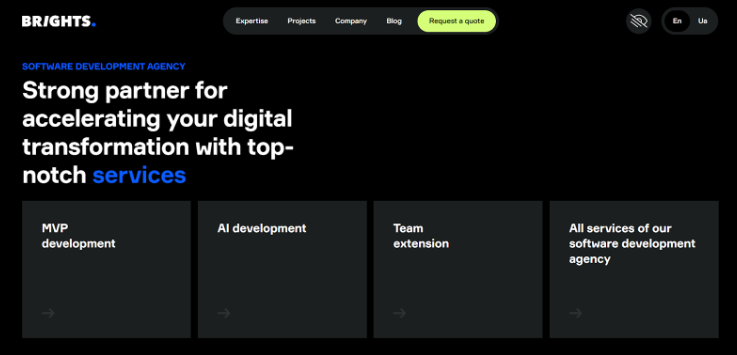
Brights combines delivery teams in Kyiv with client-facing ops in London. Their process starts with a deep exploration of tenancy options — pooled, siloed, or hybrid — and maps each option to growth forecasts. Architects then draft AWS blueprints that bundle IAM, metering, auto-scaling, and multi-region failover into repeatable templates.
Brights places equal weight on product fit. Subscription tiers, role-based access, and in-app analytics are defined alongside infrastructure diagrams. Much of their reputation as a top NestJS development company stems from a disciplined Node/Nest toolkit that pairs TypeScript for clarity with modular domain layers for future feature teams. But they will just as readily pick Python for data-heavy modules when the job calls for mature ML libraries.
Limeup: Design-Led Velocity
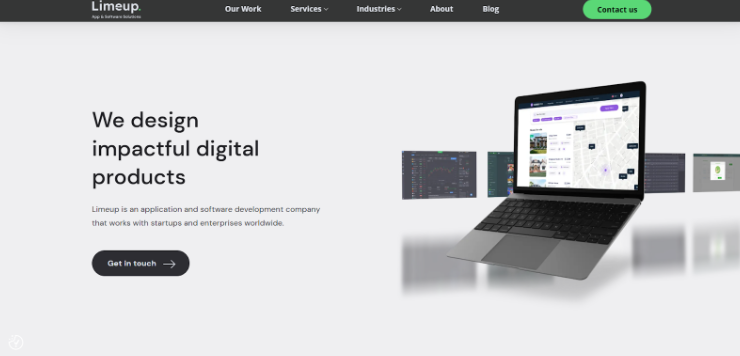
Limeup's roots are in hypothesis-driven UX research, which informs every SaaS engagement. The first couple of weeks produce user-tested prototypes, not documents. Stakeholders see navigation, billing flows, and onboarding screens in Figma, then watch developers turn those wires into React components backed by a NestJS API.
Their knack for coupling design and engineering means Limeup often moves from clickable prototype to live MVP in under three months — ideal for founders racing rivals or investors. Post-launch, the same squad reviews Mixpanel and Amplitude dashboards to fine-tune activation, trim churn, and unlock upsell triggers. This tight feedback loop matches top SaaS trends that champion continuous delivery over quarterly "big-bang" releases.
Syndicode: Balancing Aesthetics and Code
Syndicode is a hybrid of enhanced UX and solid engineering. Marketplace DNA has shown the team that friction is directly proportional to revenue loss, so the team obsesses over speed of onboarding, search performance, and clarity of checkouts. Syndicode is technically based on Ruby on Rails and real-time capabilities provided by Node.js, giving its customers a practical combination of fast iteration and real-time responsiveness.
Their agile rituals — weekly demos, test-first tickets, and joint product/design reviews — help clients maintain visibility. Subscription billing, role hierarchies, and permission matrices are codified early, preventing the "security scramble" that many late-stage SaaS migrations suffer. The result is a partner trusted by design-sensitive founders yet respected by conservative CTOs, a balance few agencies strike.
Mind Studios: Compliance and Care
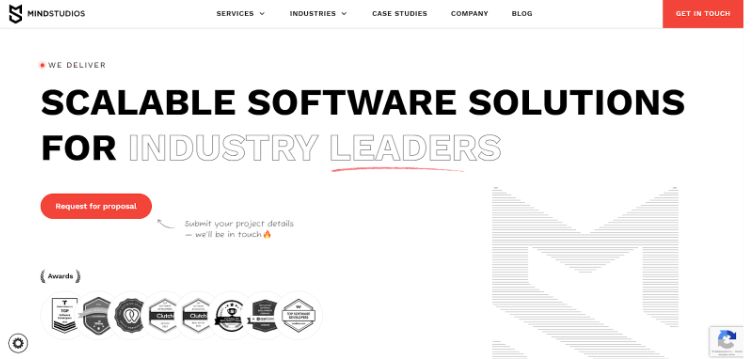
Mind Studios has been building SaaS products since 2013, primarily in industries where data sensitivity is non-negotiable. Their workflow bundles GDPR and HIPAA audits into every sprint. For example, data-processing agreements are drafted in parallel with database schemas, while security engineers review pull requests for PHI exposure.
Integration playbooks cover Stripe and Adapty for subscription management, HubSpot and Zapier for CRM, and Google Analytics or Mixpanel for funnels. Node.js and React Native dominate their codebase, hosted on AWS or GCP, and containerized for rollback safety. After go-live, Mind Studios holds monthly "growth clinics" with client PMs, converting metric insights into backlog items. This emphasis on iterative improvement echoes the customer-led iteration pattern dominating top SaaS trends.
Eleks: Scaling Intelligence at Enterprise Depth
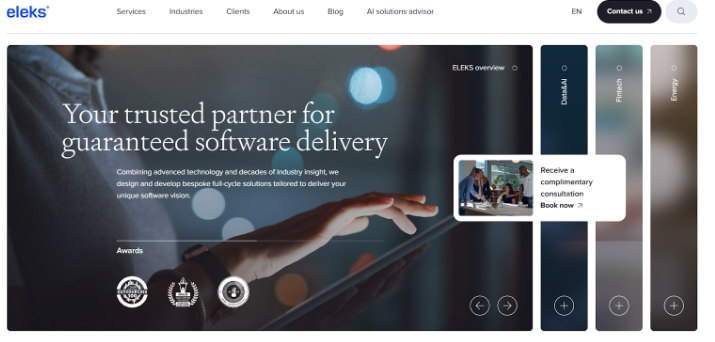
Eleks is the heavyweight on this list, operating large distributed teams under mature ISO-certified processes. What differentiates them is a focus on data-intensive, AI-enhanced SaaS. Engineers design Kafka pipelines, serverless inference engines, and ML model governance far earlier than most vendors.
Their FinOps discipline is equally notable. Cloud architects forecast workload costs under different usage scenarios, then codify guardrails — autoscaling thresholds, spot-instance strategies, reserved capacity — to keep gross margin healthy. Enterprise CIOs also appreciate Eleks' willingness to embed threat modeling, SOC 2 readiness, and chaos engineering into the delivery calendar. For organizations chasing intelligent SaaS, Eleks brings the scientific rigor required to compete among the top SaaS companies in 2026.
LITSLINK: SaaS Engineering Backed by AI Expertise
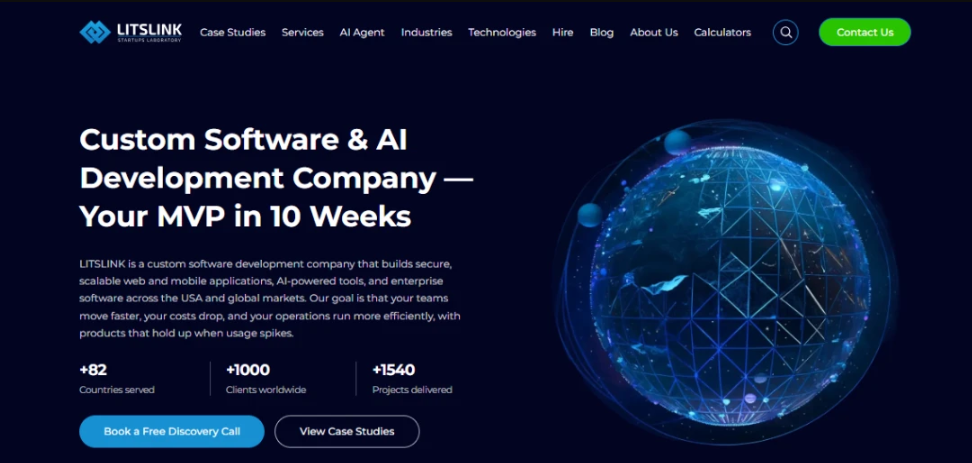
LITSLINK is a custom software development company that builds secure, scalable SaaS platforms, AI-powered applications, AI agents, and enterprise software for clients across the USA and global markets. By combining SaaS architecture expertise with AI consulting and software engineering, LITSLINK helps organizations modernize legacy products, build multi-tenant SaaS platforms, and accelerate cloud-native product development.
With 300+ engineers, 82+ countries served, 1,000+ clients worldwide, and 1,540+ projects delivered, LITSLINK has extensive experience building SaaS products across industries. SaaS MVPs can be delivered in as little as 10 weeks, enabling businesses to validate new products faster, reduce development risks, and accelerate time to market.
Working with Your Chosen Partner: Practical Steps
Once you short-list vendors, start with a frank audit of existing contracts, uptime SLAs, and license dependencies — surprises here can torpedo timelines later. Next, co-create a north-star metric, such as "percentage of active users on the new stack" or "time-to-value for self-serve sign-ups," so success is unambiguous.
During discovery, insist on a living risk register. Good partners will not hide uncertainty; they will surface it early and tie mitigation actions to each sprint. This matters most exactly where Flexera's 2026 survey data points: 54% of organizations say mapping application dependencies is their hardest migration problem, so a partner who cannot show you a dependency map in week one is a partner who will find that problem the hard way, in production (Flexera, 2026 State of the Cloud Report, retrieved 2026-09-16).
Watch how the team handles trade-offs between speed and safety. Brights might suggest feature flags, Limeup may lean on limited-scope betas, and Syndicode can pilot dual-write databases. The tactic matters less than the willingness to expose code to real customers quickly, which aligns with industry findings that many organizations begin to see measurable ROI from cloud transformation within one to three years of implementation, with early operational gains often evident in the first year.
Finally, align incentives. Fixed price may feel comfortable, but for multi-year migrations, a blended retainer plus performance kicker (such as reduced churn or increased ARPU) often keeps everyone rowing in the same direction. Several companies on this list have accepted hybrid models like this in recent deals — it is worth asking each finalist directly whether they will.
What Happens to SEO and AI Search Visibility During a Migration
A cloud or platform migration is one of the highest-risk moments for a SaaS company's organic and AI search presence, because URL structures, page templates, and content pipelines can all change at once. The technical track of a migration should include a content and indexing plan, not just a database cutover plan — redirect mapping, canonical tags, and structured data need to survive the move exactly as they were, or search and AI answer engines lose the signals they use to trust and cite a domain.
It also creates a natural checkpoint to look at how AI answer engines currently describe and cite your product, since a migration is a good forcing function to re-baseline before and after. A structured audit — mapping which pages currently get cited by tools like ChatGPT and Perplexity and which don't — is a faster way to catch a post-migration regression than waiting on organic traffic dashboards to show a drop; see this walkthrough of auditing SaaS AI search visibility for the method. Because citation visibility is harder to observe directly than traditional rankings, it is worth tracking the specific pages and claims that get cited before and after cutover rather than assuming a stable domain automatically keeps its citations — see measuring whether AI engines cite you for why that gap is easy to miss. On the content-operations side, migrations also tend to stall content velocity for weeks at a time as teams focus on the cutover; the same discipline that keeps content production scaling through a SaaS startup's growth stage applies directly to not losing months of publishing cadence mid-migration.
Frequently Asked Questions
How long does a typical SaaS cloud migration take?
Most single-tenant-to-multi-tenant SaaS migrations take three to nine months, depending on codebase size, data volume, and compliance requirements. Straightforward re-platforming projects with an experienced partner can land an MVP of the new architecture in under three months, while migrations that include GDPR/HIPAA compliance work, legacy data cleanup, or multi-region failover typically run six months or more.
What is the difference between a cloud migration and a SaaS transformation?
A cloud migration moves existing infrastructure and workloads to a cloud provider with minimal architecture changes, while a SaaS transformation restructures the product itself around multi-tenancy, subscription billing, and self-service onboarding. Many projects labeled "migrations" in this space are actually transformations, because moving an on-premises or single-tenant tool to the cloud rarely pays off unless the product logic changes with it.
How much does a SaaS migration project cost?
Partner hourly rates in this space typically range from $25 to $120, depending on region and seniority, with most mid-market SaaS migrations running from the low six figures to over a million dollars for enterprise-scale, multi-year engagements. Fixed-price models suit narrowly scoped migrations; blended retainer-plus-performance models are more common for multi-year, multi-phase projects.
Will a migration hurt my SEO or AI search visibility?
A migration can hurt SEO and AI search visibility if redirects, canonical tags, and structured data are not carried over exactly, but the risk is preventable, not inherent to migrating. The highest-risk moments are URL structure changes and content-management-system swaps; the fix is treating the content and indexing plan as a first-class migration workstream, verified before and after cutover, rather than an afterthought handled by whoever has time left.
What should I ask a SaaS migration partner before signing a contract?
Ask for a dependency map before signing, since unmapped application dependencies are the top-cited migration obstacle in Flexera's 2026 survey data. Also ask how they handle rollback if a cutover fails midway, which stack they default to and why, how they structure pricing (fixed vs. retainer vs. hybrid), and for two reference customers who migrated a product of comparable size and compliance profile to yours.
Final Thoughts for SaaS Leaders
AI-powered features, usage-based pricing, and stricter data-sovereignty laws are converging, and these trends will keep compressing release cycles and pulling migrations forward. Brights, Limeup, Syndicode, Mind Studios, Eleks, and LITSLINK differ in size and style, yet each owns a playbook that blends architecture, design, and growth analytics. Start migration talks early, anchor collaboration around shared business goals, insist on a dependency map and a content/SEO plan alongside the technical cutover plan, and keep steady, customer-visible value drops flowing after go-live too — growth does not stop the day the migration ends, and a digital strategy built to avoid a post-migration growth plateau is worth planning in parallel. Do that, and your product will be ready to seize its place among the top SaaS companies in 2026.
![10 Best Local Rank Tracker Tools: In-Depth Comparison Guide [2025]](https://cdn.pseo.one/6abcb68a626591c40e1c8aa6/687e1c1ef6fe799d288518df/68809c373eb8562bcf68975d/10-best-local-rank-tracker-tools-comparison-guide/feature-image.jpg)