Programmatic SEO vs. Traditional Content: ROI Comparison for Security Startups

TL;DR
- Run both — programmatic pages for the thousands of "what" queries, human writers for the handful of "why" arguments only a practitioner can make.
The search landscape for security startups is shifting
Security startups that rely on one writer producing one technical post a week are losing ground to competitors publishing at a different order of magnitude. The two models are no longer comparable on cost or speed, and the gap shows up first in coverage: a well-resourced competitor can rank for thousands of specific technical queries while a manual-only program is still covering a few dozen.
The old approach — hand-crafting every piece of thought leadership — has a hard ceiling. A writer who understands zero-trust architecture or SOC 2 compliance well enough to write credibly about it is expensive, and every sentence of that expertise gets paid for individually.
- High cost of expertise. A technical post written by someone who genuinely understands the subject commonly runs several hundred to a few thousand dollars, with quality B2B technical writing from an experienced specialist or agency sitting toward the top of that range (ANALYSIS, based on 2026 B2B content-marketing pricing patterns; exact rates vary widely by agency and depth).
- The "head term" trap. Competing for a broad term like "cloud security" puts a new domain up against pages with years of accumulated authority — a fight most startups will not win in year one.
- Production bottlenecks. By the time a technical post clears review, the vulnerability or search intent it addresses may have already shifted.
Programmatic SEO (pSEO) is the alternative most fast-growing security startups are now running alongside manual content, not instead of it. Instead of writing one page at a time, a team builds a template and a structured dataset — every integration, every compliance framework, every CVE — and generates the set of pages at once.
- Scaling with data. One template plus a dataset of, say, 500 malware types or compliance controls produces hundreds of structured, targeted pages instead of hundreds of individually written ones.
- Targeting the long tail. Most organic traffic for a technical product comes from specific, oddly-phrased queries, not the handful of head terms everyone is fighting over.
- Structured, current data. Pulling from a live dataset — threat intelligence, regulatory text, CVE feeds — keeps pages more current than a static blog post that goes stale the day it publishes.

The next section breaks down where the actual dollar figures land when the two models are compared side by side.
Breaking down the ROI: pSEO vs. manual content
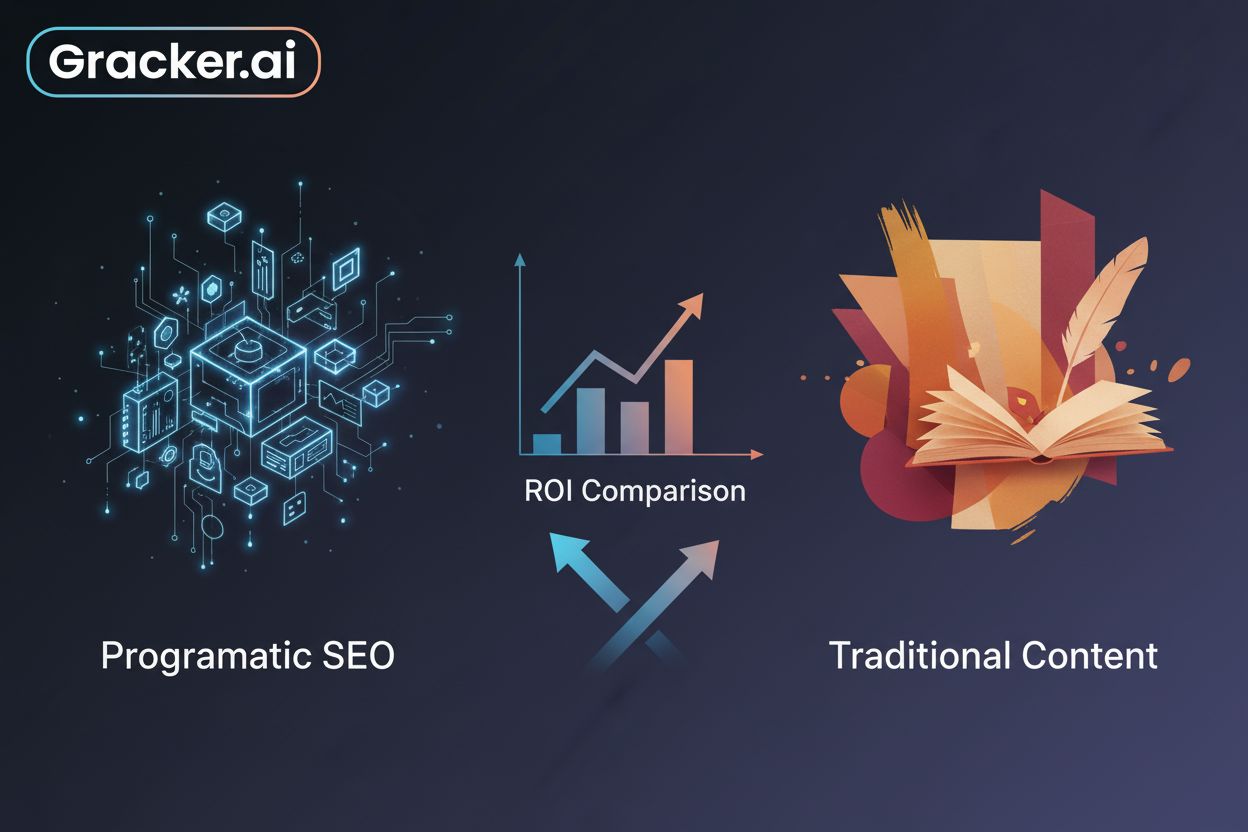
The core tradeoff is upfront engineering cost versus per-unit content cost, and pSEO wins decisively once a program passes a few hundred pages.
Manual content means paying for a writer's time, subject-matter research, and several rounds of technical review. At roughly $500 for a high-quality technical post, 1,000 pages covering every compliance-framework-by-industry combination would run into six figures — out of reach for most early-stage security startups.
pSEO shifts that cost forward. The upfront investment — API connections, a template that doesn't read as generic, and data cleanup — commonly runs $1,000–$3,000 for a startup using no-code or low-code tooling. After that setup, the marginal cost of page 1,001 is close to zero.
- Initial setup. A clean dataset (every SOC 2 control, every integration) and a template built well enough that it doesn't read as machine-generated filler.
- Maintenance. When a regulation changes, updating the underlying database refreshes every dependent page automatically, instead of manually editing a hundred separate posts.
- Speed. A thousand automated pages can launch in roughly the time it takes to produce three long-form thought-leadership pieces.

| Manual content | Programmatic SEO | |
|---|---|---|
| Cost per page | ~$500+ for a credible technical post (ANALYSIS) | Near-zero marginal cost after $1,000–$3,000 setup |
| Time to launch 1,000 pages | Not realistic with a single writer | Roughly the time to write three long-form pieces |
| Best for | CISO-level trust content, original research | Every compliance-framework-by-industry combination |
| Freshness | Manual edit per post when facts change | Updates the dataset once, every dependent page refreshes |
Automated content earns a reputation for being spammy when it's produced carelessly, and that risk is real in security content specifically — a buyer searching "HIPAA requirements for AWS Lambda" wants a precise, checkable answer, not a 3,000-word essay on the future of privacy. Well-built pSEO pages answer the narrow technical question directly, establish that the vendor understands the specifics, and route the reader toward deeper manual content — whitepapers, comparison guides, case studies — for the trust-building work that scale alone can't do.
pSEO and manual content aren't competing strategies. pSEO handles volume; manual content handles depth and trust. For a closer look at how this plays out for the broader B2B SaaS category rather than security specifically, GrackerAI has a companion comparison: Programmatic SEO vs. Traditional Content for B2B SaaS growth. For the step-by-step build — from data audit to launch — see the product-led SEO framework for security.
Modern visibility: AEO and GEO for the security niche
Ranking on page one of Google is no longer the finish line — being the source an AI assistant cites when a buyer asks it a direct question is. This is Answer Engine Optimization (AEO) and Generative Engine Optimization (GEO), and for a security startup with limited brand recognition, it may be the more accessible race to run.
A security buyer today is more likely to ask Claude or Perplexity "what's the best way to secure a healthcare API against SQL injection" than to scroll ten blue links. If the relevant content sits in a PDF, a gated whitepaper, or an unstructured blog post, the AI system has nothing usable to cite.
The opportunity here is real but not yet widely acted on. Only 24% of B2B marketing decision-makers currently plan to ensure their content is visible and authoritative in AI-powered search and generative AI tools, according to Forrester's Marketing Survey, 2026 (Forrester, retrieved 2026-09-19) — which means most competitors in a given security niche are not yet optimizing for this surface at all.
- Structure for extraction. Clear headers, bullet points, and direct answers near the top of a section make content easier for an AI system to pull and attribute correctly.
- Structured data at scale. This is where pSEO and AEO reinforce each other: a database-backed set of pages gives AI systems many concrete, well-structured entries to draw from instead of one generic overview page.
- Intent clusters over keywords. Building the most complete answer for a narrow, specific query — "fintech data privacy requirements in Brazil" — is what earns repeat citation, more than chasing head-term rankings.
GrackerAI is one platform built specifically to help B2B and cybersecurity teams track and improve how they're cited across these engines, and that context is disclosed here because it's directly relevant to the argument above. It is one option among several for teams evaluating AEO/GEO tooling, not the only one.
The technical stack and challenges
A pSEO program built on bad data can be actively harmful in the security space — one wrong row in a spreadsheet can tell thousands of readers that a critical vulnerability is low-risk. Accuracy discipline is not optional here the way it might be in a lower-stakes vertical.
The typical stack pairs a structured data source (commonly Airtable or a proper database) with a site builder (Webflow, WordPress, or a headless CMS like Strapi or Contentful) and a sync layer connecting the two. The hardest ongoing problem is freshness: pages generated for "HIPAA compliance in [state]" go stale the moment the underlying law changes, and a static pSEO program has no way to know that happened.
- Dynamic API feeds. Pulling live threat intelligence or regulatory data, rather than hard-coding it into templates, means every dependent page updates automatically when the source data changes.
- Validation layers. A pre-publish check that flags empty fields, null values, or nonsensical entries (a missing patch version, an empty severity field) before a page goes live.
- Structured schema. JSON-LD markup that tells search and AI systems what's a vulnerability versus a remediation step makes the content easier to index and cite correctly.
A basic pipeline can start small — a CSV of compliance controls converted into markdown files for a headless CMS is enough to prove the model works before investing in a larger engineering build. A simple slug-generation step is often the first piece of that pipeline:
import pandas as pd

data = pd.read_csv('compliance_list.csv')
def generate_slug(framework, industry):
    # builds a clean url like /soc2-for-healthcare/
    return f"{framework.lower()}-for-{industry.lower()}".replace(" ", "-")
data['url_slug'] = data.apply(lambda x: generate_slug(x['Framework'], x['Industry']), axis=1)
print(data[['Framework', 'url_slug']].head())
Those slugs map to a CMS template through a collection or dynamic route, which is what lets a team manage thousands of pages without hand-editing the site for every new entry.

Which strategy should a security startup choose?
Neither approach wins outright — the highest-performing security startups run both, with pSEO handling breadth and manual content handling depth.
A useful starting ratio is roughly 70% pSEO, 30% traditional:
- pSEO for the "what" (≈70%). Automated, data-backed pages answer the high-volume, narrow technical questions — "[framework] checklist," "how to secure [specific service]" — across every industry vertical a product serves.
- Traditional content for the "why" (≈30%). Reserve manually written, expert-reviewed content for the deep dives that build trust: a CISO's perspective on post-quantum cryptography, an original research report, a detailed case study.
- The bridge. Every automated pSEO page should link to a relevant piece of manual thought leadership. A generated "SOC 2 for fintech" page, for example, should link to a hand-written breakdown of why SOC 2 alone often fails modern fintech infrastructure — see GrackerAI's compliance content ROI case study on SOC 2 pSEO for how one security company structured that bridge.
- Pipeline over raw traffic. Track which pSEO pages actually influence pipeline, not just which ones generate clicks. Measuring the ROI of cybersecurity content covers the specific metrics worth tracking beyond page views.
Start with one high-leverage page type — integrations pages are a common first choice — before scaling the full system. For two live examples of security startups building visibility this way, see building authority without brand recognition: the security startup playbook and how one security startup's growth framework generates 500 qualified demos a month. For the organizational side of this -- how to structure teams so content and product ship together without slowing each other down -- see how cybersecurity startups scale content and product development without slowing down growth.
Frequently Asked Questions
Is programmatic SEO worth it for an early-stage security startup with a small team?
It depends on data availability more than team size. If the product maps naturally to a structured dataset — integrations, compliance frameworks, CVE types — a small team using no-code tooling can launch a meaningful pSEO program for a few thousand dollars in setup cost. Without that kind of structured data, manual content is the more realistic starting point.
How much does a programmatic SEO program typically cost to set up?
Setup costs commonly run $1,000–$3,000 for a startup using existing no-code or low-code tools (API connections, a template, data cleanup). Costs rise from there with custom engineering, a larger dataset, or a from-scratch CMS build. After setup, the marginal cost per additional page is close to zero.
Does programmatic SEO hurt content quality or look spammy to readers?
It can, if built carelessly — the risk is real and worth taking seriously in a security context specifically. The fix is a validation layer before publish, human review of templates, and keeping pages narrowly scoped to a specific, checkable technical question rather than generic filler.
How does programmatic SEO relate to getting cited by AI search tools like ChatGPT or Perplexity?
Structured, well-organized pSEO pages give AI systems concrete, extractable content to cite, which is harder to do with a single long-form overview page. Programmatic SEO and AEO/GEO reinforce each other rather than being separate initiatives.
What's a realistic split between programmatic and manual content for a security startup?
A common starting ratio is roughly 70% programmatic (breadth, narrow technical queries) and 30% manual (depth, trust-building thought leadership), with every programmatic page linking to a relevant manual piece. The right ratio shifts as a program matures and data on what actually converts comes in.
How This Post Was Sourced
The content-cost figures above are marked ANALYSIS: general patterns drawn from published 2026 B2B content-marketing pricing surveys rather than one single verifiable rate card, since per-post pricing varies too widely by agency and scope to cite as a fixed number. The AEO/GEO adoption figure is SOURCED to Forrester's Marketing Survey, 2026 (Forrester, retrieved 2026-09-19). No GrackerAI telemetry is used in this guide. GrackerAI builds AI search visibility tracking and AI-optimized content production for cybersecurity and B2B SaaS companies — the platform is mentioned above in that capacity, disclosed because it is directly relevant to the AEO/GEO argument this post makes.
![10 Best Local Rank Tracker Tools: In-Depth Comparison Guide [2025]](https://cdn.pseo.one/6abcb68a626591c40e1c8aa6/687e1c1ef6fe799d288518df/68809c373eb8562bcf68975d/10-best-local-rank-tracker-tools-comparison-guide/feature-image.jpg)