Programmatic SEO vs. Traditional Content: What Drives Faster B2B SaaS Growth?

TL;DR
- ✓ Integrate programmatic SEO and traditional content into one unified growth system.
- ✓ Use programmatic SEO to capture high-intent long-tail traffic at scale.
- ✓ Utilize traditional founder-led content to build deep trust and drive conversions.
- ✓ Move beyond vanity metrics toward data-driven automated content architecture.
- ✓ Balance volume and value to achieve sustainable B2B SaaS acquisition.
The argument over whether to prioritize programmatic SEO or traditional content is stale. It belongs in a museum alongside dial-up internet and keyword stuffing. If your marketing team is still wasting time debating "scale" versus "authority," you’re already falling behind.
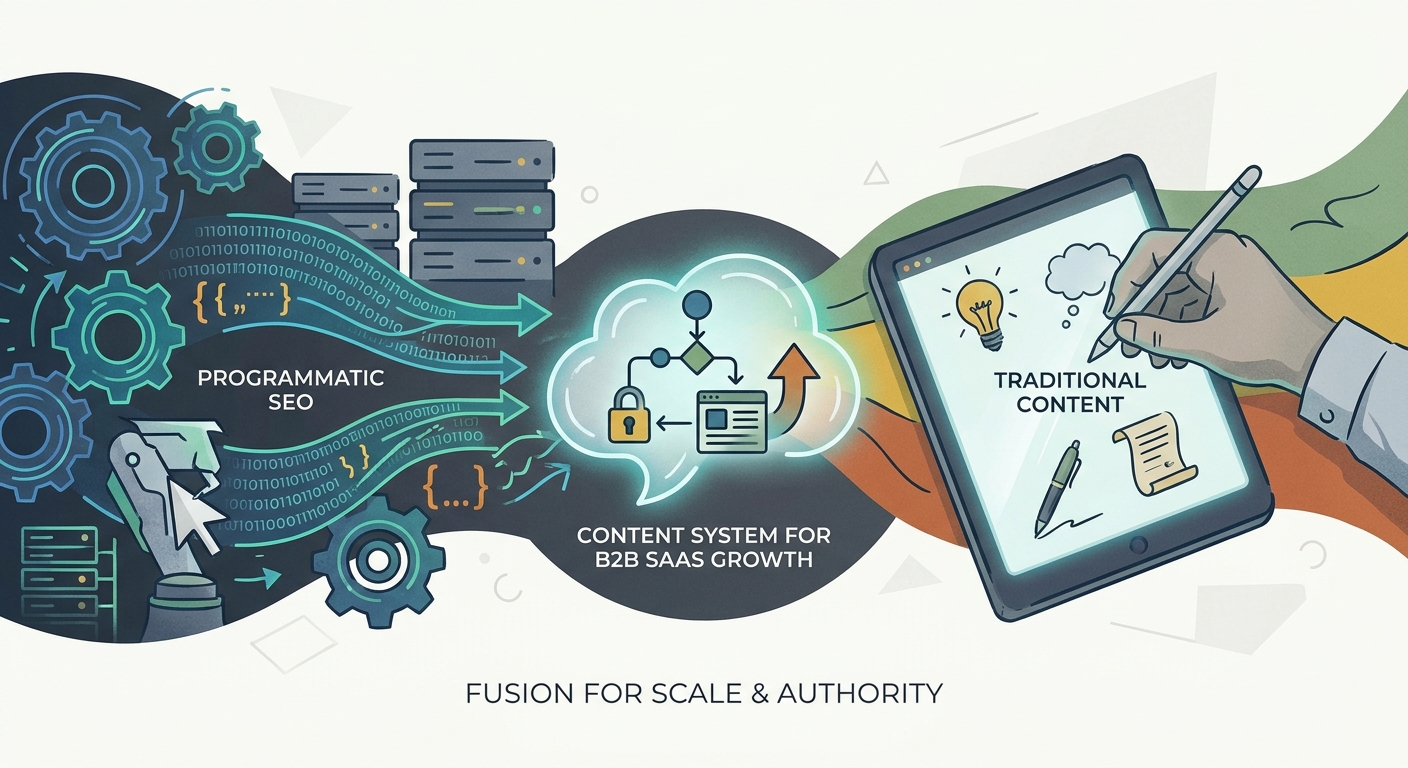
In 2026, the B2B SaaS companies actually winning aren't choosing sides. They’ve stopped viewing these as competing strategies and started treating them as a single, breathing content system. Think of programmatic SEO (pSEO) as your top-of-funnel fuel—the high-intent, long-tail search traffic that keeps the lights on. Then, think of your founder-led, traditional content as the trust-based scaffolding that actually turns those visitors into paying customers.
You need both. If you try to survive with only one, you’re essentially trying to run a marathon on one leg.
Why the "Volume vs. Value" Debate is Dead
Remember ten years ago? "Content marketing" was just an excuse to hire a dozen cheap freelancers to churn out generic, 500-word blog posts in the desperate hope that one might hit the front page of Google. It was a vanity metric trap then, and it’s a death sentence now.
The 2026 landscape is all about "Content Systems." This is an automated, data-driven architecture that spits out thousands of high-utility pages, while simultaneously maintaining a high-touch, human-centric narrative.
If you rely strictly on traditional content, your growth is shackled to your editorial calendar. You’re only as fast as your slowest writer. If you rely strictly on pSEO, you’ll end up as a "search-only" brand—a hollow shell that ranks for everything but converts for nothing. Modern search intent is a spectrum. Someone searching for "Slack vs. [Competitor]" wants a clean, programmatic comparison table. Someone searching "How to scale B2B operations" wants the deep, messy, authoritative insight that only a founder can provide. Give them both.
The Mathematical Reality of Modern B2B Growth
The gap between manual production and programmatic efficiency isn't just a slight edge; it’s an absolute chasm.
A standard, high-performing content team might grind out somewhere around 50 long-form articles a year. In that same timeframe, a lean team with a solid programmatic engine can deploy thousands of pages indexed for specific, high-intent keywords, because the marginal cost of page 1,001 is close to zero once the template and dataset exist (ANALYSIS — directional order-of-magnitude comparison, not a benchmarked figure; see sourcing note below).
| Traditional content team | Programmatic SEO engine | |
|---|---|---|
| Typical annual output | ~50 long-form articles (ANALYSIS) | Hundreds to thousands of templated pages |
| Cost structure | Pay per piece, scales linearly with headcount | Upfront build cost, then near-zero per page |
| No-code setup cost | N/A | Roughly $200–$500/month for a Webflow + Airtable + sync-tool stack (ANALYSIS) |
| Best for | Founder-led trust, original POV, deep dives | High-intent long-tail, integration/use-case permutations |
This math fundamentally changes your customer acquisition cost. When you automate landing pages for every possible integration or use-case permutation, you aren't just "writing more." You are capturing the entire long-tail market that your competitors are ignoring because it’s "too expensive" to write by hand. You’re playing the game on a different level.
Does Programmatic SEO Only Work for Certain SaaS Categories?
There’s a persistent myth that pSEO is only for job boards or real estate sites. That’s nonsense. It’s arguably the most lethal weapon for any SaaS platform with a complex ecosystem.
If your tool integrates with five hundred other apps, you should have five hundred integration pages. If you solve a specific task for ten different industries, you should have ten industry-specific hubs. It’s simple logic.
We see companies leverage Programmatic SEO Services to build out thousands of "Best [X] for [Y]" pages or "How to connect [Platform A] with [Platform B]" guides. These aren't filler. They’re functional utilities. When a lead lands on a page that matches their stack perfectly, the conversion rate doesn't just bump—it skyrockets. Why? Because the content is the product. It’s not a marketing blurb; it’s a feature.
How to Build a "Content Moat" Without Going Broke
The barrier to entry for programmatic growth has collapsed. You don't necessarily need a dedicated engineering team maintaining custom scripts anymore (ANALYSIS — cost varies significantly by scope and existing tooling).
The modern "No-Code" stack—Webflow for the front end, Airtable for the database, and a sync tool like Whalesync to keep them talking—allows a single growth marketer to orchestrate a meaningful engine. This kind of DIY setup commonly runs a few hundred dollars a month in tooling costs (ANALYSIS, based on published pricing of the tools involved as of 2026-09-21), a fraction of a full-time engineering hire.
This creates a "Content Moat." When you own the search results for every single permutation of your tool’s capabilities, your competitors literally cannot out-write you. They’d need a decade to manually build what you accomplished in a weekend.
Why Generative Engine Optimization (GEO) is the New Standard
The rules of the game have shifted. We aren't just writing for blue links anymore; we’re writing to be cited by AI agents. As detailed in our Generative Engine Optimization guide for B2B SaaS, the goal is to become the "source of truth" that Perplexity or Google AI Overviews pulls into their summaries.
Your programmatic pages need to be structured for machines. Use clean data tables, bulleted summaries, and schema markup that makes it effortless for an AI to parse your content. If your page is just a wall of keyword-stuffed text, the AI is less likely to cite it. A structured, data-rich resource that answers the query in the first 100 words has a much better shot at becoming the source an AI actually quotes.
Avoiding the "Thin Content" Penalty
"Thin content" isn't a result of automation. It’s a result of laziness. Google's own spam policies name "using generative AI tools or other similar tools to generate many pages without adding value for users" as scaled content abuse (Google Search Central, retrieved 2026-09-21) — the problem is the lack of value, not the automation itself.
If your programmatic pages are identical templates with only the city name swapped out, you deserve the penalty. You aren't adding value; you're just adding noise.
The secret to safe, high-ranking pSEO is unique data. If you’re building integration pages, don't just write "How to use X with Y." Include dynamic data—what can you do with this integration? What are the specific API endpoints? What is the setup time? Injecting unique, verifiable data into every page turns "thin" content into a "thick," high-utility resource that satisfies both human readers and search algorithms.
Where Does Founder-Led Content Fit into This Machine?
Programmatic SEO captures the "I have a problem" search. Founder-led content captures the "I trust this solution" decision.
You need the machine to feed the brand. When a user lands on one of your thousands of programmatic integration pages, they are looking for a technical answer. Once they find it, they go to your blog or case studies to judge your company’s vision and expertise.
For a deeper dive into balancing these two, check out our 2026 programmatic SEO playbook for B2B SaaS marketing.
Automation provides the scale. The founder’s voice provides the conviction. Without the machine, you are shouting into the void. Without the humanity, you are just a faceless utility that will be replaced the moment a cheaper alternative shows up.
How to Start Building Your Hybrid Content Engine
Building a hybrid engine requires a shift in workflow. You have to stop viewing content as a writing task and start viewing it as a data-modeling task.
Start by identifying the high-intent keywords that are too numerous to write manually. Map these to your product data, build your database, and then set a rigorous human-review process. For the underlying infrastructure decisions — data source, template engine, sync layer — see our technical blueprint for programmatic SEO in B2B SaaS.
Security and compliance-heavy B2B SaaS categories add their own wrinkle to this math — see the companion piece on programmatic SEO vs. traditional content ROI for security startups for how the same tradeoff plays out when the pages in question are CVE trackers and compliance-framework guides rather than integration pages.
How This Post Was Sourced
Written and maintained by the GrackerAI research and content team. The scaled-content policy claim is SOURCED to Google Search Central's spam policies documentation (Google Search Central, retrieved 2026-09-21). The output, cost, and pricing figures (annual article counts, no-code tooling cost) are ANALYSIS — directional, order-of-magnitude estimates based on typical team structures and published no-code tool pricing, not a single benchmarked study, and are labeled as such rather than presented as hard data. No GrackerAI telemetry is used in this post. GrackerAI builds AI search visibility tracking and AI-optimized content production for cybersecurity and B2B SaaS companies; it's mentioned above because GEO and structured content are directly relevant to the argument this post makes, not as an unrelated plug.
Frequently Asked Questions
Does Google penalize programmatic SEO?
No. Google does not penalize programmatic content; it penalizes low-value, spammy content. If your programmatic pages provide unique, meaningful utility—such as data-rich integration guides or comparison tables—Google views them as high-value resources.
Can a small SaaS team manage a programmatic SEO engine?
Yes. The democratization of no-code tools like Webflow, Airtable, and Whalesync means a small team can manage a programmatic engine that previously would have required a dedicated team of engineers and expensive enterprise-level software.
Which is better for B2B SaaS: Traditional or Programmatic?
This is a false dichotomy. The fastest-growing companies use programmatic SEO to handle mass acquisition at the top of the funnel and traditional, human-written content to build the authority and trust that converts that traffic into long-term customers.
How does AI/GEO change the way we write programmatic pages?
AI/GEO (Generative Engine Optimization) requires an "answer-first" structure. You must use concise summaries, structured data tables, and clear, FAQ-style formatting to ensure that AI agents can easily extract and cite your content in their search summaries.
What is the biggest risk when launching a pSEO strategy?
The biggest risk is "keyword stuffing" without providing unique value. If you generate thousands of pages that offer no unique data or insights beyond repeating the same content with minor variable changes, you will trigger spam filters and fail to provide the utility required to rank.
Does this apply to product-led growth (PLG) SaaS companies too?
Yes — if anything PLG companies have more proprietary usage data to seed pages with. How to apply programmatic SEO for PLG SaaS covers the PLG-specific application of this approach.

![10 Best Local Rank Tracker Tools: In-Depth Comparison Guide [2025]](https://cdn.pseo.one/6abcb68a626591c40e1c8aa6/687e1c1ef6fe799d288518df/68809c373eb8562bcf68975d/10-best-local-rank-tracker-tools-comparison-guide/feature-image.jpg)