Multilingual AEO Strategy for Global B2B SaaS Companies

TL;DR
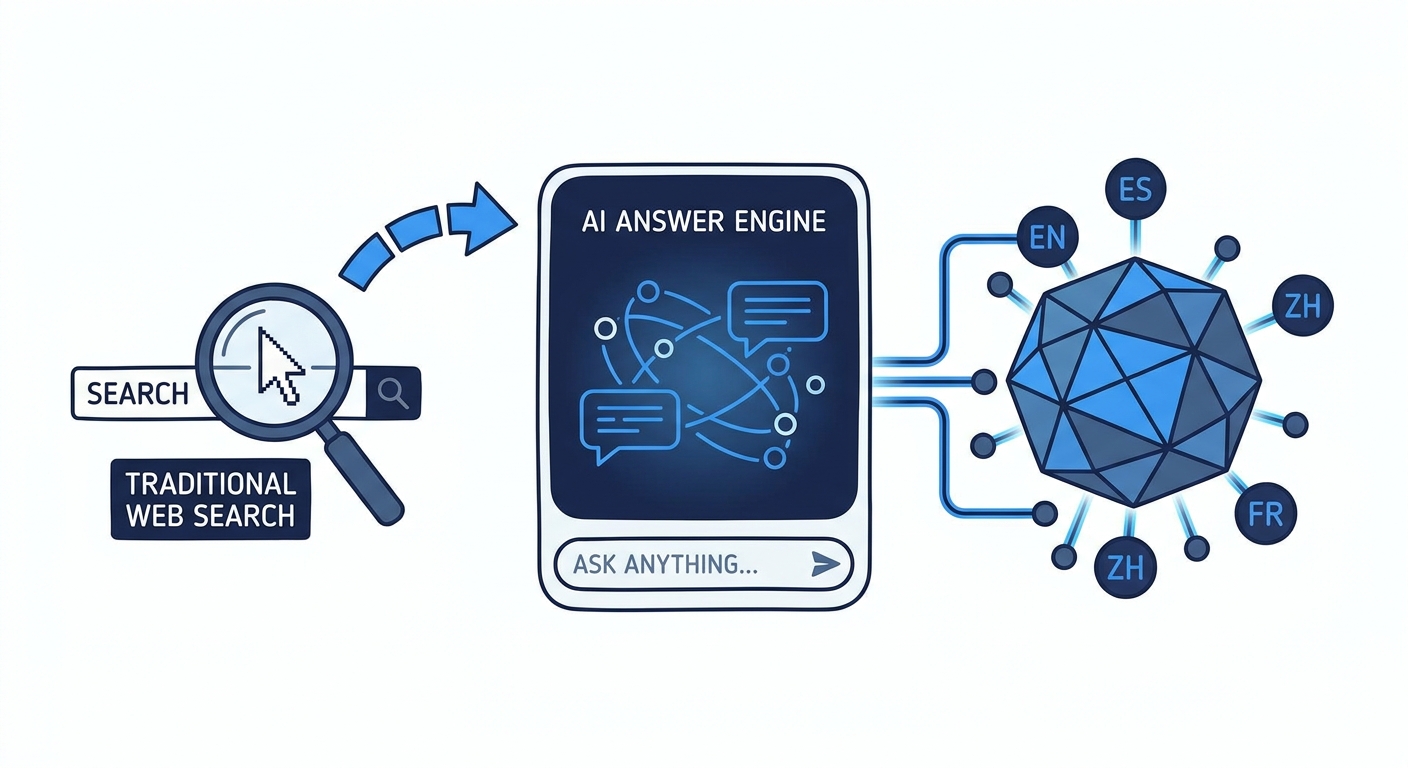
- ✓ Traditional blue link SEO is being replaced by AI Answer Engine citations.
- ✓ Global B2B SaaS brands must shift from click-based metrics to citation-first authority.
- ✓ LLMs require nuanced regional data instead of standard machine-translated marketing content.
- ✓ Mastering GEO and AEO is essential to stay visible in modern buyer research.
The blue link is dead. We can stop pretending it’s just “evolving.”
For years, B2B SaaS companies poured millions into the holy grail of page-one rankings. We obsessed over keywords, backlink profiles, and the perfect meta description. But the game has fundamentally changed. The battleground isn't a list of ten blue links anymore; it’s the opaque, high-stakes arena of Answer Engines.
If your brand isn’t being cited by ChatGPT, Perplexity, or Google AI Overviews, you’re invisible. Not "ranking lower"—you simply do not exist to the modern buyer. This isn't just a pivot in SEO strategy. It’s a total shift in how we build authority. You aren't chasing clicks; you’re chasing citations, cultural relevance, and the kind of localized, hard-hitting data that makes an AI model trust you.
Why Traditional International SEO Is Toast
Remember when international SEO was just a chore list of hreflang tags, subdirectories, and hiring a translation agency to turn your US-centric copy into "local" versions? That era is over. LLMs have turned that manual labor into a relic.
Think about an enterprise buyer in Frankfurt or Tokyo today. When they ask an AI for the "best cloud-native security platform," they aren't looking for a list of URLs to click through. They want a synthesized, definitive answer. They want the truth, and they want it now.
The shift here is jarring. You aren't optimizing for a crawler anymore; you’re optimizing for a reasoning engine. The biggest danger for global SaaS brands? The "Answer Gap." This happens when you’re perfectly optimized for a keyword, but you’re a complete ghost in the LLM’s training data for the actual problem you solve. As noted in Google's Official Guidelines on AI Overviews, these systems are designed to synthesize information—they aren't your personal referral service. If you aren't the primary source of truth, you aren't in the conversation.
What Is AEO vs. GEO and Why Does It Matter for SaaS?
Let’s clear the deck on the terminology.
AEO (Answer Engine Optimization) is about becoming the "source of truth." You want the AI to cite you. GEO (Generative Engine Optimization) is the broader, technical heavy lifting required to ensure your brand is actually included in the generation process. For a B2B SaaS player, the distinction is everything: AEO makes you the authority; GEO makes you the entity the AI actually likes to mention.
Moving from "traffic-first" to "citation-first" metrics is painful if you’ve spent your career obsessing over Google Analytics. In the old world, a click was the currency. Today, the citation is the only thing that matters. LLMs crave nuance, technical precision, and verifiable data. If your "localized" content is just a machine-translated version of your home page, the AI will sniff it out and ignore it. It lacks the regional flavor—the specific regulatory pain points, the local competitor comparisons, and the native-language workflows that high-performing LLMs need to see.
How Can Global SaaS Brands Build an LLM-Friendly Content Architecture?
Stop thinking about "pages." Start thinking about "entities."
LLMs map the world through relationships. If you’re a CRM provider, your content architecture shouldn't just be about "what is a CRM." It needs to define your entity as the direct solution to specific, complex, real-world workflows.
This is "Entity-First" content. It means mapping your technical documentation against the actual problems your prospects are typing into the prompt bar. Structured data and Schema are no longer optional "nice-to-haves." They are the map you hand the AI. Without them, you’re forcing the model to guess what you do, and it will guess wrong. By building an AI-Driven Content Strategy, you ensure your documentation is clean, semantic, and logically structured. If the AI can read it like a textbook, your citation rate will skyrocket.
The Power of Multilingual Contextualization
Machine translation is a brand killer. When an LLM is queried in German or Spanish, it’s actively looking for content that lives and breathes that market’s reality.
If your content ignores the specific compliance requirements of the EU or the competitive landscape of the APAC region, the AI will happily promote a local competitor that does. Localized data is your secret weapon. If you’re selling fintech, your UK content should be citing UK-specific financial regulations. Your US content should stick to domestic tax codes. By feeding these localized data models high-quality, region-specific case studies, you teach the AI that you are the expert in that specific market. This isn't translation. It’s cultural authority. Beyond the content itself, teams still need to confirm that region-specific pricing, currency, and landing pages actually render the way they are supposed to for a real prospect in that market -- see how B2B SaaS marketing teams use mobile data to test geo-based campaigns for that verification layer.
Executing the "Partner-Led" AEO Loop
LLMs are inherently skeptical of isolated brand sites. If you’re the only one saying you’re great, the AI views it as marketing noise. But if your brand is mentioned across third-party marketplaces, integration pages, and industry partners? That’s "validated truth."
Lean into your integrations. Being on the Salesforce AppExchange or AWS Marketplace is a goldmine for AI models. When you build deep integrations, you’re embedding yourself into the ecosystem. As this SaaS Growth Framework demonstrates, collaborative ecosystems are the fastest way to signal authority. The AI trusts the ecosystem far more than the individual.
Measuring Success in a Zero-Click World
The click is dead. If you’re still measuring success based on traffic, you’re looking at a rearview mirror.
The new metric is Brand Share-of-Voice (SOV) within AI responses. You need to track how often your brand is cited when someone asks about your category. Start tracking "Citation Velocity." If you see a competitor getting cited more often, dig in. Why? Are they better integrated? Is their documentation clearer? As Perplexity’s "Publisher Program" shows, the future of the web is moving toward a tighter loop between engines and authoritative sources. Get inside that loop or get left behind.
The 3-6 Month Roadmap for Global AEO
Don't panic. You don't need to rebuild everything by Monday. Follow this instead:
- Phase 1: The Citation Gap Analysis. Audit your AI mentions. Use the Search Engine Journal’s AEO Guide to figure out where you’re losing ground to your competitors.
- Phase 2: Localized Data Injection. Update your technical documentation. Make it region-specific. If you don't have regional case studies, commission them.
- Phase 3: Partner Ecosystem Expansion. Double down on your integrations. Get your partners to talk about you in their documentation. That third-party validation is your golden ticket.
Frequently Asked Questions
How does AEO differ from traditional international SEO?
Traditional SEO is a land grab for clicks. AEO is about being the definitive answer. We’re moving from "drive them to the site" to "be the authority in the AI’s response."
How do I measure the "ROI" of AEO if there are no clicks?
You track Brand Share-of-Voice (SOV) and sentiment. If you’re consistently cited in the AI’s answer, your pipeline will reflect it. You track assisted conversions—look for the users who mention they "read about you in an AI summary."
Do I need a different website for every language to rank in global AI search?
No. You need better, more localized content. Subdirectories are fine, provided the content is written by someone who understands the regional market, not a generic translation tool.
How can I ensure my brand is cited by ChatGPT and Perplexity?
Focus on technical documentation, Schema, and third-party validation. The AI needs to see you as the subject matter expert on specific, high-value workflows.
What is the difference between AEO and AXO (Agent Experience Optimization)?
AEO is for human-facing engines. AXO is for the future—optimizing for autonomous agents that will eventually do the buying for you. It requires API-accessible, machine-readable data. Start preparing for that now.
![10 Best Local Rank Tracker Tools: In-Depth Comparison Guide [2025]](https://cdn.pseo.one/6abcb68a626591c40e1c8aa6/687e1c1ef6fe799d288518df/68809c373eb8562bcf68975d/10-best-local-rank-tracker-tools-comparison-guide/feature-image.jpg)