How to Increase LinkedIn Connection Acceptance Rate From 15% to 45%

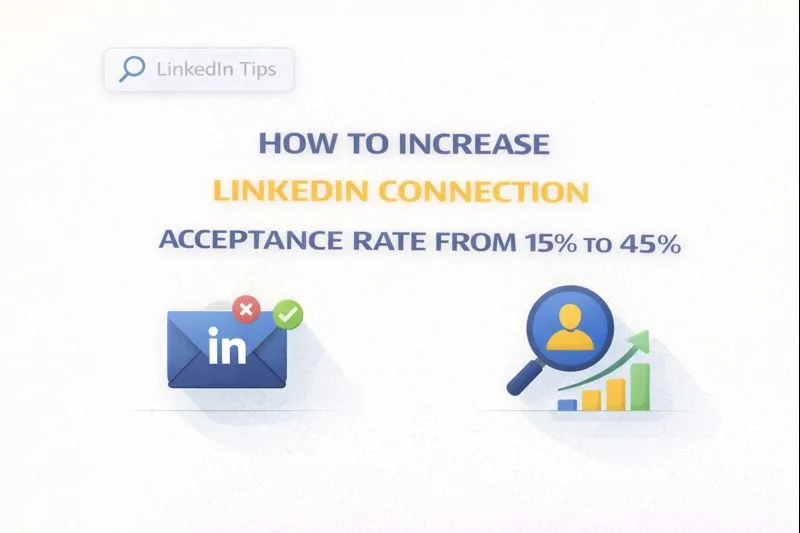
The headline insight is clear: personalized LinkedIn connection requests achieve ~45% acceptance rates, compared to ~15% for generic outreach—a 3× improvement that compounds across replies, meetings, and pipeline.
This article synthesizes findings from:
20+ million LinkedIn outreach attempts
70,000+ real campaigns
Multiple independent benchmark studies
The data shows a sharp divide between:
Average performers stuck at ~26–30% acceptance
Top performers consistently hitting 50–70%+
That gap is driven almost entirely by personalization quality, pre-connection engagement, and profile optimization—not hacks or automation volume.
Average Acceptance Rates Hide Massive Performance Variance
Across platforms tracking millions of requests, the industry-wide average acceptance rate sits between 26–30%.
Expandi (H1 2025): 29.61% average across 70,130+ campaigns
EmailSearch.io (500,000 requests): ~30% average
However, averages hide extreme performance differences.
Acceptance Rate Benchmarks by Performance Tier
Performance Tier | Acceptance Rate |
Below Average | Under 30% |
Average | 30–40% |
Good | 40–50% |
Excellent | 50%+ |
Top Optimized Campaigns | 70–78% |
A jump from 15% to 70% is not incremental—it’s transformational.
1,000 requests at 15% = 150 connections
1,000 requests at 70% = 700 connections
That 5× multiplier carries through replies, booked calls, and revenue.
Personalization Creates a 3× Acceptance Multiplier
Personalization is the single most impactful variable.
Key finding:
Personalized requests → ~45% acceptance
Generic requests → ~15% acceptance
Supporting data:
LinkedIn: Personalized InMails perform 15% better
HubSpot: Personalized messages increase responses by 30%
Acceptance vs. Replies: An Important Distinction
Interestingly, adding a message has minimal impact on acceptance alone:
With message: 26.42%
Without message: 26.37%
But it massively impacts replies:
With message: 9.36% reply rate
Without message: 5.44% reply rate (+72%)
Insight:
The message is less about “getting accepted” and more about setting up conversation after acceptance.
What Personalization Actually Works (With Data)
Not all personalization is equal.
High-Impact Personalization Signals
Personalization Type | Impact |
Referencing shared group or interest | +20% acceptance |
Engaging with prospect’s content beforehand | +60% success |
Mentioning mutual connections by name | Significant lift |
Targeting people in new roles (<90 days) | +62% acceptance |
Targeting followers of your company page | +270% acceptance |
A simple warm-up sequence—view profile → like/comment → wait 2–3 days → connect—can triple acceptance rates compared to cold requests.
Message Length: Shorter Clearly Wins
LinkedIn limits:
200 characters (free accounts)
300 characters (premium)
This constraint actually improves outcomes.
Message Length vs. Performance
Messages under 400 characters perform 22% above average
Messages over 1,200 characters perform 11% below average
Only 10% of messages are under 400 characters—yet they outperform most outreach
Best Practice
Use 2–3 concise sentences:
Who you are
Why you’re reaching out
Why the connection makes sense
No pitch. No links. No CTA.
Long messages trigger spam detection—both human and algorithmic.
Profile Optimization Multiplies Every Outreach Result
Your profile is the landing page behind every request.
Profile Optimization Data
Profile Factor | Impact |
Profile photo | 14× more views, 36× more messages |
Complete profile | +87% InMail acceptance |
5+ listed skills | 27× more discoverable |
Poor photo | 71% of recruiters reject candidates |
A strong profile independently boosts acceptance by ~10%, and compounds with personalization and timing.
Social Selling Index (SSI) Effect
Users with SSI > 70:
51% more likely to exceed revenue goals
45% more opportunities created
78% higher productivity
Timing Matters Less Than Most LinkedIn Advice Suggests
While many “gurus” obsess over timing, data shows it delivers marginal gains compared to personalization.
Reply Rates by Day
Day | Reply Rate |
Tuesday | 6.90% (best) |
Monday | 6.85% |
Thursday | 6.63% |
Saturday | 6.40% (worst) |
Other insights:
Weekday replies: ~22 hours
Weekend replies: ~48 hours
Best month: January (7.51%)
Lowest month: October (6.36%)
Bottom line:
Perfect timing + generic message loses to average timing + relevant message.
Industry and Role Targeting Changes Outcomes Significantly
Acceptance Rates by Industry
Industry | Acceptance Rate |
Technology | ~35% |
Healthcare | ~28% |
Finance/Banking | ~25% |
Reply Rates by Role
Role | Reply Rate |
HR / Talent | 12.08% |
Product | 10.24% |
Operations | 10.02% |
C-level | 6.98% |
Marketing | 6.40% |
Sales | 6.32% |
Customer Success | 6.00% |
Senior executives ignore ~95% of requests.
Average users ignore ~80%+.
Targeting mid-level operators often outperforms chasing the C-suite. Building that narrower, role-specific target list starts with the search itself — see 15 LinkedIn Sales Navigator Boolean search strings for strings that isolate mid-level operators instead of only surfacing C-suite titles.
LinkedIn vs Cold Email: LinkedIn Wins by ~2×
Channel Comparison
Channel | Avg Response Rate |
10.3% | |
Cold Email | 5.1% |
Additional insights:
InMail: 18–25% response
Cold email open rates: ~27.7%
InMail open rates: 50–60%
Combining LinkedIn + email in sequences increases response rates by ~93% when targeting multiple contacts per company.
InMail sits between those two channels in both cost and reach. For a fuller breakdown of when a paid InMail credit beats a free connection request — and when it doesn't — see LinkedIn InMail vs connection request: what gets more replies.
AI-Assisted Messaging: Helpful, But Risky
What the Data Shows
AI-assisted first messages: +61% initial engagement
AI-generated follow-ups: Slight underperformance
Copy-pasted AI content:
30% less reach
55% less engagement
Best Practice
Use AI for:
Research
Structuring
Drafting
But always human-edit for tone, relevance, and specificity. If you are layering connection-request or follow-up automation on top of this, tool choice affects both deliverability and ban risk — see our comparison of LinkedIn automation tools and safety ratings.
Recent LinkedIn Changes (2024–2025) You Must Adapt To
Platform Constraints
~100 connection requests per week
Free users: 5–20 custom notes per month
Character limits tightened
Open Profile messaging restricted
Heavy automation enforcement
Algorithm Shifts
Views down ~50%
Engagement down ~25%
Follower growth down ~59%
First-degree connections prioritized
Engagement bait penalized
Account Health Signals
Maintain >40% acceptance rate
Avoid 700+ pending requests
5–10 “I don’t know this person” reports can trigger restrictions
The Data-Backed LinkedIn Connection Playbook
1. Pre-Connection Phase
Visit profile
Like/comment on 2–3 posts
Space activity over 3–5 days
Ensure your own profile is optimized
2. Connection Request
Under 300 characters
Reference a real commonality
Clear, non-sales reason
Send mid-week during business hours
3. Post-Connection Follow-Up
24–48 hrs: thank-you + question or value
Day 3–5: second message (new angle)
Max 2–3 follow-ups
Beyond two follow-ups, returns drop sharply.
A higher acceptance rate matters more when the profile and posts a new connection sees are worth engaging with. GrackerAI's anatomy of a viral LinkedIn B2B post covers the structure behind posts that turn new connections into conversations.
Conclusion
The data is consistent and overwhelming:
Personalized requests = 3× higher acceptance
Pre-engagement = 60% higher success
Optimized profiles = ~10% lift across all metrics
Personalized messages = 72% higher reply rates
With LinkedIn tightening limits and enforcing quality signals, spray-and-pray outreach is mathematically dead.
The winners send fewer requests, invest in real relevance, and treat connection requests as relationship initiations—not lead capture forms.
That’s how top performers consistently reach 50–70%+ acceptance rates—2–3× the industry average.
![10 Best Local Rank Tracker Tools: In-Depth Comparison Guide [2025]](https://cdn.pseo.one/6abcb68a626591c40e1c8aa6/687e1c1ef6fe799d288518df/68809c373eb8562bcf68975d/10-best-local-rank-tracker-tools-comparison-guide/feature-image.jpg)