What is Generative Engine Optimization? A CMO’s Guide to Future-Proofing SEO

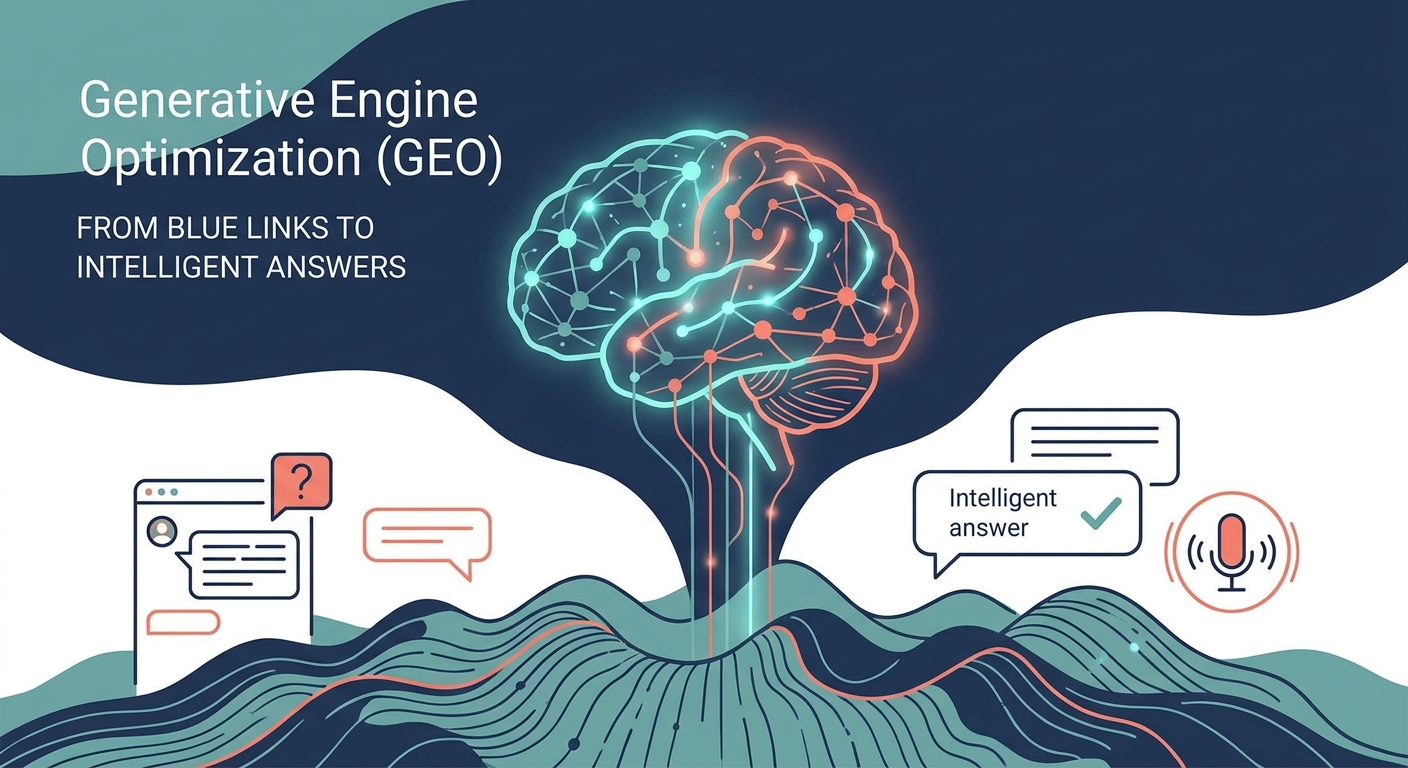
TL;DR
- ✓ Traditional organic search is declining as users shift toward AI-native discovery platforms.
- ✓ GEO shifts focus from keyword density to citation probability and authoritative content structure.
- ✓ AI models utilize RAG processes to synthesize expert answers rather than listing blue links.
- ✓ CMOs must abandon vanity metrics to prioritize brand validation within AI knowledge graphs.
Generative Engine Optimization (GEO) isn't just another acronym to add to your marketing stack. It’s the new reality of how your customers actually find you.
Think about how you use ChatGPT, Perplexity, or Gemini. You don’t search for a list of blue links anymore. You ask a question, and you expect a synthesized, high-confidence answer. If your brand isn’t part of that answer, you don’t exist in the modern funnel. For the modern CMO, this is a massive pivot: you’re no longer optimizing for a search engine’s ranking algorithm; you’re optimizing for an AI’s knowledge graph.
The Silent Crash of Traditional Search
The "Ten Blue Links" era is effectively over. We are watching a silent crash in organic search utility. User intent is increasingly satisfied without the user ever leaving the search interface. Data suggests we’re looking at a 25% decline in traditional organic search traffic as users migrate to AI-native discovery.
This isn't just a technical glitch; it’s a fundamental change in human behavior. When a decision-maker asks an AI, "What is the best enterprise cybersecurity software for a remote workforce?" they aren't looking for a list of links to click through. They’re looking for a synthesized, expert-level answer. If your brand isn’t part of that response, you’ve lost the lead before they even arrived. Understanding why the "old" SEO playbook is failing CMOs is the first step in moving away from vanity metrics like "keyword rankings" toward a reality where your brand must be recognized, validated, and cited by machines.
What is Generative Engine Optimization in 2026?
At its core, GEO is the transition from "Keyword Density" to "Citation Probability." In the old days, we stuffed pages with terms to signal relevance to a crawler. Today, we must provide factual, hierarchical, and authoritative data that a machine can retrieve to build a credible response.
As defined in the industry-standard guide to GEO, this is the process of optimizing for retrieval and synthesis. Traditional SEO relies on indexing; GEO relies on the RAG (Retrieval-Augmented Generation) process. An AI model doesn't "read" your site like a human. It treats your content as a series of vectors—mathematical representations of meaning—that it pulls into a response when the context matches your expertise. For the foundational mechanics of how AI answer engines select and cite sources in the first place, see GrackerAI's complete guide to Answer Engine Optimization.
Why is the "Old" SEO Playbook Failing CMOs?
The old SEO playbook was built on arbitrage: finding a keyword with high volume and low competition, then writing a 2,000-word fluff piece to capture traffic. Today, that’s a liability. AI engines are trained to penalize "hallucinated" or low-value content. If your site is cluttered with keyword-stuffed articles that lack actual, verifiable expertise, you’re effectively poisoning the well for the RAG systems trying to crawl your domain.
Zero-click search is the new status quo. If you are still measuring success by total sessions from organic search, you are measuring a shrinking pie. You need to pivot your focus to how often your brand is mentioned as a solution within the generative response.
How Does the "Atomic Content" Framework Work?
AI models require "Atomic Units" of information. Think of your long-form whitepapers or blog posts as raw ore; the RAG system needs that ore refined into specific, factual nuggets that can be slotted into a coherent answer. AI engines ignore the "fluff" and prioritize the specific passage that answers the user’s intent concisely.
By structuring your content into atomic units—defined passages that contain clear entity definitions, factual support, and logical hierarchy—you make it significantly easier for AI to retrieve your content as a primary source. Long-form audio like security podcasts benefits from the same treatment: deconstructing a transcript into atomic passage and entity units is exactly how you turn podcast episodes into traffic-driving, AI-citable content.
Why Does Entity Authority Outperform Domain Authority?
Domain Authority (DA) was a proxy for "link popularity." Entity Authority is a measure of "knowledge depth." AI models use Knowledge Graphs to connect your brand to specific topics, experts, and products. If the model doesn't know who your CEO is, what your software does, or which specific problems you solve better than anyone else, it cannot build an authoritative case for you.
You must move beyond simple DA metrics and start building entity authority by mapping your brand’s knowledge graph. This involves standardizing your schema, ensuring your subject matter experts have verified bios, and maintaining a consistent factual footprint across the web.
The "Citation Share" Metric: How Do You Measure Success?
If rank tracking is the ghost of SEO past, "Citation Share" is the future of enterprise growth. Citation Share measures how often your brand is cited by an AI engine in response to high-intent queries compared to your competitors.
This metric is the new KPI for the C-Suite. It's not enough to just be present; you must track your brand sentiment within those citations. We also have to manage "Negative GEO"—the risk of AI hallucinations where a model might misattribute a competitor's feature to your brand or vice versa. Monitoring these AI-generated responses is now as critical as monitoring your brand reputation on social media — see how to track brand mentions across AI search platforms for a practical approach to that monitoring. None of this matters to the board unless it connects to demand, though — see how GEO visibility tools turn AI searches into marketing pipeline for the model that ties citations to a tracked funnel.
The GEO Execution Blueprint: A Three-Phase Approach
Transitioning to a GEO-first strategy requires a structured, repeatable process. You cannot "hack" this; you have to build structural integrity.
In Phase 1, you audit your current AI visibility. In Phase 2, you perform entity cleanup, ensuring your technical schema is flawless — this is also where schema markup mistakes B2B SaaS companies commonly make tend to surface. Finally, in Phase 3, you scale via earned media. According to academic research on AI citation bias, AI engines are programmed to prefer third-party, peer-reviewed, or high-authority third-party mentions over direct brand-owned content. This means your PR and content syndication strategies are now directly tied to your organic search performance.
Budgeting for the Future: Shifting Spend to AI-Readiness
CMOs must stop funneling budget into legacy rank-tracking tools that offer little value in an AI-dominated landscape. Reallocate that spend toward platforms that specialize in entity management, AI-monitoring, and semantic search intelligence. Purpose-built AEO and GEO platforms such as GrackerAI track brand citations across ChatGPT, Perplexity, Claude, and Gemini, which gives CMOs a more direct read on citation share than a repurposed rank tracker.
You need a "Competitive Intelligence" template to evaluate your brand’s position in the AI answer space. For technical baseline compliance, refer to Google's AI Optimization Guide to ensure your infrastructure is ready for the next wave of crawling technology.
Conclusion: The New Brand Moat
In a world where AI can generate content in milliseconds, your "Brand Authority" is your only true competitive advantage. Anyone can write a blog post; not everyone can be the trusted entity that an AI model cites as the definitive source. By focusing on GEO, you are building a moat that algorithms cannot easily bridge. You are building a reputation that machines trust, and in the future of search, that is the only currency that matters.
Frequently Asked Questions
How is GEO different from traditional SEO?
Traditional SEO focuses on earning clicks through search engine rankings (blue links). GEO focuses on being the "source of truth" within an AI-generated answer, prioritizing entity authority and citation share over simple link position.
Do I still need traditional SEO in 2026?
Yes. Traditional SEO remains the foundation for technical crawling and indexing. Without a solid technical SEO baseline, your content will never reach the RAG systems, but it is no longer the sole primary objective.
How do I measure success in GEO?
Success is measured through "Citation Share"—the frequency and sentiment of your brand mentions in AI-generated answers—and your ability to dominate entity-specific queries within the AI Knowledge Graph.
What are the first three steps to start a GEO strategy?
First, perform an AI visibility audit to see where you currently stand. Second, clean up your entity data and schema markup. Third, shift your content strategy to favor atomic, fact-dense assets that support earned media and third-party validation.
How do I prevent AI engines from misrepresenting my brand?
By maintaining a "Knowledge Graph" of your brand, you ensure that AI models have a single, verifiable source of truth. Proactive monitoring of AI responses allows you to identify hallucinations early and correct them by reinforcing your brand entity across authoritative external domains.

![10 Best Local Rank Tracker Tools: In-Depth Comparison Guide [2025]](https://cdn.pseo.one/6abcb68a626591c40e1c8aa6/687e1c1ef6fe799d288518df/68809c373eb8562bcf68975d/10-best-local-rank-tracker-tools-comparison-guide/feature-image.jpg)