The Architecture of Retrieval: Overcoming "Vector Displacement" in Generative Search

TL;DR
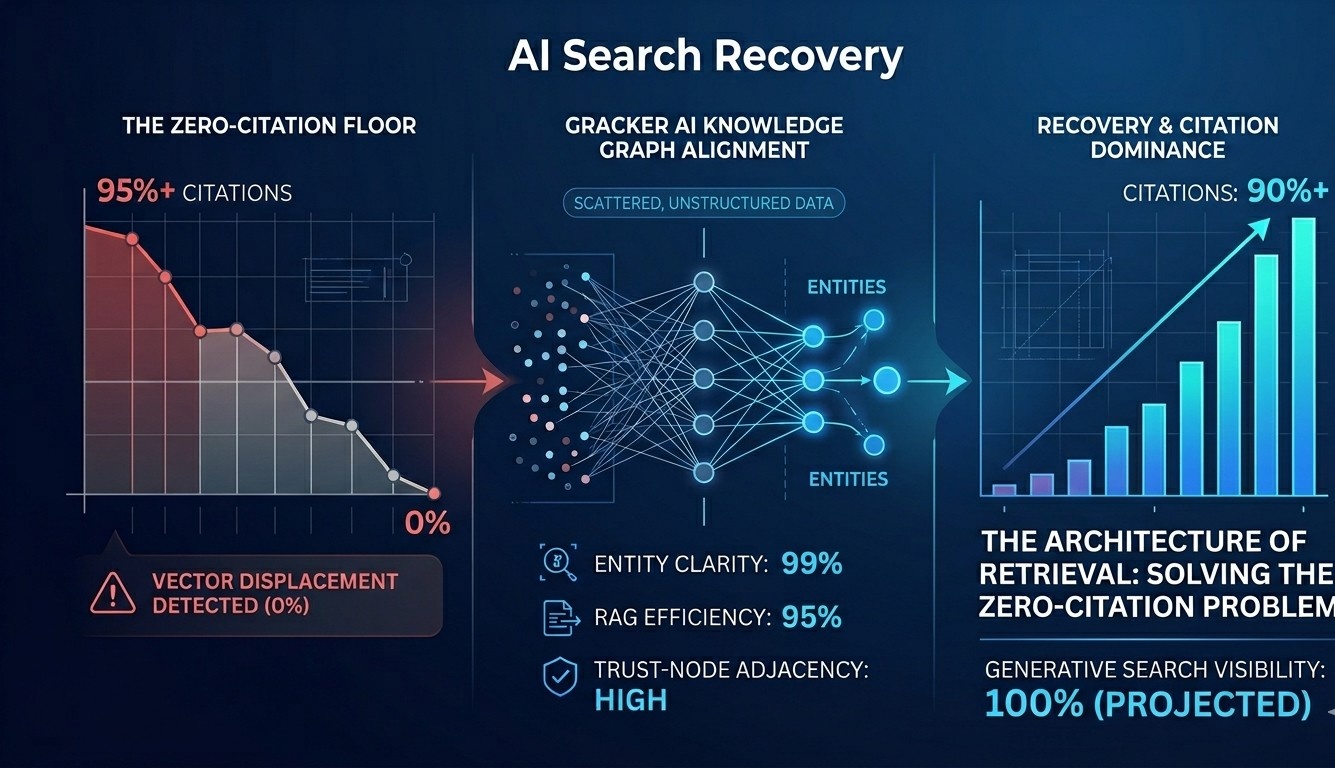
- This guide provides a high-entropy technical framework for brands facing the "Zero-Citation Floor," shifting the strategy from traditional SEO to Vector Displacement recovery. By realigning brand entities with RAG (Retrieval-Augmented Generation) logic, Gracker AI transforms invisible data into high-confidence citations for the next generation of generative search engines.
A brand's AI search visibility drops to near-zero for one of four verifiable reasons: the page is blocked from crawling or indexing, the content duplicates what a more authoritative source already says, the page lacks the structured data that helps machines parse it, or the brand has too few credible third-party mentions for an answer engine to treat it as a safe citation. None of this is mysterious or proprietary — it is the same set of factors Google names in its own guidance for its AI-powered Search features, and the same retrieval mechanics published in the academic literature behind every major retrieval-augmented generation (RAG) system.
This guide walks through each cause with a diagnostic checklist, then a recovery plan you can act on without guessing at unverifiable "AI ranking factors."
Why AI Visibility Drops: The Four Verifiable Causes
A visibility drop is a symptom. The cause is almost always one of the following, roughly in order of how often it shows up in the wild.
1. Crawling and Indexing Failures
If Google (or another engine's crawler) cannot fetch and index a page, it cannot cite it — full stop. Google states plainly that its generative AI features are "rooted in our core Search ranking and quality systems" (Google Search Central, Optimizing for AI Search Features, retrieved 2026-09-18). A page has to clear ordinary technical SEO requirements — crawlable, indexable, no accidental noindex, no robots block — before it is even eligible to appear in an AI Overview or be retrieved by a chat assistant.
Diagnostic checklist:
- Confirm the URL is indexed (
site:search or Search Console's URL Inspection tool). - Check
robots.txtand any<meta name="robots">tags for accidental blocks. - Confirm the page returns a 200 status and loads without a client-side-only render an unauthenticated crawler can't execute.
2. Commodity Content With No Unique Point of View
Google is explicit that it does not want, and actively down-ranks, content that just recycles what is already available. Its own guidance tells publishers to "provide a unique point of view" rather than "commodity content" that repeats the web's existing answer to a question (Google Search Central, Optimizing for AI Search Features, retrieved 2026-09-18). If your page says the same thing as the top five existing results in the same order, an answer engine has no reason to retrieve your copy over the one it already trusts.
The fix is not more keywords. It's a first-hand data point, a named methodology, an original test, or an argument the rest of the web hasn't already made.
3. Missing or Broken Structured Data
Structured data does not guarantee a citation, but it removes ambiguity a retrieval system would otherwise have to resolve statistically. Google states that it "uses structured data that it finds on the web to understand the content of the page, as well as to gather information about the web and the world in general" (Google Search Central, Structured Data Introduction, retrieved 2026-09-18). Article, FAQ, and Organization schema (per schema.org) give a retrieval system an unambiguous entity graph instead of one it has to infer from prose.
Worth noting: Google's own guidance also debunks two things marketers keep asking about — you do not need an llms.txt file (not a recognized standard any major engine consumes), and chunking content into artificially short paragraphs for "AI parsing" isn't a documented ranking factor. Structured data does real, documented work. Cosmetic AI-formatting tricks don't.
4. Too Few Credible Third-Party Signals
Retrieval-augmented generation systems — the architecture behind most AI answer engines — generate a response by first retrieving a small set of external passages and then conditioning the language model's output on them (Lewis et al., "Retrieval-Augmented Generation for Knowledge-Intensive NLP Tasks," arXiv:2005.11401, retrieved 2026-09-18). Which passages get retrieved is shaped by the same signals search engines have used for years: crawlability, topical relevance, and — heavily — whether other credible sources reference the same entity. A brand that nobody else writes about independently gives a retrieval system very little to condition on besides the brand's own marketing copy, which most systems are tuned to treat cautiously.
ANALYSIS: Academic survey work on RAG trustworthiness identifies retrieval quality as a primary driver of output reliability — the paper's authors note that "unreliable retrieval or improper knowledge utilization may still lead to undesirable outputs" (Zhou et al., "Trustworthiness in Retrieval-Augmented Generation Systems: A Survey," arXiv:2409.10102, retrieved 2026-09-18). This is a general finding about RAG architecture, not a GrackerAI measurement — treat it as directional, not a formula for how any specific engine ranks your brand. For a deeper technical walkthrough of structuring documentation specifically for RAG pipelines -- chunking strategy, metadata tagging, and access control -- see our guide on making infosec documentation RAG-ready.
The Recovery Framework
Work the list in this order. Each step depends on the one before it.
| Step | What you're fixing | How you verify it worked |
|---|---|---|
| 1. Clear technical blockers | Crawling, indexing, robots rules | URL Inspection shows "URL is on Google" |
| 2. Add one genuinely new data point per page | Commodity content | A competitor or AI answer would have to cite you specifically, not a generic source |
| 3. Add or repair Article/FAQ/Organization schema | Ambiguous entity signals | Google's Rich Results Test returns no errors |
| 4. Earn independent third-party mentions | Thin citation graph | Search your brand name in an AI answer engine and count non-owned domains that appear alongside it |
None of these steps are AI-specific tricks. They are the same fundamentals Google names for its own AI features, applied with more discipline than "commodity content" usually gets.
How to Measure Whether It's Working
A recovery effort only counts if you can see the needle move. Track citation frequency and source diversity across the engines that matter for your category over time rather than checking once and assuming the fix landed — AI answers are non-deterministic and vary by prompt, so a single check tells you little. GrackerAI's AI visibility monitoring tracks citation and mention frequency across ChatGPT, Perplexity, Google AI Overviews, and other engines on a recurring basis so a real trend is visible instead of a single noisy sample; see also how AI visibility scoring works and how AI engines actually choose what to cite for the underlying methodology.
For the numbers behind "is this working," pair citation tracking with the revenue-side view in how to measure AI search visibility against revenue KPIs and the baseline approach in how to measure AI search visibility.
Frequently Asked Questions
Why did my AI search visibility drop to zero overnight?
A sudden drop to zero is almost always a crawling or indexing failure — an accidental noindex, a robots.txt block, or a broken deploy — rather than a content-quality issue, because content-quality effects are usually gradual. Check Search Console's URL Inspection tool first before changing any content.
Is there a specific "AI SEO" ranking factor separate from normal SEO?
No documented one. Google states its generative AI features run on the same core Search ranking and quality systems as regular Search results (Google Search Central, retrieved 2026-09-18). Treat "AEO" as a discipline of emphasis — structured data, citability, unique data points — not a separate ranking algorithm.
Do I need an llms.txt file to be cited by AI engines?
No. Google's own guidance explicitly lists this as a myth — it is not a standard any major search engine or AI assistant is documented to consume as a ranking or retrieval signal.
How long does it take to recover AI search visibility after fixing these issues?
There's no fixed timeline, because it depends on how often the relevant pages get re-crawled and how often the engine you're tracking refreshes its retrieval index. Weeks is a realistic floor; treat any claim of guaranteed same-week recovery as unverifiable.
Does adding schema markup guarantee my content gets cited by ChatGPT or Perplexity?
No single change guarantees a citation. Schema markup removes ambiguity for machines parsing your content, which helps retrieval systems represent your entity correctly — it's a necessary input, not a guarantee, since citation also depends on topical relevance and the strength of competing sources.
Should I rewrite all my content the moment visibility drops?
No — diagnose first. Rewriting content doesn't fix a crawling block, and it can waste effort if the real problem is technical access rather than content quality. Work through the recovery framework in order.
How This Guide Was Sourced
Written by the GrackerAI research and content team (gracker.ai). Every normative claim above is drawn from Google's own Search Central documentation (retrieved 2026-09-18, page last updated 2026-07-10) and from peer-reviewed/arXiv research on retrieval-augmented generation architecture (retrieved 2026-09-18). AI search behavior changes as engines update their systems — pin your reading to the retrieval dates above and re-verify before acting on anything time-sensitive.
No GrackerAI telemetry is used in this guide. Every figure above is external and linked. GrackerAI builds AI search visibility tracking and AI-optimized content production; that's disclosed here because it's directly relevant to the "how to measure whether it's working" section above.

![10 Best Local Rank Tracker Tools: In-Depth Comparison Guide [2025]](https://cdn.pseo.one/6abcb68a626591c40e1c8aa6/687e1c1ef6fe799d288518df/68809c373eb8562bcf68975d/10-best-local-rank-tracker-tools-comparison-guide/feature-image.jpg)