How E-E-A-T Impacts AEO Ranking in AI Answers

TL;DR
Understanding the new search landscape where ai does the reading
Ever tried to find a decent CRM lately? You probably didn't scroll past the first page of Google—you likely just asked a chatbot and took the first three names it gave you. That’s the "new" search, and honestly, it’s a bit of a wild west for us marketers right now.
We’re moving away from the old "ten blue links" and heading straight into a world where ai does the heavy lifting. Instead of giving users a list of websites to go visit, engines like Perplexity or Google's ai Overviews are just reading the web for them and spitting out a summary.
According to Amsive, ai Overviews are already popping up in about 16% of Google desktop searches in the US. That’s a huge chunk of real estate being taken over by a single, synthesized answer.
- Traditional seo is evolving into aeo: It's not just about ranking #1 anymore; it's about being the source the ai actually quotes.
- The rise of zero-click searches: A 2025 study by TripleDart found that zero-click searches—where the user gets what they need without clicking a single link—now make up roughly 60% of all Google searches.
- Brand research is changing: Users trust ai assistants to do the "boring" part of comparing brands (like retail or finance tools) because it’s faster than opening twenty tabs.

If you think ai is just making stuff up... well, sometimes it is. That's why "trust" is the only currency that matters now. To understand how these engines "think," you gotta look at Retrieval-Augmented Generation (RAG). Basically, the ai doesn't just guess; it retrieves a few "trusted" documents from the web and summarizes them. It’s like an open-book test where the ai only picks the smartest kids' notes to read from.
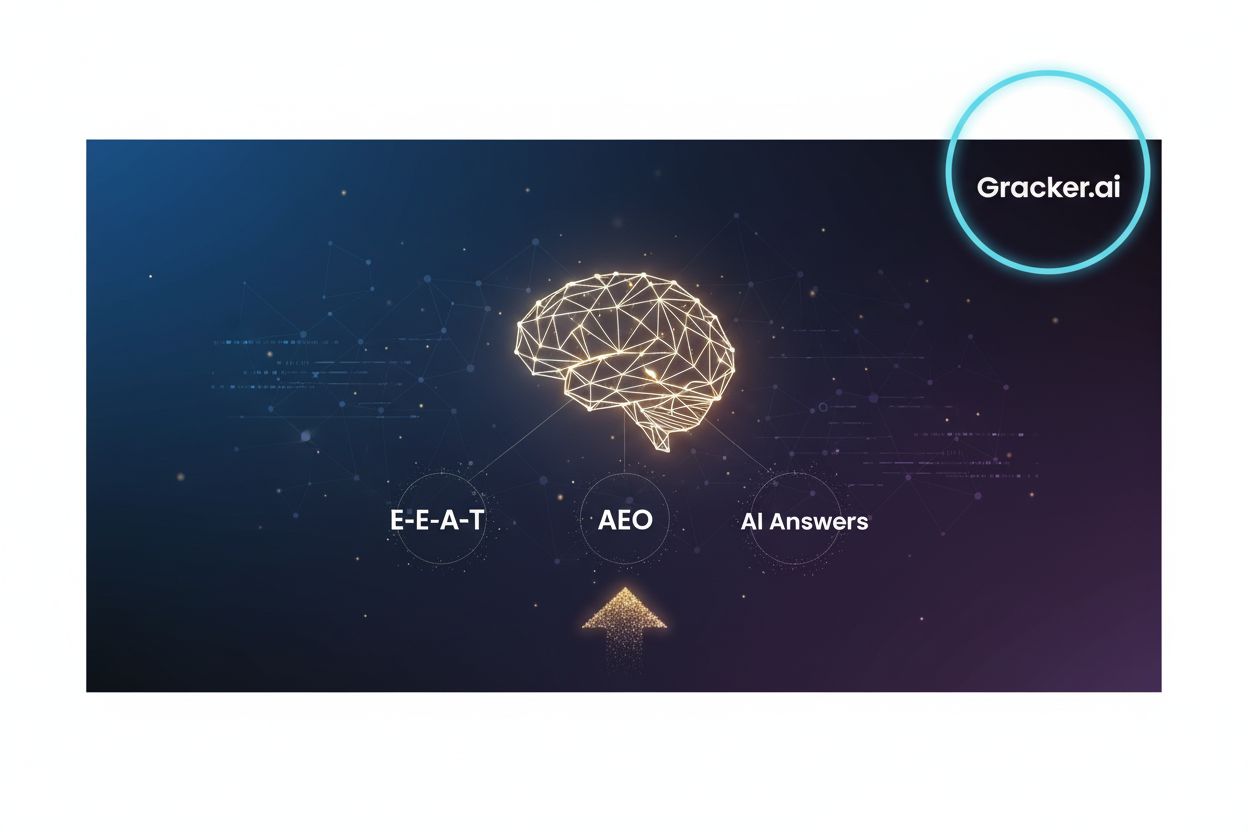
Trustworthiness is basically the biggest pillar for aeo (answer engine optimization) in 2025. If your site looks sketchy or doesn't have clear author expertise, the ai is going to skip right over you and quote your competitor instead.
As Kieran Gilmurray points out, seo ensures you're found, but aeo ensures you are actually quoted. Credible sources win because they reduce the risk of the ai looking stupid.
I’ve seen this play out in healthcare and finance specifically. A top-tier hospital might have great info, but if it isn't structured in a way that an api can easily grab, the ai will just pull a summary from a random forum that did format their answers clearly.
So, it's about being the most "extractable" expert in the room. Anyway, next we’re gonna dive into how reputation and authority actually fuel this whole process.
How each pillar of E-E-A-T fuels your AEO engine
If you think aeo is just about keywords, you're gonna have a bad time. It’s actually more like building a reputation for your brand that an ai can bet its life on.
See, these engines don't just want data; they want proof that you know what you’re talking about. According to makDigital, companies that actually use aeo strategies are seeing 40% higher brand mention rates. That’s because they’re feeding the e-e-a-t engine exactly what it craves.
- Experience is the new king: ai loves "I did this" over "here is how to do this."
- Expertise is your digital id: If the bot can't verify who wrote the piece, it won't quote it.
- Trust is the final hurdle: Inconsistent facts across your site will kill your ranking faster than a bad backlink ever could.
I’ve noticed lately that generic "how-to" guides are dying a slow death in ai overviews. Why? Because ai can write those itself. What it can't do is replicate the messy, real-world experience of a human.
A 2025 report from Amsive suggests that user-generated content (ugc) platforms like reddit and quora are dominating citations. On perplexity, reddit alone accounts for nearly 47% of citations. This happens because those sites are packed with people saying, "I tried this and here’s what happened."
If you're a b2b saas company, stop writing generic blogs. Start publishing case studies that deep-dive into specific failures and wins. Use phrases like "In our testing..." or "We found that..." to signal to the llm that this isn't just repurposed fluff.
You can't just claim to be an expert anymore; you gotta prove it to the crawlers. One way to do this is through your authors digital footprint. If your head of engineering writes an article, but their name doesn't appear anywhere else on the web, the ai might ignore it.
As previously discussed, e-e-a-t is the foundation. But specifically for expertise, you need to use author bios that actually mean something. Link those bios to linkedin profiles or wikipedia pages using "sameAs" schema. It’s like showing your id at a bar—the ai needs to know you're legit before it serves your answer to a user.

Niche knowledge is way harder for ai to fake, so go deep. If you’re in healthcare, don't just talk about "wellness." Talk about specific clinical outcomes or patient data (anonymized, obviously). The more technical and specific you are, the more the ai relies on you as a primary source.
Trust is basically the "don't be a liar" pillar. You can't just repeat that 60% zero-click stat and expect to be trusted. You need hard signals. I’m talking about having an up-to-date SSL certificate, clear and easy-to-find privacy policies, and verified reviews from actual humans on sites like G2 or Trustpilot. If the llm sees people complaining about your billing on a forum, it’s gonna flag you as "low trust" no matter how good your content is.
In cybersecurity or finance, this is huge. You need to cite original research constantly. Don't just say "cyberattacks are up." Say "According to our 2024 internal audit of 500 firms, attacks rose by 12%." That level of precision builds a "trust score" that makes you the go-to source for an api.
I saw this work for a small fintech firm recently. They stopped trying to rank for "best credit cards" (impossible) and started writing about "how to dispute a specific type of merchant fee." Because they used first-hand experience and cited specific banking regulations, they started appearing in perplexity answers almost overnight. They weren't the biggest, but they were the most "trustworthy" for that specific, deep-niche question.
So, it's really about being the most reliable person in the room. Anyway, next we’re gonna look at why structured data is the "secret sauce" for making all this e-e-a-t stuff actually readable for a bot.
Technical aeo strategies to amplify your trust signals
So, you’ve got your e-e-a-t pillars sorted, but how do you actually make sure an ai bot can "read" your expertise without getting a headache? It’s one thing to be an expert; it’s another to speak the language of the machines.
If you aren't using schema, you're basically leaving your ai rankings to chance. Think of schema as the "cliff notes" for search bots. It takes your messy, creative prose and turns it into organized data that an api can swallow in milliseconds.
According to a 2025 guide by makDigital, there is a huge correlation between structured data and getting cited—ai systems basically reward pages that are easy to extract.
- Person and Organization schema: This is how you prove you aren't a bot. By using the
sameAsproperty, you can link your author bio to a linkedin profile or a wikipedia page. It’s like showing a passport to the ai. - FAQ and How-To schema: These are aeo cheat codes. When you wrap a question and answer in FAQ schema, you’re handing the ai a pre-packaged snippet it can use for a zero-click answer.
- Entity-first structure: Instead of just chasing keywords, use schema to define the "entities" (people, places, things) your content is about. This helps the llm connect the dots between your brand and a specific solution.
I once spent three hours trying to rank a b2b blog about "cloud security," and it did nothing. Then, we added FAQ schema for the top three questions in the niche, and boom—it popped up in a perplexity answer within days. It wasn't better content; it was just more "extractable."

Now, doing all this manually for five hundred pages is a nightmare. This is where the problem of "scale" hits you like a truck. You can't manually update schema and "chunk" every paragraph for aeo by hand. This is why tools like gracker.ai are becoming essential for b2b saas companies—it automates the technical heavy lifting so you don't stay invisible to the 40% of buyers who now use ai assistants for their initial research.
As TripleDart points out, organic clicks are dropping, but impressions in ai overviews are actually up. You need a way to audit your "ai visibility" just like you used to audit your keyword rankings.
- Audit your ai footprint: See where ai assistants are actually quoting you (or your competitors) so you can fix the gaps.
- Optimize for high-intent queries: Instead of just writing for "seo," tailor content for the specific conversational prompts buyers use in tools like claude or chatgpt.
- Automation is the only way to scale: Using a tool to handle the technical side helps you stay ahead of the curve without losing your mind.
I’ve seen plenty of ceo types get frustrated because their "best in class" tool doesn't show up when they ask gemini for a recommendation. Usually, it's because their technical aeo is non-existent.
Julia McCoy recently analyzed the current landscape and found that ranking in answer engines is actually 3X easier than traditional seo right now, mostly because only about 11.7% of keywords are currently triggering these ai overviews. It's a wide-open field.
If you're in a competitive niche like fintech or healthcare, the window to claim "authoritative source" status is closing fast. Once an llm decides a certain site is the "truth," it’s really hard to unseat them.
Anyway, that’s the technical side of things. Next, we’re gonna look at how you can actually measure if any of this is working, because tracking "rankings" in a zero-click world is a whole different ballgame.
Optimizing content for liftable clarity and citation
Look, if you're still writing 2,000-word "ultimate guides" and hoping the ai will just figure it out, you're basically playing a losing game of hide-and-seek. The bots are busy; they don't want to dig through your life story to find the three steps to fix a leaky faucet.
To get cited in 2025, your content needs to be "liftable." That means a bot can reach in, grab a chunk, and drop it into a chat window without it sounding like a broken mess. It’s all about making the robot's job so easy it feels lazy not to quote you.
There is this weirdly specific "goldilocks zone" for ai answers. According to a 2025 deep-dive by TripleDart, ai engines really love pulling direct answers that are between 40 to 60 words. It’s long enough to be useful but short enough to fit in a mobile snippet.
- The Inverted Pyramid is back: Put the "meat" right at the top. If your heading asks a question, the very next sentence should answer it directly—no "in today's fast-paced world" fluff allowed.
- Bullet points are ai catnip: If you’re listing "Best CRM features," use a clean list. A 2025 report from makDigital mentions that listicles make up about 32% of all ai citations because they’re easy to parse.
- Front-load the value: Put your main entities (brand names, numbers, or key facts) in the first half of the sentence. If the ai truncates your text, you still want the most important bit to survive.
I tried this with a client in the retail space. We took their "How to Choose a Winter Coat" blog and added a 50-word summary box right under the H1. Within two weeks, perplexity was using that exact box as its primary answer. It felt like cheating, honestly.

Think of your article not as a single "piece" of content, but as a collection of lego bricks. This is what we call semantic chunking. Basically, you break your content into topically complete units—usually 100-300 words—that focus on one specific sub-topic. This lets llms index and retrieve the exact info they need without losing the context of the surrounding text. Each section should be able to stand on its own if a bot decides to rip it out and show it to someone on a smart watch.
- One section, one intent: Don't try to answer "How much does it cost?" and "How do I install it?" in the same paragraph. You'll just confuse the natural language processing (nlp) models.
- Clear, boring headings: "Unlocking Your Potential" is a bad heading. "5 Benefits of Cloud Migration" is a great one. Headings are basically labels for the ai agent to know what's inside the box.
- Ditch the jargon: If you use too much "synergistic ecosystem" talk, the ai might misinterpret what you're actually selling. Use clear, human language that a middle-schooler could understand.
I've seen this go wrong in b2b saas all the time. A company will have a great feature, but they describe it using so many trademarked buzzwords that the llm can't figure out if it's a software tool or a vitamin supplement.
As noted in the Julia McCoy analysis, the land grab is real. If you can make your expertise modular and easy to "lift," you're going to win citations while your competitors are still trying to figure out why their traffic is dropping.
Anyway, that’s how you build the content. Next, we’re gonna look at how to actually measure if any of this is working, because checking "page 1" isn't the flex it used to be.
Measuring Success in the AEO Era
If you're still staring at your Google Search Console waiting for clicks to go up, you're gonna be waiting a long time. In a zero-click world, the "click" is becoming a secondary metric. You need to start tracking how often you're the one the ai is actually talking about.
The first big metric is Share of Model (SoM). This is basically the new "Share of Voice." You want to know what percentage of the time an llm mentions your brand when someone asks for a recommendation in your category. If you ask ChatGPT for the "best project management tools" ten times, and you show up in seven of them, your SoM is 70%. There are tools popping up to track this, but you can also do it manually for your top five keywords.
Next, you gotta look at Brand Mentions in LLMs. This isn't just about being in the summary; it's about the sentiment. Is the ai calling you "the affordable option" or "the enterprise leader"? Tracking these citations across Perplexity, Gemini, and Claude gives you a much better picture of your authority than a simple ranking ever could.
Finally, don't ignore Referral Traffic from AI Engines. While most searches are zero-click, the people who do click through from an ai overview are usually much higher intent. They’ve already read the summary and want to go deeper. If your "ai referral" traffic has a 20% higher conversion rate than your standard organic traffic, you're winning at aeo.

Honestly, it’s a bit of a grind to switch your brain over to these new numbers, but it’s worth it. Within 18 months, a huge chunk of searches will be handled by these engines, so you want to be the name they trust.
Conclusion and the future of ai-first marketing
So, where does this leave us? If you're feeling like the goalposts just moved to a different stadium, you're not wrong, but honestly, it's a stadium where it's actually easier to play once you know the rules.
The shift from "ranking" to "being the answer" is basically the biggest vibe shift in marketing since we all realized mobile phones were going to outpace desktops. We are moving toward a world where your website is less of a destination and more of a "knowledge warehouse" for ai agents to shop from.
If there is one thing you take away from this whole deep dive, let it be this: trust is the only currency that doesn't devalue in an ai world. As we’ve seen, e-e-a-t isn't just a checklist for google anymore; it’s the literal filter through which every major llm decides if you are worth quoting or if you’re just generating noise.
- Trust is the foundation of the next decade: If an ai can’t verify who you are or why you’re an expert, you simply won't exist in the "answer" layer of the web.
- From links to citations: As mentioned earlier, aeo ensures you are actually quoted, while seo just gets you found. The future is about being the "trusted source" behind the summary.
- Experience wins every time: ai can summarize facts, but it can't replicate the "I was there" perspective. Double down on first-person insights and messy, real-world data.

I've seen this play out in real time with a retail client who was obsessed with keywords but had zero author authority. We didn't just write more; we fixed their "Person" schema and linked their founders to actual industry whitepapers. Suddenly, perplexity started picking them up because they finally looked like real humans to the bot.
You don't need a million-dollar budget to start this. Honestly, most of the wins come from just being more organized and way more clear than your competitors.
- Audit your ai footprint: Go to chatgpt or claude and ask it about your niche. See who it quotes. If it isn't you, look at those sources—are they using lists? Better schema? More recent stats?
- Modularize your best stuff: Take your top-performing blogs and add those 40-60 word "liftable" summaries we talked about. make it easy for the bot to be lazy.
- Fix your technical trust signals: Don't ignore the boring stuff. As previously discussed, using
sameAsin your schema is like showing your id at the door. It’s a tiny bit of code that carries massive weight.
As noted in the Julia McCoy analysis we looked at, within 18 months, 30-40% of searches will be answered by ai engines. The land grab is happening NOW, and since only a small fraction of keywords currently trigger these overviews, the early movers are going to own the space.
The future of ai-first marketing isn't about outsmarting the algorithm; it’s about being so undeniably authoritative that the algorithm has no choice but to trust you. It’s a return to "human-first" content, just delivered through a machine-readable straw.
Anyway, search isn't dying—it's just growing up. It’s finally becoming the "answer engine" we were promised back in the 90s. The only question is whether your brand will be the one giving those answers or just watching from the sidelines. Good luck out there, it’s gonna be a wild ride.