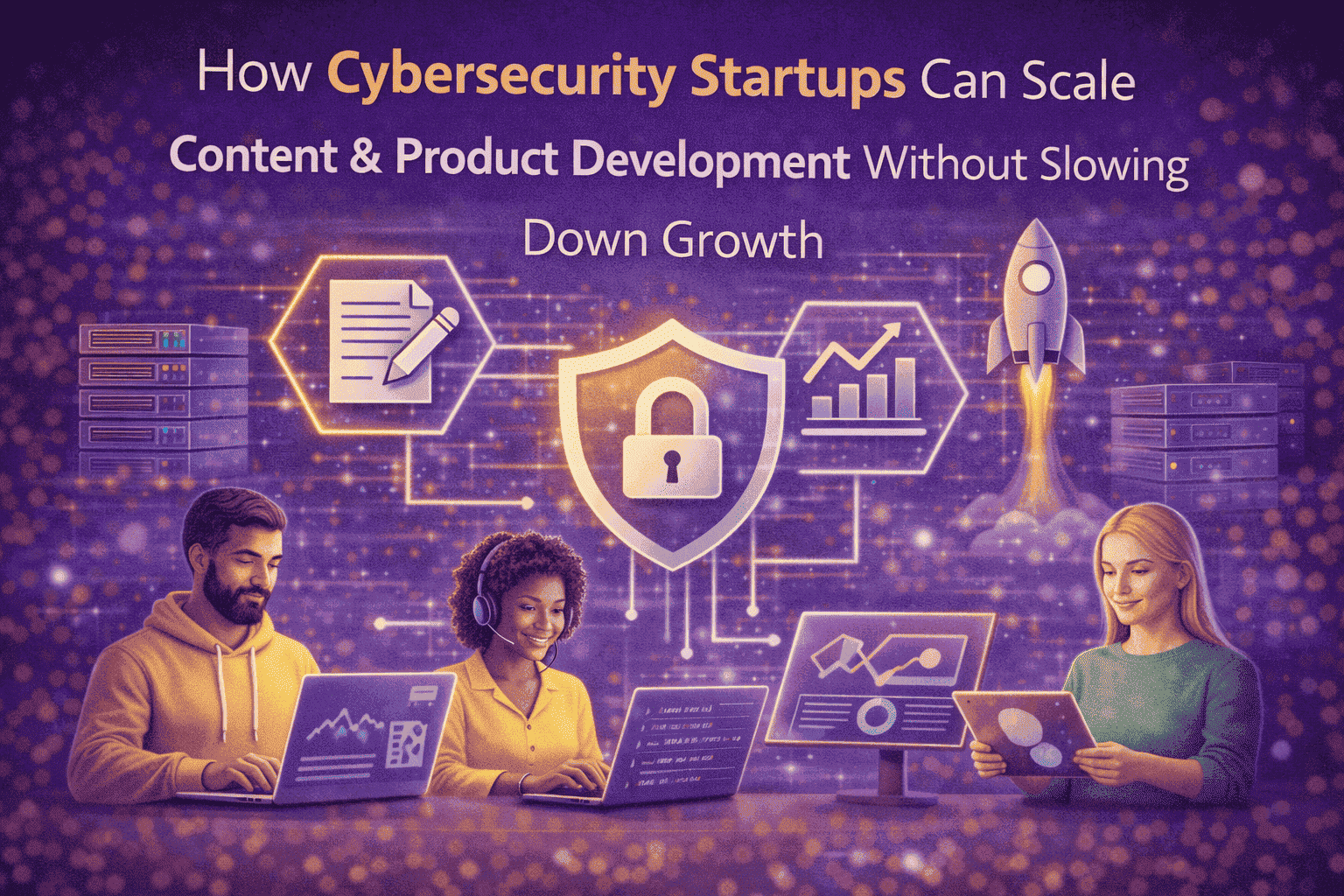
How Cybersecurity Startups Can Scale Content & Product Development Without Slowing Down Growth

TL;DR
- Cybersecurity startups scale product and content together by splitting work into core and context, giving squads end-to-end ownership of both code and its narrative, slicing roadmaps thin, and automating the repetitive middle.
Cyber-security moves faster than almost any other industry, which means your growth plans can feel like they are written on a whiteboard that a threat actor keeps erasing. Founders, CTOs, and product leaders see the same crunch: you must add new detections, hardening controls, and integrations while also publishing credible content that attracts, educates, and converts buyers. If either cadence slips, competitors and attackers both race ahead.
Below is a field-tested playbook that shows how to scale product and content together. We will keep it conversational, practical, and rooted in patterns used by seed-stage and Series-C security startups during 2023-2026. We will not add new sections - just go deeper where it matters.
The Scale Paradox: Why “More People” Often Hurts First

Early in a startup’s life, speed comes from intimacy. Three engineers, a designer, and a security researcher sit within earshot of each other, shipping weekly patches and writing the release note in the same sitting. As soon as you add headcount, that intimacy dilutes and suddenly the system groans under the weight of coordination.
Every founder eventually notices three warning signs:
Releases stall behind manual QA, compliance, or a single specialist’s review queue.
Blog cadence drops from weekly to “when we have bandwidth,” starving SEO and sales enablement.
Customer feedback hides inside private Slack threads instead of looping back to the roadmap.
If you do not fix these early, growth slows no matter how smart your new hires are. The cure is not simply “hire more people.” First, design a system - clear ownership, modular work slices, and lightweight automation - so that added humans amplify speed rather than clogging it.
Behind the scenes, think of your startup as a supply chain that converts insights into shipped value. The fewer hand-offs and context switching inside that chain, the faster your cycle time stays, even as volume increases. This mindset underpins the rest of the playbook.
Build the Right Team Architecture Before You Need It
Many growing security companies turn to staff augmentation services when they need to expand engineering or content operations quickly without long-term hiring friction. That tactic spotlights a deeper principle: speed comes from being able to flex capacity in and out without rewriting your org chart each quarter.
Core vs. Context Roles
Borrow Geoffrey Moore’s lens: core work differentiates you (Zone to Win book); context work merely keeps the machine humming. For an offensive-security SaaS, building new exploit detection logic is core, while migrating the marketing site to a new CMS is context. Treating the two buckets differently keeps your scarce experts focused where their talent moves the needle.
Before you hire another person, run a ruthless audit of tasks. Keep a short list, usually five or fewer, that truly separates your product in the buyer’s mind. Everything else is a candidate for outsourcing, automation, or rotational duty. When context work surges - say you must crank out fifty pages of SOC 2 documentation - ring-fence it from the squad touching your detection engine. That simple fence prevents slowdowns that ripple for months.
“Pizza-Size” Squads With Full-Stack Responsibility
Amazon’s two-pizza rule is now startup gospel, yet most young companies forget to include non-code roles in that pizza count. A healthy security squad owns a user problem end-to-end: ingestion, analytics, UI, DevOps, docs, demos, and even a snippet of marketing copy. When a squad surfaces a new Kubernetes escape detection, the embedded writer or developer advocate drafts the advisory in parallel, so a feature never idles waiting for words.
A few founders worry this “mini-org” pattern will duplicate skills. In practice, the redundancy is small, and the payoff of fewer meetings and cleaner accountability is enormous. Plus, you can still run a guild or chapter model for deep expertise, where writers and researchers share standards weekly across squads.
On-Demand Specialists
Certain talents, such as de-obfuscating Flutter malware or pen-testing quantum-safe crypto, appear in spikes. Turning them into full-time positions often backfires because their calendars fall quiet between spikes, yet salary burns constantly. A smarter approach is to curate a bench of freelance or boutique partners who can plug in fast, join your Slack, and roll off cleanly.
Treat those partners like equals. Share your internal threat model docs, roadmap context, and release calendars. Pay them promptly and invite them to retros. The result is a trusted external brain that you can scale up and down with demand.
Implementation Checklist
Before we move on, sanity-check your current team setup against these questions:
Does every squad own a customer outcome, including docs and demos, or are those scattered?
Can you point to a living list of context tasks ready for outsourcing, automation, or rotational duty?
Do you have at least two vetted partners (staff-aug or freelance) who can be summoned within two weeks?
If any answer is “no,” fix it first; later optimizations will fall flat without this foundation. After you nail team design, you can tackle how work itself flows.
Product Road-Mapping: Go Modular, Not Monolithic

Cybersecurity features usually intertwine deeply - an EDR agent, for example, touches the kernel, telemetry store, and dashboard. That complexity tempts teams to bundle work into whale-size epics. Unfortunately, whales sink speedboats: while one mammoth epic drags on, marketing and sales starve for launch news.
Define Thin, Safe Slices
“Thin” does not mean superficial. Each slice must be deployable, defensible, and testable in isolation. Take a data-loss-prevention startup: rather than building full exfiltration coverage first, ship just “source-code exfil to GitHub over HTTPS.” That slice is easy to describe, monitor, and roll back if something goes sideways. Customers who care hardest about source code will love you sooner, and your team gathers real-world telemetry to guide the next slice. This same thin-slice logic is what makes AI-assisted MVP development work in the first place — see how AI supports both MVP product development and marketing strategy for connecting that early scoping work directly to positioning.
Pair Every Feature Ticket With an Enablement Ticket
Product changes are only half of the story; the other half consists of the narrative, demos, screenshots, and postmortems. When both ticket types ride the same Kanban board, delays instantly surface. A squad cannot mark a feature done if the “how we talk about it” artifact is missing. This lightweight guardrail alone has rescued launch dates at three startups I advise.
Version by Use-Case, Not by Build Number
Outside your org, customers think in outcomes: “ransomware resilience,” “PCI-compliant Kubernetes,” or “SOC staffing efficiency.” Bundle the slices into those themes, then market the themes aggressively. Doing so lets you recycle collateral when you enhance a previous module, and it gives sales a story customers remember.
Mini-Retrospectives
Beware of two common fails.
First, some teams slice too thin, shipping “almost functional” slivers that create confusion.
Second, others over-specify a slice until it balloons into a sub-whale.
The remedy is a quick retro every three slices: ask whether each dropped safely, whether users adopted it, and whether internal docs stayed synced. Adjust slice thickness accordingly.
The Content Engine: Turn Knowledge Into a Compounding Asset
Cybersecurity buyers are allergic to puff pieces. They want proof - tactics, packet captures, and mitigation guides that stand up to a penetration test. That necessity means your content team is not merely a marketing arm; it is an IP factory that compounds in value just like code. For a closer look at the specific tension between publishing speed and technical accuracy in security content, see the cybersecurity content velocity problem. Done well, this content engine and your product roadmap should reinforce each other rather than compete for budget — see Content-Led Growth vs. Product-Led Growth: The Hybrid Model Nobody's Talking About for how to structure that handoff instead of picking one lane.
Build a Structured Knowledge Base First
Before drafting your next blog, capture every lab note and support solution in an internal wiki. Tag each page by MITRE ATT&CK tactic, OWASP category, or compliance control. Writers then assemble content Lego-style, which slashes the time spent hunting for “the right port-knocking diagram from last year’s slide deck.”
The Research-Thursday Cadence
Time-zone math permitting, block one half-day every other Thursday. Engineers demo a fresh exploit path or hardening technique to everyone, from SDRs to the CFO. Record the call and autogenerate a transcript using open-source ASR to jump-start drafts. A single 30-minute demo almost always spawns:
A technical deep-dive blog for practitioner readers.
A LinkedIn carousel highlighting three actionable takeaways.
New FAQ entries that reduce support load.
Because Research Thursday is rhythmical, staff write with less dread and more anticipation. After twelve sessions, you will possess an annual “threat research almanac” that rivals companies ten times your size.
Repurpose, Don’t Duplicate
Teams recycling primary research into multiple derivative formats report that 46% of marketers say content repurposing delivers the best results for engagement, leads, and conversions, while 65% identify it as the most cost-effective strategy, and 48% find it makes the best use of their time compared to creating new content or updating existing content. Start with the densest artifact, often a webinar or lab report, then spin out micro-assets: a 60-second TikTok demo, a GitHub gist, or an internal field enablement card.
SEO Without Losing Credibility
Keyword stuffing fell out of favor years ago, but structured optimization still delivers. Use schema markup, e.g., SoftwareSourceCode, FAQPage, so Google surfaces your tutorials as rich snippets. Focus on low-competition, high-intent phrases such as “Kubernetes admission controller bypass 2026.” Publishing under an engineer's byline signals E-E-A-T, which Google publicly announced as a ranking input in late 2022. Tie each post to the knowledge-base page it expanded; backlinks strengthen both resources. For the ROI math behind choosing programmatic versus manually written content at this stage, see programmatic SEO vs. traditional content: ROI comparison for security startups.
Avoiding Content Debt
A sneaky risk appears when squads ship modules faster than the content team can update docs. Prevent this by embedding a “content debt” column in sprint reviews. Any launch with outdated docs earns a yellow flag. Two yellows in a row trigger an automatic capacity swap: a squad pauses new code for one sprint to clear the backlog. It feels harsh once and then never recurs.
Automate Repetitive Workflows Early
People should spend cycles on novel detection logic or original research, not on copy-pasting screenshots into blogs or manually verifying encryption flags. Even small slices of automation pay compounding returns.
DevSecOps Pipelines With Policy as Code
Tooling such as Open Policy Agent, Kyverno, or GitHub’s built-in branch protection lets you codify security gates. In modern DevSecOps pipelines, automated security checks integrated into CI/CD, such as vulnerability scanning of dependencies or policy enforcement, can block pull requests before they reach later QA stages and generate machine‑readable evidence (e.g., JSON reports) that can be exported into compliance and GRC dashboards when the tooling is configured accordingly.
Content Ops Pipelines
Treat marketing assets like software. Store Markdown or MDX inside Git, trigger preview builds on Netlify, and run an SEO linter that flags missing alt-text or duplicate H1 tags. A merge to the main auto-publishes; no one wonders who presses the “Publish” button on WordPress. Once this pipeline exists, staff-augmented writers can clone the repo on day one and ship - with the same lint and test safety net as engineers.
Internal ChatOps for Reuse
A simple Slack bot can pull the canonical JSON schema for telemetry events, the standard legal disclosure paragraph, or the latest DDoS graph. Writing the bot takes half a day; savings stack forever. The ceiling here is your imagination: automatically watermark images, convert diagrams to dark mode, or fetch the current list of CVEs your product mitigates.
Retiring Manual Drudgery
Set a quarterly ritual: each squad nominates one manual step that took more than three engineer-hours in the last sprint. The whole org votes on which two to automate next. This bottom-up approach brings to light problems that leaders don't usually see, and it keeps morale high because engineers love getting rid of boring tasks.
Metrics and Feedback Loops: Measure What Protects Velocity
What you measure affects how people act. Vanity KPIs, such as total features shipped, can hide problems that are getting worse. Instead, rank metrics by how directly they protect or accelerate cycle time.
Mean Time to Commit (MTTC)
Track calendar days from “task ready” to the first merged commit. A spike usually signals unclear requirements, brittle local environments, or review queues stuck on one subject-matter expert. If MTTC rises for two sprints, dig immediately.
Content Cycle Time
Measure concept-to-publish days for every asset class: blogs, release notes, and customer stories. Break it into stages (draft, SME review, legal/readability, design, SEO pass). That granularity makes bottlenecks obvious. If legal creates a nine-day lag, try a standing “content office hour” so reviewers batch work together.
Customer Usage Depth
Monitor how many distinct modules or features each account turns on. High depth predicts retention better than MAU in security because buyers rarely churn from protective capabilities they actively use. Attach depth to customer success health scores so account managers can flag under-adoption early.
Feedback Loop Delay
The time between when a customer reports a problem and when the team sends back their first verified response, which could be a patch, a document update, or a workaround. This key performance indicator shows how much trust there is. Short delays show flexibility, but long ones hurt the chances of renewal.
Dashboards are helpful, yet narrative beats numbers alone. Require each squad lead to write a two-paragraph “captain’s log” weekly: what the metrics revealed, root causes, and next actions. Over time, these logs build a searchable timeline of organizational learning.
Putting It All Together: A 90-Day Action Blueprint
Reading a playbook is easy; living it during funding, roadmap pressure, and audits is tougher. Below is a condensed three-month plan that many security startups have used as a starting scaffold.
Weeks 1-2. Map every task into core or context. Offload one context area (e.g., website rebuild) to a trusted partner. Stand up a prototype pizza-sized squad charter.
Weeks 3-4. Audit backlog for whales; split at least one epic into two independent, safe slices and pair enablement tickets. Verify you can describe each slice’s value in a single Twitter post.
Weeks 5-6. Create a Git-based content repo with Netlify previews. Migrate the five top blog posts. Install an SEO linter and alt-text checker so writers see failed tests in pull-request comments.
Weeks 7-8. Add two policy-as-code gates to CI (e.g., dependency version CVE scan, encryption flag). In parallel, run the first Research Thursday, record it, and turn it into at least three derivative assets.
Weeks 9-10. Instrument MTTC and content cycle time. Display in a shared Grafana dashboard, but more importantly, discuss in squad reviews. Set a public goal: reduce each by 15 percent next quarter.
Weeks 11-12. Pilot the Slack ChatOps bot that fetches canonical snippets. Select the next manual task to automate. Celebrate the first inline quote pulled by a sales engineer without leaving Slack.
By day 90, the cultural muscle memory of modular work, paired enablement, and automated guardrails is in place. Future hires slide into the rhythm you have established rather than you scrambling to create onboarding after they arrive.
Final Thoughts
Scaling both product and content inside a cybersecurity startup is not about incinerating more cash or adding more stand-ups. It is about the architecture of people, of work slices, and of automation pipelines. When those three align, the new headcount multiplies velocity instead of dividing it.
Remember the core idea: velocity is a system property. If your team is earlier-stage and still building the content muscle from scratch, how to scale content production for your SaaS startup covers the fundamentals, and the best GEO tools for early-stage startups covers which AI-visibility platform to pair with it. None of that automation converts a buyer on its own, though — AI can optimize operations, but branding still wins customers is the reminder that velocity earns you the right to compete, not the win itself. Protect the system with modular roadmaps, flexible capacity, reliable automation, and metrics that catch drag early. Do that, and growth not only continues but also accelerates, even while the threat landscape and competition intensify.
![10 Best Local Rank Tracker Tools: In-Depth Comparison Guide [2025]](https://cdn.pseo.one/6abcb68a626591c40e1c8aa6/687e1c1ef6fe799d288518df/68809c373eb8562bcf68975d/10-best-local-rank-tracker-tools-comparison-guide/feature-image.jpg)