Answer Engine Optimization (AEO): The New Playbook for B2B SaaS Authority

TL;DR
- ✓ Traditional SEO is declining as AI search changes how users find information.
- ✓ AEO focuses on securing brand citations within AI-generated summary responses.
- ✓ B2B SaaS leaders must prioritize authority to cut through market noise.
- ✓ Shift your strategy from high-volume keyword traffic to high-intent AI recommendations.
Answer Engine Optimization (AEO) for B2B SaaS is the practice of structuring your product content, documentation, and third-party footprint so AI answer engines — ChatGPT, Perplexity, Google AI Mode, Microsoft Copilot, and others — extract it, trust it, and name your product when a buyer asks a question. Where SEO earns a ranking position on a results page, AEO earns a mention inside the AI's synthesized answer, with no click required.
This guide is the foundational reference in a three-part series. If you want the execution checklist, see our 8 AEO strategies for B2B SaaS. If you're specifically trying to get cited in ChatGPT's search results, see our ChatGPT-focused guide. This piece covers what AEO is, why it now matters to B2B SaaS specifically, and how it relates to adjacent terms like GEO.
Key Takeaways
- AEO targets citation inside an AI-generated answer; SEO targets a ranking position on a results page. They are complementary, not competing, disciplines.
- Gartner's February 2024 forecast projects a 25% drop in traditional search engine volume by 2026 as buyers shift queries to AI chatbots and virtual agents (Gartner, retrieved 2026-09-21). It is a projection, not a measured outcome, and worth tracking against reality as 2026 plays out.
- G2's 2025 Buyer Behavior research, published April 2026, found AI chatbots are now the top source influencing B2B vendor shortlists, ahead of review sites, analyst firms, and vendor websites (G2, retrieved 2026-09-21).
- AEO and GEO (Generative Engine Optimization) describe the same underlying discipline from two angles — AEO from the answer-engine/buyer-question side, GEO from the generative-content-optimization side. Most B2B SaaS teams don't need to pick one term; they need one program.
- You cannot manage AEO with SEO tooling alone. Google Search Console shows clicks; it has no visibility into what an AI engine said about your brand inside a chat window.
What Is Answer Engine Optimization (AEO)?
AEO is the discipline of formatting content, structuring data, and building entity signals so generative AI engines cite your product as the answer to a buyer's question, instead of ranking you as one link among ten. The unit of success changes: SEO counts rankings and clicks; AEO counts citations and mentions inside an AI response the buyer never has to leave.
Three things distinguish AEO work from traditional SEO work:
- The output is a citation, not a click. A buyer can get your product recommended by name and never visit your site in that session.
- The audience is a model, not a crawler. An AI engine retrieves passages, weighs sources, and synthesizes an answer — it doesn't just index a URL and rank it.
- Third-party sources carry more weight. Review sites, community threads, and industry publications feed AI answers as heavily as your own domain does, so an AEO program has to extend past your blog.
Why AEO Matters for B2B SaaS Right Now
B2B SaaS buying is a high-consideration process: long evaluation cycles, multiple stakeholders, and heavy feature comparison. Buyers increasingly use AI chatbots to compress that research instead of manually comparing five vendor sites.
G2's April 2026 research on B2B software buying — based on its own buyer survey data — found that "AI chatbots are now the top source influencing buyer shortlists, ahead of review sites, analyst firms, and vendor websites," and that 51% of B2B software buyers now start their research with an AI chatbot more often than with Google, up from 29% a year earlier (G2, retrieved 2026-09-21). The same research found 69% of buyers chose a different vendor than the one they initially planned to evaluate because it was part of the chatbot's recommendation.
Forrester's 2026: The State of Business Buying adds an important nuance rather than a simple green light: generative AI tools are becoming a starting point for B2B research, but they "often deliver incomplete or unreliable information, creating mistrust" — so buyers still lean on internal and external human networks to validate what the AI told them (Forrester, retrieved 2026-09-21). ANALYSIS: the practical read for B2B SaaS marketers is that AI answers now shape the shortlist, but a credible, corroborated brand presence across multiple sources still matters more than winning a single citation — the AI-cited claim has to survive a human fact-check.
If your product doesn't surface in that first AI-mediated pass, you are frequently excluded from the shortlist before a human evaluator ever opens a comparison spreadsheet.
AEO vs. Traditional SEO vs. GEO
These three terms get used loosely. Here's the practical distinction:
| Dimension | Traditional SEO | AEO | GEO |
|---|---|---|---|
| Optimizes for | Ranking position on a results page | Being named inside an AI-generated answer | Being represented accurately across generative AI outputs |
| Primary metric | Rank, organic clicks | Citation frequency, share of answer | Citation frequency, sentiment, and accuracy across engines |
| Core unit of content | The page | The extractable answer/passage | The entity (your brand, product, claims) as the model understands it |
| Typical tooling | Rank trackers, Search Console | AI-citation monitoring, schema validators | AI-citation monitoring, prompt-level tracking |
In practice, most teams don't run two separate programs. AEO and GEO describe the same work — structuring content and entity signals so generative engines extract and trust it — from two angles. Our GEO guide for B2B SaaS goes deeper on the entity-consistency side of this if that's the term your organization uses internally.
The Core Components of an AEO Program
A working AEO program has four parts. Each is covered in more tactical depth elsewhere in this series:
- Extractable content — direct, answer-first paragraphs, quotable definitions, comparison tables, and question-phrased headings. See the full 8-strategy playbook for the execution detail.
- Machine-readable data — JSON-LD schema (Article, FAQPage, Product/SoftwareApplication) that gives engines a structured version of your claims. Our schema markup guide for AEO covers the specific properties B2B SaaS teams get wrong most often.
- Third-party corroboration — review-site presence, community mentions, and citations on industry publications the engines already trust, so your own marketing copy isn't the only source making the claim.
- Per-engine monitoring — because coverage varies by engine, a brand can dominate one and be invisible on another. See how to monitor brand mentions in AI search for the measurement approach.
How Do AI Answer Engines Decide What to Cite?
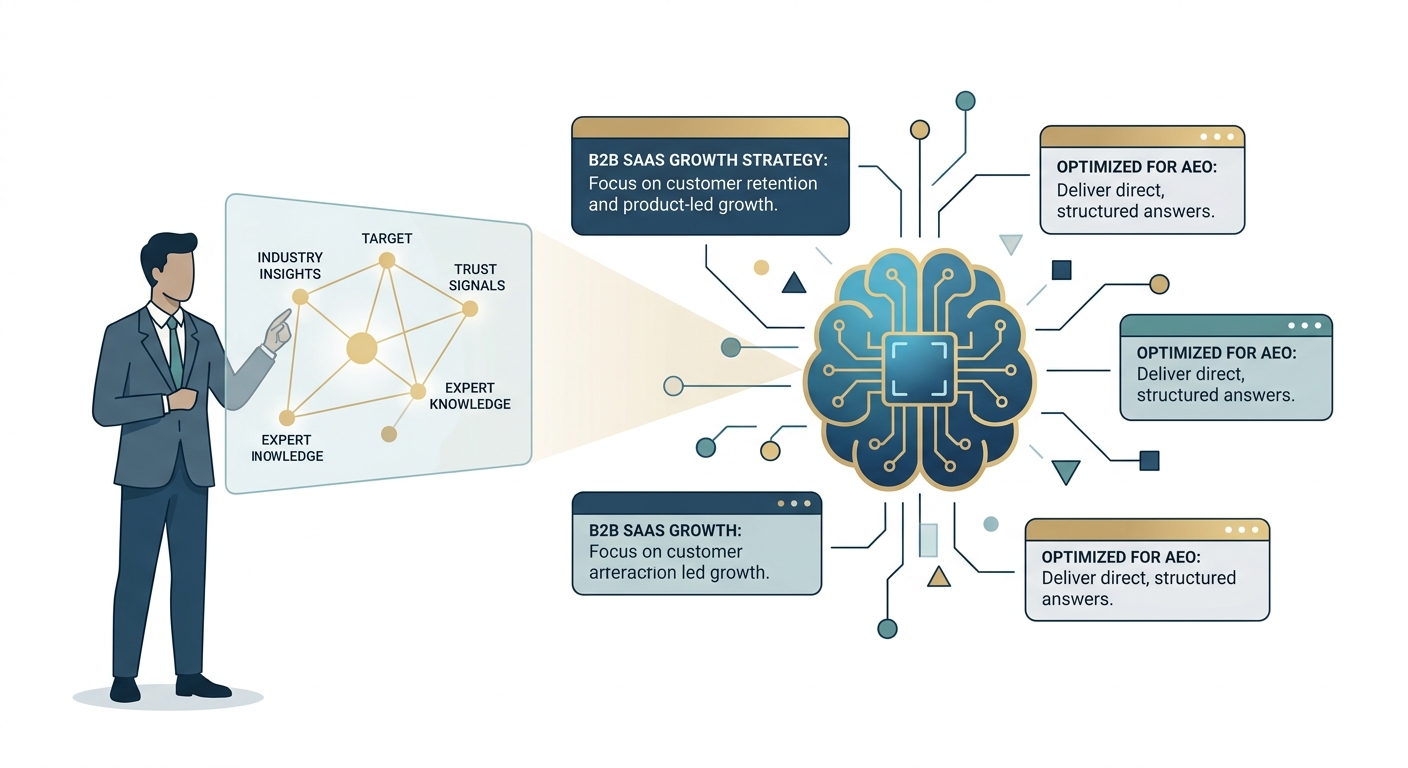
Engines retrieve candidate passages for a query, then weigh them by extractability (is there a clean, standalone answer to lift?), corroboration (do multiple independent sources agree?), and structure (does schema or formatting make the claim easy to parse?). A vague, marketing-toned paragraph buried in the fifth section of a page competes poorly against a direct, 40-60 word answer positioned right under a heading that matches the buyer's actual question.
This is why AEO rewards writing discipline more than it rewards technical tricks. The single highest-leverage change most B2B SaaS teams can make is rewriting their opening paragraphs and section leads so each one stands alone as a complete, accurate answer.
Measuring AEO: What "Working" Looks Like
Standard web analytics undercount AEO impact because a citation inside a chat response frequently generates no referral traffic. Track these instead:
- Citation frequency per engine — how often each AI engine names your product for your core category questions, tracked separately per engine rather than blended, since per-engine performance varies widely.
- Branded search lift — a rise in direct traffic and brand-name queries after buyers encounter your brand in an AI answer.
- Assisted and delayed conversions — deals where the buyer mentions discovering or shortlisting you through an AI tool.
GrackerAI, which publishes this guide, builds AI citation-tracking software that measures exactly these signals across engines — see our AI visibility platform or the mechanics in how we calculate an AI visibility score. Coverage depends on plan: Starter tracks 3 engines (ChatGPT, Perplexity, Google AI Mode) at $99/mo ($79/mo billed annually), Scale adds Microsoft Copilot for 4 engines at $499/mo ($399/mo annually), and Enterprise covers 10 engines — Scale's four plus Google AI Overviews, Gemini, DeepSeek, Grok, Claude, and Brave Leo — at custom pricing. Every plan includes a 7-day trial and requires a credit card to start (GrackerAI pricing, retrieved 2026-09-19).
How This Guide Was Sourced
Written and maintained by GrackerAI's research and content team (gracker.ai). Search-volume and buyer-behavior claims are drawn from Gartner's February 2024 press release, G2's April 2026 buyer-behavior research, and Forrester's 2026 business-buying research, each linked inline with a retrieval date above — treat the Gartner figure as a 2024 projection for 2026, not a confirmed outcome. Product, pricing, and engine-coverage figures for GrackerAI were verified directly against gracker.ai/pricing on 2026-09-19. No GrackerAI telemetry is used in this guide. GrackerAI sells AI search visibility tracking and AI-optimized content production, which is the product referenced above; the rest of this guide is written to be accurate regardless of whether you ever use it.
Frequently Asked Questions
What is Answer Engine Optimization (AEO)?
AEO is the practice of structuring content, data, and third-party signals so AI answer engines like ChatGPT, Perplexity, and Google AI Overviews name your product when they answer a buyer's question, rather than simply ranking your page on a results list.
How is AEO different from traditional SEO?
Traditional SEO optimizes for a ranking position that a human then clicks through. AEO optimizes for being named inside the AI's synthesized answer itself, which can happen with no click at all. SEO rewards keywords and backlinks; AEO rewards extractable answers, structured data, and corroborated claims across multiple sources.
Is AEO the same thing as GEO?
They describe the same underlying work from two angles. AEO frames it around the answer engine and the buyer's question; GEO (Generative Engine Optimization) frames it around the generative model's representation of your brand as an entity. Most teams run one program, not two — see our GEO guide for the entity-focused version of this material.
Which AI engines should B2B SaaS brands optimize for?
Prioritize the engines your buyers actually use, then expand. ChatGPT, Perplexity, and Google AI Mode are the most commonly tracked starting set; Microsoft Copilot, Google AI Overviews, Gemini, and Claude follow as programs mature. Per-engine performance varies significantly, so track citations separately by engine rather than as a single blended number.
How long does it take to see AEO results?
Most B2B SaaS teams see early movement in visibility within 4 to 6 weeks of applying foundational format and schema changes, with more meaningful citation gains at 2 to 3 months as engines recrawl content and third-party mentions accumulate. Off-page work like earning review-site presence and original research takes longer but compounds.
Do I need a monitoring tool, or can I do AEO manually?
You can apply the content and schema changes manually. Monitoring is the part that's hard to do by hand, because AI citations don't show up in Google Analytics or Search Console and checking multiple engines by hand for every core query doesn't scale. That's the specific gap purpose-built tracking closes.
Conclusion
AEO is not a rebrand of SEO and it isn't optional for B2B SaaS categories where buyers now start their research inside a chat window. Start with the definition in this guide, move to the 8-strategy execution playbook to actually implement it, and use the ChatGPT-specific guide if that single engine is where your buyers are concentrated. The programs that win are the ones that treat this as a measurable discipline with sourced claims, not a keyword-stuffing exercise with a new name.
![10 Best Local Rank Tracker Tools: In-Depth Comparison Guide [2025]](https://cdn.pseo.one/6abcb68a626591c40e1c8aa6/687e1c1ef6fe799d288518df/68809c373eb8562bcf68975d/10-best-local-rank-tracker-tools-comparison-guide/feature-image.jpg)