Ensuring Quality in AI-Generated SEO Content with Test Automation

Organizations are relying more and more on automated platforms to produce high-quality SEO content at scale in the age of AI-driven digital marketing. Automated content systems allow marketers to publish more regularly while maintaining consistency from optimized blog posts to intelligently structured knowledge bases.
The challenge of ensuring dependability, accuracy, and quality skyrockets as the automation grows. It is important to verify AI-generated SEO assets, such as meta descriptions, titles, structured snippets, full articles, or internal articles. This is to ensure they satisfy the editorial standards, preserve brand integrity, and load correctly on different platforms.
Test automation is necessary in this scenario. Teams can easily verify the entire content automation pipeline with the help of modern testing solutions. The article below explains the importance of automated testing for AI-generated SEO workflows and the ways in which tools can be used by platforms like Gracker.ai to guarantee output quality at scale. For the editorial side of that pipeline — how the content itself should be researched, structured, and optimized before it ever reaches a testing suite — see our 2025 SEO writing blueprint.
Why Testing AI-Generated SEO Content Matters
Scalability, consistency, and speed are just some of the major benefits that AI-assisted content platforms offer, but they also bring with them new failure points:
Consistency Across Templates: Formatting guidelines, templates, and content structures are important components of automated SEO platforms.
Even minor template mistakes can lead to hundreds of flawed pages.
Accuracy of On-Page SEO Elements: Rigid guidelines that often differ depending on the client or type of content must be followed for the title tags, meta descriptions, H1 structure, internal links, keyword usage, and schema markup.
Functional Validation: The front end of the website must surely display content accurately:
Does the article page load without formatting breaks?
Are the internal links accurate and working?
Are there clickable CTA buttons?
Editorial Quality Checks: If the underlying AI prompt or model changes, there may be variations in spelling, grammar, tone of voice, and keyword density.
Continuous Publishing Pipelines: Teams must verify more than 100 new pages every day without causing workflow lag. Test automation in such scenarios becomes critical because automated content generation is faster than manual reviews.
Testing catches the failure modes, but it assumes the underlying visibility strategy is sound in the first place — see how to make your company more visible for the traditional-plus-AI-search foundation this testing layer is meant to protect.
Automated Testing for AI-Generated Content Production
Automated testing frameworks help validate that the content pipeline, from creation to publishing, works reliably.
Important advantages include:
Natural Language Testing: testRigor, as an automated software testing tool, allows test scripts to be written in plain English. This makes testing accessible to non-technical content teams, editors, and marketers.
Cross-Browser Functional Checks: Chrome, Firefox, Safari, and mobile browsers must all be able to load automated content accurately.
End-to-End Content Validation: Automated tests can cover the full workflow, from logging into Gracker.ai to creating content and publishing it on a website or CMS.
Regression Testing: Test automation ensures continuous quality in the event that Gracker.ai modifies templates or prompt models.
Scalability: In just a few minutes, automated checks execute hundreds of tests.
Let us analyze how testing techniques relate to a platform like GrackerAI in order to understand how this applies in a practical setting.
Testing Strategies for AI-Generated SEO Assets
The following are some strategic techniques to automate testing for a content automation platform efficiently:
Template Validation
Ensure every generated page has:
Has working internal and external links.
Shows proper paragraph spacing, formatting, and meta tags.
Has the right H1/H2/H3 hierarchy.
These components can be validated with natural language assertions using testRigor.
Content Workflow Automation
Users of an automated content generation platform rely on a well-defined process for creating content:
Login
Create a new article or knowledge base.
Select an AI model
Generate content.
Export or publish
Testing each stage ensures that the backend and user interface operations are working as expected.
Publish-Level QA Checks
Following content publication, automation can validate:
Article loads correctly.
The navigation elements work.
Buttons or CTAs appear.
Schema markup or meta elements exist.
These validations ensure that the content displays and generates correctly.
Functional publish checks are only half the QA picture. For the editorial-review side of the same pipeline — flagging generic AI phrasing and verifying sourcing before a page goes live — see a practical QA workflow for AI-generated content.
Integration With SEO Tools
Usual workloads consist of:
SurferSEO
WordPress
Webflow
Shopify
Automated tests can validate error-free publishing and seamless integration.
Test automation is one layer of a larger system. For where it fits alongside data sourcing, schema, and monitoring, see the complete tech stack for programmatic SEO.
Example: Simple testRigor Test Case for Gracker.ai
This is a simple, beginner-friendly testRigor test case that verifies the very first step in the Gracker.ai workflow: accessing the login page and confirming that fields are present. It adheres to the guidelines that only corporate IDs are allowed to log in.
Test Case: Validate Gracker.ai’s Login Flow UI
The Goal: It is to ensure that users can access the login page and view the necessary fields.
How it helps:
Verifies that the login page loads correctly.
Validates the presence of main UI elements.
Ensures fields accept input.
Validates the error messaging after a login attempt with a non-corporate ID.

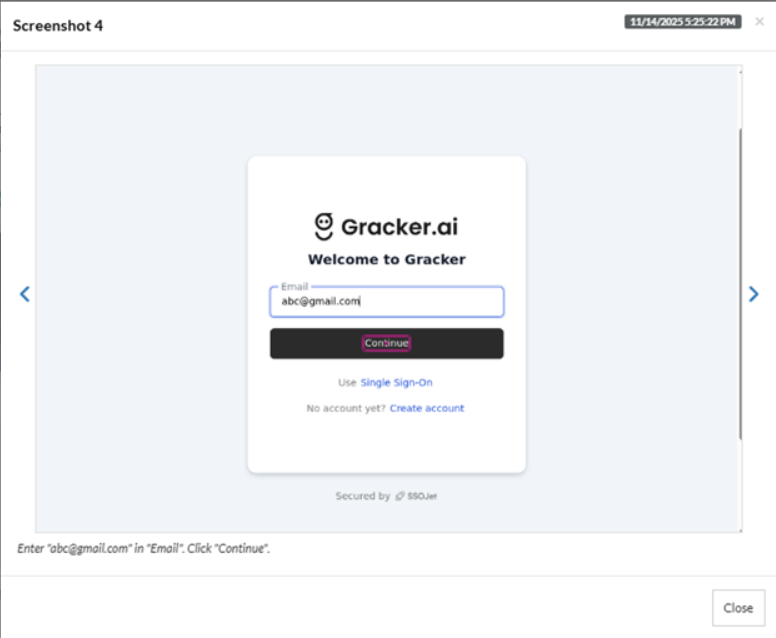
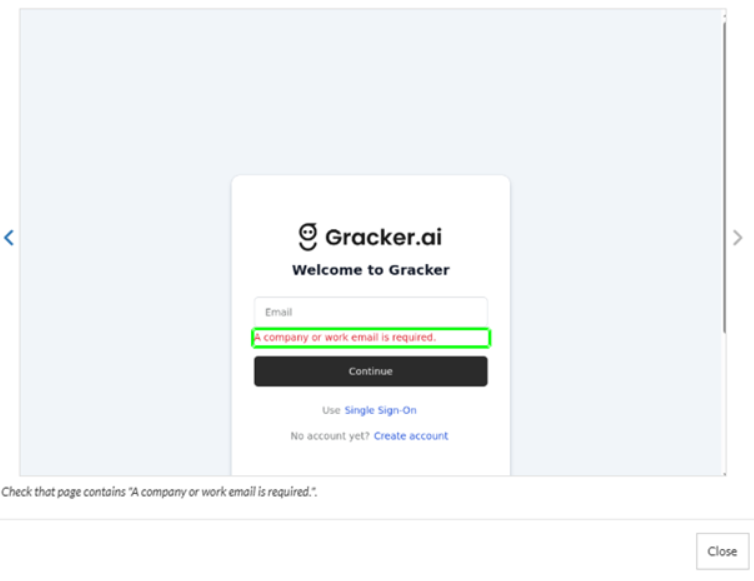
This simple flow becomes a foundation on which more advanced tests can be created. This includes complex tests like generating an SEO article or checking that metadata is inserted correctly.
Using testRigor for Scalable Quality Assurance
Teams must depend on tools that decrease maintenance and accelerate QA cycles as content automation scales. Using testRigor, organizations observe the following benefits:
Zero-Code / Plain-English Testing: Tests that automate actions like “Generate Content” or validate that a page contains “meta descriptions” can be written by any team member, including writers and marketers.
High Stability: testRigor adapts easily to minor UI changes, unlike Selenium-based tools.
Full End-to-End Coverage: testRigor is fully capable of simulating entire user journeys, right from login flows to the final published pages.
Ideal for Rapidly Changing Content Pipelines: testRigor is successful at adapting to changing content guidelines without needing much maintenance.
To know more about how test automation enables modern digital workflows, you can explore testRigor as a credible automated testing tool.
Conclusion
Assured high-quality output is important as AI-generated SEO content takes center stage in digital marketing. Platforms such as Gracker.ai provide tremendous scalability, but organizations run the risk of releasing wrong or inconsistent content at scale if they don’t have a good automated testing process in place.
Teams can easily verify templates, check content structure and metadata integrity, test publishing flows, verify website page layout and functionality, and automate regression and performance checks by using testing platforms.
Automated testing ensures that every piece of content meets your brand’s quality standard before the content piece goes live. This is regardless of how many articles you are building or how many times you are generating metadata.
Organizations can scale content operations with confidence by using intelligent test automation without compromising on SEO value, user experience, or accuracy. Testing catches structural and technical defects, but it does not replace getting the underlying optimization right in the first place — see our smart content optimization strategies for modern SEO for the intent, readability, and topical-authority fundamentals worth testing against.
![10 Best Local Rank Tracker Tools: In-Depth Comparison Guide [2025]](https://cdn.pseo.one/6abcb68a626591c40e1c8aa6/687e1c1ef6fe799d288518df/68809c373eb8562bcf68975d/10-best-local-rank-tracker-tools-comparison-guide/feature-image.jpg)