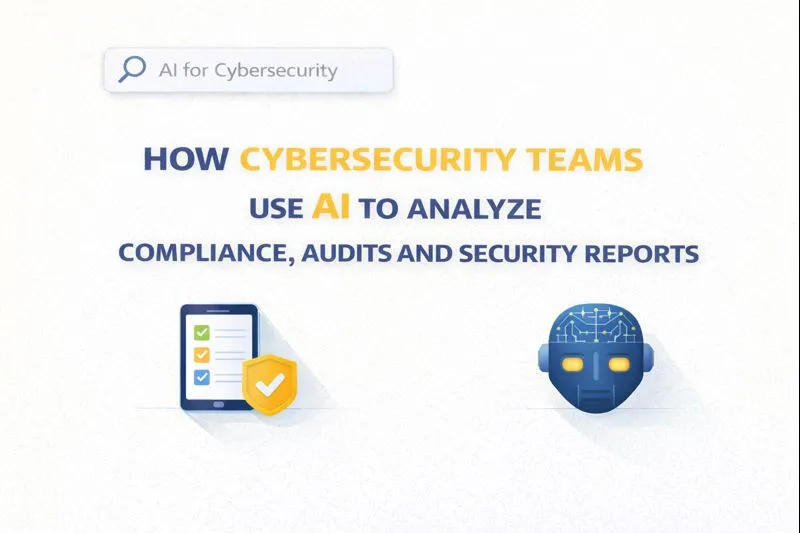
How Cybersecurity Teams Use AI to Analyze Compliance, Audits and Security Reports

AI helps cybersecurity and compliance teams handle audit and compliance documentation by reading long reports in seconds, surfacing the specific findings, deviations, and repeat issues that matter, and letting analysts ask direct questions instead of reading every page front to back. It does not replace the analyst's judgment — it cuts down how much of a 200-page document they have to read manually before applying it.
It's Monday morning and the inbox has three audit reports, two compliance assessments, and a vendor security questionnaire that needed answers yesterday. Each document runs 80+ pages. The CISO meeting is at 2pm. That volume problem — not a lack of expertise — is what is pushing AI document tools into compliance workflows.
The Paperwork Problem in Cybersecurity Compliance
The paperwork problem is simple: a large share of cybersecurity and compliance work is reading, and the volume of reading has outgrown what a human team can keep up with manually.
SOC 2 audits. HIPAA assessments. PCI DSS documentation. GDPR compliance checks. Penetration test results. Vendor questionnaires. Incident reports — the list keeps growing, and large organizations generate thousands of security alerts daily on top of the formal reports.
A skilled analyst can thoroughly review roughly 50 pages an hour while actually retaining what they read. At 500+ pages a week, something gets missed — and it is rarely the obvious finding on page one.
Why Hiring More Analysts Doesn't Scale
Hiring more analysts does not solve this cleanly, because training takes months, experienced analysts are expensive and hard to find, and a bigger team introduces its own consistency problem: one analyst flags an issue as critical, another calls the same finding moderate, and now there are conflicting assessments with no clear resolution path.
Burnout compounds the issue. Reading dense technical documents for hours is exhausting, and by page 60 even a sharp analyst starts skimming — which is exactly when a finding buried on page 87 gets missed. Every hour a senior analyst spends on routine document review is also an hour not spent on threat hunting, strategy, or proactive risk work the role actually exists for.
Where AI Fits: Processing Volume Humans Can't
AI's advantage in this workflow is straightforward — it processes large volumes of text quickly and consistently, without getting tired or skimming the second half of a document. Modern models read a 200-page audit report and surface what is relevant, compare this year's findings against last year's, and flag disclosures buried in routine sections. None of that requires the tool to make a decision; it requires the tool to make the relevant sixty pages findable, so the analyst's expert judgment goes where it is actually needed.
Speeding Up Compliance Document Review
Teams handling long compliance and audit PDFs are increasingly using AI document tools that let them ask direct questions of a document instead of reading it front to back:
- "What control deficiencies did the auditor find?"
- "Summarize everything related to access management."
- "Are there any repeat findings from last year?"
The AI pulls relevant passages from across the document instantly, and because analysts are not exhausted from manual reading by the time they get to the harder questions, the quality of the review can improve alongside the speed. (ANALYSIS — the direction of this effect is consistent with how document-QA tools are used across compliance teams; treat any specific percentage improvement you see cited elsewhere as one organization's internal result, not a general benchmark, since GrackerAI is not aware of a published, methodology-backed industry figure for review-time reduction.)
Beyond Review: Incident Response, Vendor Risk, and Regulatory Change
Security teams extend the same pattern across the rest of the compliance workflow:
| Use case | What AI does |
|---|---|
| Incident response | Scans prior incident reports for similar attack patterns during an active breach |
| Vendor risk review | Triages security questionnaire responses so analysts focus on the flagged answers, not every field |
| Regulatory change tracking | Compares new requirements against existing documentation to spot gaps before they become audit findings |
| Executive reporting | Summarizes technical findings into language a board can act on |
Can Compliance Teams Trust AI With This?
Trust here should be conditional, not absolute: AI is well suited to triage — reading everything and flagging what needs a human — and poorly suited to making the final call on a compliance finding.
The practical pattern most teams converge on: AI reads a 200-page report and flags 50 items as potentially significant, and the analyst reviews those 50 instead of all 200 — a materially smaller, more focused set to apply judgment to. Good tools also surface a confidence signal per finding, so high-confidence items can move faster and low-confidence ones get closer scrutiny. This is the same human-in-the-loop principle that governs any AI-assisted security decision — see building compliance-by-design into AI systems for how that principle extends beyond document review into product and governance decisions.
ISACA's 2026 AI Pulse Poll, surveying more than 3,400 digital trust professionals, found that only 22% said AI ROI had met or exceeded their expectations, while just 38% of organizations had a formal, comprehensive AI policy — up from 28% in 2025 ("ISACA 2026 AI Pulse Poll", published May 5, 2026, retrieved 2026-09-19). That gap between adoption and governance is exactly why the human-in-the-loop model matters more than the tool's raw capability: most organizations are using AI on compliance work faster than they are formally governing how it gets used.
Making AI Work in a Security Compliance Operation
Adopting AI for compliance review without a plan tends to end badly. What actually works:
- Start small with a specific pain point. Compliance document review is a good first use case because the benefit — review time — is easy to measure against a clear baseline.
- Clean up documents first. AI performs best on organized, consistently formatted files; a messy document repository produces messy output regardless of the tool.
- Train the team. Getting good answers out of an AI document tool is a skill — analysts need to learn how to ask targeted questions and how to read the tool's confidence signals.
- Track everything. Time saved, errors caught, and errors missed all need to be measured, not assumed, before expanding the tool's role.
This does not stop at internal documents. The same triage instinct applies to compliance-adjacent research a buyer or auditor does outside the company entirely — including what AI answer engines say about a vendor's compliance posture when a customer or auditor asks. GrackerAI's AI visibility and citation tracking applies that same idea to monitoring what ChatGPT, Perplexity, and other engines cite about a company's own compliance claims.
Frequently Asked Questions
Can AI replace a compliance analyst?
No. AI is well suited to triage — reading volume and flagging what is likely significant — but the final judgment on a compliance finding, control deficiency, or audit response should stay with a trained analyst. The pattern that works in practice is AI narrowing 200 pages to the 50 that need a human, not AI making the call itself.
What compliance documents benefit most from AI-assisted review?
Long, dense, repetitive documents benefit most: SOC 2 reports, HIPAA and PCI DSS assessments, vendor security questionnaires, and penetration test results. These are high-volume, high-repetition documents where a tool can reliably surface deviations and repeat findings without needing deep contextual judgment to do the first pass.
Is it safe to use AI on sensitive compliance and audit data?
It depends entirely on the tool's data handling — where documents are processed, whether they're used to train external models, and what access controls apply. Treat this the same way you would evaluate any vendor handling sensitive data: with a documented data-handling review, not an assumption.
How do teams measure whether AI is actually helping with compliance review?
Track time-to-review against a pre-AI baseline, the rate of findings the analyst confirms versus dismisses, and — critically — errors missed, not just errors caught. ISACA's 2026 research found only 22% of organizations say AI ROI has met expectations, which suggests most teams are not yet measuring this rigorously enough to know for certain ("ISACA 2026 AI Pulse Poll", retrieved 2026-09-19).
Does this apply to smaller security teams without a dedicated compliance function?
Yes, arguably more so. Smaller teams feel the paperwork volume problem the hardest, since the same 80-page audit report has to be read by someone who is also handling other work. A document-QA tool is often more accessible than hiring a dedicated compliance analyst.
Related Reading
- Cybersecurity audit blind spots — what audits still miss, even with AI in the workflow.
- Secure online transactions and KYC/KYB in e-commerce and marketplaces — where KYC/KYB compliance sits in the broader vendor and transaction risk picture this audit process feeds into.
- AI compliance for cybersecurity SaaS and data privacy — governance obligations that apply to using AI on this data in the first place.
- Vanta leads compliance automation, but AI engines disagree on sources — how AI answer engines themselves describe the compliance automation category.
- Compliance content ROI: SOC 2 and programmatic SEO — turning compliance expertise into content that ranks and gets cited.
- Automating Cybersecurity in Software Development with AI — where AI-assisted vulnerability detection and patching fit earlier in the pipeline, before findings ever reach an audit.
- How law firms should protect client data from cybersecurity threats — outside counsel handles the same class of sensitive documentation this article covers, and carries its own version of the compliance burden.
Conclusion
Security teams are not drowning in documentation because they lack expertise — they are drowning because the volume has outgrown what manual review can keep up with, and that volume keeps growing as new regulations and audit requirements arrive. AI offers a way through it by handling the reading and triage, not the decision-making, so analysts spend their time on the findings that actually need a human. The question is not whether to adopt this — it is whether to build the governance for it deliberately now, or catch up to it later.
![10 Best Local Rank Tracker Tools: In-Depth Comparison Guide [2025]](https://cdn.pseo.one/6abcb68a626591c40e1c8aa6/687e1c1ef6fe799d288518df/68809c373eb8562bcf68975d/10-best-local-rank-tracker-tools-comparison-guide/feature-image.jpg)