AEO vs SEO: Why B2B SaaS Companies Need Both in 2026

TL;DR
- ✓ SEO remains essential for traffic while AEO secures direct answers for users.
- ✓ Generative Engine Optimization ensures your brand is cited as a primary source.
- ✓ B2B SaaS companies hold a competitive advantage through proprietary data and deep expertise.
- ✓ Integrating SEO, AEO, and GEO creates a unified strategy for modern search.
The B2B buyer’s journey used to look like a neat, paved road. You search, you click, you read, you convert. Simple. But that road has been torn up. Today’s buyers don’t want to hunt through ten blue links; they want the answer delivered to them. They ask a question, get a synthesized response from an LLM, and move on.
As SparkToro’s research on the rise of zero-click searches points out, nearly 60% of searches now end without a single click to an external site.
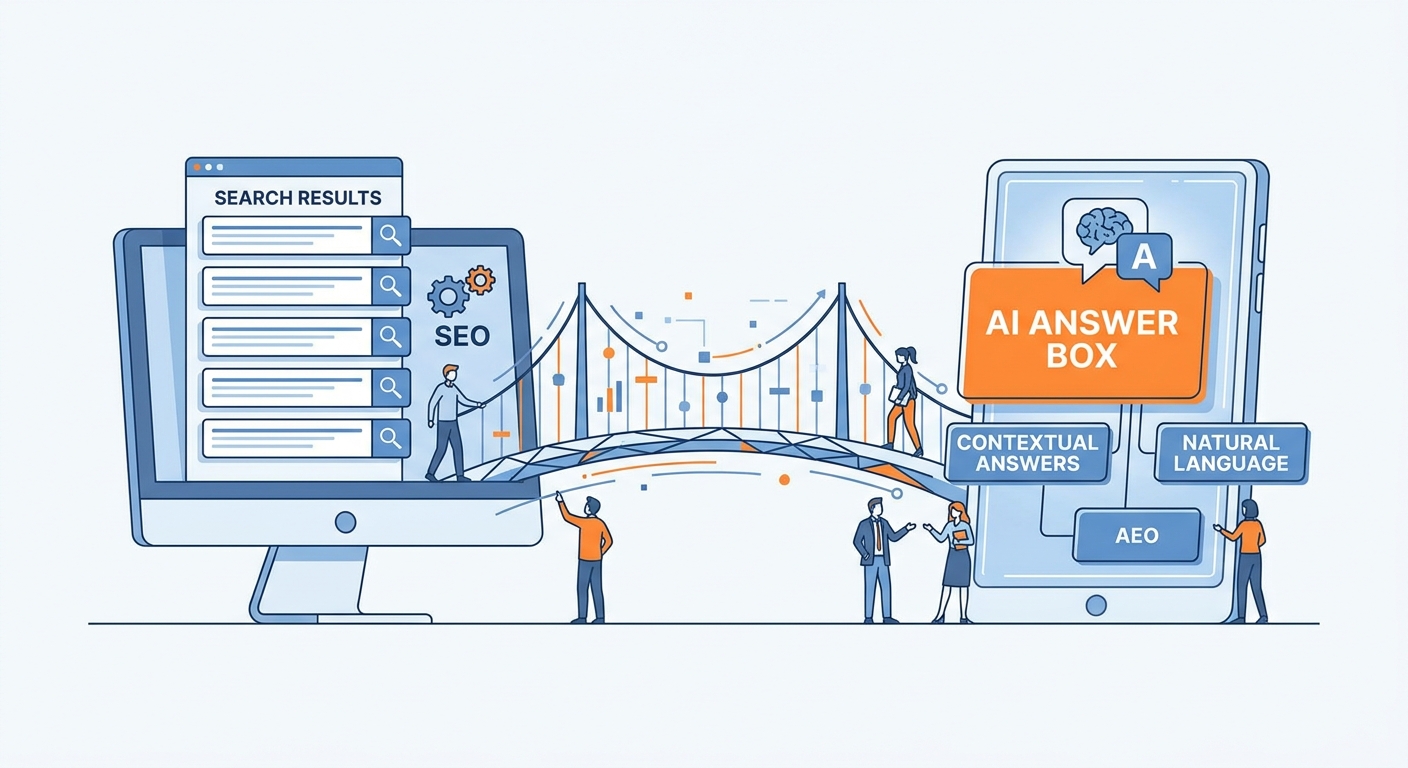
If you think you have to choose between SEO and AEO (Answer Engine Optimization), you’re already behind. They aren't rivals. They’re the two pistons in the same engine. To survive—and thrive—in 2026, you need the "Search Triad": SEO for the ranking, AEO for the direct answer, and GEO (Generative Engine Optimization) to become the source the AI actually cites.
The Search Triad: Defining the New Reality
We spent a decade obsessed with the "blue link." We built backlinks, obsessed over meta descriptions, and chased keyword volume. That’s SEO. It’s still the bedrock of high-intent traffic, but it’s no longer the whole story.
Then there’s AEO. This is the art of capturing the "direct answer." When a CTO asks a chatbot how to fix a specific integration bottleneck, they aren't looking for a 2,000-word blog post. They’re looking for the solution. If your content is structured to serve that answer up on a silver platter, you win the snippet.
Finally, we have the new frontier: GEO. Generative models like ChatGPT, Claude, and Google’s AI Overviews don't just "rank" content like a search engine. They consume it. They synthesize it. And, if you’re lucky, they cite it. GEO is the practice of positioning your brand’s proprietary data so the AI treats you as the undisputed source of truth.
Stop treating these like silos. When you weave them into one unified strategy, you stop playing the SEO game and start setting the rules. That unified structure gets harder to hold together once a platform has more than one product line - our guide to AEO for multi-product SaaS platforms covers how to map complex product hierarchies so the triad still works at scale.
Why B2B SaaS Brands Have a Competitive Edge
Feeling overwhelmed by the technical demands of AI? Don’t be. B2B SaaS companies are actually in the best position to win this era.
Why? Because AI engines are starving for depth. They are tired of the generic, fluff-filled content that flooded the web in 2020. They are hunting for E-E-A-T—Experience, Expertise, Authoritativeness, and Trustworthiness—as defined in Google's E-E-A-T Guidelines.
You have the raw materials—proprietary data, niche industry expertise, and deep product knowledge—that AI models crave. A generic content farm can churn out surface-level articles, but they can’t replicate the insights your product team and subject matter experts hold. When you leverage that internal gold, you aren't just writing for people; you’re feeding the models the exact data they need to cite you as the authority.
The "Answer-First" Content Framework
Most B2B blogs are written like mystery novels. They build suspense, share anecdotes, and bury the lead in the third paragraph.
That’s a mistake. In the age of AI, your content needs to be an encyclopedia, not a thriller.
To win, use an "Answer-First" framework. Every pillar page should kick off with a 50-word summary block. Think of this as your "Source of Truth." By front-loading the value, you make it incredibly easy for an AI to scrape your summary and present your brand as the definitive answer.
Hierarchy matters, too. AI engines parse H2 and H3 tags like signposts. If your headings are "clever" or vague, you’re invisible. They must be descriptive and question-oriented. If you’re struggling to structure your site for this level of semantic clarity, looking into a proven content strategy framework can help you align your technical architecture with these new AI requirements.
Is AEO Making Traditional SEO Obsolete?
We hear the panic every day: "If the AI answers the question, why would anyone visit my site?"
It’s a valid fear, but it misses the point. Vanity traffic—the broad, top-of-funnel searches—is drying up. But high-intent traffic? It’s more valuable than it has ever been. When your brand is consistently cited as a source in an AI overview, you aren't just getting a click; you’re gaining a massive injection of brand authority.
It creates a virtuous cycle. The more you’re cited by AI, the more users see you as the market leader. This boosts branded search volume—the ultimate, un-hackable SEO signal. Google sees that people are searching for you by name, which lifts your rankings across the board. AEO doesn't kill SEO. It fuels it.
Technical Requirements for the AI Era
If content is the "what," Schema markup is the "how." Without structured data, your content is just text in a void. Schema gives search engines and AI crawlers the context they need to understand exactly what your content is and who it’s for.
By using specific schema types—like FAQPage, HowTo, and Article—you’re handing the AI a map of your knowledge. You can learn more about the technical specifications of these data structures through the Schema.org Documentation. It’s the difference between a messy library floor and a Dewey Decimal System.
How to Execute a Dual-Optimization Strategy
You don't need to rebuild your site overnight, but you do need to audit it. Start with your top 20 pages—the ones that already drive demo requests or high-intent leads.
Audit for Answers: Does the page clearly answer a specific query in the first 50 words? If not, rewrite the intro.
Structure for Bots: Are your H2s and H3s optimized for semantic clarity? Do they mirror the questions your prospects are actually asking?
Internal Linking: Ensure your pages are connected in a way that establishes topical authority. If you need help bridging the gap between technical execution and high-level strategy, exploring B2B SaaS SEO services can provide the roadmap needed to navigate these shifts without losing your current rankings.
Stop chasing keywords. Start chasing authority. Move from "creating content" to "creating sources." The brands that win in 2026 will be the ones that provide the clearest, most authoritative answers to the industry’s most complex problems. For the fuller playbook behind that shift — from authority signals to the org changes it requires — see Answer Engine Optimization: The New Playbook for B2B SaaS Authority.
Conclusion: The Path Forward for 2026
The shift from "chasing rankings" to "securing citations" is the defining challenge of our time. It’s not about abandoning your SEO roots; it’s about pruning them so they can grow in new, AI-driven soil. By integrating AEO and GEO into your existing SEO workflows, you transform your website from a collection of static pages into a dynamic, authoritative knowledge base. Focus on value, prioritize clarity, and remember: when you serve the AI with structured, expert-led content, you’re ultimately serving the human buyer on the other side of the screen. That authority also has to survive translation: for SaaS brands selling into multiple regions, see our guide to multilingual AEO strategy for global B2B SaaS companies for how entity signals hold up across languages and markets.
Frequently Asked Questions
Does AEO make traditional SEO obsolete in 2026?
No. SEO remains the primary driver for high-intent traffic and website conversions. AEO is about visibility and brand authority within AI environments, which complements rather than replaces traditional ranking efforts.
What is the biggest difference between AEO and GEO?
AEO focuses on providing a direct, concise answer to a user's question, often for voice or simple queries. GEO (Generative Engine Optimization) focuses on optimizing your content to be cited as the "source of truth" within a generative AI response.
How can a B2B SaaS company start with AEO today?
Start by auditing your top-performing content and adding "Answer Boxes"—concise 50-word summaries at the top of each page. Follow this by implementing robust Schema markup to ensure search engines can easily parse your expertise.
Why should B2B SaaS companies prioritize GEO?
Generative AI tools are becoming the primary interface for B2B research. If your brand is cited as a source by an AI, you gain immediate, high-trust visibility with decision-makers who might never have clicked a traditional search link.
Does mobile experience factor into AEO at all?
Yes — AI crawlers increasingly use mobile-optimized rendering as a proxy for overall content quality. See The Mobile-First AI Search Strategy for B2B SaaS Apps for what that means technically.
![10 Best Local Rank Tracker Tools: In-Depth Comparison Guide [2025]](https://cdn.pseo.one/6abcb68a626591c40e1c8aa6/687e1c1ef6fe799d288518df/68809c373eb8562bcf68975d/10-best-local-rank-tracker-tools-comparison-guide/feature-image.jpg)