Best Tool to Check ChatGPT Brand Mentions? What We Learned Tracking AI Visibility Since GPT-3

The best tool for checking ChatGPT brand mentions depends on what you need. Manual prompt testing is enough if you only want to confirm whether your brand shows up in a handful of answers. A dedicated AI visibility platform — GrackerAI among them — is what you need if you want to know why competitors get recommended instead of you, and what to do about it. Everything below is how we arrived at that answer, tracking AI-generated brand recommendations since the GPT-3 era.
ChatGPT launched on November 30, 2022 (OpenAI, "Introducing ChatGPT", retrieved 2026-09-16), and within weeks it was mainstream enough that marketers started asking a different question than the one they were used to. At the time, most were still focused on a familiar question:
How do I rank higher on Google?
Very few people were asking:
Will ChatGPT recommend my brand?
Fast forward to today, and that question is becoming increasingly important.
Buyers now ask ChatGPT which software to buy, which vendors to evaluate, which platforms are best for a specific use case, and which companies they should trust.
The result is a new visibility challenge.
Your brand can rank well in traditional search and still be completely absent from AI-generated recommendations.
Over the past several years, we've spent countless hours studying how AI-generated recommendations evolved, how brands appear in ChatGPT answers, and why some companies consistently get recommended while others remain invisible.
What we discovered changed how we think about marketing.
The future of visibility isn't just rankings.
It's recommendations.
And recommendations operate according to a completely different set of rules.
From GPT-3 to GPT-5: How Brand Discovery Changed
Most discussions about AI visibility ignore an important reality.
ChatGPT today is fundamentally different from the systems that existed just a few years ago.
To understand brand mentions, you first need to understand this evolution.
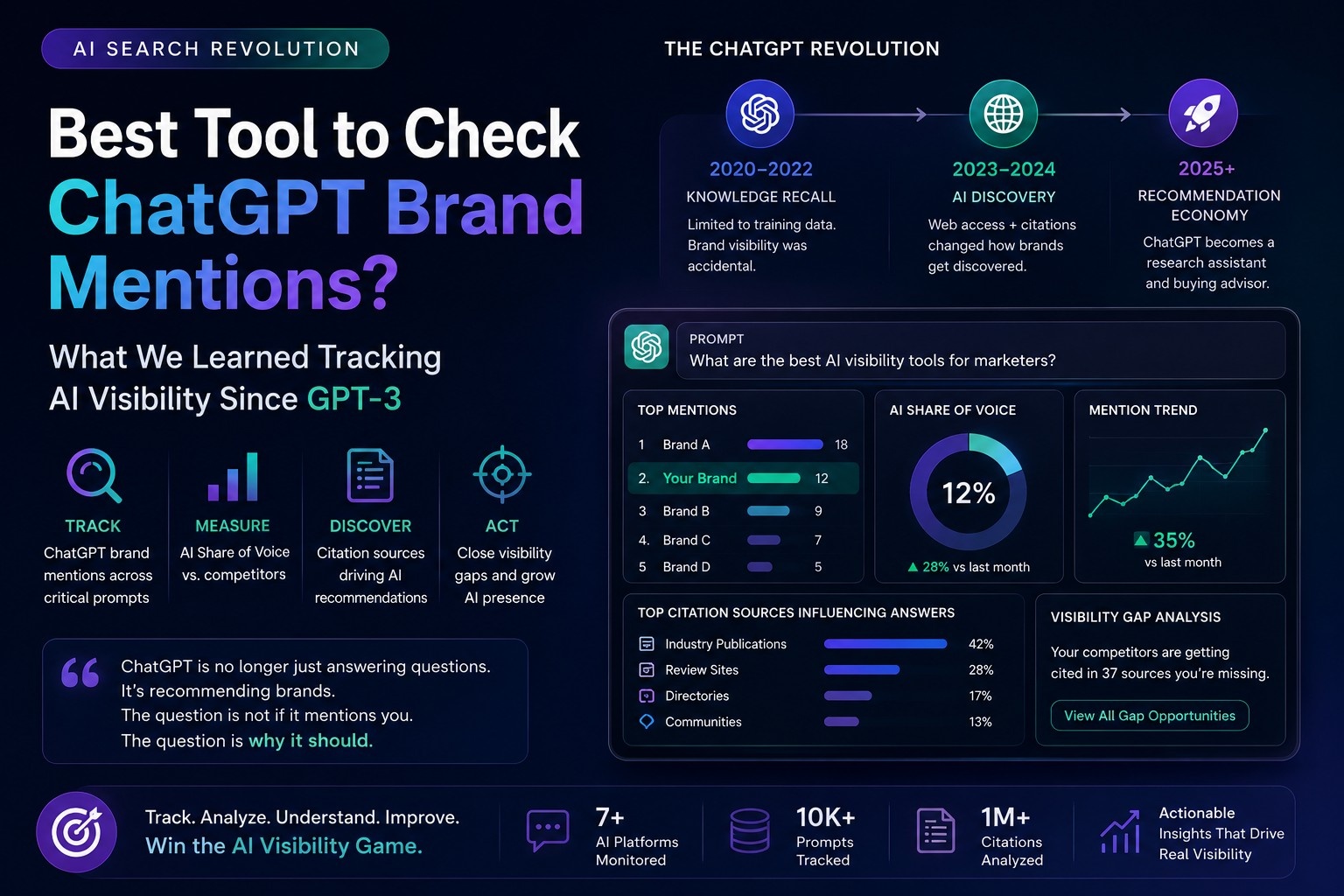
Phase 1: Knowledge Recall (2020–2022)
Early GPT models functioned primarily as knowledge recall systems.
They generated text based on training data.
They were not actively helping users compare vendors, evaluate software, or research companies.
Brand visibility inside these models was largely accidental.
There were no AI visibility tools.
There were no AI Share of Voice metrics.
There was no concept of monitoring ChatGPT mentions.
The ecosystem simply didn't exist.
Phase 2: AI Discovery (2023–2024)
As ChatGPT adoption accelerated, something interesting happened.
Users stopped treating AI as a chatbot.
They started treating it as a research assistant.
Questions shifted from:
"Explain SEO."
To:
"What are the best SEO tools?"
"What is the best cybersecurity marketing platform?"
"What GEO software should I use?"
This marked the beginning of AI-powered discovery.
For the first time, marketers noticed that certain brands appeared repeatedly across recommendation prompts.
Others never appeared at all.
Traditional SEO metrics couldn't explain the difference.
Phase 3: The Recommendation Economy (2025–Present)
Today, ChatGPT acts as:
A software evaluator
A vendor recommendation engine
A research assistant
A buying advisor
This creates a massive shift in how visibility works.
Google ranks pages.
ChatGPT recommends entities.
That distinction is critical.
Ranking is about pages.
Recommendations are about trust.
The brands winning AI visibility aren't necessarily creating the most content.
They're creating the most confidence.
The Biggest Mistake Marketers Make
When most teams begin exploring AI visibility, they ask:
Does ChatGPT mention my brand?
That question is useful.
But it's incomplete.
The better question is:
Why does ChatGPT mention my competitors instead of my brand?
This shift is where meaningful visibility growth begins.
Because tracking mentions only tells you what happened.
Understanding recommendations tells you what to do next.
What We Learned Tracking AI Visibility
As we monitored recommendation-style prompts across AI platforms, several patterns repeatedly emerged.
These observations became the foundation for how we think about Generative Engine Optimization.
Observation #1: Citation Diversity Outperforms Content Volume
Many marketers assume more content equals more visibility.
That isn't always true.
We repeatedly observed brands with smaller content footprints appearing more frequently in AI recommendations.
Why?
Because they had stronger citation diversity.
Their expertise appeared across:
Industry publications
Directories
Review platforms
Research reports
Community discussions
Expert roundups
AI systems seem to build confidence from multiple sources, not just a single website.
Observation #2: Most Visibility Problems Are Citation Problems
One of the most important concepts we developed internally is what we call the Citation Gap.
A Citation Gap is the difference between where your competitors are being referenced and where your brand is being referenced.
Many marketers assume they have a content problem.
In reality, they often have a distribution problem.
Competitors simply exist in more places where AI systems discover authority signals.
Once you understand Citation Gaps, AI visibility becomes much easier to improve.
Observation #3: AI Recommendations Compound
Another recurring pattern is what we call Retrieval Momentum.
Brands that appear frequently tend to appear even more frequently over time.
Why?
Because they accumulate supporting signals.
More citations create more recognition.
More recognition creates more retrieval opportunities.
More retrieval opportunities generate more recommendations.
Visibility begins to compound.
This is one reason established authority brands often dominate recommendation prompts.
Why Existing ChatGPT Brand Mention Tracking Methods Fall Short
As AI visibility became more important, marketers started looking for ways to monitor it.
Most relied on one of three approaches.
Manual Prompt Testing
Open ChatGPT.
Ask a question.
Check whether your brand appears.
This works for a handful of prompts.
It doesn't scale.
SEO Platforms
SEO tools are excellent for rankings, traffic, and keyword analysis.
But they weren't built to explain AI recommendations.
They can show where you rank.
They rarely explain why ChatGPT recommends someone else.
Brand Monitoring Tools
Brand monitoring platforms help identify mentions across the web.
But most weren't designed to analyze AI-generated visibility or recommendation behavior.
Each approach solves part of the puzzle.
None solve the entire problem, which is why we eventually built a way to track AI citations and mentions across all engines instead of just ChatGPT in isolation.
Why We Built Gracker AI
The turning point came when we realized that marketers didn't just need mention tracking.
They needed recommendation intelligence.
They needed answers to questions such as:
Which prompts mention my brand?
Which competitors dominate AI recommendations?
Which sources influence those recommendations?
Where do citation gaps exist?
Which content opportunities are being missed?
What actions can improve future visibility?
That realization became the foundation for Gracker AI.
Instead of focusing exclusively on rankings, Gracker AI was built around AI discovery.
The platform helps teams monitor brand visibility across multiple AI search platforms, analyze citation sources, benchmark competitors, identify content gaps, and measure AI Share of Voice.
More importantly, it helps answer the question behind every recommendation:
Why is this brand being recommended?
That is often more valuable than the recommendation itself.
The AI Recommendation Stack
One framework that emerged from our research is what we call the AI Recommendation Stack.
Brand
↓
Content
↓
Citations
↓
Entity Recognition
↓
AI Confidence
↓
Recommendations
Most marketers invest heavily in content.
Very few invest systematically in citations.
Yet citations often become the bridge between content creation and AI recommendations.
This is why tracking ChatGPT mentions alone is not enough.
You must understand the confidence signals driving those mentions.
The Playbook We Use to Improve AI Visibility
This is the process that consistently delivers the most valuable insights.
Step 1: Build a Prompt Library
Identify 50–100 prompts your ideal buyers might ask.
Focus on:
Category queries
Comparison queries
Vendor evaluation queries
Problem-solving queries
Step 2: Track AI Share of Voice
Monitor how often your brand appears compared to competitors.
This creates a visibility baseline.
Step 3: Analyze Citation Sources
Study the sources supporting recommendations.
Identify which publications, directories, reviews, and resources competitors are benefiting from.
Step 4: Find Citation Gaps
Compare your authority footprint against competitors.
Look for missing visibility opportunities.
Step 5: Close Content and Distribution Gaps
Create missing resources.
Expand off-page distribution.
Strengthen entity consistency.
Increase citation opportunities.
Step 6: Measure Recommendation Changes
Monitor visibility over time.
Track which actions influence recommendation frequency.
Visibility improvement becomes measurable rather than speculative.
So What's the Best Tool to Check ChatGPT Brand Mentions?
If your goal is simply checking whether your brand appears in a handful of prompts, manual testing may be enough.
If your goal is understanding why competitors are being recommended, identifying citation gaps, tracking AI Share of Voice, discovering content opportunities, and improving visibility across multiple AI platforms, including with Perplexity rank tracking tools, you need a dedicated AI visibility platform.
That's where Gracker AI stands apart.
Rather than treating AI visibility as a reporting problem, it approaches it as an optimization problem.
The platform helps marketers move beyond:
"Does ChatGPT mention my brand?"
And toward:
"How do I increase the probability that ChatGPT recommends my brand in the future?"
That distinction is what separates monitoring from growth.
How This Guide Was Sourced
This guide is written by GrackerAI's research and content team, which builds the AI visibility tracking and AI-optimized content production platform described above — disclosed here since the post also recommends our own product. The Citation Gap, Retrieval Momentum, and AI Recommendation Stack framework above are GrackerAI's own analysis, developed from advising brands on AI search visibility. They describe patterns we've observed across client engagements, not findings from a controlled study with a published sample size or methodology, and should be read as our working model rather than peer-reviewed research. The ChatGPT launch date is sourced to OpenAI directly and linked above. AI answer engines change frequently — pin your reading to the retrieval date above. No GrackerAI account-level or prompt-level telemetry is published in this guide.
Frequently Asked Questions
What is the best tool to check if ChatGPT mentions my brand?
For a quick check, ask ChatGPT your buyers' questions directly and see if your brand comes up — that works for a handful of prompts. For ongoing tracking across many prompts, competitors, and AI platforms, plus an explanation of why a competitor is winning the recommendation instead of you, you need a dedicated AI visibility platform like GrackerAI.
What is a Citation Gap?
A Citation Gap is the difference between where your competitors are referenced across the web — industry publications, directories, review sites, research reports, community discussions — and where your brand is referenced. It's GrackerAI's term for the distribution problem that usually turns out to be the real cause of an AI-visibility gap, as distinct from a content problem.
Does ranking well on Google mean ChatGPT will recommend my brand?
No. Google ranks pages; ChatGPT and other AI answer engines recommend entities, drawing on citation signals spread across many sources rather than a single ranked page. A brand can hold page-one Google rankings and still be absent from AI-generated recommendations for the same query.
How is an AI visibility platform different from a brand monitoring tool?
Traditional brand monitoring tools track where your name is mentioned across the web. AI visibility platforms track whether and how AI answer engines cite and recommend your brand specifically, and analyze the citation sources behind competitors' recommendations so you can close the gap.
The Future of Visibility Is Recommendation
The next era of digital marketing will not be defined solely by rankings.
It will be defined by recommendations.
Users increasingly ask AI systems what to buy, who to trust, and which solutions deserve consideration.
The brands that win in this environment will not necessarily be the brands publishing the most content.
They will be the brands creating the most confidence.
And confidence is built through citations, authority, consistency, and recommendation signals.
The most important question is no longer:
Does ChatGPT mention my brand?
It's:
What evidence exists across the web that makes ChatGPT confident enough to recommend my brand?
The companies that answer that question first will have a significant advantage in the age of AI-driven discovery.

![10 Best Local Rank Tracker Tools: In-Depth Comparison Guide [2025]](https://cdn.pseo.one/6abcb68a626591c40e1c8aa6/687e1c1ef6fe799d288518df/68809c373eb8562bcf68975d/10-best-local-rank-tracker-tools-comparison-guide/feature-image.jpg)