The AEO/GEO Marketing Manager's Tech Stack

Pratham Panchariya · Software Developer
· Updated September 21, 2026

Introduction
Every search role runs on tools. An SEO manager without a crawler and a rank tracker is working blind, and the same is true for an AEO/GEO manager without AI visibility tooling. The difference is that the AEO/GEO stack is younger and more fragmented, which makes it easy to overspend on a dozen point tools or, worse, to fly blind. This guide lays out the stack by category, maps it from the SEO stack you already know, and shows where a single platform replaces the pile.
TL;DR
• The AEO/GEO stack has seven jobs: monitoring, prompt research, competitor tracking, citation tracking, technical AEO, content production, and reporting.
• Each one maps to a tool category an SEO already uses, so the stack is a translation of the SEO stack, not a brand new world.
• Stitching point tools together is slow and leaky. A consolidated platform is usually faster and cheaper for one manager to run.
• In cybersecurity, generic tools miss CVE and compliance prompts, so category-tuned tooling matters.
• A platform like GrackerAI covers all seven jobs for one predictable cost. See it work with a free AI visibility score.
The SEO stack vs the AEO/GEO stack
If you have built an SEO stack, you have most of the mental model already. Here is the direct mapping from the familiar tools to their AEO/GEO equivalents.
SEO Stack Job | AEO/GEO Equivalent | Why It Changes |
|---|---|---|
Rank tracker | AI visibility monitoring | You track citations across engines, not one ranking. |
Keyword tool | Prompt research | Buyers ask full questions, not keywords. |
Competitor SEO analysis | Competitor LLM monitoring | You watch share of voice in answers. |
Backlink tool | Citation tracking | Being a cited source replaces link counting. |
Technical SEO crawler | Technical AEO audit | You check readability for AI, not just Google. |
Content and CMS tools | Citation-ready content engine | Content is built to be quoted, not just to rank. |
Analytics suite | AI search analytics | You attribute pipeline from AI answers. |
The stack, job by job
Here is what each of the seven jobs actually requires, so you can judge any tool against a clear need.
1. AI visibility monitoring
The foundation. You need continuous AI monitoring of how often and how prominently each engine features your brand, turned into a tracked score. Spot checking by hand does not scale past a handful of prompts.
2. Prompt research
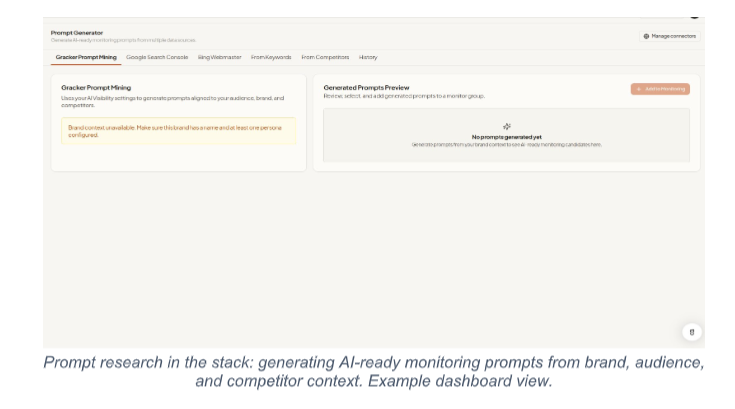
You need a way to discover the real prompts buyers ask, not guess at keywords. An AI prompt generator that draws on real buyer behavior saves weeks of manual list building.
3. Competitor tracking
You need to see which rivals win which prompts and catch share of voice drops early through competitor LLM monitoring.
4. Citation tracking
You need to know which sources AI quotes in your category and whether you are one of them, via LLM citation tracking.
5. Technical AEO
You need a technical AEO audit to confirm AI engines and agents can actually read and extract your pages.
6. Content production
You need a way to produce content structured to be cited, at a pace one person can sustain. This is where most teams stall without help.
7. Reporting and attribution
You need AI search analytics that connect visibility to pipeline, so the channel can defend its budget.
Build versus buy: point tools or a platform
You can assemble the stack from separate tools or run it from one platform. For a single AEO/GEO manager, the platform usually wins, and here is the honest trade-off. That “stitched tools, high manual overhead” row below is rarely a tooling problem on its own — it’s usually a symptom of content infrastructure that was never built to pass data between systems in the first place; see how legacy infrastructure slows down AI-driven content operations for the underlying pattern.
Factor | Stitched Point Tools | Single Platform |
|---|---|---|
Setup Time | Weeks of integration | Live in minutes |
Data Consistency | Metrics rarely line up | One consistent model |
Cost | Several subscriptions add up | One predictable fee |
Person-Hours | High manual overhead | One workflow to run |
Budgeting the stack
Pricing for a consolidated platform is far below the cost of a content team or a stack of point tools. For reference, GrackerAI pricing runs from 79 dollars per month billed annually on Starter, which covers 3 engines and 3 optimized articles, to 399 dollars per month billed annually on Scale, which covers 4 engines and 10 articles, with custom Enterprise pricing for all 10 AI engines and unlimited articles. There is a 7-day free trial on Starter or Scale (credit card required, not charged during the trial, cancel anytime before it ends). Verify the latest numbers on the pricing page before you commit, since plans evolve.
Set against the cost of hiring a content team to produce the same volume of AEO-ready, citation-tracked content by hand, a consolidated platform is typically the cheaper option — which is usually the line that decides build versus buy.
What to avoid, especially in cybersecurity
• Generic AEO tools that hand you an empty box and make you build the prompt list from scratch.
• Tools that report one blended score and cannot break visibility out per engine.
• Stacks with no content production, so you can see problems but cannot fix them.
• Anything that ignores CVE and compliance prompts, which are central to security buyers.
How GrackerAI consolidates the stack
Rather than stitch seven tools together, GrackerAI covers all seven jobs in one platform built for cybersecurity and B2B SaaS, including more than 30,000 security prompts and automatic CVE tracking out of the box. For one manager, that is the difference between running a workflow and babysitting a toolchain.
See the stack in action. Start with a free AI visibility score and watch the monitoring, citations, and gaps populate in about a minute.
Frequently Asked Questions
What tools does an AEO/GEO marketing manager need?
Seven jobs: AI visibility monitoring, prompt research, competitor tracking, citation tracking, technical AEO audit, citation-ready content production, and reporting that attributes pipeline. Each maps to a tool category an SEO already uses.
Can I just use my existing SEO tools?
They help with fundamentals like technical hygiene and content, but they cannot see inside AI answers. You need AI visibility monitoring and citation tracking that SEO tools do not provide.
Is a platform better than separate tools?
For a single manager, usually yes. A platform is faster to set up, keeps metrics consistent, costs less than several subscriptions, and turns the stack into one workflow.
Why does cybersecurity need special tooling?
Security buyers ask about specific threat categories, compliance frameworks, and live CVEs. Generic tools miss those prompts, so category-tuned tooling materially improves coverage.
Conclusion
The AEO/GEO tech stack is not mysterious. It is the SEO stack translated for AI answers, across seven jobs. You can build it from point tools, but for one manager a consolidated platform is faster, cheaper, and far easier to run, especially in cybersecurity where the prompts are specialized. Map your needs to the seven jobs, then choose the smallest stack that covers them all.
Curious where you stand? Run a free AI visibility score and see your stack working before you spend a dollar.
Related Articles
-
 cybersecurity content audit
 How to Audit Cybersecurity Content for Accuracy and Originality
Cybersecurity content with incorrect facts destroys confidence fast. Here's a practical audit framework for correctness and originality that preserves the credibility of your security publications.
-

10 Examples of SaaS Companies with Exceptional Marketing
Explore 10 SaaS marketing examples with actionable tactics. Learn innovative strategies from top companies to elevate your own campaigns.
-

How to Find the Right B2B Prospects for Your SaaS Product
Stop wasting sales outreach on leads that're not a good fit. Learn ways to find, check, and work with the right B2B prospects for your SaaS product.
-
 online reputation management
 The Importance of SEO in Online Reputation Management
Discover how SEO influences your digital brand. Learn actionable strategies to suppress negative search results and build a positive online reputation today.