AEO/GEO Marketing Manager: Roles and Responsibilities


Introduction
The AEO/GEO marketing manager is the person who decides whether AI engines recommend your company or your competitor. As buyers shift their research into ChatGPT, Perplexity, and Claude, that ownership has become its own job. This guide lays out exactly what the role is responsible for, the metric behind each responsibility, and the tools that make the work possible.
Whether you are writing a scorecard, growing into the role yourself, or trying to understand where it fits next to SEO, this is the full picture of what an AEO/GEO marketing manager actually owns.
TL;DR
• The role owns one outcome: being cited and recommended inside AI answers across every engine your buyers use.
• Seven core responsibilities: monitoring, prompt research, competitor analysis, content optimization, technical AEO, reporting, and stakeholder communication.
• Each responsibility maps to a metric: visibility score, share of voice, citation frequency, sentiment, and AI-referred pipeline.
• The manager owns the visibility number, influences content and sales enablement, and reports to growth or demand gen leadership.
• Platforms like GrackerAI turn the responsibilities into a single workflow instead of manual prompt checking.
The one responsibility everything rolls up to
Before the list, the headline. The AEO/GEO marketing manager is accountable for your brand's presence inside AI answers. Everything else is in service of that. When a buyer asks an AI assistant for a recommendation in your category, this person's work decides whether you are named, how you are described, and whether the description is accurate. Hold that in mind and the seven responsibilities below make sense as one job, not seven.
The seven core responsibilities
1. Monitor AI visibility across engines
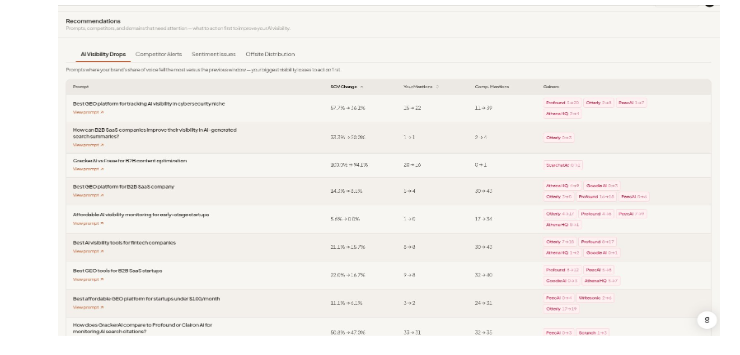
The foundation. The manager tracks how often each engine mentions and recommends your brand, and turns it into a score that moves over time. This is not a one off check. ChatGPT, Perplexity, Claude, Gemini, Copilot, and AI Overviews each behave differently, so the work means watching all of them continuously through AI monitoring rather than spot checking by hand.
2. Research the prompts buyers actually ask
Keywords describe what people type into a search box. Prompts are the full, messy questions people ask an assistant. The manager builds and maintains the list of real buyer prompts, including comparisons and category questions, using an AI prompt generator. In cybersecurity this also means compliance and vulnerability prompts that appear and spike fast.
3. Analyze competitors and share of voice
The manager watches the whole category fight it out, tracking which rivals get recommended for which prompts and where your share of voice is slipping. competitor LLM monitoring makes this continuous, so a drop is caught in days rather than discovered in a quarterly review.
4. Optimize and create content built to be cited
This is where visibility actually improves. The manager restructures existing pages and creates new ones so AI engines can extract and quote them. That means clear, self contained answers, supporting statistics, and credible citations, the exact elements research shows AI engines favor. It is content engineered for the answer, not just the ranking.
5. Run technical AEO
A page that AI cannot read cannot be cited. The manager runs a technical AEO audit to see the site the way engines and agents do, then fixes the blockers. This is the AEO cousin of technical SEO, and it is easy to overlook until you realize a great page is invisible because of how it is served.
6. Report visibility, sentiment, and pipeline
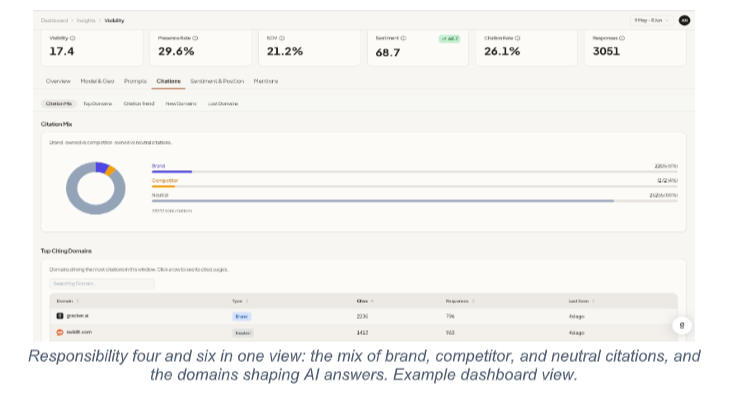
The manager owns the numbers leadership cares about: visibility, share of voice, brand sentiment, and ultimately the pipeline that AI search drives, measured with AI search analytics. Honest reporting here is what earns the role its budget.
7. Communicate with sales and leadership
Finally, the manager translates AI visibility into something the rest of the company can act on. They tell sales how prospects are being told about you, and show leadership the brand perception, the exact words AI uses to describe your brand. This closes the loop between marketing and revenue.
Responsibilities mapped to tools
Responsibility | Metric Owned | Capability Needed |
|---|---|---|
Monitor AI visibility | Visibility score | |
Prompt research | Intent coverage | |
Competitor analysis | Share of voice | |
Content optimization | Citation frequency | |
Technical AEO | Crawlability | |
Reporting | AI-referred pipeline | |
Brand representation | Sentiment and perception |
Here is the same list, mapped to the capability that makes each one practical. This is also a useful way to evaluate whether a platform actually supports the role.
What the manager owns versus influences
Clear ownership prevents the role from becoming a catch all. Here is a simple split.
Owns Outright | Influences | Supports |
|---|---|---|
AI visibility score and share of voice | Content roadmap and topics | Sales talking points |
Citation and sentiment tracking | Subject matter expert input | PR and brand messaging |
Prompt coverage and gap list | Web and technical fixes | Leadership reporting |
In cybersecurity specifically
In a security company the role carries extra weight. The manager must cover threat category prompts, compliance queries across frameworks like SOC 2 and ISO 27001, and live CVE questions that spike the moment a vulnerability lands. Buyers are skeptical and technical, so accuracy in how AI describes your product is not cosmetic, it affects trust. A platform that ships security prompts and auto tracks critical CVEs lets the manager focus on strategy instead of list building.
How GrackerAI supports the role
Every responsibility above maps to a part of the GrackerAI platform, built specifically for cybersecurity and B2B SaaS. The result is that one person can run the whole role rather than stitching together half a dozen manual processes. Teams report a 25 percent average AI visibility increase in 90 days, 20 to 35 percent more inbound leads, and up to 80 percent lower content cost. You can see where you stand with a free AI visibility score in about a minute on the 7-day free trial (credit card required).
Frequently asked questions## How This Role Compares to Other Team-Lead Positions
Much of the day-to-day here -- mentoring, delegation, translating results for leadership -- overlaps with what any team lead's core responsibilities look like, applied to an AI-visibility team specifically rather than a generic one.
What are the main responsibilities of an AEO/GEO marketing manager?
Monitoring AI visibility, researching buyer prompts, analyzing competitors and share of voice, optimizing content to be cited, running technical AEO, reporting on visibility and pipeline, and briefing sales and leadership.
What metrics does the role own?
AI visibility score, share of voice, citation frequency and position, sentiment, and AI-referred pipeline, each tracked per engine rather than as one blended number.
Who does an AEO/GEO manager report to?
Usually the head of growth, demand generation, or marketing. The role sits next to SEO and content, and in many teams it grows out of the existing SEO function.
Can one person handle all these responsibilities?
Yes, at most companies, when supported by a platform that automates monitoring and content. As AI search becomes a larger share of pipeline, larger teams split monitoring from content production.
Conclusion
Strip away the jargon and the AEO/GEO marketing manager owns one thing: whether AI recommends you. The seven responsibilities are simply the work that protects and grows that outcome. Define the ownership clearly, tie each duty to a metric, and give the person a platform that turns the list into a single workflow. See the responsibilities in action. Start with your free AI visibility score and watch how the numbers connect.
![10 Best Local Rank Tracker Tools: In-Depth Comparison Guide [2025]](https://cdn.pseo.one/6abcb68a626591c40e1c8aa6/687e1c1ef6fe799d288518df/68809c373eb8562bcf68975d/10-best-local-rank-tracker-tools-comparison-guide/feature-image.jpg)