Tracking Local AI Search Visibility: A Guide for Multi-Location Bran


TL;DR
- Track local AI search visibility by measuring citation frequency, share of voice, sentiment and factual accuracy per location and per engine — a national rollup hides the markets where you are absent.
To track local AI search visibility, stop measuring keyword rank and start measuring how often AI engines cite each of your locations. Run one fixed prompt set through ChatGPT, Perplexity, Gemini, Copilot, and Google AI Overviews, sample it separately in every market you operate in, and score four things per location: citation frequency, share of voice, sentiment, and factual accuracy. A national average will lie to you. The unit of measurement is the location, not the brand.
That is the whole discipline. The rest of this guide shows you how to run it, what the numbers should look like, and which tools do the work at scale.
Key takeaways -
AI assistants are far more selective than Google. SOCi found ChatGPT recommends just 1.2% of local business locations, versus 35.9% for Google's local 3-pack (SOCi, 2026 Local Visibility Index, retrieved 2026-09-16).
Winning traditional local search does not carry over. Only 45% of retail brands leading in local search also appeared in AI recommendations (SOCi, 2026).
There is no single AI rank. Answers change run to run — the odds of an identical brand list twice are under 1 in 100 (SparkToro/Gumshoe, 2026) — and citation sources diverge sharply by engine, so you track each engine and each location on its own.
Getting cited is not the same as getting traffic. G2 is cited in about 23.1% of B2B review-platform answers, yet lost roughly 84.5% of its organic traffic (SE Ranking, 2026).
Measurement has to be geo-specific and language-specific. The same query returns different brands in the US, the UK, and Germany, and different brands again in English versus French.
Your wins in Google local do not carry over to AI
Start with the number that reframes everything. SOCi's 2026 Local Visibility Index analyzed nearly 350,000 locations across 2,751 multi-location brands and measured how often each one was surfaced by an AI assistant. ChatGPT recommended just 1.2% of locations. Perplexity managed 7.4%. Gemini reached 11%. For the same brands, Google's local 3-pack featured them 35.9% of the time.
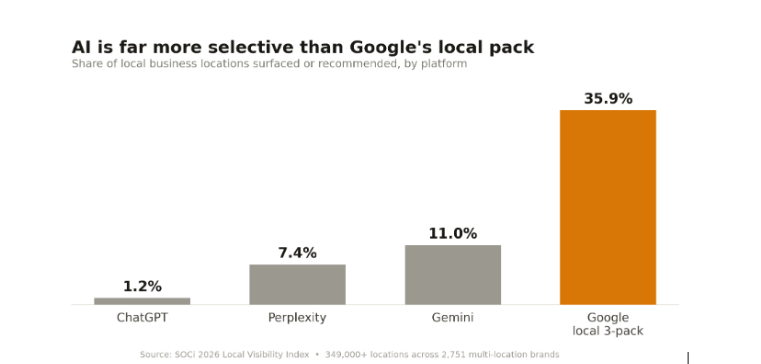
AI engines surface a fraction of the locations that traditional local search does. Source: SOCi 2026 Local Visibility Index.
That makes AI local visibility roughly three to thirty times harder to earn than a traditional local ranking. And the two systems barely overlap: in retail, only 45% of the brands winning traditional local search also showed up in AI recommendations. More than half of the brands dominating the map pack are invisible the moment a customer asks an assistant instead of typing into a search bar.
This is not a future problem. Whitespark's 2026 Local Search Ranking Factors report added AI search visibility as a formal ranking category for the first time this year, reflecting how far local and AI search signals have merged (Whitespark, 2026 Local Search Ranking Factors, retrieved 2026-09-16). Yext's 2026 consumer research found 47% of US adults used an AI tool to find a local business in the past month — 59% among people who search daily — and in households earning $150,000 or more, AI has already passed Google as the starting point for local searches (Yext, "Ask, Verify, Act" 2026 Consumer Search Behaviors Report, retrieved 2026-09-16).
If your only local scorecard is rank, you are measuring a race that fewer of your buyers are watching.
Why rank tracking is the wrong instrument now
A local rank tracker checks a fixed position on a stable index. AI search has neither a fixed position nor a stable index. Three properties break the old tool.
AI answers are non-deterministic. Ask the same question twice and the brands named, their order, and even the length of the list can all change. In a study led by Rand Fishkin (SparkToro) and Patrick O'Donnell (Gumshoe), 600 volunteers ran 12 identical prompts through ChatGPT, Claude, and Google AI close to 3,000 times, and the odds of getting the identical brand list twice were under 1 in 100 (SparkToro, "AIs are highly inconsistent when recommending brands or products", retrieved 2026-09-16). You cannot honestly say your brand ranks number three in ChatGPT when the next run may put you first or drop you entirely. The only stable metric is appearance rate: across many runs, what percentage of answers include you.
Every engine is a separate universe. Citation patterns vary sharply by platform: Perplexity draws roughly 46.7% of its top-source citations from Reddit alone, its single heaviest-weighted source, while ChatGPT leans far more on Wikipedia (roughly 48% of its top-10 citations) (Profound, "AI Platform Citation Patterns", retrieved 2026-09-16, longitudinal study of 680M+ citations, Aug 2024–Oct 2025). Winning in ChatGPT tells you close to nothing about Perplexity. A blended visibility score hides exactly the engine where you are collapsing.
The traffic is invisible in your analytics. There is no native way to see AI citations in Google Search Console, and AI referrals usually arrive as direct or dark traffic. A Page One Power survey of 600 marketing professionals found only 27% consistently track how their brand appears in AI-generated answers (Page One Power, March 2026 survey, retrieved 2026-09-16). Most teams cannot see the layer that is quietly reshaping their pipeline.
Traditional trackers were built for link position. AI search rewards source authority, and those are different things. An engine decides to name you based on how confidently it trusts the sources that describe you, not where your URL sits in a list of ten blue links.
What to measure instead, and what good looks like
Rank is out. Here is the scorecard that replaces it. Track each metric per engine and per location, never as one rolled-up number.
Metric | The question it answers | What good looks like |
|---|---|---|
Appearance / citation rate | In this market, how often does the engine name us for the prompts that matter? | Trending up week over week, measured across 5+ runs per prompt |
Share of voice | Of all brands named in our category, what share of the mentions are ours? | Any engine trailing your overall average by more than 15 points is a priority fix |
Citation position | Where in the answer do we appear? | First three brands named. Being first drives far higher buyer recall |
Sentiment | Does the engine describe us well, or cite us and then undercut us? | Net positive, with negative mentions under 10% |
Factual accuracy | Does the engine report the right address, hours, and services here? | 100%. SOCi found profiles only ~68% accurate on ChatGPT and Perplexity, vs. 100% on Gemini (grounded in Google Maps) — SOCi 2026 |
The accuracy row is the one most teams skip and the one that quietly kills multi-location brands. An engine can name you often and still list the wrong hours for a store two towns over. That is a separate failure from invisibility, and you only catch it if you check per location.
The multi-location multiplier
For a single-location business, AI visibility is one question. For a brand with a thousand locations, it is a thousand questions, because every location has its own reviews, its own citations, and its own representation inside each model. You can own your headquarters metro and be absent across half your secondary markets, and a national rollup will never show it.
Two forces make this harder than it looks.
Data consistency is now a ranking factor, not housekeeping. AI engines do not rank pages. They evaluate confidence. They triangulate a location's name, address, phone, hours, and services from many sources, and when those sources conflict, the model cannot form a confident picture, so it drops you. Whitespark's 2026 Local Search Ranking Factors report, which added AI Search Visibility as a standalone category for the first time, treats inconsistent citations as a direct liability. The practical rule: consistent NAP data across the messy, unstructured web (directories, reviews, mentions, not just your own schema) is now a prerequisite for being cited.
Each engine reads from a different map, so optimize for AI is meaningless until you name the engine. Here is where the citations actually come from, and the lever that follows from each:
Gemini anchors local queries in Google Maps. Your Google Business Profile is your Gemini strategy.
Copilot is grounded in Bing. Bing Places and Bing-indexed pages are your Copilot strategy.
Perplexity reads the live web and leans heavily on community sources. Profound's longitudinal analysis of roughly 680 million citations (Aug 2024–Oct 2025) found Reddit alone accounted for 46.7% of Perplexity's top-source citations, the single heaviest concentration of any source on any platform (Profound, "AI Platform Citation Patterns", retrieved 2026-09-16). Fresh threads and forum presence are your Perplexity strategy.
ChatGPT draws on a wide swath of the open web and authoritative third parties. Encyclopedic and high-authority references are your ChatGPT strategy.
Claude leans on documentation and reference-style sources. Clear, structured, factual pages are your Claude strategy.
And most of this happens off your own domain. AirOps' analysis of over 21,000 brand mentions across ChatGPT, Claude, and Perplexity found roughly 85% of brand mentions in AI search come from third-party pages rather than the brand's own site, with mentions on top-of-funnel commercial queries about 6.5x more likely to come from third-party content (AirOps, "Third-Party Sources Drive 85% of Brand Discovery", retrieved 2026-09-16). Your AI reputation is mostly built on property you do not own, which is exactly why you have to monitor it rather than assume it.
Language is a separate axis from country
A brand in Montreal is not tracking one market, it is tracking at least two: English (Canada) and French (Canada). Engines answer in the language of the prompt and pull from language-specific sources, so the brands named in a French query can differ completely from the ones named in English, even for the same city. If you serve more than one language, track each one on its own, or you will only ever see half of what your buyers see.
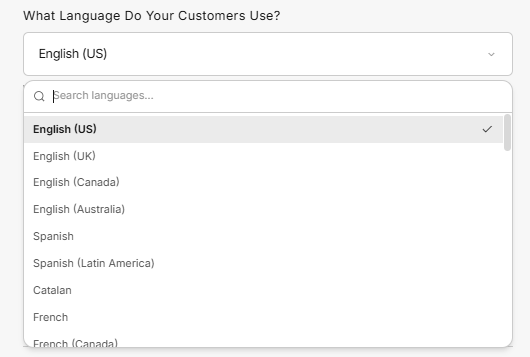
Track visibility by the language your buyers actually search in, not just by country with the help of GrackerAI
A measurement framework you can run this week
You do not need a platform to start. You need a repeatable loop. Here is the loop. For the KPI definitions and per-engine reporting discipline behind each step, see AEO/GEO marketing manager KPIs: what to measure and how.
1. Build one prompt set per market. Write the questions your buyers actually ask, then localize them. Use variables so the same set runs across every location:
Query Type | Example Prompt |
|---|---|
Best in a City |
|
Top Providers |
|
Nearby Search |
|
Brand Comparison |
|
Service Recommendation |
|
Trust-Based Search |
|
Ten to twenty prompts per market is enough to start. Keep the set frozen so week-over-week numbers are comparable.
In practice, a per-market monitor comes down to a few dials: pick the country, optionally narrow to a specific city, choose which engines to watch, set your buyer's language, and run it on a schedule. Here is that exact setup inside GrackerAI:
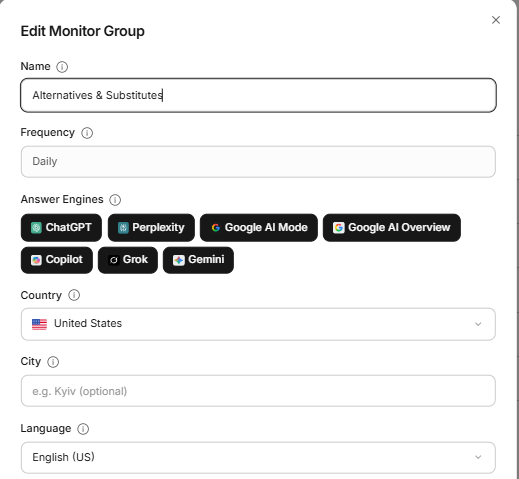
One monitor per market: country, optional city, engine selection, and buyer language, refreshed daily. Duplicate it per city or region and you have a per-location tracking grid.
2. Sample, do not spot-check. Because answers vary run to run, one query proves nothing. Run each prompt at least five to ten times per engine per market and record the appearance rate, not a rank. If that volume is unrealistic by hand, this is the point where a tool that multi-samples at scale pays for itself.
3. Log it in a flat sheet. One row per prompt-engine-market-run, with these columns:
Prompt | Market | Engine | Runs | Appearance % | Avg position | Sentiment | Cited source URL | Competitor named | Date |
|---|
The cited source URL column is the most valuable and the most ignored. It tells you which third-party pages the engine trusts in each market, which is your entire content and outreach roadmap.
4. Set alert thresholds, not a monthly review. Local AI visibility changes faster than a quarterly audit can catch. Flag anything that crosses a line: appearance rate drops more than a few points week over week, any engine falls more than 15 points below your average share of voice, sentiment turns net negative, or a new competitor appears in a market where you used to stand alone.
5. Close the loop on attribution. Since clicks mostly will not show up, watch the proxies: branded search volume, direct traffic, and assisted conversions in the markets where your appearance rate is climbing. Rising citations plus rising branded search is the signal that visibility is converting.
The best tools for tracking local AI search visibility
No single tool wins for everyone, and the split is simple. Physical storefront brands need listings, reviews, and per-location presence, so lead with a location-marketing platform. Multi-market and multi-region B2B brands, including software and security vendors with territory-based sales, need per-country citation and share-of-voice tracking, so lead with an AI-native monitor.
Tool | Best for | Per-engine depth | Geo granularity | Closes the gap |
|---|---|---|---|---|
GrackerAI | Multi-market B2B and cybersecurity brands | Every major engine, never blended | Per country, city, and language | Yes, built-in article engine |
SOCi | Large brick-and-mortar chains and franchises | ChatGPT, Gemini, Perplexity plus listings | Per location, at scale | Yes, agentic listings work |
Semrush AI Visibility | Teams wanting AI and classic SEO in one system | Wide, per-platform | By region and platform | Partial, content on higher tiers |
Nightwatch | Agencies needing deep geo rank plus AI tracking | Major engines, citation intelligence | Zip-code level, 190+ countries | No, monitoring only |
Peec AI | Agencies tracking competitor SOV by market | Major engines, per-engine | Country and region, 115+ languages | No, monitoring only |
Otterly AI | Small teams starting out | 4 base engines, add-ons for more | 50+ countries | No, monitoring only |
Birdeye | Enterprises tying AI presence to reviews and listings | Major engines plus listing accuracy | Per location and DMA | Yes, listings and reputation |
A few honest notes so the table is useful rather than decorative:
SOCi is the deepest option for physical multi-location brands and the source of the visibility data cited throughout this guide, scoring brands on more than 120 metrics across Google Maps, Gemini, Yelp, Facebook, ChatGPT, and Perplexity. The trade-off is weight: it is an enterprise location-marketing suite, not a lightweight tracker.
Nightwatch is unusually strong on geographic depth (zip-code precision across 190+ countries) and connects traditional rank shifts to AI citation shifts in one view. It monitors, it does not create content.
Peec AI shines on competitor share of voice segmented by country and language, though it does not publish USD pricing openly, which is friction if you need to quote clients.
Otterly AI is the cheapest way in and the fastest to a first reading, but analysis is shallow and Gemini and Google AI Mode are paid add-ons.
Where GrackerAI fits, honestly
Disclosure: we publish this guide.
Built specifically for cybersecurity companies and B2B SaaS, not general local businesses or consumer brands.
Tracks AI citations across all major AI search engines:
ChatGPT
Perplexity
Gemini
Microsoft Copilot
Grok
Google AI Mode
Google AI Overviews
Provides country-, city-, and buyer-language-level tracking for granular insights.
Measures:
Share of voice
Citation position
Sentiment
Brand mentions
Instead of relying on a single blended visibility score.
Uses real Google Search Console and Bing search queries to track the prompts your audience actually searches for.
Automatically identifies content gaps and generates citation-optimized articles to improve AI visibility.
Best suited for organizations focused on AI Search Visibility, AEO, and GEO, rather than local SEO.
Limitation: Businesses with physical storefronts that need Google Business Profile management, local listings, and review management are better served by platforms like SOCi or Birdeye.
The trap nobody warns you about: cited but not clicked
Here is the counterintuitive part. Winning the citation does not automatically win the traffic, and chasing citations blindly can hide a revenue problem.
The cleanest example is G2. It is cited in roughly 23.1% of review-platform answers inside AI Overviews, one of the most-referenced sources in the entire B2B category. It also lost about 84.5% of its organic traffic over the same window (SE Ranking, review-platform AI Overview citation analysis, retrieved 2026-09-16). AI validated its authority and did not keep the click. For local brands the same physics apply: Yext's 2026 research found that even after an AI recommendation, most users still verify — 62% search Google for more information, 58% visit the business website directly, and 52% click through to a cited source before acting (Yext, 2026 Consumer Search Behaviors Report, retrieved 2026-09-16). Being named is the start of the journey, not the end of it.
The takeaway is not to ignore citations. It is to measure the right outcome. Track citation share to know whether AI trusts you, then track branded search, direct visits, and pipeline to know whether that trust is turning into customers. A brand cited everywhere with flat branded search has a conversion problem, not a visibility problem, and you will only see the difference if you measure both.
Where to invest to actually get cited across markets
Because most citations come from third-party sources, the work is off your own site. Three moves have the highest leverage.
Win the review platforms AI already trusts. An SE Ranking analysis of 30,000 commercial keywords found that 88% of all review-platform citations in AI Overviews go to just five sites: Gartner Peer Insights (26%), G2 (23.1%), Capterra (17.8%), Software Advice (12.8%), and TrustRadius (8.3%) (SE Ranking, retrieved 2026-09-16). If you sell B2B, your presence and review volume on those five properties is a direct AI visibility lever. For consumer and local brands, the equivalent is Google, Yelp, and the category-specific directories your buyers cite.
Publish enough to move the model's memory. Industry practitioners estimate it takes roughly 250 pieces of content or mentions to meaningfully shift how an AI model perceives a brand. This is why sporadic blogging does not move AI visibility. If you are not defining your narrative across the web at that volume, competitors and third parties will define it for you.
Use the fast lanes. Some sources enter AI answers within hours, not months. LinkedIn posts, Reddit threads, and YouTube can surface in AI responses quickly, and publishing on a respected industry site can put you in the answer set fast. For a brand fixing invisibility in a specific market, these are the quickest ways to give an engine something fresh and credible to cite.
Frequently asked questions
What is local AI search visibility?
It is how often, where, and how accurately AI engines like ChatGPT, Perplexity, and Gemini cite or recommend your locations when users ask location-based questions. Unlike local rank tracking, it measures citations, share of voice, and sentiment inside AI answers rather than a position in the local pack.
Which tools are best for tracking local AI search visibility for multi-location businesses?
For multi-market and B2B brands, GrackerAI offers per-engine, per-country and city-level tracking plus an article engine that closes the gaps it finds. For brick-and-mortar chains, SOCi and Birdeye lead on per-location listings, reviews, and AI presence. Nightwatch, Peec AI, and Otterly AI cover strong geographic monitoring at different price points. The right pick depends on whether you manage physical storefronts or track visibility across markets.
Why do traditional local rank trackers fail for AI search?
AI answers are non-deterministic, differ from engine to engine, and rarely pass a clean referral. A rank tracker checks a fixed position on Google, so it cannot tell you whether ChatGPT names your brand, with what sentiment, or which sources it cited. AI search rewards source authority, not link position, and rank trackers do not measure authority.
What is AEO and why does it matter for location queries?
Answer Engine Optimization is the practice of structuring content and data so an engine can extract and cite it directly in an answer. For location queries it matters because AI usually returns one recommended answer, so being the cited source is the difference between being chosen and being invisible.
How does NAP consistency affect AI citations?
AI engines triangulate a location's name, address, and phone data from many sources and lower their confidence when those sources disagree. Because engines cite what they are confident about, consistent NAP data across directories, reviews, and unstructured pages directly raises the odds a location gets surfaced.
Can I track AI visibility separately for each country, city, or language?
Yes, and you should. AI answers vary by geography and by language, so a national score can hide entire markets where you are invisible. Tools built for this, GrackerAI among them, let you segment visibility by country, city, and buyer language so you can see exactly where you are winning and where you are not, market by market.
See where you actually stand in AI search visibility.
AI search visibility is at a stage similar to where local SEO was 15 years ago—brands that start measuring now can build a long-term competitive advantage.
Run a free AI visibility score in about 60 seconds.
Book a demo to track your AI visibility across markets.
No signup required to check your AI visibility score.
![10 Best Local Rank Tracker Tools: In-Depth Comparison Guide [2025]](https://cdn.pseo.one/6abcb68a626591c40e1c8aa6/687e1c1ef6fe799d288518df/68809c373eb8562bcf68975d/10-best-local-rank-tracker-tools-comparison-guide/feature-image.jpg)