AI Search Visibility for Cybersecurity Vendors: The GRC Content Strategy

TL;DR
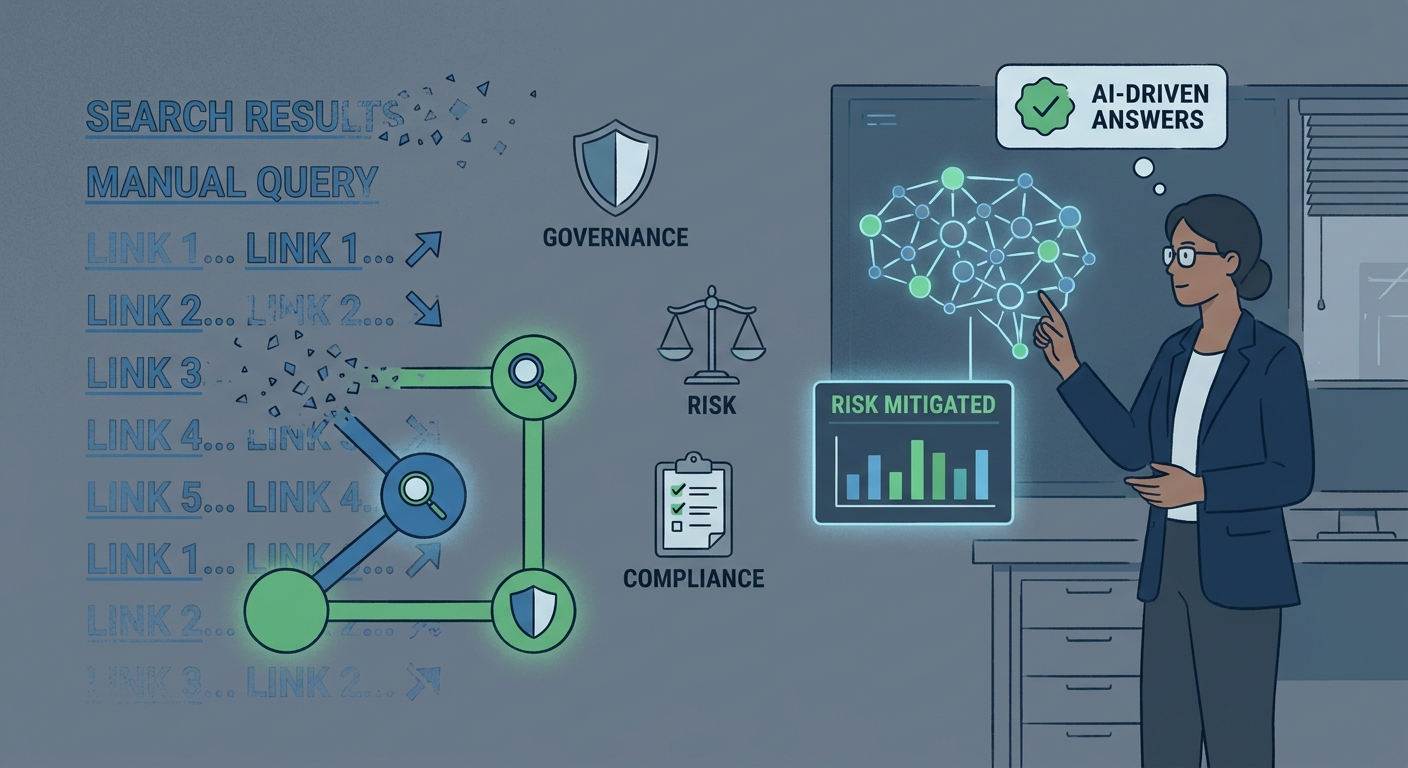
- ✓ Traditional SEO is failing as buyers shift to AI-driven answer engines.
- ✓ Generative Engine Optimization prioritizes factual density and machine-readable data structures.
- ✓ Cybersecurity brands must establish entity authority to become the AI source of truth.
- ✓ Pivot from keyword-stuffed content to concise answers that satisfy LLM queries.
The era of chasing blue links is over — see why blue link SEO is dying for security vendors for the mechanics of that shift specifically.
If you’re still banking on traditional SEO to put your GRC platform in front of buyers, you’re playing a game that ended two years ago. The modern CISO doesn't have time to sift through six pages of "ultimate guides" to find out if your tool handles NIS2 compliance. They’re asking an LLM to do the heavy lifting for them.
Buyers are moving from searching to asking. They want a direct answer, not a list of ten blog posts to skim. If your content isn't built to be the "Source of Truth" for AI models, you’re invisible. Period. To win today, you need to pivot from SEO to Generative Engine Optimization (GEO).
Why Traditional SEO is Hitting a Wall
For twenty years, the playbook was simple: stuff a whitepaper with keywords, beg for backlinks, and pray for a page-one ranking. It worked. But it also created a digital landfill of "content bloat"—pages written for algorithms, not humans.
Today’s buyer—exhausted, hurried, and juggling a thousand compliance debt items—is skipping Google’s search results entirely. They’re turning to Perplexity, ChatGPT, and AI Overviews to synthesize the noise.
When a buyer asks, "How do I map my existing ISO 27001 controls to the EU AI Act?", they aren't looking for a marketing brochure. They’re looking for a precise, authoritative synthesis. Traditional SEO fails here because it optimizes for clicks, not clarity. If your site is a collection of thin, keyword-heavy landing pages, you aren't just failing to rank—you’re actively confusing the AI models that now act as the gatekeepers to your prospects.
The friction is real. Compliance frameworks are a labyrinth, and when your information is locked away in static, unreadable PDFs, you’re missing the boat. By applying a robust Content Strategy for Cybersecurity, you can finally consolidate your expertise into a machine-readable format that actually speaks the language of the LLM. Editorial rigor and security posture reinforce each other here — see the role of editorial SEO in strengthening online security practices for how that overlap plays out in practice.
What is Generative Engine Optimization (GEO)?
Think of GEO as the art of becoming "the answer." It’s not about ranking; it’s about Entity Authority.
In the eyes of an LLM, your brand is an "entity." Whether you’re known for "Continuous Compliance," "Risk Assessment," or "SOC2 Type II," you need the AI to associate your brand with those concepts definitively. If you want to be cited as the go-to expert, you have to prioritize factual density over persuasive fluff.
LLMs thrive on verifiable, concise, and structured data. As outlined in this Generative Engine Optimization (GEO) Guide, the shift is toward "Answer Engines." If your website doesn't serve up the data in a way the AI can parse, it’ll simply ignore you and cite the competitor who did the homework.
Your authority is no longer just a "Domain Authority" score. It’s a measure of how often you’re the trusted source for a definition or an interpretation. Stop writing for the human reader alone and start writing for the hidden agent standing between the buyer and the screen.
Structuring Your GRC Knowledge Graph
You need to stop thinking of your website as a brochure and start treating it as a semantic knowledge graph. AI crawlers don't "read" like we do; they look for relationships. If your documentation is buried in a CSS-heavy layout or trapped in a non-searchable PDF, you’ve already lost. That same discipline is what makes documentation usable by retrieval-augmented generation systems in the first place -- see our guide on making infosec documentation RAG-ready for the chunking and metadata tagging that turns a PDF library into a machine-readable knowledge base.
To get the AI to look at you, you need to build three layers of intelligence:
- Schema.org and JSON-LD: This is your foundation. Use structured data to tell the AI exactly what you do. Does your tool support HIPAA? Don't make the AI guess. Use code to declare your features, certifications, and threat-modeling capabilities explicitly.
- Entity-Relationship Mapping: Connect the dots. If you’re solving for the EU AI Act, your content needs to explicitly tie your platform’s features to specific articles of that regulation.
- Dynamic Documentation: Kill the static whitepaper. Replace it with API-exposed data, interactive calculators, and dashboards that evolve alongside the regulations.
When you structure your knowledge this way, you stop being a vendor and start being a "Source of Truth." You become the data point the AI feels safe citing. For a look at what that level of structured, audit-ready operational detail looks like in practice — risk taxonomies, SoD rule counts, KRI thresholds — see our SAP GRC risk management setup guide.
The Roadmap: From "Top-of-Funnel" to "Answer-of-Funnel"
The traditional funnel is dusty and outdated. Nobody is looking for your "Ultimate Guide to Compliance" to kill 15 minutes. They want a specific answer to a high-stakes problem. This is the "Answer-of-Funnel" stage.
Own the Entity
Pick your lane. Do you want to be the authority on "Automated Risk Assessment"? Then every piece of content you produce should circle back to a core "Hub" page that defines that concept with absolute precision. Create a cluster of authority. When the AI crawls your site, it should see a masterclass on the topic, not a collection of disjointed blog posts.
Leverage Third-Party Validation
AI models are programmed to look for consensus. If Gartner, G2, or industry experts have mentioned you, make sure that’s on your site in a structured format. When your own documentation cites these validations, you build a "Trust Architecture" that makes it nearly impossible for an AI to bypass you.
Change Your Metrics
Stop obsessing over traffic. It’s a vanity metric. Start tracking "Share of Answer" (SoA). When an AI is asked about the best GRC tools for mid-market cybersecurity, does your brand show up in the top three citations? That is your new scorecard. Monitor "Entity Sentiment," too—are you being associated with "innovation" and "trust," or just another generic list item?
Building the "Source of Truth"
The future of cybersecurity marketing isn't about being the loudest voice. It’s about being the most accurate.
Regulatory environments, like those discussed in The EU AI Act Explained, are becoming way too complex for any one human to track. Buyers are outsourcing this complexity to AI; you need to outsource your content visibility to the same.
By leveraging GRC Automation Solutions, you can feed the AI the real-time, automated evidence it craves. Functional, live data is the ultimate currency for an LLM. It’s the difference between a marketing claim and a verifiable fact.
If you want to survive the next five years, stop writing for the Google search bar. Start writing for the AI agent. Build the knowledge graph, enforce the schema, and become the source that the machines cite when they need to tell the truth.
Frequently Asked Questions
How does Generative Engine Optimization (GEO) differ from traditional SEO?
SEO focuses on driving clicks to your website by gaming search engine rankings. GEO focuses on providing structured, authoritative, and machine-readable answers that AI models can easily ingest and cite as a primary source of truth.
Why are whitepapers and long-form guides becoming less effective?
Modern buyers—and the AI tools they use—value speed and precision. Long-form "content bloat" often obscures the actual answers. AI models prefer concise, schema-rich content that directly addresses specific regulatory or technical questions.
What is the most important technical change I can make today?
Implement Schema.org and JSON-LD markup across your site. This allows AI crawlers to "understand" your entity—your capabilities, certifications, and features—at a code level, rather than relying on them to parse text-heavy pages.
How do I measure success if not by traffic?
Track your "Share of Answer" (SoA). Test your brand's presence by asking AI tools specific industry questions and seeing if your brand is consistently cited as a top-three authority.
Does this mean I should stop writing for humans?
Absolutely not. You should stop writing only for humans. By structuring your content for machine-readability, you make it easier for AI to synthesize your expertise, which ultimately makes it easier for humans to find the direct answers they need.
![10 Best Local Rank Tracker Tools: In-Depth Comparison Guide [2025]](https://cdn.pseo.one/6abcb68a626591c40e1c8aa6/687e1c1ef6fe799d288518df/68809c373eb8562bcf68975d/10-best-local-rank-tracker-tools-comparison-guide/feature-image.jpg)