Why Google Ads conversion data is becoming less reliable (and what marketers can do)

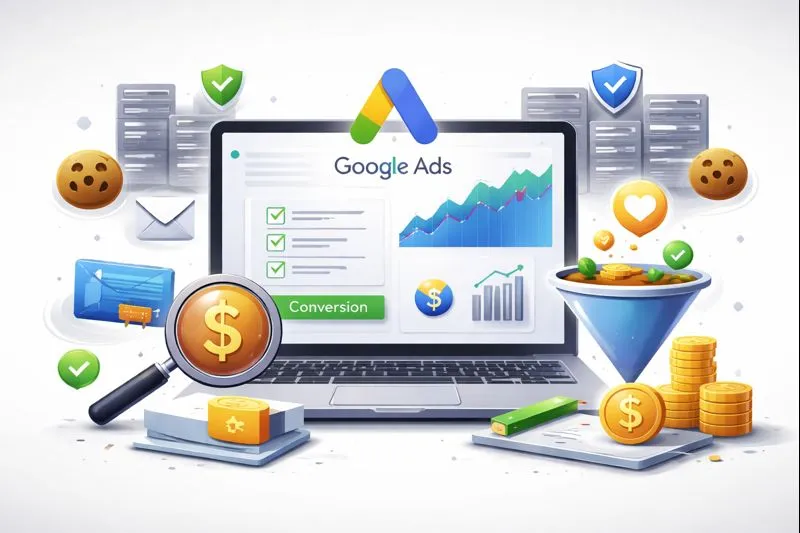
A conversion on Google Ads can be any action a visitor undertakes after clicking on an ad, such as a purchase, a submission, a call, or a sign-up. The classic method of conversion measurement has always been the use of JavaScript tags on a website that trigger whenever a visitor commits one of those, but it is experiencing grave challenges. This directly influences the quality of Google Ads conversions tracking and affects all aspects of a company’s marketing activity.
Let’s examine the mentioned challenges in detail, and then take a look at what you can do to ensure the accuracy of your data.
The reasons why Google Ads conversion data may be becoming less reliable
The technology of conversion tracking has seen many changes in recent years. The tools that were useful in 2020 no longer offer you complete insight into your conversions. Some lose their efficiency due to new technologies, others - because of new rules.
Limited execution of tracking scripts: the use of browser extensions like ad blockers by people who want to view less advertising could inadvertently block tracking scripts, preventing conversion events from being triggered.
Browser restrictions: Safari’s Intelligent Tracking Prevention and Firefox’s Enhanced Tracking Protection can disrupt the attribution path by restricting the lifetime of cookies and impacting tracking scripts as well.
Compliance with privacy policies: under GDPR, CCPA, and other privacy regulations, the transmission of unprocessed data from tracking could pose legal concerns. On the other hand, without the use of cookies, the firing of the traditional client-side tag will not occur. This results in incomplete data from the performance of your campaign.
Cross-device and cross-browser fragmentation: an additional layer of complexity comes from this issue. A customer may click on your ad on mobile Safari and then convert on desktop Chrome days later. Without a reliable plan of action, the conversion would be attributed to “direct” traffic in Google Analytics or simply not attributed in your Google Ads account at all.
It is also important to mention that all these issues should be addressed preventively, not reactively. There are no direct signs or an alarm icon that your conversion tracking is suffering from ad blockers or ITPs. Your results are suffering, and as a consequence, your planning and profits. Thus, it is better to be prepared.
Recommendations on making Google Ads conversion tracking great again
There are solutions that can help you to make the conversion tracking reliable again. They can be used alone or in combination for maximum benefit in your marketing campaign.
Switch to server-side tracking
The use of server-side tracking for Google Ads, as opposed to simply relying on the browser, represents a paradigm shift in terms of how data flows. Conversion data tracked via a server Google Tag Manager container can be enriched to fill the gaps caused by ad blockers and browser restrictions, and thus, is more accurate and reliable.
With the help of platforms like Stape, you can easily set up your server Google Tag Manager container and integrate it with Google Ads, Meta, TikTok, and other analytical platforms from a single dashboard. This would allow you to track conversions that would have gone unrecorded in your reports otherwise.
Use first-party cookies

First-party cookies are stored on your own domain and have a longer lifespan compared to third-party cookies. This ensures much better attribution and closes the gaps in analytics, when returning customers may be considered new ones. Overall, switching to using first-party cookies is a great improvement for any business.
Send enhanced conversion data
Enhanced conversions enable Google Ads to better match conversions with clicks, even in the absence or expiration of cookies. This is made possible by the use of hashed first-party information, such as email or phone numbers, which is securely sent to Google.
As soon as the user submits the form or completes the purchase, their email or phone number (or both) is recorded. This information gets hashed before processing. Google uses the hashed value to look up the logged-in user’s information and correctly link the conversion to the corresponding ad click. Both server and web Google Tag Manager containers support enhanced conversions.
Track online & offline conversions
By measuring the conversions happening both online and offline, the gaps created through delayed leads, payment redirects, and cross-device activity can be eliminated.
For instance, your lead might click on your Performance Max campaign on Monday, then book a demo on Wednesday, and eventually turn into a paying customer after three weeks by coming personally to the office. This means that Google Ads will only receive data on the demo booking (if tracked) and not the revenue, unless the data on online conversions is imported to the system.
Server-side solutions can assist with tracking both offline and online conversions, so that Google Ads can have complete data from first visit through closed deals.
User consent and modeled conversions
Consent is one of the crucial terms in modern data tracking. If a user does not accept the terms, their conversion is not going to be tracked, which influences the analytics negatively. However, a properly configured Consent Mode enables Google Ads to build the conversion models even when users deny the use of cookies, rather than losing the data altogether. This is how it works:
When consent is granted by the user, tags fire as usual, and conversions are tracked directly.
When a user declines, a ping without cookies is sent, enabling Google to build conversion models from aggregated patterns.
The reports from your system provide information about conversions that are observed and conversions that are modeled.
This approach meets the requirements of the GDPR legislation while ensuring that the loss of data is reduced to a minimum.
Conclusion
The accuracy of Google Ads conversions is being impacted by browser limitations, ad blockers, the impact of regulations regarding user data, and the removal of third-party cookies. The discrepancy between the performance in your business and the performance in your Google Ads account is increasing. B2B SaaS teams rebuilding their tracking stack from scratch should also look past Google Ads itself — see our roundup of the best PPC tools for B2B SaaS for attribution and reporting tools built for longer sales cycles. For the broader strategic shift this cleaner data feeds into -- bidding, budget allocation, and diversification beyond Google -- see Improve Your Pay-Per-Click (PPC) Strategy.
Attribution gaps are only one leak in the budget. See protecting your marketing budget from hidden threats for click fraud and other silent drains worth auditing alongside your tracking stack.
The good news is that there are workable solutions that address these issues. Server-side tracking, first-party cookies, tracking offline conversions, using a Consent Mode, and enhanced conversions will improve the overall quality of the tracked information. Thus, the sooner you start mastering these tools, the more reliable your Google Ads conversion data will be.

![10 Best Local Rank Tracker Tools: In-Depth Comparison Guide [2025]](https://cdn.pseo.one/6abcb68a626591c40e1c8aa6/687e1c1ef6fe799d288518df/68809c373eb8562bcf68975d/10-best-local-rank-tracker-tools-comparison-guide/feature-image.jpg)