Connecting Advertising Concepts with Growth Hacking

Abhimanyu Singh · Engineering Manager & AI Builder
· Updated September 7, 2026
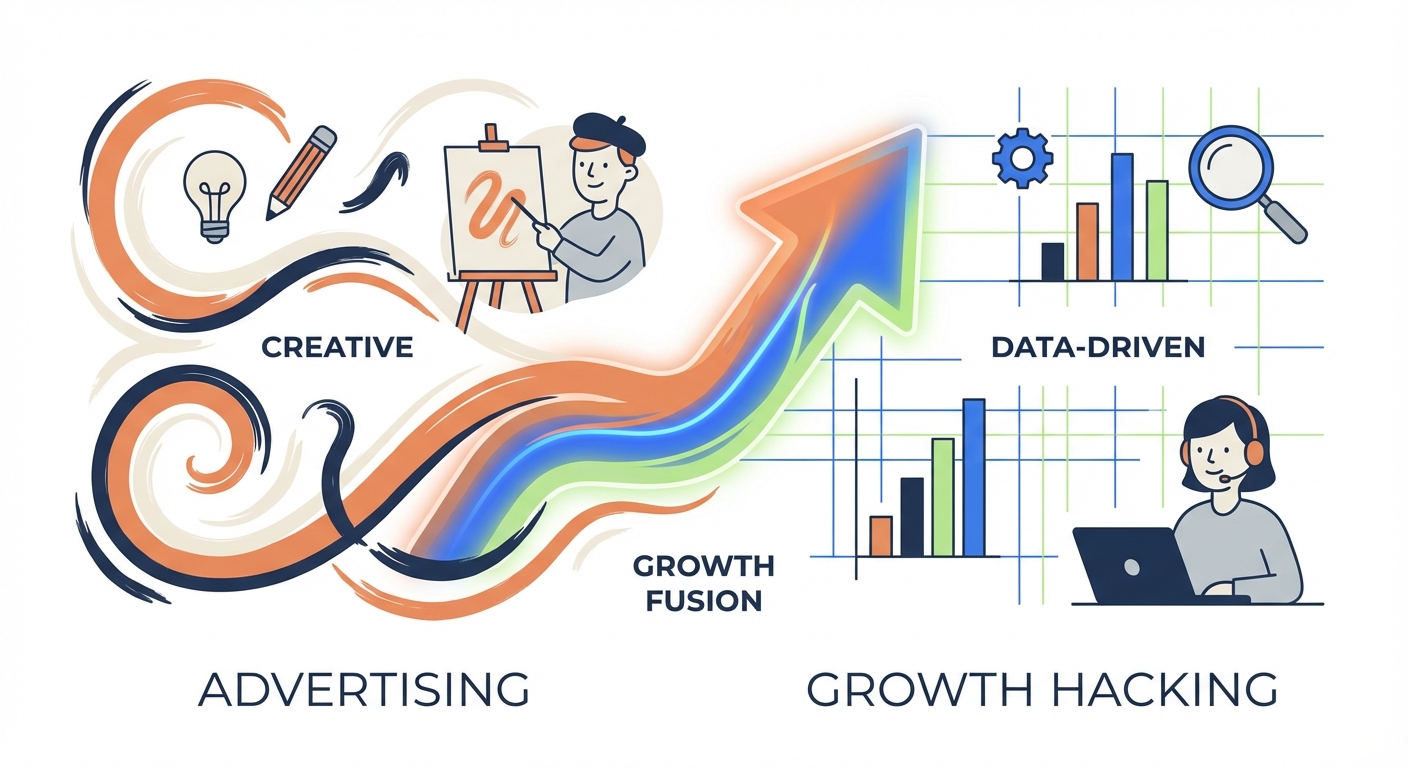
The wall between the glossy, creative world of advertising and the cold, clinical world of growth hacking has finally crumbled. It’s 2026, and if you’re still keeping these two in separate rooms, you’re losing.
For years, ad teams were the ones obsessing over the “hero” aesthetic at the top of the funnel, while growth hackers lurked in the basement, tweaking button colors and referral triggers. That era is dead. Today’s winners don’t see ads as a standalone expense. They see them as the spark for a self-sustaining engine. If you’re just throwing money at ads to get clicks, you aren’t marketing—you’re burning cash. You need a systems-based approach where every dollar spent is engineered to trigger a compounding loop.
How Has the Definition of “Growth” Shifted Since 2010?
When “growth hacking” first hit the scene—back when we were all reading about the origin of growth hacking—it was all about the “trick.” Everyone wanted that one weird hack to blow up their user base overnight. It was scrappy, it was messy, and honest to god, most of it was unsustainable.
Today? Growth is just high-level data engineering. It’s not about finding a loophole in an algorithm anymore. It’s about building a machine that gets hungrier and faster the more you feed it.
Modern growth is a discipline. It demands total harmony between the promise your ad makes and the experience your product delivers. A growth hacker in 2026 isn’t a lone wolf with a bag of tricks. They’re a systems architect. They understand that acquisition, activation, and retention aren’t different departments. They’re just different points in the same stream of data.
Why is the “Funnel” Being Replaced by the “Loop”?
The old-school linear funnel—where a user enters the top and eventually “drops out” the bottom—is a relic. It assumes growth is a one-way street. That’s a lie. High-growth companies are all about “loop” mechanics now. The output of one cycle (a happy, loyal user) becomes the input for the next cycle (a referral or a viral trigger).
graph TD
    A[Paid Ad Input] --> B[User Acquisition]
    B --> C[Product-Led Engagement]
    C --> D[Referral/Viral Trigger]
    D -->|Reinvestment| A
    D --> E[Sustainable Growth]
When you shift to this circular framework, you stop paying for the same user twice. Your ad spend is just the starter fluid. Your product design is what keeps the engine roaring.
How Do You Bridge the Gap Between Brand Awareness and Conversion?
Top-of-Funnel: How Creative Testing Feeds the Machine
If you’re still crafting one “perfect” hero video and crossing your fingers, you’re already behind. In 2026, the top-of-funnel is a lab. AI has changed the game completely. You don’t need to guess anymore—you can generate thousands of variations of copy and visuals to see what actually sticks. When you automate growth, you’re not just saving time. You’re hunting for the specific hooks that resonate, driving down your CAC while building a brand presence that actually means something.
Middle-of-Funnel: Is Your UX Optimized for the “Growth” Mindset?
Here’s the truth: the “growth” work starts the second someone clicks. If your ad promises a solution, your landing page better deliver it without a single second of friction. CRO is the bridge here. It’s the connective tissue between the creative promise and the technical reality. If your UX isn’t tight, you’re just pouring expensive water into a leaky bucket. Growth-minded teams treat the landing page as an extension of the ad. Everything—the voice, the vibe, the value—needs to be perfectly synchronized.
Bottom-of-Funnel: Can Retention Be Engineered?
Retention is the ultimate growth hack. It starts the moment someone interacts with your brand. Paid ads shouldn’t stop at the first purchase; they should be the opening chapter of a long-term relationship. By building a sustainable growth engine, you ensure that your post-purchase experience actually encourages referrals and community. If your ads don’t lead to a product experience that makes a user want to tell their friends, you’re missing out on the only form of growth that truly scales: word-of-mouth.
The AI Creative Playbook: How to Scale Without Losing Authenticity
Have you noticed the “lo-fi” content taking over your feed? There’s a reason for that. Over-produced, high-gloss commercials feel like advertising. They feel like a sales pitch. Creator-led, raw, authentic content feels like a recommendation from a friend. According to key trends in modern programmatic advertising, programmatic budgets are shifting toward inventory that supports high-engagement, native-style creative.
The problem is scale. You can’t hire a film crew for every test. But you can use AI to iterate. Take your brand’s core pillars and use generative tools to pump out hundreds of variations—testimonials, screen-shares, unboxing-style clips. You keep the human element front and center, but you keep the analytical rigor of a performance campaign. It’s the best of both worlds.
The “Anti-Growth” Angle: When Does Optimization Kill Your Brand?
There is a massive trap here: over-optimizing for short-term metrics like CAC or ROAS. If you tweak every single pixel just to squeeze out one more conversion, you’ll end up with a robotic, soulless brand that nobody actually likes.
True growth needs balance. You need the performance metrics to keep the lights on, but you need brand equity to keep people coming back. If your ads are nothing but “discount codes” and “click here” buttons, you’ll burn through your audience in months. A healthy strategy leaves room for storytelling. Build trust. Establish authority. Optimization should be the servant of your brand, not the master.
How Do You Reconcile Metrics Across Teams?
The biggest friction in any company is the language barrier. Advertising teams talk in CPM, CTR, and CPC. Growth teams talk in LTV, Churn, and Virality. It’s like they’re speaking different languages.
Looking at industry-wide trends on AI and marketing, it’s clear: the winners are the ones killing vanity metrics. Stop obsessing over the click and start obsessing over the “cost-per-activated-user.” When your ad team knows their creative success is measured by downstream behavior—not just vanity vanity numbers—the entire strategy shifts toward quality.
The T-Shaped Marketer: Why You Need to Master Both Storytelling and Data
The “T-shaped” marketer isn’t just a buzzword. It’s a survival requirement for 2026. You need a broad understanding of the whole ecosystem—the plumbing of the growth loop, the nuances of the platforms, the psychology of the click—while having a deep, sharp specialty in either storytelling or analytics.
You need to be able to write an ad that makes a human cry, and then immediately dive into the dashboard to see if that emotional beat actually moved the needle on LTV. The ability to toggle between the “why” (the story) and the “how” (the data) is the hallmark of the modern growth advertiser. It isn’t enough to be a good writer or a good analyst. You have to be both. The data gives you the map, but the story is what gets you to the destination.
Frequently Asked Questions
Is “Growth Hacking” still relevant in 2026?
Yes, it has evolved into a disciplined, data-informed, cross-functional engineering approach that focuses on sustainable, system-wide optimization rather than short-term, “lucky” tricks.
How do I balance brand advertising with growth hacking?
By integrating measurable, performance-based calls-to-action into brand-led storytelling that feeds directly into a product-led growth loop, ensuring that your ads build both immediate traffic and long-term brand equity simultaneously.
What is the most important skill for a growth-focused advertiser today?
The ability to interpret real-time data to iterate on ad creative and funnel messaging without diluting the brand’s unique voice or sacrificing long-term trust.
How does AI change the relationship between ads and growth?
AI allows for hyper-personalization at scale, enabling teams to test thousands of creative variations to determine exactly which messaging triggers the most efficient growth loops, effectively closing the gap between creative intent and measurable performance.
Related Articles
-
 cybersecurity content audit
 How to Audit Cybersecurity Content for Accuracy and Originality
Cybersecurity content with incorrect facts destroys confidence fast. Here's a practical audit framework for correctness and originality that preserves the credibility of your security publications.
-

10 Examples of SaaS Companies with Exceptional Marketing
Explore 10 SaaS marketing examples with actionable tactics. Learn innovative strategies from top companies to elevate your own campaigns.
-
How to Find the Right B2B Prospects for Your SaaS Product
Stop wasting sales outreach on leads that're not a good fit. Learn ways to find, check, and work with the right B2B prospects for your SaaS product.
-
 online reputation management
 The Importance of SEO in Online Reputation Management
Discover how SEO influences your digital brand. Learn actionable strategies to suppress negative search results and build a positive online reputation today.