Claude SEO Tool: How to Optimize for Anthropic's Claude

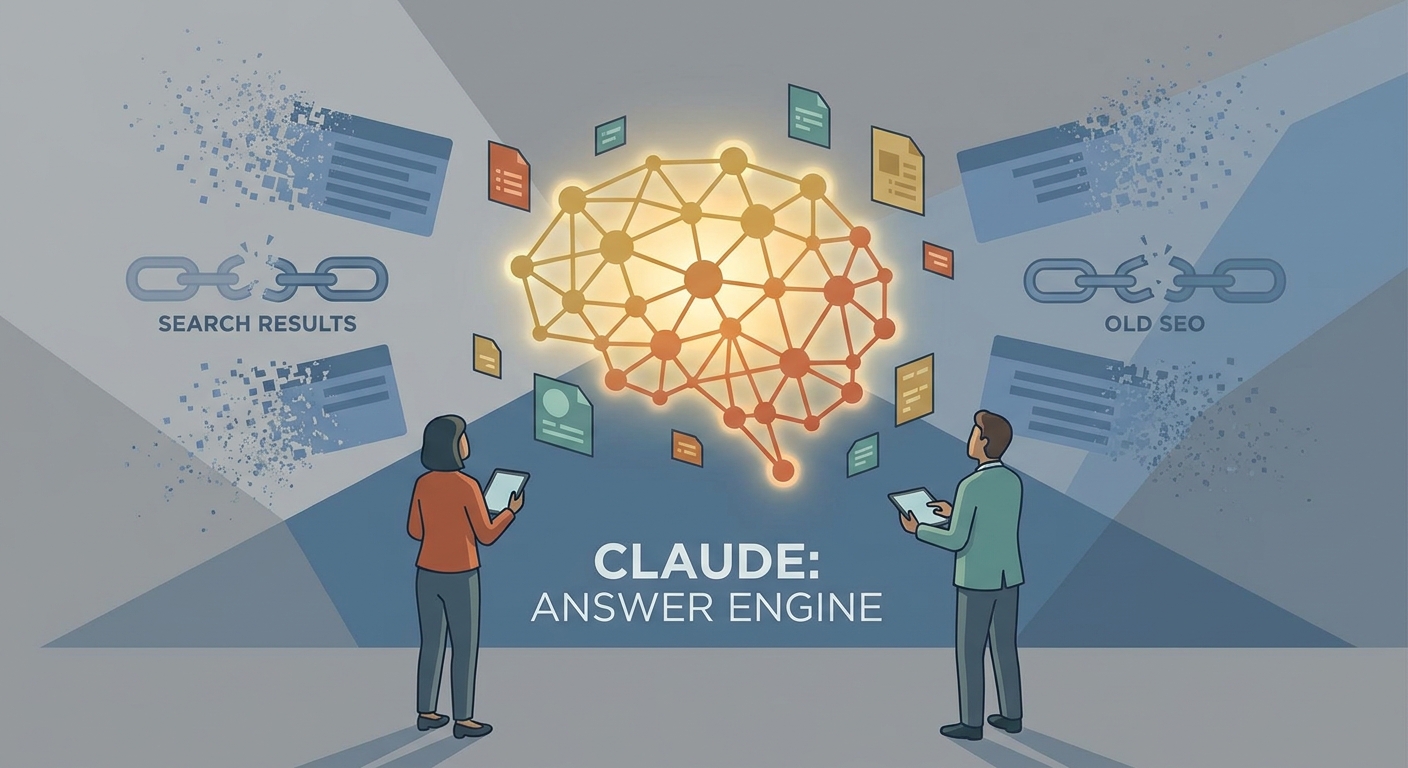
Forget the blue links. Seriously—stop obsessing over them.
For twenty years, SEO was a rigged game. You chased Google’s shifting goalposts, stuffed keywords into headers, and prayed that a backlink farm would push you onto page one. That world is gone. We’ve entered the age of the Answer Engine. Users don’t want a list of ten websites anymore; they want the answer. They want it now, and they want it synthesized perfectly.
Anthropic’s Claude is the new gatekeeper. It’s not just searching; it’s reasoning. If your site is still full of keyword-stuffed fluff, Claude will treat it like noise. To win in 2026, you have to pivot from traditional SEO to Answer Engine Optimization (AEO). You need to stop being a "result" and start being the "answer."
Why "Blue Link" SEO is Effectively Dead
Think about how you use Claude. Do you want it to spit out a list of links? No. You want it to digest the complexity of your question and give you a coherent, expert response.
Claude doesn't care about your keyword density. It cares about topical mastery. It looks for entities—people, places, concepts, and the invisible threads that connect them. If you aren't providing the "signal"—the deep, authoritative truth—Claude will find someone else who is. This isn't a trend; it's a fundamental rewrite of the internet’s operating system.
The "Claude Advantage": Thinking, Not Just Indexing
Claude sits on top of the web like a reasoning layer. While old-school search indices count how many times you said "best running shoes," Claude asks, "Does this source actually understand the mechanics of running?"
It looks for logical hierarchy. It looks for coherence. When you optimize for Claude, you aren't gaming an algorithm; you’re making your site readable for a machine that is trying to "think."
If you want to dive deeper into this shift, learn more about our approach to AI-native content strategy to see how we bridge the gap between human expertise and machine intelligence. When you align your site structure with how an LLM perceives value, you stop chasing traffic and start securing citations. That is the new gold standard.
Making Your Site "Claude-Ready" with MCP
If you want Claude to treat your site as a primary source, you need to give it a map. That’s where the Model Context Protocol (MCP) comes in. It’s the connective tissue between your data and the AI’s brain. By implementing the official Model Context Protocol documentation, you’re effectively handing Claude a key to your house.
Instead of forcing the AI to "scrape" your site like a blind spider, an MCP-compliant site allows Claude to query your internal knowledge base in real-time. For developers, this is the biggest technical pivot of the year. If you can make your site queryable, you move from being a "maybe" in the AI’s response to being the "definite" source.
The llms.txt Standard: Your Site’s North Star
If MCP is the handshake, llms.txt is the map.
The web is messy. There are thousands of pages, broken links, and outdated meta-tags. llms.txt is the antidote. It’s a simple, text-based file that lives at your root directory. It tells the AI exactly what you do, how your site is structured, and what your core value propositions are.
You should learn the technical specifications for llms.txt and draft this file today. By deploying it, you stop guessing what the AI sees and start dictating the narrative. It eliminates the ambiguity that causes LLMs to hallucinate or ignore your content entirely. Be clear. Be concise. Be the source the AI trusts.
Auditing Content Like a Pro (Without the Bloated Tools)
You don’t need a $500-a-month SEO suite to find your gaps. You need a brain and a CSV export.
Take your performance data from Google Search Console (GSC). Feed that raw data into Claude and ask it to find the "stuck" pages—the ones sitting on page two that have the right intent but lack the depth to break through.
Use Claude to cross-reference your content against Google’s E-E-A-T Guidelines. Ask it, "Does this feel generic, or does this feel like it was written by an expert?" The AI is surprisingly good at calling out its own kind of fluff.
Three Prompts to Fast-Track Your AEO
Stop staring at a blank cursor. Use these prompts to get the machine working for you.
Prompt 1: Entity Mapping
"Analyze the following content and map my brand entities to these search intents: [Insert Intents]. Identify which entities are missing that would help establish topical authority for this specific user journey."
Prompt 2: Schema Generation
"Based on this article, generate the necessary JSON-LD schema to optimize for LLM extraction. Ensure you include 'about' and 'mentions' tags for all key entities to improve machine readability."
Prompt 3: Content Gap Analysis
"Compare my page [Insert URL/Content] against these top-ranking competitors [Insert Links]. Identify the missing data points, specific expert insights, or entity relationships that the competitors cover but I do not. Provide a list of actionable additions."
The Elephant in the Room: Hallucinations
Look, Claude is powerful, but it isn't an oracle. It can—and will—hallucinate keyword volumes or competitor data if you let it run wild. Never treat LLM-generated analytics as gospel. Use Claude to synthesize, brainstorm, and structure, but always double-check the raw numbers against GSC or your own analytics platform.
Human oversight is the ultimate check-and-balance. If you need a team to integrate these AI-native strategies into your content engine without the risk of robotic, hallucinated output, explore our SEO services to see how we maintain human authority in an AI-first world.
Frequently Asked Questions
Does optimizing for Claude help my Google rankings?
Yes. By focusing on entity-rich, structured, and high-quality content that satisfies user intent, you are inherently aligning with Google’s E-E-A-T guidelines, which prioritize helpful, authoritative content.
What is the most important technical change for Claude SEO?
Implementing a clean, semantic HTML structure and a dedicated llms.txt file at your root directory is currently the most effective way to ensure AI crawlers interpret your site correctly.
Is Claude better than ChatGPT for complex SEO tasks?
Claude is often preferred for long-form content and complex reasoning tasks due to its massive context window and its superior ability to follow granular formatting instructions without deviating.
How often should I update my site's llms.txt file?
You should update your llms.txt file whenever you publish a pillar piece of content or undergo a significant structural change to your site’s information architecture.
Can Claude identify my brand's unique "voice" for SEO?
Absolutely. By providing Claude with a "style guide" or examples of your best-performing, human-written content, you can prompt it to analyze your tone and replicate it across new drafts, ensuring consistency across your domain.