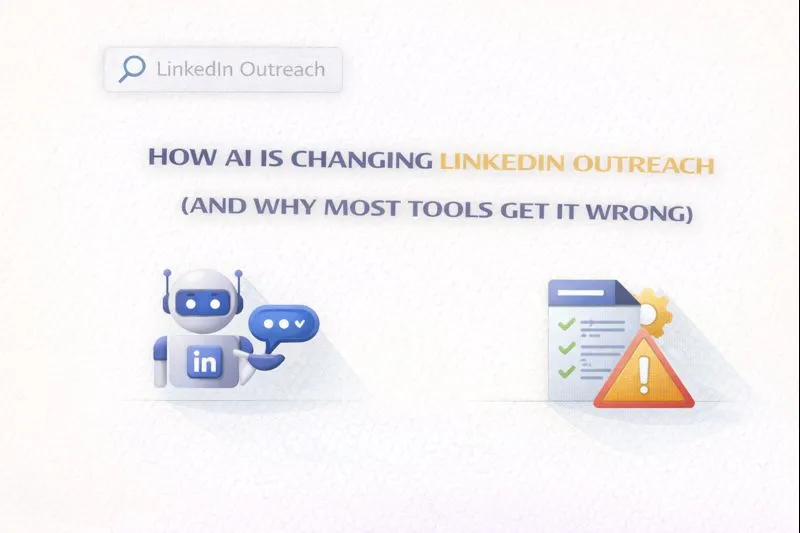
How AI Is Changing LinkedIn Outreach (And Why Most Tools Get It Wrong)

LinkedIn has over 1 billion professionals worldwide, with 61 million senior-level decision-makers actively using the platform. For B2B sales and marketing teams, this represents an unprecedented opportunity to connect with qualified prospects.
But there's a problem.
The same AI tools that promise to "scale personalization" are actually destroying what makes LinkedIn outreach work in the first place: genuine human connection.
This article breaks down exactly how AI is transforming LinkedIn outreach, where most tools fail, and what actually works in 2025.
The State of AI-Powered LinkedIn Outreach in 2025
The numbers tell a compelling story. According to a 2024 HubSpot report, 78% of marketers now use AI for content creation, and LinkedIn outreach is no exception. Tools like Expandi, HeyReach, Closely, and dozens of others have flooded the market with promises of "hyper-personalization at scale." See our comparison of LinkedIn automation tools for current pricing and safety ratings across the category.
Here's what the data actually shows:
LinkedIn response rates average 10.3%, more than double the 5.1% average for cold email (Expandi State of LinkedIn Outreach Report, 2025)
Personalized connection requests achieve a 9.36% reply rate compared to just 5.44% for blank requests (Belkins 2024 Study)
AI-driven first messages show a 4.19% response rate versus 2.60% for non-AI messages (Belkins 2024)
Template-based outreach gets 0.3-1% response rates, while truly personalized messages achieve 5-7% (SuperAGI Research)
The gap between "AI-assisted" and "AI-personalized" outreach is where most tools—and most sales teams—get it wrong.
Those response-rate numbers also depend heavily on which channel is sending the message. See LinkedIn InMail vs connection request: what gets more replies for how personalization interacts differently with each one.
What AI Gets Right: The Genuine Advantages
Before diving into the problems, let's acknowledge what AI actually does well for LinkedIn outreach.
Research Automation
The most valuable application of AI isn't writing messages—it's gathering intelligence. Modern AI tools can analyze a prospect's entire digital footprint in seconds: their LinkedIn activity, company news, recent posts, job changes, and technology stack.
This research used to take 15-30 minutes per prospect. AI can now surface these insights in under 30 seconds, allowing sales reps to focus on what humans do best: building relationships.
Timing and Signal Detection
AI excels at identifying buying signals that humans would miss: funding announcements, executive hires, technology changes, or expansion plans. These trigger events indicate when a prospect might actually be receptive to outreach.
Tools that focus on signal detection rather than message generation tend to deliver better results because they help sales teams reach out at the right moment, not just with the right words.
Pattern Recognition
AI can analyze what's working across thousands of outreach attempts. Which subject lines get opened? Which message structures generate replies? Which follow-up timing works best? This data-driven optimization was previously impossible at scale.
Where AI Goes Wrong: The Five Critical Failures
Despite these advantages, most AI-powered LinkedIn outreach tools fail because they misunderstand what "personalization" actually means.
Failure 1: Mail Merge Masquerading as Personalization
The biggest lie in AI outreach is that inserting a prospect's name and company into a template equals personalization.
As Sam Jacobs, founder of Pavilion, noted in a recent interview: "Outreach said and SalesLoft said personalization at scale and that was not true because there was no dynamic emails that were being sent. You sent one email to 1,000 people, which is not personalization at scale just because you mail merged their name into it."
True personalization requires understanding the prospect's specific challenges, recent activities, and current priorities—not just their job title.
Failure 2: Generic Messages That Sound Like AI Wrote Them
AI-generated messages have a tell: they're often too perfect, too structured, and too generic. They hit all the "best practice" notes but lack the imperfection that makes human communication authentic.
Buyers in 2025 have seen every trick: fake "Re:" subject lines, artificial urgency, manufactured compliments. They can detect automation instantly, and they ignore it.
According to Zapier's 2025 testing, even top AI detectors fail to consistently identify AI-generated content. But prospects don't need detection tools—they recognize inauthentic communication intuitively.
Failure 3: Over-Automation That Triggers Platform Penalties
LinkedIn's algorithm has become increasingly sophisticated at detecting automated behavior. In 2025, the platform penalizes AI-generated content with approximately 30% less reach and 55% less engagement compared to human-written content.
The detection systems identify patterns: identical message timing, robotic interaction sequences, and template-based outreach that looks "too perfect." Accounts that rely heavily on automation risk restrictions, reduced visibility, or outright bans.
Failure 4: Volume Over Value
Most AI tools are optimized for sending more messages faster. The underlying assumption is that outreach is a numbers game—send enough messages, and some will convert.
This approach backfires on LinkedIn. The platform's professional context means users have higher expectations for relevance. A generic AI message doesn't just get ignored—it damages your brand perception and reduces future response rates.
Failure 5: Ignoring the Conversation After the Connection
The most sophisticated AI tools focus almost entirely on the initial outreach: the connection request and first message. But LinkedIn success depends on what happens after.
AI tools rarely handle the nuanced follow-up conversations that turn connections into meetings. They can't navigate objections, pick up on verbal cues, or adapt their approach based on how a conversation evolves.
What Actually Works: The Human-AI Hybrid Approach
The highest-performing LinkedIn outreach strategies in 2025 combine AI capabilities with human judgment. Here's the framework that generates results.
Step 1: Use AI for Research, Not Writing
Let AI do the heavy lifting on prospect research. Have it analyze LinkedIn profiles, company news, recent posts, and trigger events. Use these insights to understand your prospect's world—then write the message yourself.
This approach captures AI's speed advantage while preserving the authenticity that generates responses.
Step 2: Focus on Trigger-Based Outreach
Rather than blasting a list of prospects, use AI to identify specific moments when outreach makes sense: a new funding round, a job change, a LinkedIn post about a relevant challenge, or a company announcement.
AI-identified triggers combined with human-written messages consistently outperform both pure automation and pure manual approaches.
Step 3: Prioritize Quality Over Quantity
The data is clear: ultra-personalized outreach to fewer prospects outperforms spray-and-pray automation. Companies like SalesBread report 48.14% positive reply ratios using hyper-personalized approaches—compared to industry averages below 10%.
Sending 30 deeply researched messages will generate more meetings than sending 300 templated ones.
Step 4: Warm Up Before Reaching Out
The best AI tools help you engage with prospects before sending a connection request. Viewing their profile, liking their posts, commenting on their content—these actions create familiarity and dramatically increase acceptance rates.
Expandi's research shows that Builder Campaigns with multiple touchpoints achieve a 22% connection approval rate and 7.22% reply rate, significantly outperforming cold approaches.
Step 5: Keep Humans in the Loop
AI should never operate on full autopilot. The most effective approach uses AI to draft initial messages, but requires human review and personalization before sending. This catches the generic phrasing, factual errors, and tone-deaf messaging that AI often produces.
The LinkedIn Algorithm Factor
Beyond outreach tools, AI is changing how LinkedIn itself distributes content. Understanding these changes is crucial for anyone using the platform for lead generation.
LinkedIn's 2025 algorithm now prioritizes expertise over virality. The platform has shifted from rewarding high engagement to rewarding consistent, valuable content from recognized experts in specific niches.
Key algorithm factors for content visibility:
First-hour engagement determines whether your post reaches a broader audience
Dwell time (how long people spend reading your content) signals quality
Comment quality matters more than quantity—meaningful discussions beat "Great post!" replies
Consistency of posting builds algorithm trust in your account
For outreach, this means your personal brand directly impacts your connection request acceptance rates. Prospects who see your valuable content are far more likely to accept your connection and respond to your messages.
AEO and GEO: The Next Frontier
As AI search engines like ChatGPT, Perplexity, and Gemini become primary research tools for B2B buyers, a new challenge emerges: getting your company recommended in AI-generated answers. Fifty-one percent of B2B software buyers now start their research in an AI chatbot rather than a traditional search engine, based on a March 2026 survey of 1,076 B2B decision-makers (G2, "The Answer Economy: G2's 2026 AI Search Insight Report", retrieved 2026-09-19).
Answer Engine Optimization (AEO) and Generative Engine Optimization (GEO) represent the evolution beyond traditional SEO. While SEO focused on ranking in Google's blue links, AEO/GEO focuses on getting cited as an authoritative source when AI engines answer user questions.
For LinkedIn lead generation, this matters because your prospects are increasingly researching solutions through AI chat interfaces. If your company isn't appearing in those AI-generated recommendations, you're invisible during the critical research phase of the buying journey — including for the account-based targets you've built out through LinkedIn ABM.
The companies winning at AI search visibility share common traits:
Deep, authoritative content that directly answers specific questions
Strong backlink profiles from trusted industry sources
Clear, structured information that AI can easily parse and cite
Consistent publication of expert-level content
Building AEO/GEO visibility creates a compounding advantage: prospects who've already encountered your brand through AI search are significantly more likely to accept your LinkedIn connection requests and engage with your outreach.
The Bottom Line
AI is genuinely transforming LinkedIn outreach—but not in the way most tools promise. The transformation isn't about sending more automated messages faster. It's about using AI intelligence to be more strategic, more timely, and more relevant in human-to-human outreach.
The tools that succeed in 2025 are those that augment human capability rather than replace human judgment. They use AI where it excels—research, timing, pattern recognition—and leave the actual relationship-building to humans.
The future of LinkedIn outreach isn't AI or human. It's AI-enhanced human connection. The teams that master this combination will consistently outperform both pure automation and pure manual approaches.
And as AI search engines become the primary way B2B buyers research solutions, visibility in these channels becomes just as important as your outreach strategy. The companies that build authority in AI-generated answers create a flywheel effect: better brand recognition, higher connection acceptance rates, and more responsive prospects.
The question isn't whether to use AI in your LinkedIn strategy. It's whether you're using it to genuinely connect—or just to send more spam faster.
Frequently Asked Questions
Is AI-powered LinkedIn outreach actually more effective than manual outreach?
It depends entirely on what the AI is doing. AI used for research, trigger detection, and timing consistently improves results. AI used to auto-generate the message itself tends to underperform genuinely personalized, human-written outreach, because prospects can detect generic AI phrasing.
Will LinkedIn penalize me for using automation tools?
Over-automation risks reduced reach and, in extreme cases, account restrictions. The safer approach uses AI for research and drafting while keeping sending volume, timing variation, and final message review under human control rather than full autopilot.
How much should I personalize each LinkedIn message?
Enough that the message could only have been sent to that specific person — reference something from their recent activity, a company event, or a shared connection. Inserting a name and company into a template is not personalization; prospects recognize the difference.
Does AI search visibility (AEO/GEO) actually affect LinkedIn response rates?
Indirectly, yes. Prospects who have already encountered your brand through an AI-generated answer arrive at your connection request with existing context and trust, which tends to lift acceptance and response rates compared to a cold, unfamiliar name.
The same personalization principles that improve outreach reply rates also apply to organic posting. See GrackerAI's anatomy of a viral LinkedIn B2B post for the hook, body, and CTA structure behind posts that convert.
Key Takeaways
AI-powered first messages achieve 4.19% response rates versus 2.60% for non-AI messages—but only when the personalization is genuine
Template-based outreach gets 0.3-1% response rates while truly personalized messages achieve 5-7%
LinkedIn's algorithm penalizes AI-generated content with approximately 30% less reach
The human-AI hybrid approach outperforms both pure automation and pure manual outreach
Quality beats quantity: 30 deeply personalized messages outperform 300 templated ones
AI search visibility (AEO/GEO) is becoming critical for B2B lead generation success
Use AI for research and timing, but keep humans in the writing and conversation loop
Want to see how your company appears in AI-generated answers? Analyze your AEO and GEO visibility scores to understand whether ChatGPT, Perplexity, and Gemini are recommending your solutions to potential customers.
![10 Best Local Rank Tracker Tools: In-Depth Comparison Guide [2025]](https://cdn.pseo.one/6abcb68a626591c40e1c8aa6/687e1c1ef6fe799d288518df/68809c373eb8562bcf68975d/10-best-local-rank-tracker-tools-comparison-guide/feature-image.jpg)